
Published · Updated
advantages of private credit fundsAdvantages of private credit funds for UK property 2026
By James Dawes, CeMAP, Founder, James William & Co Capital

Private credit funds consistently deliver returns around 8 to 9% in UK property lending, outperforming traditional equity markets with notably lower volatility. This challenges the assumption that only stock investments offer compelling growth. For high net worth individuals and family offices seeking sophisticated funding solutions, private credit represents a strategic alternative that combines competitive yields with asset backed security. Understanding how these funds operate, their distinct advantages over conventional finance, and their practical applications in large scale developments can transform your approach to property investment and capital deployment.
Table of Contents
- What Are Private Credit Funds In UK Property Finance?
- Advantages Of Private Credit Funds Over Traditional Property Finance
- Practical Applications: Using Private Credit Funds For UK Large Scale Property Developments
- Key Considerations And Risks When Investing In Private Credit Funds
- Discover Specialist Property Finance With James William & Co Capital
Key takeaways
| Point | Details |
|---|---|
| Steady returns | Private credit funds generate net returns of 8 to 9% in UK property lending with lower volatility than equities. |
| Speed and flexibility | These funds offer faster funding decisions and more tailored terms than traditional bank financing. |
| Asset backed security | Direct lending on property assets with structured agreements mitigates investment risk effectively. |
| Ideal for complex deals | High net worth individuals and family offices benefit from bespoke solutions for large scale property transactions. |
| Optimised capital deployment | Private credit funds enable strategic capital allocation while maintaining predictable income streams. |
What are private credit funds in UK property finance?
Private credit funds pool capital from institutional investors, family offices, and high net worth individuals to lend directly to property developers and investors outside traditional banking channels. Unlike conventional mortgages where banks act as intermediaries, these funds provide debt financing directly, creating a streamlined relationship between capital providers and borrowers. This direct lending model eliminates multiple layers of approval, enabling quicker decisions and more flexible structuring to accommodate complex property transactions.
These funds operate by raising committed capital, then deploying it through secured loans against UK real estate assets. Loan structures typically include first charge mortgages, mezzanine debt, or bridge financing for developments, refurbishments, and acquisitions. The asset backed nature of these loans provides tangible security, with loan to value ratios carefully managed to protect investor capital. Returns come primarily from interest payments, with UK property direct lending yielding around 8 to 9%, exemplified by platforms like CrowdProperty achieving 9.83%.
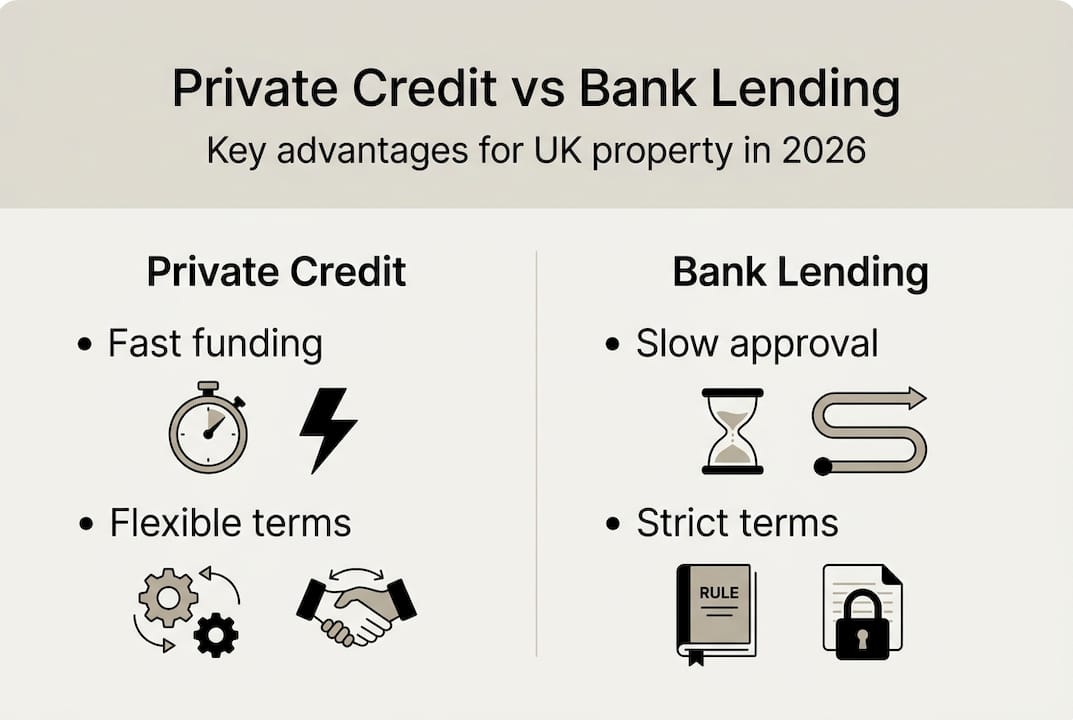
Compared to traditional bank loans, private credit funds offer distinct advantages in execution speed and deal flexibility. Banks often require extensive documentation, lengthy approval processes, and rigid covenant structures that can delay or derail time sensitive opportunities. Private credit funds, by contrast, can commit capital within weeks rather than months, adapting terms to match specific project requirements. This agility proves invaluable for developers acquiring sites at auction, executing complex refinances, or pursuing opportunities where traditional lenders hesitate due to perceived complexity.
The typical return profile attracts sophisticated investors seeking income generation with moderate risk exposure. Private credit funds deliver predictable cash flows through regular interest payments, avoiding the volatility associated with equity markets. For family offices managing multi generational wealth, this combination of steady income, asset security, and professional fund management aligns with conservative yet growth oriented investment mandates. The funds also provide diversification beyond direct property ownership, spreading risk across multiple borrowers and projects.
Pro Tip: When evaluating private credit funds, examine the fund manager’s underwriting standards and track record across different market cycles to assess their ability to maintain consistent returns whilst managing borrower default risk effectively.
Key characteristics of private credit funds include:
- Direct lending relationships eliminating banking intermediaries
- Asset backed security through first or second charge mortgages
- Flexible structuring accommodating complex deal requirements
- Faster capital deployment compared to traditional finance
- Professional fund management with specialised property expertise
Understanding UK property finance trends in 2026 helps contextualise where private credit funds fit within the broader funding landscape and how they complement other financing instruments for sophisticated investors.
Advantages of private credit funds over traditional property finance
Private credit funds deliver measurable performance advantages that distinguish them from conventional property financing. UK property direct lending outperforms stocks long term with lower drawdowns, providing a compelling risk adjusted return profile. This historical performance stems from the secured nature of property lending, where tangible assets underpin every loan, combined with rigorous due diligence processes that screen borrowers and projects before capital deployment.

The comparison between private credit funds and traditional lending reveals fundamental differences across key metrics:
| Factor | Private Credit Funds | Traditional Bank Lending |
|---|---|---|
| Funding Speed | 2 to 4 weeks typical | 8 to 16 weeks typical |
| Returns to Investors | 8 to 9% net annually | Not applicable (banks retain spread) |
| Deal Flexibility | High, bespoke structuring | Low, standardised products |
| Approval Criteria | Asset focused, pragmatic | Rigid, box ticking compliance |
| Loan to Value | Up to 75% typically | 60 to 70% typically |
| Covenant Flexibility | Negotiable terms | Fixed, non negotiable |
Beyond raw performance metrics, private credit funds offer strategic advantages that enhance capital efficiency for property investors. The ability to structure loans around specific project cash flows, exit strategies, and risk profiles enables more sophisticated capital stacks than standard mortgage products permit. For ground up developments, funds can provide phased drawdowns matching construction milestones, reducing interest costs and aligning funding with actual capital needs.
Core advantages of private credit funds include:
- Higher yields than traditional fixed income investments with comparable risk profiles
- Quicker funding enabling investors to seize time sensitive opportunities
- Tailored terms accommodating complex ownership structures and offshore vehicles
- Asset backed security providing tangible collateral and downside protection
- Lower correlation with equity markets delivering portfolio diversification benefits
- Professional management eliminating direct borrower relationship complexities
The risk mitigation inherent in private credit funds stems from multiple protective layers. First charge security over property assets ensures priority in any enforcement scenario. Conservative loan to value ratios create equity cushions absorbing potential value declines. Regular interest payments provide early warning signals of borrower stress, enabling proactive intervention before problems escalate. Fund diversification across multiple loans spreads risk, preventing single borrower defaults from materially impacting overall returns.
Pro Tip: Scrutinise fund track records across at least one full property cycle to verify their ability to maintain returns and manage defaults during market downturns, not just during favourable conditions.
For investors seeking to optimise real estate funding strategies, private credit funds represent a sophisticated tool that balances income generation with capital preservation, particularly valuable for family offices managing complex wealth structures and multi generational investment horizons.
Practical applications: using private credit funds for UK large scale property developments
Large scale property developments demand sophisticated funding structures that private credit funds are uniquely positioned to provide. These funds fill critical financing gaps where traditional lenders prove reluctant, particularly for complex projects involving ground up construction, brownfield regeneration, or mixed use schemes requiring phased capital deployment. Understanding how to engage private credit funds strategically transforms development feasibility and project economics.
Steps to leverage private credit funds for large scale developments:
- Conduct preliminary due diligence on target funds, evaluating their investment criteria, typical loan sizes, and sector focus to identify suitable partners for your specific project requirements.
- Prepare comprehensive project documentation including development appraisals, planning consents, cost breakdowns, and exit strategies demonstrating clear value creation and repayment capacity.
- Engage fund managers early in project planning to structure financing that aligns with construction phasing, cash flow projections, and risk mitigation strategies specific to your development.
- Negotiate bespoke terms addressing covenant flexibility, interest roll up options, extension provisions, and exit mechanisms that accommodate potential market shifts or timeline variations.
- Establish transparent reporting protocols providing funds with regular project updates, cost monitoring, and milestone achievements maintaining confidence and enabling proactive issue resolution.
- Coordinate private credit funding with other capital sources including senior debt, mezzanine layers, or joint venture equity creating optimised capital stacks that maximise returns whilst managing risk exposure.
The empirical evidence supporting private credit fund effectiveness in UK projects is compelling:
CrowdProperty’s yield of 9.83% demonstrates strong returns in UK lending, validating the fund model’s ability to generate consistent income whilst supporting real economy property development across diverse project types and market conditions.
Private credit funds excel at filling funding gaps that emerge during complex development scenarios. When traditional lenders cap exposure at 60% loan to value, private credit can provide mezzanine layers bridging to 75% or higher, reducing developer equity requirements and improving project returns. For sites requiring remediation, funds can structure loans accommodating upfront costs before value realisation, something standard construction finance rarely permits.
Family offices pursuing bespoke investment strategies find private credit funds particularly valuable. These funds can accommodate offshore holding structures, complex ownership arrangements, and multi jurisdictional tax planning that traditional lenders struggle to underwrite. The ability to negotiate directly with fund managers, rather than navigating rigid bank policies, enables creative solutions matching specific family office mandates and governance requirements.
Exploring types of property finance for UK developers provides context for how private credit fits within broader funding ecosystems, whilst understanding risks and opportunities in property investment helps frame appropriate risk management strategies when deploying private credit capital.
Key considerations and risks when investing in private credit funds
Whilst private credit funds offer compelling advantages, sophisticated investors must evaluate potential risks and critical success factors before committing capital. No investment vehicle eliminates risk entirely, and understanding specific vulnerabilities enables informed decision making and appropriate portfolio allocation. The structured, asset backed nature of private credit loans provides meaningful protection, but market dynamics, borrower performance, and fund management quality all influence outcomes.
Primary risks associated with private credit fund investments include:
- Market cycle downturns reducing property values and potentially impairing loan security if borrowers default during value troughs
- Borrower default risk where developers face project delays, cost overruns, or sales challenges preventing timely loan repayment
- Fund manager quality variations affecting underwriting standards, borrower selection, and workout effectiveness when loans experience stress
- Liquidity constraints as private credit funds typically require multi year capital commitments with limited secondary market exit options
- Interest rate sensitivity impacting both fund returns and underlying borrower capacity to service debt in rising rate environments
- Concentration risk if funds focus narrowly on specific property sectors, geographic regions, or borrower types without adequate diversification
The protective mechanisms inherent in structured agreements and asset backing mitigate risks substantially compared to unsecured lending. First charge mortgages provide priority claims over property assets, ensuring investors stand ahead of other creditors in enforcement scenarios. Conservative loan to value ratios create equity buffers absorbing moderate value declines without impairing capital. Regular interest payments and reporting requirements enable early identification of borrower stress, allowing proactive intervention before situations deteriorate.
Due diligence on fund managers proves critical to successful private credit investing. Examine track records spanning multiple market cycles, focusing on default rates, recovery percentages, and consistency of returns during both favourable and challenging periods. Assess underwriting processes, including site inspections, borrower vetting, and project feasibility analysis. Evaluate fund governance structures, fee transparency, and alignment of manager interests with investor outcomes through co investment or performance based compensation.
Pro Tip: Request detailed information on fund workout procedures and historical default management to understand how managers handle borrower stress, including their approach to enforcement, asset realisation, and investor communication during challenging situations.
Aligning investment horizon and risk tolerance with private credit strategies ensures appropriate portfolio fit. These funds typically require capital commitments of three to five years, with limited liquidity during that period. Investors needing short term access to capital should allocate accordingly, maintaining sufficient liquid reserves outside private credit positions. Risk tolerance assessment should consider both capital preservation priorities and income generation objectives, balancing potential returns against acceptable downside scenarios.
The UK regulatory environment provides meaningful investor protections within private credit markets. Funds operating under Financial Conduct Authority oversight must maintain appropriate capital adequacy, governance standards, and disclosure practices. Investor categorisation as high net worth or sophisticated investors ensures appropriate risk acknowledgment, whilst fund reporting requirements provide transparency into performance, holdings, and risk exposures. Understanding these protections and their limitations helps investors make informed allocation decisions.
For comprehensive guidance on structuring sophisticated property finance arrangements, exploring capital advisory services for UK property finance provides valuable insights into professional approaches to risk management and capital optimisation across diverse investment scenarios.
Discover specialist property finance with James William & Co Capital
Navigating private credit funds and sophisticated property finance requires expert guidance tailored to your specific investment objectives. James William & Co Capital specialises in structuring bespoke funding solutions for high net worth individuals, family offices, and professional developers pursuing complex UK real estate transactions. Our extensive network includes leading private credit funds, family offices, and specialist lenders, enabling us to arrange optimal capital structures matching your project requirements and risk parameters.

Whether you’re exploring private credit fund investments, structuring multi layered debt stacks for large scale developments, or seeking mezzanine capital for acquisitions, our capital concierge approach provides single point coordination across funding sources. Explore our specialist property finance services to discover how we deliver rapid, tailored solutions under pressure. Review detailed property finance case studies demonstrating successful execution across diverse transaction types. For family offices, our wealth planning services integrate property finance strategies with broader wealth management objectives, ensuring cohesive capital deployment aligned with multi generational goals.
FAQ
Are private credit funds suitable for all UK property investors?
Private credit funds primarily benefit experienced investors with substantial capital to deploy in larger property transactions, typically requiring minimum investments of £50,000 to £100,000 or higher. They are not ideal for entry level investors or those seeking small scale residential buy to let financing. Suitability depends heavily on investment goals, risk appetite, liquidity needs, and the complexity of property projects you pursue, with sophisticated investors finding the most value in these structures.
How do private credit funds compare with direct equity investments in property?
Private credit funds provide debt based returns with lower risk profiles and less operational control compared to direct equity investments in property. Equity positions offer higher potential upside through capital appreciation and rental income but carry greater downside risk and require active management. The debt position in private credit funds delivers predictable income streams through interest payments with asset backed security, but limits capital gain exposure and participation in property value increases beyond loan repayment.
What factors affect returns from private credit funds in the UK?
Returns depend primarily on prevailing interest rates, fund underwriting standards, quality of asset security, and broader property market cycle conditions. Experienced fund managers with rigorous due diligence processes typically deliver steadier income streams by selecting creditworthy borrowers and viable projects. Geographic diversification, sector allocation, loan to value discipline, and proactive portfolio management during market stress also significantly influence consistency of returns and capital preservation across different economic environments.
How liquid are investments in private credit funds?
Private credit fund investments typically require capital commitments of three to five years with limited liquidity during that period. Unlike publicly traded securities, these funds lack active secondary markets for investor exits, meaning capital remains locked until fund maturity or specific redemption windows. Some funds offer quarterly or annual redemption opportunities subject to available liquidity and notice periods, but investors should plan for illiquidity and maintain sufficient liquid reserves outside these positions to meet shorter term capital needs.
What due diligence should investors conduct before committing to private credit funds?
Investors should thoroughly examine fund manager track records across complete property cycles, focusing on default rates, recovery percentages, and return consistency during both growth and downturn periods. Assess underwriting processes, including borrower vetting, project feasibility analysis, and site inspection protocols. Review fund governance structures, fee transparency, alignment of manager interests through co investment, and historical communication practices during challenging situations. Request detailed information on portfolio composition, geographic and sector diversification, loan to value distributions, and workout procedures for managing borrower stress effectively.
Recommended
Related Topics
Speak to a specialist
Discuss your finance with James directly
Whole-of-market specialist finance — bridging, development, commercial and residential. No call centres, no obligation. James reviews every enquiry personally.
New to specialist finance? How unbiased broker advice works · Deals we have completed
Explore Related Finance