
Published · Updated
what is asset financeAsset Finance: Leveraging Assets for Property Funding
By James Dawes, CeMAP, Founder, James William & Co Capital

Securing funding for ambitious real estate projects in the United Kingdom often means weighing growth opportunities against capital demands. For developers and institutional investors, maintaining liquidity while expanding multi-asset portfolios is a constant challenge. Asset finance uses the property or equipment itself as security for the borrowed funds, offering a way to unlock investment power without depleting cash reserves. This article explores how flexible asset finance structures cater to complex acquisitions, refinances, and strategies tailored for sophisticated portfolios.
Table of Contents
- Defining Asset Finance in UK Property
- Key Types of Asset Finance Solutions
- How Asset Finance Funding Is Structured
- Legal and Regulatory Framework in the UK
- Risks, Costs and Best Practice for Developers
Key Takeaways
| Point | Details |
|---|---|
| Asset Finance Leverages Value | Asset finance allows borrowers to use properties as collateral to secure funding while preserving capital for other investments. |
| Flexible Financing Structures | Various asset finance solutions cater to complex development needs, offering tailored terms that align with revenue generation timelines. |
| Understanding Regulatory Compliance | Familiarity with the dual regulatory environment in the UK is essential for compliance and to ensure protection when engaging with lenders. |
| Risks Require Rigorous Management | Developers should proactively identify and mitigate risks related to covenants, refinancing, cost overruns, and tax implications to enhance project success. |
Defining Asset Finance in UK Property
Asset finance represents a straightforward yet sophisticated approach to funding property acquisitions and developments without depleting your liquid capital. At its core, asset finance uses the property or equipment itself as security for the borrowed funds, allowing you to acquire assets whilst maintaining cash reserves for operational needs, contingencies, or other investment opportunities. For property developers and institutional investors managing multi-asset portfolios, this distinction proves critical. Rather than selling existing assets or liquidating reserves to fund a new acquisition, you’re leveraging the earning potential of the asset you’re acquiring to secure the financing.
In the UK property context, asset finance operates as a structured lending mechanism where lenders evaluate both the asset’s value and your capacity to service debt from rental income, development returns, or operational cash flow. The Finance & Leasing Association reports asset finance statistics demonstrating that asset finance continues to drive property investment and business expansion across the UK market. What distinguishes asset finance from traditional mortgages is the flexibility in structure. You’re not simply obtaining a standard residential or commercial mortgage. Instead, you’re accessing a funding solution that can accommodate complex scenarios: mixed-use developments with staggered revenue generation, portfolios requiring refinancing across multiple properties, or situations where traditional lending criteria prove restrictive due to covenant requirements or unusual property characteristics.
For high-net-worth investors and developers, the appeal centres on operational leverage and cash flow optimisation. By securing financing against assets rather than drawing on personal reserves, you preserve dry powder for value-add opportunities, land acquisition, or funding unexpected development costs without requiring additional equity injections or syndication arrangements. The mechanics vary depending on property type and your financial structure. A straightforward buy-to-let acquisition might utilise traditional asset-backed lending, whilst a complex development project might layer asset finance with mezzanine debt or bridging solutions to create a bespoke capital stack matched to phased revenue generation.
Understanding how asset finance integrates within your broader capital strategy requires recognising that property assets held by government and public bodies demonstrate how asset finance functions within larger portfolios to maintain value and sustainability. Your situation may differ fundamentally, but the underlying principle remains: strategically structured financing that works with your asset’s characteristics rather than forcing your deal into a standardised lending product.
Pro tip: When evaluating asset finance options, focus on matching the financing structure to your specific revenue model—whether that’s rental income, development exit timing, or operational cash flow. Lenders prioritise deal structures where the financing matches the asset’s income-generation timeline, reducing transaction friction and accelerating approval.
Key Types of Asset Finance Solutions
The asset finance marketplace offers several distinct structures, each designed for specific circumstances and ownership objectives. Understanding these options proves essential when structuring your property funding strategy, as selecting the wrong vehicle can create unnecessary tax complications, limit your exit flexibility, or misalign financing with your revenue generation timeline.
Hire purchase, finance leases, operating leases, and asset refinance represent the primary categories available in the UK market. Hire purchase allows you to acquire ownership of property or equipment through regular payments, with title transferring to you once the contract concludes. This structure works particularly well for investors seeking full ownership without requiring substantial upfront capital. Finance leases operate differently: you gain the benefit and control of the asset whilst the lender retains legal ownership until the lease terminates. This distinction matters considerably for tax treatment and balance sheet presentation, especially if you’re managing investor relationships or navigating specific covenant requirements tied to asset ownership.
Operating leases provide short-term access to assets without ownership transfer, offering flexibility for situations where your space or equipment needs may change. For property developers and institutional investors managing complex portfolios, operating leases enable you to scale operations without long-term capital lock-in. Asset refinance, meanwhile, unlocks value from properties you already own by borrowing against their equity. This approach proves invaluable when you’ve accumulated property holdings and need capital for new development, portfolio expansion, or opportunistic acquisitions without liquidating existing assets. A developer holding three investment properties might refinance one or more to raise acquisition capital for a larger mixed-use development, preserving rental income streams whilst deploying capital strategically.
Each structure carries distinct implications for cash flow timing, tax treatment, and covenant flexibility. A complex development deal might layer multiple asset finance types across your capital stack: operating leases on temporary facilities, hire purchase on long-term infrastructure, and asset refinance on completed phases generating income. The specifics depend entirely on your business model, exit timeline, and the property characteristics themselves. A distressed portfolio refinance looks completely different from a ground-up development acquisition, and forcing either into a standardised structure often costs money through unnecessary restrictions or suboptimal tax outcomes.
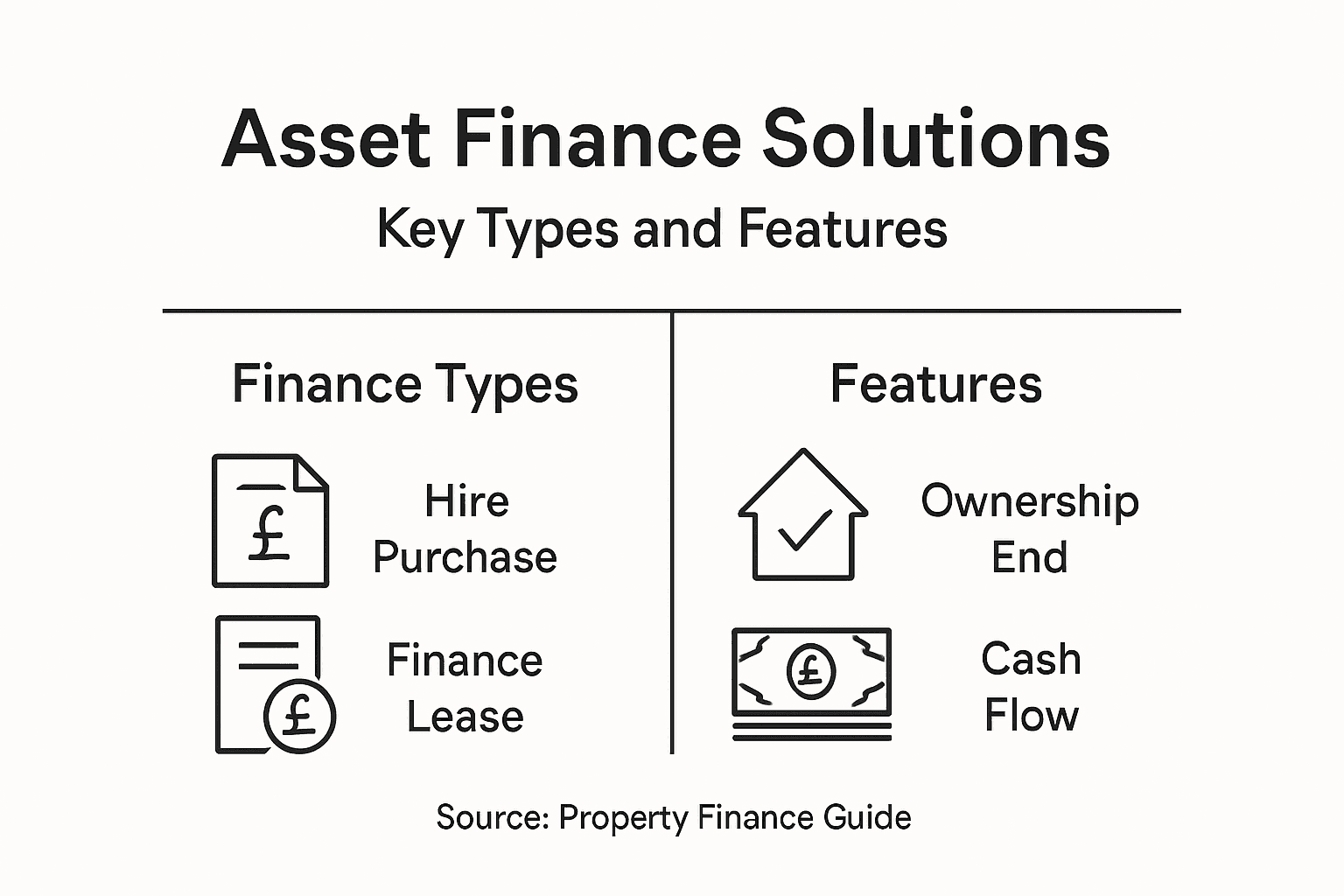
Here’s how the main types of asset finance solutions differ in the UK:
| Finance Type | Ownership at End | Typical Use Case | Impact on Cash Flow |
|---|---|---|---|
| Hire Purchase | Transfers to buyer | Investors seeking ownership | Predictable payments |
| Finance Lease | Retains with lender | Asset use without ownership | Fixed payments, no equity |
| Operating Lease | Retains with lender | Short-term needs | Lower upfront, flexible |
| Asset Refinance | Existing owner | Unlock property equity | Raises capital, ongoing debt |
Pro tip: Before committing to any asset finance structure, map your revenue generation timeline against the financing term. Lenders move fastest when the debt service schedule aligns precisely with when your asset actually generates cash, reducing their perceived risk and cutting weeks from approval timelines.
How Asset Finance Funding Is Structured
Asset finance structuring begins with a fundamental principle: matching the funding vehicle to both the asset’s income profile and your exit strategy. Unlike vanilla mortgages with fixed terms and standard covenants, asset finance allows you to build custom capital structures that reflect how your property actually generates returns.
The foundational layer involves security valuation and covenant architecture. Lenders conduct detailed assessments of the asset’s current value, future income potential, and underlying risks. For a buy-to-let portfolio, this means analysing rental yields, void risk, and tenant quality. For a development project, it means stress-testing exit assumptions against realistic market conditions. Asset-based lending instruments range from invoice finance to leasing structures, each offering different risk management profiles depending on your specific situation. The lender then structures covenants around these realities. A development property generating zero income during construction requires completely different covenant terms than a stabilised investment property with predictable rental cash flows. This is where sophistication matters. Rather than applying blanket covenants to every deal, experienced lenders build flexibility around your actual business model.

The multi-layered debt stack represents the next structural element. Asset finance rarely operates as a single loan product. Instead, you’re orchestrating several funding instruments that interact strategically. A ground-up development might combine senior debt, mezzanine finance, and sometimes bridging to cover off-plan acquisition, construction, and stabilisation phases. Each layer carries different terms, repayment schedules, and security positions. The senior lender holds first position on the asset, commanding lower interest rates but strict covenants. The mezzanine provider accepts subordinated security in exchange for higher returns and greater flexibility on operational metrics. This stacking approach allows you to access more total capital whilst managing overall cost of funds more efficiently than if you’d secured everything at senior rates.
Structuring also encompasses security mechanisms and release schedules. Rather than holding the entire asset as security throughout the facility term, staged release arrangements allow you to free completed phases or income-producing units from charge as you hit predetermined milestones. A phased residential development releases security on completed units as pre-sales reach certain thresholds, enabling you to redeploy capital into subsequent phases. Public and private finance institutions deploy catalytic finance strategically to maximise funding efficiency across infrastructure and property investment. The covenant package typically includes financial tests (debt service coverage, loan-to-value ratios), operational metrics (occupancy rates, rental growth), and distribution restrictions that only release once the asset performs to agreed standards. This protects both lender and borrower by aligning incentives and preventing premature capital extraction before the asset has stabilised.
Pro tip: Structure covenant reviews to coincide with your actual business milestones rather than calendar dates. Lenders appreciate deals where refinancing or covenant relief discussions happen when you have concrete performance data to present, not at arbitrary annual review points.
Legal and Regulatory Framework in the UK
Navigating asset finance in the UK requires understanding a regulatory environment shaped by two distinct bodies with complementary but separate responsibilities. The Financial Conduct Authority (FCA) oversees market conduct and consumer protection, whilst the Prudential Regulation Authority (PRA) manages systemic risk and firm safety. For property developers and institutional investors, this dual framework creates specific compliance obligations that differ markedly from residential mortgage lending.
The FCA’s regulatory approach to asset management has evolved significantly post-Brexit, with the Authority adapting retained European Union laws into a tailored UK regime. This modernisation reflects a deliberate policy to support innovation and competition whilst maintaining rigorous investor protection standards. What this means practically: lenders offering asset finance must hold FCA authorisation, undergo regular capital adequacy assessments, and maintain comprehensive risk management frameworks. If you’re borrowing from an authorised lender, you benefit from the Financial Services Compensation Scheme protection, though coverage limits and scope vary depending on the specific nature of your borrowing arrangement. For complex multi-layered deals involving mezzanine debt or private credit providers, not all parties may carry equivalent regulatory oversight, creating different risk profiles you’ll need to evaluate carefully.
Financial and professional services regulations require FCA authorisation for any firm operating in asset finance, with distinct requirements depending on whether the lender operates as a credit institution, investment firm, or alternative finance provider. This matters because different regulatory categories carry different capital requirements, which ultimately affects lending appetite, pricing, and speed. A traditional bank might move slowly but offers lower rates; a specialist alternative lender might respond faster but requires higher pricing to offset regulatory capital costs. Beyond authorisation, you’ll encounter specific regulatory obligations around disclosure, affordability assessments, and information provision. Many institutional investors assume these apply only to consumer lending, but recent FCA guidance increasingly applies conduct standards to commercial borrowers, particularly around transparency in costs and clear explanation of product terms.
Property-specific regulations also govern valuation standards, environmental assessments, and sustainability reporting. Large developments now face Building Safety Act requirements, fire safety compliance (relevant for many residential developments), and potential sustainability-linked lending covenants reflecting Environmental, Social, and Governance (ESG) considerations. Lenders increasingly incorporate climate risk and environmental liability assessments into security valuations, particularly for properties in flood-risk areas or requiring significant remediation. This regulatory layer operates independently from core asset finance regulation but directly affects lending decisions and covenant requirements.
Pro tip: Request your lender’s FCA authorisation details and PRA status upfront, then confirm the specific regulatory classification of your specific borrowing product. Different asset finance vehicles (hire purchase versus finance lease versus asset refinance) may fall under different regulatory categories, affecting your protections and the lender’s obligations.
Risks, Costs and Best Practice for Developers
Asset finance introduces specific cost pressures that extend well beyond headline interest rates. The true cost of your funding sits across multiple dimensions, and overlooking them creates hidden drains on project economics. Rising costs from technology investment, compliance, and staffing across the UK asset finance industry translate directly into higher pricing for borrowers. Lenders operating under tightened regulatory capital requirements and compliance frameworks pass these expenses through as elevated arrangement fees, commitment fees, and ongoing monitoring charges. A development project structured across three tranches with staggered funding releases incurs arrangement costs on each drawdown stage. Similarly, covenant monitoring becomes increasingly granular on large deals, with lenders requiring quarterly financial reporting, asset valuations, and compliance certifications. These aren’t optional extras; they’re mandatory requirements embedded in modern credit structures. Budget for arrangement fees typically ranging from 0.5% to 2% of facility size, plus annual commitment fees on undrawn balances. For a £20 million facility, commitment fees alone can cost £40,000 to £60,000 annually even before you’ve accessed the funds.
Interest rate and refinancing risk represents the second major cost dimension. Asset finance pricing responds to base rate movements, lender credit conditions, and your specific risk profile. A floating rate facility offers flexibility but exposes you to rate volatility; a fixed rate locks costs but removes downside if markets soften. The critical mistake developers make: assuming rate certainty based on today’s pricing without stress-testing against rate stress scenarios. If your development exit depends on achieving a specific yield and rates rise 200 basis points before completion, that margin evaporates. Similarly, refinancing risk emerges when your debt matures before your asset reaches stabilisation. A five-year facility on a seven-year development timeline creates refinancing exposure at a point where you can’t exit or sell. Structure your debt maturity around realistic exit timing, not optimistic best-case scenarios.
Covenant breaches and performance risk prove far more damaging than rate swings. A breach of loan-to-value covenants forces capital injections precisely when you can’t afford them. A failure to meet occupancy targets on a mixed-use scheme triggers acceleration clauses. Lenders build covenants conservatively, but defaults occur when projects underperform or markets shift. The best practice here is brutal honesty during underwriting. Conservative stress-testing during deal structuring beats discovering problems mid-construction. If your rental assumptions require 95% occupancy in a market averaging 88%, reset expectations. If your development budget assumes zero cost inflation when inflation sits at 4% annually, account for the 12% cumulative impact across a three-year build. Lenders respect developers who stress-test rigorously and adjust structurally rather than hope conditions improve.
Tax structuring and compliance costs deserve explicit attention. Depending on your entity structure (individual, corporate, partnership, or offshore vehicle), asset finance carries different tax consequences. Interest deductibility varies by structure. Withholding obligations differ. Capital allowances may or may not be available. A £50 million development structured incorrectly can generate £2 million in unnecessary tax leakage. Equally important: covenant requirements increasingly mandate specific reporting standards, audit certification, and professional accountant sign-offs. Budget for annual accounting, audit, and compliance costs that exceed standard property investment arrangements.
The table below summarises key risks in asset finance and best-practice mitigations:
| Risk Type | Potential Issue | Mitigation Approach |
|---|---|---|
| Covenant Breach | Forced capital injection | Conservative stress-testing |
| Refinancing Risk | Unplanned debt maturity | Align loan term with project exit |
| Cost Overruns | Erodes returns | Include inflation in budgeting |
| Tax Structuring | Unnecessary tax leakage | Seek upfront specialist advice |
Pro tip: During deal underwriting, identify your three highest-risk covenant areas and discuss with lenders upfront whether amendment mechanisms exist before you sign. Knowing your refinancing flexibility before problems arise costs nothing now but saves millions when conditions tighten.
Unlock Tailored Asset Finance Solutions for Your UK Property Projects
Navigating the complexities of asset finance requires more than just understanding terminology such as hire purchase, finance leases, or multi-layered debt stacks. The real challenge lies in aligning your financing structure with your property’s income profile and exit strategy while managing refinancing risks and covenant requirements. Whether you are a high-net-worth investor or a property developer aiming to optimise cash flow without sacrificing ownership or operational flexibility, James William & Co Capital is here to help.
With specialist expertise in structuring sophisticated funding solutions including asset finance, mezzanine debt, and complex refinance arrangements, we work alongside trusted family offices, private credit funds, and expert lenders. Our capital concierge approach offers you a single point of contact to arrange rapid, bespoke finance tailored to your development timelines and revenue models. Don’t let regulatory intricacies, cost pressures, or refinancing uncertainties hold back your ambitions. Visit James William & Co Capital now and secure the strategic financing your property portfolio deserves.
Explore how our expert guidance on bridging and development finance can accelerate your projects and protect your returns by visiting our website. For solutions tailored to large-scale acquisitions and refinances, trust in a partner who understands the nuances of UK asset finance and capital structuring.
Frequently Asked Questions
What is asset finance in property funding?
Asset finance is a method of funding property acquisitions and developments by using the property itself as security for borrowed funds, preserving cash reserves for other operational needs or investment opportunities.
How does asset finance differ from traditional mortgages?
Asset finance offers more flexibility in structure, allowing for tailored financing solutions that can accommodate complex scenarios, unlike traditional mortgages that typically have fixed terms and covenants.
What are the main types of asset finance solutions?
The main types of asset finance include hire purchase, finance leases, operating leases, and asset refinance, each designed to serve different ownership objectives and circumstances.
What risks should be considered when using asset finance?
Key risks include covenant breaches, refinancing risk, cost overruns, and the potential for unnecessary tax leakage. Mitigations involve conservative stress-testing, aligning loan terms with project exit, and seeking specialist tax advice.
Recommended
- James William & Co Capital | Specialist Property Finance
- James William & Co Capital | Specialist Property Finance
- James William & Co Capital | Specialist Property Finance
- James William & Co Capital | Specialist Property Finance
- Financing Options for Investors: Building Wealth in Real Estate | Bold Street AI
Related Topics
Speak to a specialist
Discuss your finance with James directly
Whole-of-market specialist finance — bridging, development, commercial and residential. No call centres, no obligation. James reviews every enquiry personally.
New to specialist finance? How unbiased broker advice works · Deals we have completed
Explore Related Finance