
Published · Updated
role of asset managers in property financeRole of Asset Managers in UK Property Finance
By James Dawes, CeMAP, Founder, James William & Co Capital

Securing optimal returns from property portfolios in the United Kingdom means balancing strategic oversight with rigorous financial management. Asset managers and institutional investors know that aligning estate objectives with regulatory compliance, market movements, and stakeholder interests is essential in such a complex sector. By exploring the distinct roles within property asset management, you gain the foundations to elevate your approach to high-value property finance and uncover effective strategies for complex transactions and refinancing challenges.
Table of Contents
- Defining Property Asset Management Roles
- Types of Asset Managers in Real Estate
- Strategic Functions in Property Finance
- Legal, Regulatory and Compliance Frameworks
- Risk Management and Value Enhancement
- Asset Manager Impact on Investment Outcomes
Key Takeaways
| Point | Details |
|---|---|
| Comprehensive Role of Asset Managers | Asset managers are crucial for turning raw property assets into profitable investments, requiring a blend of financial acumen, market intelligence, and strategic oversight. |
| Navigating Regulatory Frameworks | Successful property asset management involves adhering to stringent legal and regulatory standards, necessitating proactive compliance strategies. |
| Dynamic Risk Management | Implementing effective risk management approaches is essential for safeguarding asset value and capitalising on market opportunities. |
| Impact on Investment Outcomes | Asset managers drive financial performance through strategic portfolio optimisation and rigorous performance monitoring, translating strategies into measurable results. |
Defining Property Asset Management Roles
Property asset management represents a sophisticated strategic discipline within the United Kingdom’s real estate ecosystem, involving complex oversight and strategic decision-making for institutional property portfolios. Asset managers play a pivotal role in transforming raw property assets into optimised financial instruments that generate sustainable returns and align with broader organisational objectives.
The core responsibilities of property asset managers encompass multiple critical dimensions, as defined by strategic sector guidelines. Their fundamental mandate includes:
- Comprehensive financial performance monitoring
- Strategic estate portfolio optimisation
- Risk management and mitigation
- Compliance with regulatory frameworks
- Value enhancement through targeted investments
Within the UK context, asset managers must navigate a complex landscape of regulatory requirements, market dynamics, and institutional expectations. Government strategic asset management protocols emphasise the need for a holistic approach that balances financial performance with broader societal and sustainability objectives.
Asset Management Expertise involves synthesising multiple competencies, including:
- Advanced financial analysis
- Property market intelligence
- Risk assessment capabilities
- Strategic planning skills
- Stakeholder engagement techniques
Successful asset managers must demonstrate an intricate understanding of macroeconomic trends, micro-market nuances, and institutional investment strategies. They transform theoretical knowledge into pragmatic solutions that deliver measurable value across diverse property portfolios.
Pro tip: Develop a robust, data-driven approach to asset management by continuously monitoring key performance indicators and maintaining flexible investment strategies.
Types of Asset Managers in Real Estate
The real estate asset management landscape in the United Kingdom encompasses diverse professional roles, each tailored to specific property sectors and strategic objectives. Civil service property frameworks highlight the nuanced specialisations required across different property management domains.
Key types of asset managers include:
- Strategic Asset Managers: Responsible for long-term portfolio planning
- Operational Asset Managers: Focused on day-to-day property performance
- Commercial Property Managers: Specialising in income-generating real estate
- Environmental Asset Managers: Addressing sustainability and ecological considerations
- Development and Planning Managers: Overseeing property transformation and growth strategies
Each asset management role requires distinct competencies and expertise. Strategic sector guidelines emphasise the importance of specialised knowledge in navigating complex property landscapes.
Public Sector Asset Management presents unique challenges, with professionals typically categorised into:
- Compliance managers
- Portfolio optimisation specialists
- Investment strategy developers
- Risk mitigation experts
- Performance monitoring professionals
Private Sector Asset Managers often differentiate themselves through:
- Institutional investment management
- High-net-worth client portfolios
- Real estate investment trust (REIT) specialisation
- Alternative property investment strategies
- Global property portfolio management
Asset managers must continually adapt their expertise to evolving market conditions, regulatory environments, and technological innovations.
Successful asset managers blend technical knowledge, market intelligence, and strategic thinking to deliver exceptional value across diverse property portfolios.

The following table compares public and private sector asset management approaches in UK property finance:
| Aspect | Public Sector Focus | Private Sector Focus |
|---|---|---|
| Strategic Objective | Societal value and compliance | Investment returns and growth |
| Regulatory Requirements | Stringent government regulations | Industry best practices |
| Portfolio Composition | Diverse public assets | High-value commercial portfolios |
| Performance Measurement | Statutory reporting standards | Financial benchmarking tools |
| Investment Strategy | Sustainability and risk mitigation | Capital gain and diversification |
Pro tip: Develop cross-disciplinary skills and maintain continuous professional development to remain competitive across different asset management specialisations.
Strategic Functions in Property Finance
Property finance in the United Kingdom demands sophisticated strategic management that goes beyond traditional financial oversight. Strategic asset management protocols outline comprehensive frameworks for executing complex financial strategies within real estate portfolios.
The core strategic functions of property finance encompass several critical dimensions:
- Financial Forecasting: Predicting long-term revenue and expenditure trajectories
- Investment Appraisal: Evaluating potential property investments
- Risk Management: Identifying and mitigating financial vulnerabilities
- Capital Allocation: Optimising resource deployment across property assets
- Performance Monitoring: Tracking key financial metrics and portfolio health
Asset managers must integrate multiple strategic approaches to deliver comprehensive financial management. RICS strategic guidelines emphasise the importance of holistic financial governance that balances operational efficiency with long-term value creation.
Financial Strategic Functions typically involve:
- Detailed budgetary planning
- Procurement oversight
- Investment strategy development
- Expenditure control mechanisms
- Sustainable funding models
Strategic property finance requires a dynamic approach that anticipates market shifts and institutional requirements.
Successful financial strategy demands continuous adaptation, leveraging advanced analytical tools and deep market understanding to drive portfolio performance and mitigate potential risks.
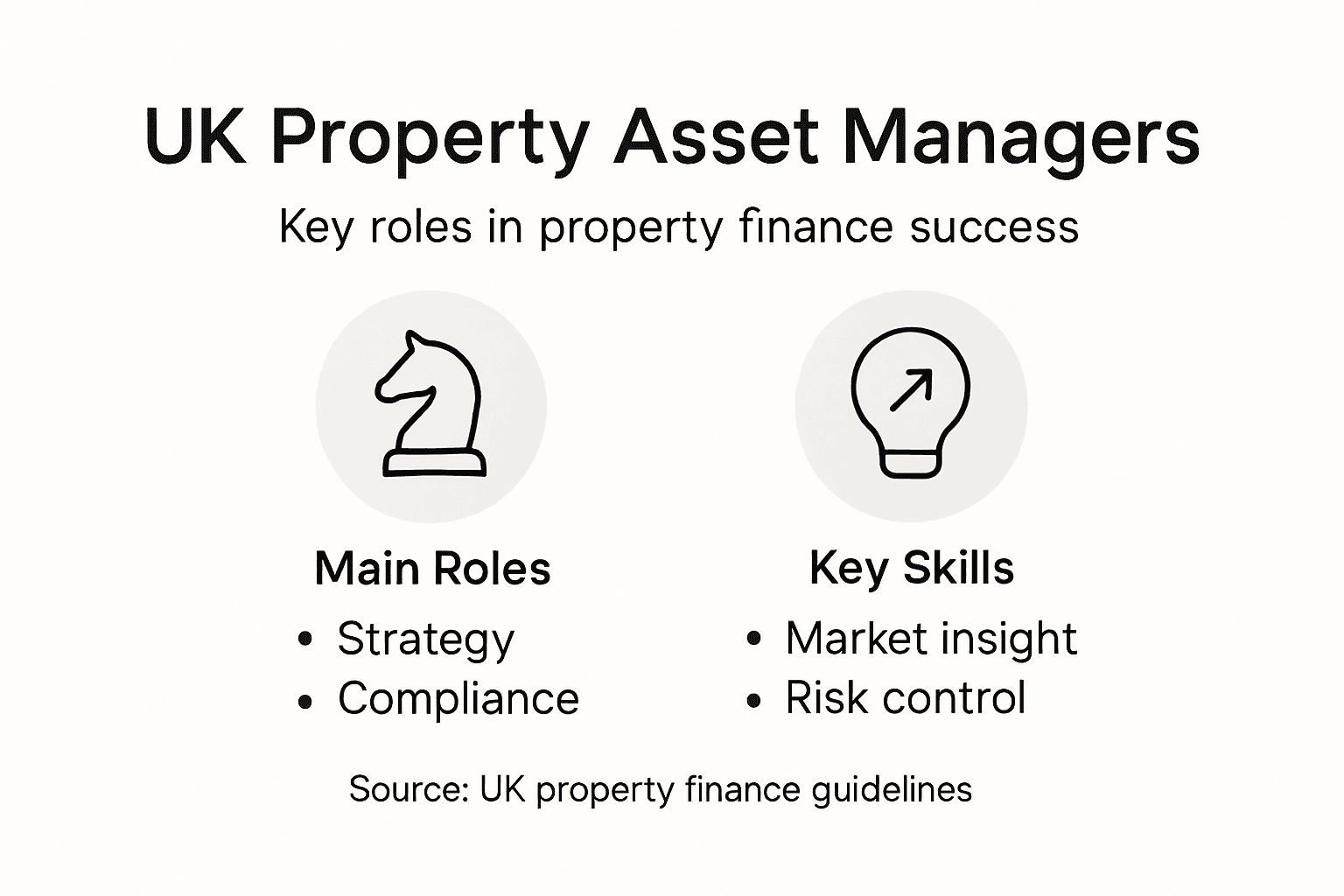
The table below summarises key strategic functions in property asset management and their corresponding business impacts:
| Strategic Function | Description | Business Impact |
|---|---|---|
| Financial Forecasting | Predicting revenues and expenses | Enhanced budgeting accuracy |
| Investment Appraisal | Analysing new asset acquisition potential | Improved portfolio growth |
| Risk Management | Identifying and mitigating vulnerabilities | Reduced financial exposure |
| Capital Allocation | Distributing resources across assets | Optimised returns and efficiency |
| Performance Monitoring | Tracking asset and portfolio health | Informed decision-making |
Pro tip: Develop comprehensive financial modelling skills and maintain robust data analytics capabilities to enhance strategic decision-making in property finance.
Legal, Regulatory and Compliance Frameworks
The United Kingdom’s property asset management sector operates within a complex and rigorous legal landscape that demands meticulous attention to regulatory requirements. Government property data standards establish comprehensive frameworks that govern how property assets are managed, documented, and reported.
Key legal and regulatory compliance areas include:
- Statutory Reporting: Maintaining accurate and transparent property records
- Health and Safety Regulations: Ensuring property compliance with current building standards
- Data Protection: Managing sensitive property-related information
- Procurement Laws: Adhering to legal requirements in property transactions
- Financial Governance: Meeting reporting and audit standards
Asset managers must navigate multiple layers of regulatory oversight, including local and national legislative requirements. Housing association compliance frameworks highlight the intricate responsibilities of property professionals in maintaining legal and operational integrity.
Compliance Management requires comprehensive understanding of:
- Building safety legislation
- Environmental protection regulations
- Contract management protocols
- Risk assessment procedures
- Statutory reporting requirements
Successful compliance is not about mere checkbox management, but creating a proactive culture of regulatory excellence.
The evolving regulatory landscape demands continuous professional development and adaptive strategies to ensure full legal and operational compliance across property portfolios.
Pro tip: Implement a robust compliance tracking system and schedule regular internal audits to maintain proactive regulatory management.
Risk Management and Value Enhancement
Property asset management in the United Kingdom demands a sophisticated approach to risk management that goes beyond traditional defensive strategies. RICS strategic guidance emphasises proactive risk mitigation as a critical mechanism for protecting and enhancing property asset value.
Key risk management dimensions include:
- Financial Risk Assessment: Evaluating potential economic vulnerabilities
- Market Volatility Analysis: Understanding sector-specific risk factors
- Regulatory Compliance Risk: Monitoring legal and governance challenges
- Operational Performance Risks: Identifying potential infrastructure limitations
- Investment Portfolio Diversification: Spreading risk across multiple asset classes
Comprehensive risk management requires a multifaceted approach that integrates data analytics, predictive modelling, and strategic foresight. Asset managers must develop robust frameworks that anticipate potential challenges while creating opportunities for value enhancement.
Value Enhancement Strategies typically encompass:
- Strategic property repositioning
- Capital improvement programmes
- Technical infrastructure upgrades
- Energy efficiency investments
- Adaptive reuse of existing assets
Effective risk management transforms potential threats into strategic opportunities for portfolio growth and value creation.
Successful asset managers leverage sophisticated analytical tools and deep market intelligence to develop nuanced risk mitigation strategies that protect and enhance property portfolio performance.
Pro tip: Implement dynamic risk assessment models that incorporate real-time market data and predictive analytics to enable proactive portfolio management.
Asset Manager Impact on Investment Outcomes
Asset managers play a pivotal role in shaping investment performance and strategic value creation within the United Kingdom’s property finance ecosystem. Strategic asset management frameworks demonstrate how professional oversight directly translates into tangible financial outcomes.
Key investment impact dimensions include:
- Portfolio Optimisation: Strategically restructuring asset allocations
- Risk Mitigation: Identifying and neutralising potential investment vulnerabilities
- Performance Monitoring: Tracking and improving asset financial metrics
- Capital Deployment: Directing investments towards high-potential opportunities
- Market Intelligence Integration: Leveraging sophisticated analytical insights
Professional asset managers transform theoretical investment strategies into executable financial plans. Government strategic asset management protocols illustrate how targeted interventions can generate substantial economic value across diverse property portfolios.
Investment Outcome Enhancement typically involves:
- Detailed performance benchmarking
- Proactive market trend analysis
- Strategic capital reallocation
- Tenant relationship management
- Continuous portfolio refinement
Exceptional asset managers convert complex market dynamics into measurable investment success through strategic, data-driven decision-making.
The most effective asset managers combine deep financial acumen, technological sophistication, and nuanced market understanding to consistently deliver superior investment outcomes.
Pro tip: Develop comprehensive performance dashboards that integrate real-time market data and predictive analytics to enable agile investment strategies.
Unlock Strategic Advantage in UK Property Finance with Expert Funding Solutions
Navigating the complex roles and strategic functions of asset managers in UK property finance demands precise, flexible funding support tailored to maximise portfolio value and mitigate risk. Whether you are focused on capital allocation, risk management, or enhancing investment outcomes, James William & Co Capital specialises in structuring sophisticated finance solutions designed to meet the unique challenges faced by property asset managers, developers, and investors. Key challenges such as multi-layered debt stacks and complex refinance deals require expert handling, ensuring you remain compliant and agile in ever-evolving market conditions.

Empower your property asset management with bespoke mortgage and funding options from a trusted specialist broker. Start your journey towards optimised capital deployment and enhanced financial performance by connecting with James William & Co Capital today. Discover how our “capital concierge” approach delivers tailored support and swift execution for high-value UK property finance transactions. Visit James William & Co Capital to learn more and take the next step towards achieving your strategic property finance goals.
Frequently Asked Questions
What are the main responsibilities of asset managers in property finance?
Asset managers in property finance are responsible for comprehensive financial performance monitoring, strategic portfolio optimisation, risk management, compliance with regulatory frameworks, and value enhancement through targeted investments.
How do asset managers enhance property value?
Asset managers enhance property value through strategies such as strategic property repositioning, capital improvement programmes, energy efficiency investments, and the adaptive reuse of existing assets.
What skills are essential for successful asset managers?
Successful asset managers require advanced financial analysis, property market intelligence, risk assessment capabilities, strategic planning skills, and effective stakeholder engagement techniques.
What role does risk management play in asset management?
Risk management is critical in asset management, allowing asset managers to identify and mitigate financial vulnerabilities, understand market volatility, monitor regulatory compliance, and develop investment portfolio diversification strategies.
Recommended
Related Topics
Speak to a specialist
Discuss your finance with James directly
Whole-of-market specialist finance — bridging, development, commercial and residential. No call centres, no obligation. James reviews every enquiry personally.
New to specialist finance? How unbiased broker advice works · Deals we have completed
Explore Related Finance