
Published · Updated
what is bespoke financeBespoke Finance: Transforming Complex UK Property Deals
By James Dawes, CeMAP, Founder, James William & Co Capital

Securing capital for multi-million property ventures in the United Kingdom rarely fits into a standard mortgage template. When intricate deals demand rapid funding and tailored structure, bespoke finance solutions offer the flexibility and speed traditional banks cannot match. This article explores how custom finance unlocks opportunities for complex acquisitions, development schemes, and rapid turnarounds, helping experienced developers and investors access specialist funding built around their unique requirements.
Table of Contents
- What Is Bespoke Finance In The UK?
- Types Of Bespoke Finance Solutions Available
- How Bespoke Finance Works For Property Deals
- Legal And Regulatory Framework For Bespoke Loans
- Risks, Costs, And Key Due Diligence Steps
- Comparing Bespoke Finance With Standard Lending
Key Takeaways
| Point | Details |
|---|---|
| Bespoke Finance Offers Flexibility | Unlike standard lending, bespoke finance tailors funding solutions to meet specific circumstances, enhancing adaptability for complex transactions. |
| Access to Specialist Capital Sources | Bespoke finance allows access to private credit funds and family offices, which can better accommodate intricate financial needs. |
| Rigorous Due Diligence Required | The absence of standard safeguards necessitates comprehensive due diligence to mitigate risks associated with bespoke lending. |
| Customisation Reduces Overall Costs | Paying for only what is needed can lead to lower total borrowing costs, as bespoke structures avoid unnecessary fees from standard products. |
What Is Bespoke Finance in the UK?
Bespoke finance represents a fundamental shift from off-the-shelf lending solutions to customised financial strategies built specifically for your transaction. Rather than fitting your deal into a standard product box, bespoke finance shapes the entire funding structure around your unique circumstances, your property characteristics, and your business objectives.
At its core, bespoke finance tailors financial solutions to address the distinct complexities you face as a developer or investor. Traditional lenders operate within rigid parameters: set loan-to-value ratios, standard repayment terms, fixed covenant packages. Bespoke finance discards these constraints. Your lender examines the specific nuances of your deal—whether that’s a challenging planning permission history, a phased development timeline, or offshore equity structures—and constructs financing that accommodates those realities.
This approach proves invaluable for complex acquisitions where conventional mortgages simply won’t work. Consider a multi-site development requiring staged purchases across 18 months, or a refinance involving existing mezzanine debt and preferred equity. Standard products collapse under this complexity. Bespoke arrangements thrive in it, offering flexibility to respond to the actual commercial environment you’re operating within.
The mechanics include structured finance arrangements, development funding tied to construction milestones, and asset-based solutions that reflect your specific collateral profile. Covenant packages become negotiable rather than standardised, interest-only periods can align with your cash-flow realities, and security structures accommodate your group’s corporate arrangements.
What makes bespoke finance particularly powerful for UK property professionals is the access it provides to specialist capital sources—family offices, private credit funds, and dedicated development finance providers—who explicitly exist to solve complex problems that mainstream lenders won’t touch. These institutions deploy capital precisely because they can structure solutions tailored to individual transactions.
Pro tip: When approaching bespoke finance discussions, prepare a comprehensive deal summary that explicitly highlights why your transaction sits outside standard lending parameters—this immediately positions your deal as genuinely bespoke rather than simply difficult.
Types of Bespoke Finance Solutions Available
The range of bespoke finance solutions spans far beyond standard mortgages. Each option addresses specific deal structures, timelines, and funding gaps that conventional lenders simply cannot accommodate. Your choice depends entirely on your transaction profile, your exit strategy, and the particular challenges you’re solving for.
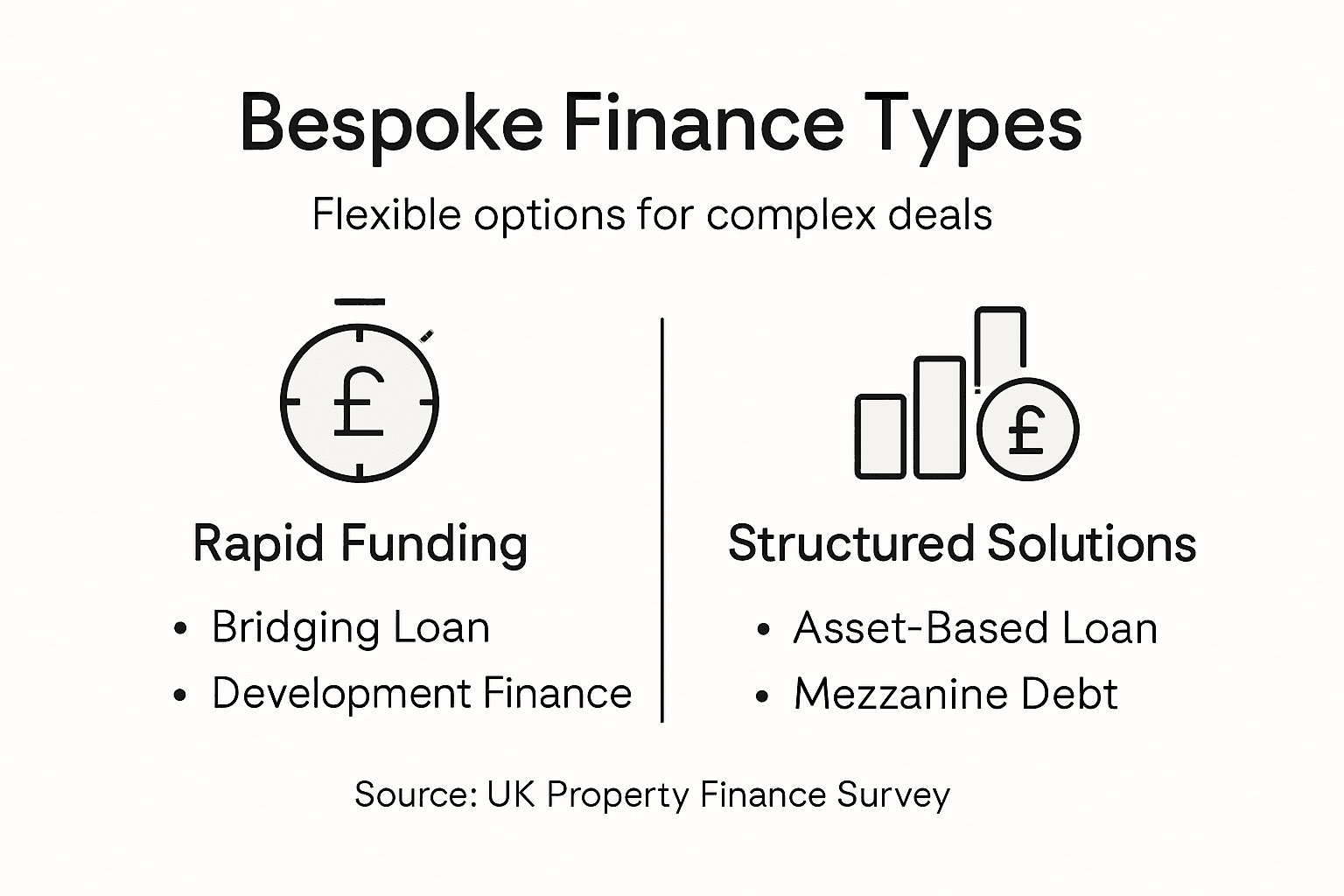
Bridging finance serves as the rapid-execution tool. You acquire a property before selling an existing asset, refinancing previous debt, or completing a planning permission. Bridging finance typically operates over 6 to 24 months, releasing capital when you need it—not when a standard lender’s approval timeline permits. This proves essential for competitive off-market acquisitions where speed separates winners from runners-up.
Development finance structures funding around construction milestones rather than standard repayment schedules. Your facility releases capital progressively as you complete foundations, secure practical completion, or reach pre-lettings. This aligns lender interests directly with your project delivery, and development finance arrangements accommodate contingencies, cost overruns, and market conditions that fixed-term mortgages cannot tolerate.

Asset-based finance anchors funding to your specific collateral profile. Rather than forcing your deal into a standardised loan-to-value box, your lender structures debt against the actual security value of the property, equipment, or receivables you’re deploying. This approach particularly benefits investors with complex portfolios or unconventional asset types.
Mezzanine debt and structured equity fill the layers between senior debt and equity. These instruments offer flexibility on terms, conversion rights, and exit scenarios that traditional financing structures cannot provide. They work exceptionally well when layering capital from multiple sources or managing preferred equity arrangements.
Commercial mortgages with bespoke covenants replace standardised borrowing conditions with tailored packages reflecting your operational reality. Interest-only periods, covenant holidays, or staged amortisation schedules become negotiable rather than fixed.
Here is a summary of key bespoke property finance options and their core business uses:
| Solution Type | Typical Use Case | Unique Benefit |
|---|---|---|
| Bridging Finance | Fast property acquisitions | Rapid capital release |
| Development Finance | Construction projects with milestones | Drawdown tied to progress |
| Asset-Based Finance | Funding complex or unique assets | Flexibility on collateral |
| Mezzanine/Structured Equity | Layered capital and sophisticated deals | Customisable exit options |
| Commercial Mortgage (Bespoke) | Business with fluctuating cash flows | Negotiable covenant terms |
Pro tip: Map your specific deal challenges—whether speed, complexity, or timing—against these solution types before approaching lenders; this clarity positions you to request precisely the right structure rather than accepting compromises.
How Bespoke Finance Works for Property Deals
Bespoke finance operates through a methodical assessment process that begins with understanding your specific transaction. Unlike standard mortgage applications where lenders plug your details into formulaic systems, bespoke finance demands detailed analysis of your deal structure, your exit strategy, and the particular complexities that make your transaction unique.
The process starts with a comprehensive brief. You present your situation to a specialist broker or lender—the acquisition price, existing debt, your timeline, your business plan for the asset, any planning considerations, and your intended exit. Bespoke property finance sourcing focuses on borrowing of £250,000 or more, often involving loans between £1 million and £5 million where conventional products simply cannot operate.
Your broker then matches your deal against their network of lenders. Rather than applying to a bank with a standard product, bespoke finance identifies lenders and capital sources that specialise in precisely your deal type. A complex multi-site development connects with development finance specialists. A rapid acquisition for below-market pricing connects with bridging providers. A refinance involving layered debt structures connects with specialist credit funds.
Structuring follows assessment. Your lender designs the facility architecture around your needs rather than forcing compromise. Interest-only periods align with your lease-up timelines. Covenant packages reflect your actual operational metrics rather than standardised ratios. Security arrangements accommodate your corporate structure, whether that involves offshore vehicles, JV partnerships, or group guarantees.
Once terms are agreed, execution accelerates. Bespoke lenders move faster than banks because they work within defined parameters you’ve already negotiated. There are no surprises at valuation or final approval stages because the structure itself was tailored upfront. Speed matters intensely when you’re competing for deals or managing time-sensitive refinances.
The entire process prioritises finding better borrowing terms whilst avoiding unnecessary costs, restrictive covenants, or excessive security demands. You pay only for what your deal requires, not for standardised product features you’ll never use.
Pro tip: Provide your broker with a written deal summary covering transaction value, timeline, exit strategy, and specific lending challenges before initial conversations; this transforms the assessment process from exploratory to focused execution.
Legal and Regulatory Framework for Bespoke Loans
The regulatory landscape for bespoke lending differs fundamentally from consumer mortgages and retail banking. Understanding which rules apply to your facility matters because it directly affects lender availability, approval timelines, and the terms you can negotiate.
For commercial lending to incorporated or tax-resident businesses, the picture simplifies considerably. Most bespoke property finance sits outside the regulated perimeter entirely. Your lender does not require a banking licence or regulatory approval from the Financial Conduct Authority (FCA) to lend against UK property assets. This is precisely why private credit funds, specialist development finance providers, and family offices can move quickly without navigating the approval delays that banks encounter.
The critical distinction emerges when lending qualifies as a regulated mortgage loan or consumer credit facility. FCA authorisation requirements apply when lending falls under the Financial Services and Markets Act 2000 definitions. Consumer credit lending triggers regulation automatically. Mortgage loans taken out by individuals for residential property trigger regulation. But bespoke commercial lending to property developers or institutional investors typically falls outside these definitions entirely.
Your lender’s regulatory status matters more than the loan itself. Some bespoke finance providers operate as authorised firms operating under FCA rules, whilst others operate entirely outside the regulated sector. Both models function perfectly legally for commercial property lending. The unregulated route often enables faster decision-making and greater flexibility on terms.
That said, regulatory obligations exist around certain conduct. The lender cannot impose unenforceable penalties or unconscionable bargains, particularly where insolvency law applies. Economic terms are freely negotiated between commercial parties, but courts retain power to challenge genuinely punitive provisions.
For your purposes as a developer or investor, the key reality is straightforward: bespoke commercial property lending operates within a light-touch regulatory environment that enables lenders to structure creatively and move quickly. Your focus remains on finding the right capital partner with the expertise and appetite for your specific deal structure.
Pro tip: Confirm with your broker whether your lender operates as an FCA-authorised firm or an unregulated credit provider; either can work perfectly, but the distinction affects approval speed and covenant negotiation flexibility, so understanding it upfront prevents misaligned expectations.
Risks, Costs, and Key Due Diligence Steps
Bespoke finance removes many constraints, but it introduces distinct risks that demand rigorous due diligence. The flexibility that makes bespoke solutions attractive also means fewer standardised safeguards. You must understand what you’re entering into and what could derail your deal.
Costs operate differently in bespoke finance than mainstream mortgages. Arrangement fees typically run higher because lenders invest significant time structuring customised solutions. Expect fees between 1 and 3 percent of facility size, sometimes higher for genuinely complex deals. Interest rates reflect the credit risk profile and the lender’s cost of capital, not published rates. Exit fees or prepayment penalties may apply if you refinance before maturity. Professional costs multiply: legal fees, surveyor costs, accountant involvement, and broker fees all stack up. Budget £15,000 to £40,000 in professional costs for deals above £1 million, depending on complexity.
The real risks sit deeper. Bespoke lenders operate outside standardised frameworks, which means less transparent regulation and fewer consumer protections. Your lender’s financial stability matters enormously. If they encounter difficulties mid-transaction, you face uncertainty. Covenant packages, whilst negotiable, still constrain your operations. Trigger events could force refinancing if breached. Security arrangements often extend beyond the property itself, potentially affecting other group assets.
Financial due diligence becomes essential before committing. You must verify the lender’s credentials, capital base, and historical performance. Review their track record with similar deal types. Understand their exit strategy and what happens if your transaction hits difficulties.
Key due diligence steps include reviewing the full facility agreement, examining all security documentation, assessing covenant triggers, and understanding enforcement mechanisms. Your solicitor must verify all terms against the summary provided. Hidden liabilities emerge through proper document review. Covenant definitions require careful examination because breaches could trigger acceleration clauses you didn’t anticipate.
Operational risks include refinancing risk if market conditions shift. Some bespoke facilities cannot be refinanced through mainstream lenders, leaving you dependent on the original capital source.
Pro tip: Dedicate time to covenant testing before facility drawdown; model scenarios where rental income drops 20 percent or construction costs overrun by 15 percent to confirm you can maintain compliance even under stressed conditions.
Comparing Bespoke Finance With Standard Lending
Standard lending follows rigid templates. Banks apply identical criteria to every applicant, plugging your circumstances into standardised assessment models. Loan-to-value ratios sit fixed. Repayment terms remain uniform. Covenant packages are non-negotiable. You accept the product as designed or move to another bank that offers something equally inflexible.
Bespoke finance operates on completely different principles. Customised financial solutions tailored to your unique circumstances replace standardised structures. Your deal dictates the terms, not a product manual written three years ago. Interest rates reflect your specific risk profile and the actual cost of capital your lender deploys, not a published mortgage table.
The speed difference proves dramatic. Banks typically require 8 to 12 weeks from application to completion. Their underwriting departments follow checklists. Valuations must meet standardised criteria. Your deal either fits their framework or it doesn’t. Bespoke lenders move in 2 to 6 weeks because they’re already focused on your specific transaction type. They skip irrelevant procedures entirely.
Flexibility separates the two approaches most visibly. Standard mortgages demand identical security across all borrowers. Bespoke arrangements accommodate your corporate structure, whether that involves offshore vehicles, partnership equity, or group guarantees. Repayment schedules can align with your construction timeline or lease-up period rather than fixed amortisation. Interest-only periods become negotiable. Covenant definitions reflect your operational metrics rather than standardised metrics.
Approval certainty differs substantially. Banks generate definitive yes or no decisions predictably. Bespoke lenders move iteratively. Initial enthusiasm can shift if deeper diligence reveals complexities. Terms may change as structure evolves. This flexibility cuts both ways: you gain customisation, but lose the certainty of a standardised product decision.
Costs tell the final story. Standard mortgages charge lower fees because they’re mass-produced products. Bespoke finance carries higher arrangement fees reflecting custom structuring work. However, you avoid paying for product features you’ll never use, and the tailored structure often reduces your total borrowing costs through better-matched terms.
Compare key differences between bespoke finance and standard lending in UK property deals:
| Aspect | Bespoke Finance | Standard Lending |
|---|---|---|
| Time to Completion | 2–6 weeks | 8–12 weeks |
| Flexibility | Structure tailored to each client | Fixed terms and covenants |
| Typical Fees | Higher arrangement and legal costs | Lower, standardised fees |
| Regulation | Often unregulated for business lending | Highly regulated (FCA) |
| Approval Process | Iterative, bespoke assessment | Binary, formulaic decision |
Choose standard lending when your deal fits neatly into conventional boxes. Choose bespoke finance when complexity, speed, or unique circumstances demand solutions that templates cannot accommodate.
Pro tip: Before approaching either lender type, clarify which constraints frustrate your deal most—timeline, structure, covenant flexibility, or speed—then target lenders specialising in solving precisely those problems rather than seeking a generalist fit.
Unlock Bespoke Finance Solutions for Complex UK Property Deals
Navigating the complexities of UK property finance demands expertise tailored to your unique challenges like multi-layered debt stacks, offshore vehicles, and bespoke covenant packages discussed in this article. At James William & Co Capital, we understand that standard lending cannot meet your timeline pressures or structural needs. Our specialist brokers partner with family offices and private credit funds to deliver rapid, customised funding for large-scale acquisitions, developments and refinances. Benefit from a capital concierge approach delivering full end-to-end structuring, negotiation and execution designed specifically for your deal complexities.
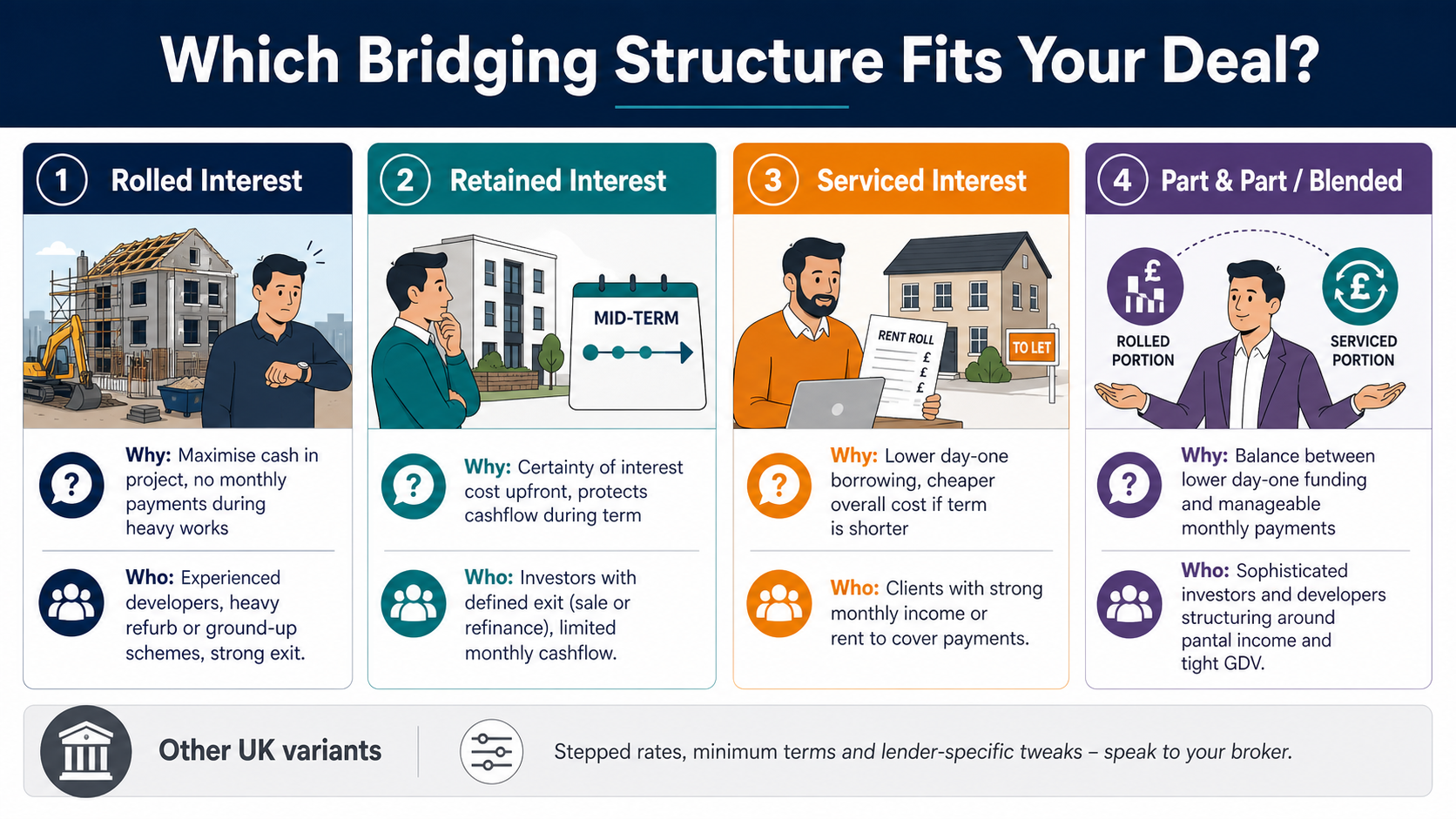
Discover how our bridging finance, development finance and mezzanine debt solutions align perfectly with the bespoke options you need. Do not let rigid lending frameworks or slow approvals stall your project. Act now to access expert advice and tailored capital from James William & Co Capital and explore how our bespoke property finance services can transform your transaction. Reach out today to partner with brokers specialising in sophisticated UK property funding and secure the competitive advantage this article highlights.
Frequently Asked Questions
What is bespoke finance in property development?
Bespoke finance is a custom financial solution specifically designed to address the unique complexities of a property transaction, as opposed to standardised lending products that may not fit specific circumstances.
How does bespoke finance differ from traditional mortgages?
Bespoke finance offers tailored solutions with flexible terms and quicker approvals, whereas traditional mortgages follow rigid templates with fixed terms and longer processing times.
What types of bespoke finance solutions are available?
Common types include bridging finance for rapid acquisitions, development finance linked to construction milestones, asset-based finance for unique collateral, mezzanine debt for layered funding, and commercial mortgages with tailored covenants.
What should I consider when approaching a bespoke finance lender?
Before approaching a lender, prepare a detailed deal summary highlighting your transaction’s unique challenges like complexity, speed requirements, and specific financing needs to position your deal effectively.
Recommended
Related Topics
Speak to a specialist
Discuss your finance with James directly
Whole-of-market specialist finance — bridging, development, commercial and residential. No call centres, no obligation. James reviews every enquiry personally.
New to specialist finance? How unbiased broker advice works · Deals we have completed
Explore Related Finance