
Published · Updated
explaining break clause in loansBreak clause in loans explained: a complete guide
By James Dawes, CeMAP, Founder, James William & Co Capital

TL;DR:
- A break clause allows either party to end a fixed-rate loan early, with a break cost to compensate for potential losses. The cost varies based on interest rate movements, loan size, and remaining term, and can significantly escalate for larger loans. Borrowers should model break costs carefully, negotiate terms early, and treat the clause as a critical pricing component.
A break clause in a loan agreement is a contractual provision that permits either the borrower or the lender to terminate a fixed-rate loan before its scheduled end date. The financial consequence of exercising this right is called a break cost. Understanding break clauses is not optional for anyone taking on fixed-rate finance in the UK. Whether you are a property developer, a business owner, or an individual borrower, the terms buried in your loan contract can cost you tens of thousands of pounds if you exit at the wrong moment.

Explaining break clause in loans: what it means and why it matters
A break clause, also referred to as a break option in loan contracts, gives one or both parties the right to end a fixed-rate agreement early. The lender includes this clause to protect its funding position. When a borrower exits a fixed-rate loan early, the lender loses the interest income it had priced into its funding model. The break cost is the mechanism that compensates for that loss.
The meaning of a break clause extends beyond a simple exit fee. It reflects the lender’s cost of unwinding its hedging position in the wholesale money markets. That is why break costs are market-sensitive and can change daily. A borrower who fixes a rate when the market is low, then tries to exit when rates have risen, may face a very different cost compared to someone exiting in a falling-rate environment.
James William & Co structures complex fixed-rate facilities for UK property developers and investors. Understanding the break clause importance in loans is central to how those facilities are negotiated and documented.
How are break costs calculated?
Break cost is calculated by multiplying the interest rate differential by the outstanding principal and the remaining fixed term, then discounting that figure to present value and adding administrative fees. That formula sounds straightforward, but the inputs are not. Lenders use proprietary wholesale rate data that changes every trading day, which means the figure you receive today may be materially different from the figure you receive next week.
The interest rate differential is the gap between your fixed rate and the current market rate for an equivalent term. If you fixed at 5% and the market rate is now 3%, the lender faces a 2% shortfall on the remaining loan balance for the remaining term. On a large loan, that adds up quickly.
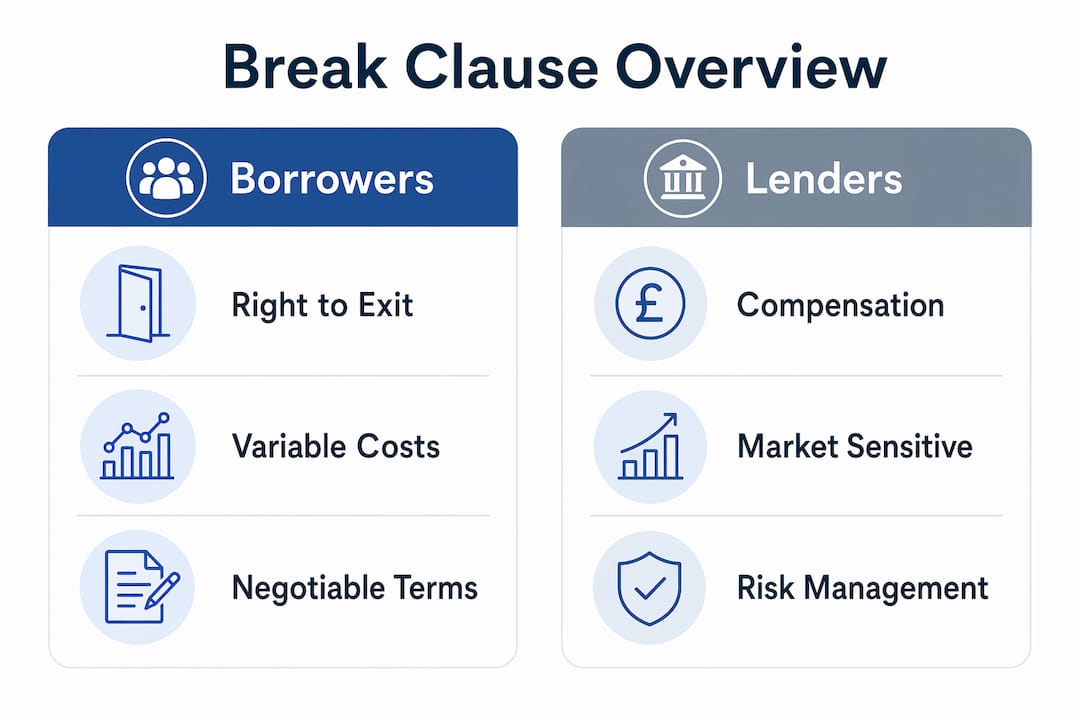
A 2% rate shift on a loan of approximately £387,000 can produce a break cost exceeding £23,000, with administrative fees adding a further £250–£400. That figure illustrates why break costs on commercial and development loans, which are typically far larger, can run into six figures.
Most fixed-rate contracts also include a present-value adjustment formula that incorporates funding spreads and discounts future lost interest payments. This adjustment consistently pushes break costs higher than a simple interest rate differential calculation would suggest.
The table below illustrates how break costs scale with loan size and rate movement.
| Loan principal | Fixed rate | Current market rate | Remaining term | Estimated break cost |
|---|---|---|---|---|
| £500,000 | 5.00% | 3.50% | 2 years | £15,000+ |
| £1,000,000 | 5.00% | 3.00% | 3 years | £60,000+ |
| £2,500,000 | 5.50% | 3.50% | 4 years | £200,000+ |
| £500,000 | 5.00% | 6.00% | 2 years | £0 (nil cost) |
The final row reflects an important exception. If interest rates have risen since you fixed your loan, the break cost may be zero or even waived entirely. The lender can re-lend those funds at a higher rate, so it suffers no loss. Break costs only apply when market rates fall below your fixed rate.
Pro Tip: Request a written break cost quote from your lender before making any refinancing decision. Lenders calculate these figures using live wholesale data, so the quote is only valid on the day it is issued. Confirm the figure again immediately before you commit.
What is the difference between break costs and early repayment penalties?
Break costs differ from prepayment penalties in one fundamental way: break costs are market-sensitive and variable, while prepayment penalties are fixed-percentage fees set at the time of the loan agreement. Confusing the two leads borrowers to either underestimate or overestimate the cost of exiting early.
A prepayment penalty is typically expressed as a percentage of the outstanding balance, for example 2% or 3%, regardless of what interest rates are doing. A break cost, by contrast, can be zero in a rising-rate environment and substantial in a falling-rate environment. The same loan can carry a very different exit cost depending entirely on market conditions at the time of exit.
Key differences between the two:
- Nature of the fee. Break costs are calculated from market rate movements. Prepayment penalties are fixed contractual percentages.
- Predictability. Prepayment penalties are known at signing. Break costs are unknown until the day of exit.
- Direction of movement. Break costs can fall to zero or be waived. Prepayment penalties are always payable if triggered.
- Regulatory treatment. In some jurisdictions, prepayment penalties on residential loans are capped or banned. Break costs on fixed-rate commercial loans are generally unrestricted.
- Calculation complexity. Break costs involve wholesale rate data, present-value discounting, and funding spreads. Prepayment penalties require only a multiplication.
Pro Tip: Read your loan agreement carefully and identify which type of exit fee applies. Ask your solicitor or finance broker to confirm in writing whether the clause is a market-sensitive break cost or a fixed prepayment penalty. The distinction changes your exit strategy entirely.
Many borrowers confuse these two fee types and plan their refinancing on the wrong assumption. That mistake can turn a financially sound refinancing decision into an expensive one.
What risks do break clauses pose, and how can borrowers manage them?
Break clauses carry risks that go beyond the cost of a voluntary exit. Business loan agreements often contain tripwires that trigger mandatory early repayment, such as receiving a government grant, an insurance payout, or a change of control in the business. These involuntary triggers can force a break cost on a borrower who had no intention of exiting the loan.
One-sided break clauses are a particular concern. Some lenders reserve the right to call in the loan early under specific conditions, while the borrower has no equivalent right. This asymmetry is common in commercial and development finance, where lenders protect their position through covenant packages. A borrower who does not identify and negotiate these clauses at the outset has no recourse when the lender exercises them.
Practical steps to manage break clause risk:
- Negotiate at the term sheet stage. Break clause terms are most negotiable before you sign. Ask for mutual break rights or a cap on break costs.
- Identify involuntary triggers. Review every event of default and mandatory prepayment clause. Understand what actions or external events could force an early exit.
- Model the break-even point. Borrowers should calculate the break-even point before refinancing, as a rate reduction of 100 or more basis points and a long remaining term are usually needed to offset a significant break cost.
- Time your exit carefully. If rates are rising, your break cost may be falling. Waiting for the right market moment can reduce or eliminate the cost entirely.
- Request regular quotes. Lenders calculate break costs using proprietary wholesale rate data that fluctuates daily. A quote from last month is not reliable for a decision made today.
For UK property developers managing real estate debt across multiple facilities, break clause exposure can compound quickly. Structuring loans with staggered fixed periods or variable-rate tranches reduces the risk of a single large break cost event.
How do break clauses affect individuals and businesses differently?
Regulatory treatment of break costs varies significantly by jurisdiction and by borrower type. In the UK, residential mortgage borrowers benefit from Financial Conduct Authority rules that limit early repayment charges on regulated mortgage contracts. Commercial borrowers and property developers operate under no equivalent cap. Their break costs are governed purely by contract.
In Australia, variable-rate loans originated after 2011 carry no exit penalties, but fixed-rate loans maintain full break costs. Discharge fees in Australia typically run around £350 per property. In the United States, the Dodd-Frank Act restricts prepayment penalties on certain residential mortgages, but commercial loans remain largely unregulated on this point.
The table below summarises key regulatory distinctions across three jurisdictions.
| Jurisdiction | Residential loans | Commercial loans | Key regulatory body |
|---|---|---|---|
| United Kingdom | FCA caps early repayment charges on regulated mortgages | No cap; governed by contract | Financial Conduct Authority |
| Australia | No exit fees on variable-rate loans post-2011; break costs apply to fixed-rate | Full break costs apply | Australian Prudential Regulation Authority |
| United States | Dodd-Frank restricts penalties on qualifying residential mortgages | No federal cap on commercial break costs | Consumer Financial Protection Bureau |
Business borrowers face the most complex break clause structures. Loan agreements for business borrowers frequently include mandatory prepayment triggers tied to events outside the borrower’s control. A company that sells a subsidiary, receives an insurance settlement, or undergoes a shareholder restructure may find itself facing a break cost it never anticipated. Retail borrowers, by contrast, typically encounter break clauses only when they choose to refinance or sell a property.
For UK developers and investors, understanding the types of property finance available and how each product handles break costs is a core part of structuring a deal correctly.
Key takeaways
A break clause in a fixed-rate loan is a market-sensitive contractual right, and the cost of exercising it depends entirely on interest rate movements at the time of exit, not on a fixed fee.
| Point | Details |
|---|---|
| Break cost definition | A break cost compensates the lender for lost interest when a fixed-rate loan ends early. |
| Calculation complexity | Break costs use present-value discounting and funding spreads, making them higher than a simple rate differential suggests. |
| Break costs vs penalties | Break costs are variable and market-driven; prepayment penalties are fixed percentages set at signing. |
| Involuntary triggers | Business loans often contain mandatory repayment clauses tied to grants, insurance payouts, or ownership changes. |
| Negotiation is possible | Break clause terms are most flexible at the term sheet stage, before the loan is signed. |
James’s view: what borrowers consistently get wrong
Most borrowers treat break clauses as a theoretical risk until the moment they become a real one. By then, the negotiating window has closed. The clause is in the contract, the rate environment has moved, and the cost is what it is.
The asymmetry of information here is significant. Lenders control the wholesale rate data used to calculate break costs. They produce the quote, and the borrower has no independent way to verify it. I have seen borrowers accept a break cost figure without question, when a more thorough review of the calculation methodology would have revealed errors or inflated funding spread assumptions.
The most common mistake I see is borrowers focusing entirely on the headline interest rate when comparing loan offers, and ignoring the break clause terms entirely. A loan priced 0.25% cheaper but with an aggressive break cost structure can cost far more over its life than a slightly higher-rate loan with a capped or mutual break right.
My practical recommendation is this: treat the break clause as a pricing component, not a footnote. Request a written explanation of how break costs will be calculated, ask for a worked example at the term sheet stage, and model the cost of exit at multiple points in the loan term before you sign. For complex facilities involving development finance structuring, this analysis should be part of the initial underwriting, not an afterthought.
— James
How James William & Co helps with complex loan structures
Break clauses in commercial and development finance are rarely straightforward. The cost of getting them wrong is not abstract. It shows up as a six-figure charge at the worst possible moment in a project’s cash flow.
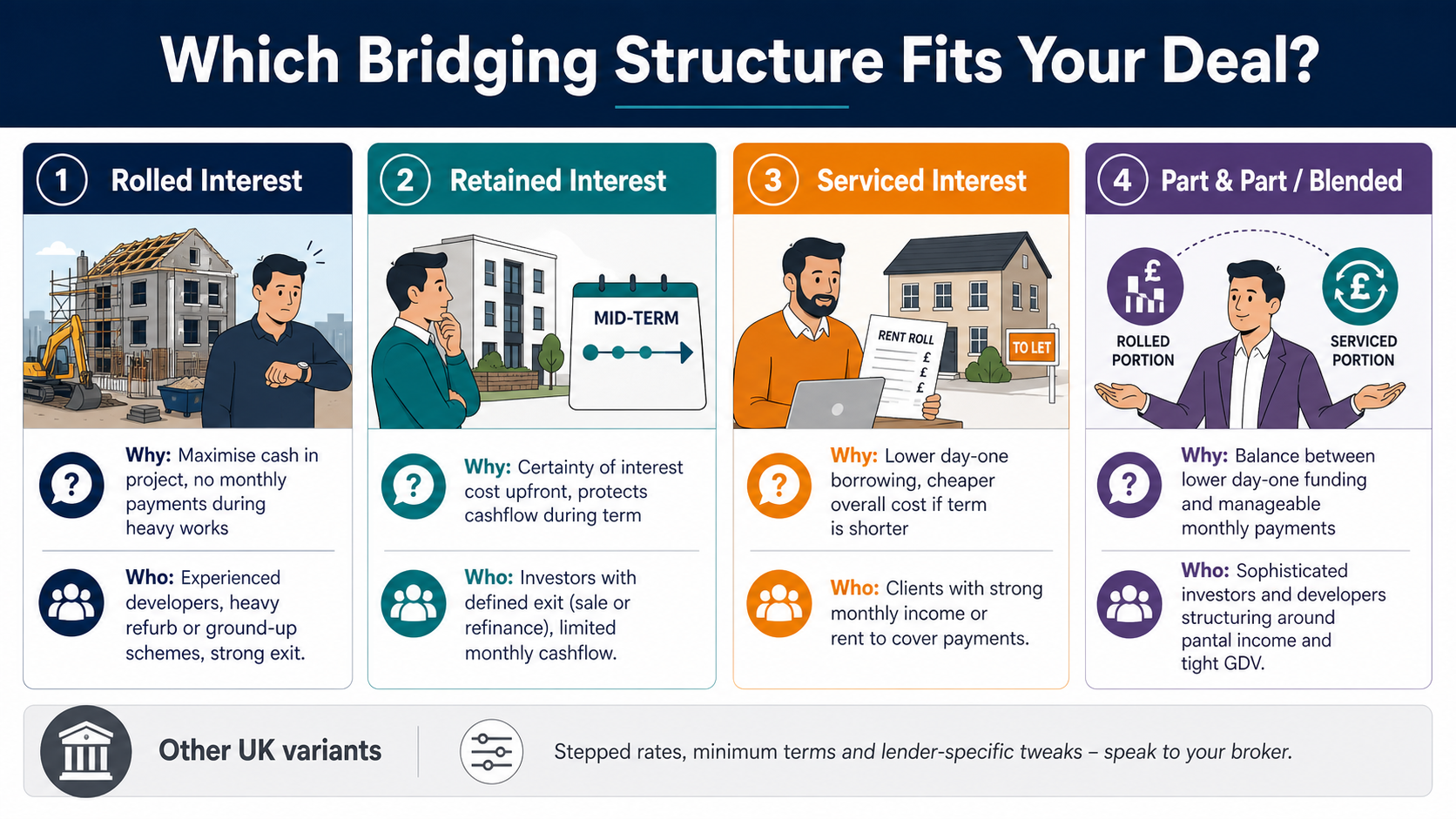
James William & Co works with UK property developers, investors, and high-net-worth borrowers to structure facilities where break clause risk is identified, negotiated, and priced correctly from the outset. The firm’s specialist property finance advisory covers bridging finance, development loans, commercial mortgages, and mezzanine debt, with bespoke covenant packages that reflect each client’s specific exit strategy. If you are arranging fixed-rate finance and want the break clause terms reviewed before you commit, speak to the James William & Co team directly.
FAQ
What is a break clause in a loan?
A break clause is a contractual provision in a fixed-rate loan that allows early termination by the borrower or lender. Exercising it typically triggers a break cost to compensate the lender for lost interest income.
How is a break cost calculated?
Break cost is calculated using the interest rate differential, the outstanding loan principal, and the remaining fixed term, discounted to present value and adjusted for funding spreads and administrative fees.
When is a break cost zero?
A break cost is zero or waived when market interest rates have risen above the borrower’s fixed rate since the loan was taken out. In that scenario, the lender can re-lend the funds at a higher rate and suffers no loss.
What is the difference between a break cost and a prepayment penalty?
A break cost is market-sensitive and changes daily based on interest rate movements. A prepayment penalty is a fixed percentage of the outstanding balance, set at the time the loan is agreed.
Can break clause terms be negotiated?
Break clause terms are negotiable at the term sheet stage before the loan is signed. Borrowers can request mutual break rights, cost caps, or a worked example of how break costs will be calculated under different rate scenarios.
Recommended
Related Topics
Speak to a specialist
Discuss your finance with James directly
Whole-of-market specialist finance — bridging, development, commercial and residential. No call centres, no obligation. James reviews every enquiry personally.
New to specialist finance? How unbiased broker advice works · Deals we have completed
Explore Related Finance