
Published · Updated
commercial mortgage definitionCommercial Mortgage Definition: Implications For UK Investors
By James Dawes, CeMAP, Founder, James William & Co Capital

Complex property investments demand precise funding arrangements. High-net-worth investors and developers across the United Kingdom face unique challenges when securing a commercial mortgage compared to traditional residential loans. From differences in underwriting criteria to the wide spectrum of loan structures spanning office buildings, retail spaces, and development projects, understanding these nuances is key. This guide clarifies how lenders evaluate commercial deals, highlights the specific risk factors, and details the options available within the extensive UK commercial property market.
Table of Contents
- Defining Commercial Mortgages In The UK
- Distinguishing Commercial Mortgage Types
- How Lenders Assess And Structure Deals
- Legal Framework And Borrower Obligations
- Risks And Common Mistakes To Avoid
Key Takeaways
| Point | Details |
|---|---|
| Understanding Types of Mortgages | Commercial mortgages are distinct from residential ones, focusing on business viability and property cashflow rather than just market value. |
| Lender Assessment Criteria | Lenders prioritise business financial health, property performance, and the debt structure during the evaluation process. |
| Covenants and Obligations | Borrowers must comprehend and comply with financial covenants, which impact ongoing loan management and potential enforcement actions. |
| Exit Strategy Planning | Developing robust exit strategies is essential, accounting for market volatility and alternative funding options if conditions change. |
Defining Commercial Mortgages In The UK
A commercial mortgage is a loan secured against property held for business purposes rather than residential use. Unlike traditional residential mortgages that finance family homes, commercial mortgages finance office buildings, retail units, industrial warehouses, hotels, and leisure facilities.
The distinction matters significantly. Loans secured on commercial property differ fundamentally in how lenders assess risk, structure terms, and calculate returns. Lenders focus on the business’s financial performance and the property’s income-generating potential, not just its market value.
How Commercial Mortgages Differ From Residential Mortgages
You’ll notice key differences when comparing the two structures:
- Underwriting criteria: Lenders examine your business accounts, cash flow projections, and trading history—not just credit scores
- Loan terms: Commercial mortgages typically run 5 to 20 years, often with shorter fixed periods than residential products
- Interest rates: Usually higher than residential rates, reflecting increased commercial risk
- Loan-to-value ratios: Generally 60–75% for commercial property, versus 80–95% for residential
- Repayment structures: More flexible arrangements including interest-only periods and stepped repayments
Commercial lenders prioritise business viability and property cashflow over personal credit history, creating fundamentally different assessment criteria.
When accessing real estate funding sources available to UK developers, you’ll find that commercial mortgages sit within a broader toolkit of financing options.
Key Characteristics Of Commercial Mortgages
Commercial mortgages carry specific operational features that affect how you structure your investment:
- Security structure: The lender takes a legal charge over your commercial property as security
- Assessment basis: Applications prioritise property performance metrics and business viability over personal factors
- Covenant requirements: Lenders impose financial covenants, such as minimum interest cover ratios or debt service coverage requirements
- Exit provisions: Most products include refinancing options and early repayment flexibility, though with defined terms
The UK commercial property market is substantial, encompassing offices across London’s financial districts, regional retail parks, industrial sheds in logistics hubs, and leisure assets. Each sector carries distinct risk profiles, affecting how lenders price and structure your mortgage.

What Lenders Examine
When you apply for commercial mortgage finance, expect scrutiny across three primary areas:
- Business financial health: Trading accounts for 2–3 years, profit projections, tax returns, and management accounts
- Property assessment: Valuation by an independent surveyor, lease terms (if let), tenant quality, and income security
- Loan structure: Your equity contribution, exit strategy, and how your project fits within your wider portfolio
Pro tip: Prepare 24–36 months of comprehensive financial records and secure detailed property valuations before approaching lenders; this accelerates underwriting and demonstrates serious intent to sophisticated debt providers.
Distinguishing Commercial Mortgage Types
Commercial mortgages aren’t one-size-fits-all. The market offers distinct products tailored to different investment scenarios, each with unique terms, interest rate structures, and risk profiles. Understanding which type suits your strategy is crucial for structuring deals efficiently.
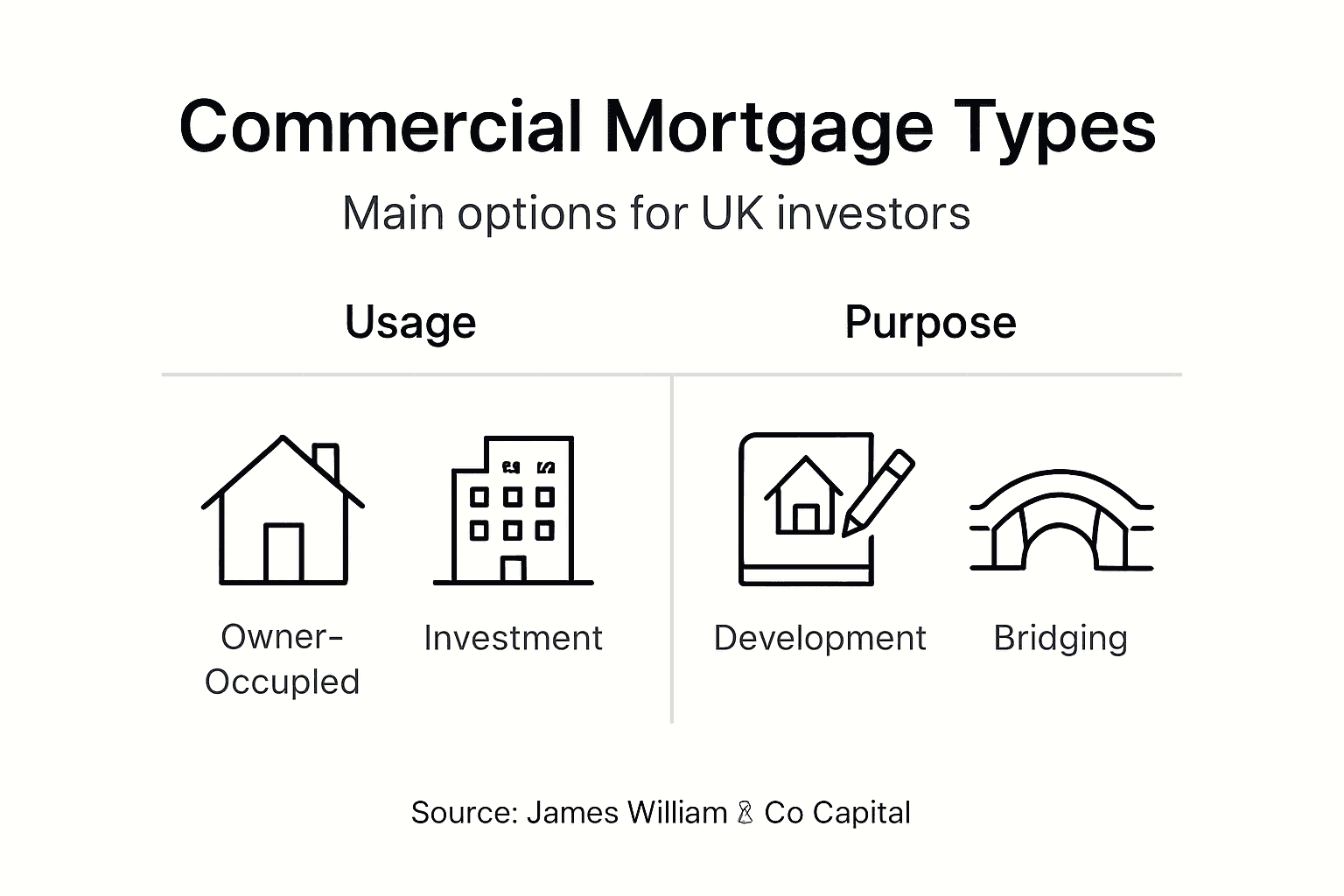
Owner-Occupied Commercial Mortgages
These mortgages finance property that you occupy for your own business operations. Your business occupies the building as its primary place of trade, reducing lender risk significantly.
Key features include:
- Lower interest rates compared to investment mortgages, reflecting reduced risk
- Stronger covenant packages based on your business’s operational performance
- Longer amortisation periods, often 15–25 years
- Better terms overall because lenders view owner-occupation as stable
A solicitor’s office occupying leasehold space or a manufacturer operating from a freehold factory both qualify as owner-occupied properties.
Investment Property Mortgages
These finance commercial properties you lease to tenants, generating rental income. The property’s cashflow supports repayment, not your business operations.
Lenders focus heavily on:
- Tenant quality and lease length (longer leases reduce risk)
- Rental income stability versus your debt service obligations
- Void periods and assumed occupancy rates
- Lease terms remaining at the point of valuation
Investment property mortgages prioritise cashflow coverage and tenant creditworthiness, shifting risk assessment from your business to the asset’s income generation.
Development Finance
Specialised lending supports property construction and refurbishment projects. These are short-term loans funding ground-up developments or major renovations, typically arranged in stages as construction progresses.
Structure typically involves:
- Drawdown tranches released against certified construction milestones
- Interest-only repayment during the building phase
- Exit at completion through refinancing into a standard mortgage
- Roll-over provisions if projects overrun timescales
Bridging Finance
Bridging loans provide short-term liquidity when you need funds quickly but permanent financing isn’t yet available. These typically last 6–18 months and carry higher interest rates reflecting their temporary nature.
Common applications:
- Purchasing before your current property sells
- Funding acquisition costs whilst securing development finance
- Bridging liquidity gaps between transactions
- Completing time-sensitive acquisitions
Within the broader spectrum of real estate debt structures available in the UK property market, bridging occupies a distinct position as a short-term tactical tool rather than permanent capital.
Comparing The Four Types
Each mortgage type serves different purposes in your investment portfolio. Owner-occupied mortgages suit business property purchases. Investment mortgages finance rental assets. Development finance builds new stock. Bridging solves timing mismatches.
Here is a concise comparison of commercial mortgage types in the UK for quick reference:
| Mortgage Type | Primary Purpose | Typical Term | Main Risk Factor |
|---|---|---|---|
| Owner-Occupied | Business operations | 15–25 years | Business performance |
| Investment Property | Rental income | 5–20 years | Tenant reliability, voids |
| Development Finance | Construction/refurb | Up to 36 months | Project completion, overruns |
| Bridging Finance | Short-term liquidity | 6–18 months | Market timing, exit delays |
Your exit strategy determines which product works best. If you’re holding for rental income, investment mortgages make sense. Building a new office block? Development finance followed by permanent refinancing. Purchasing before selling your current property? Bridging bridges that gap.
Pro tip: Structure your financing stack by working backwards from your exit—if you’re refinancing into permanent debt at completion, ensure development finance terms and conditions align with permanent lender requirements to avoid costly restructuring.
How Lenders Assess And Structure Deals
Commercial lenders don’t simply look at your credit score. They conduct multi-layered assessment of your business strength, the property’s worth, and whether the debt structure itself makes sense. This rigorous process protects their capital and determines your deal’s viability.
The Assessment Framework
Lenders evaluate three interconnected elements when reviewing your application:
- Borrower creditworthiness: Your trading history, accounts, cash flow, and management team
- Property fundamentals: Independent valuation, lease quality, tenant covenants, location risk
- Debt serviceability: Whether rental income or business profit comfortably covers interest and capital repayment
Each carries equal weight. A strong business backing a weak property won’t work. Equally, a prime asset behind an undercapitalised business raises red flags.
Loan-To-Value And Security
Loan-to-value (LTV) ratios determine how much lenders will advance against your property’s value. Commercial mortgages typically range from 50–75% LTV, depending on property type and your covenant strength.
The remaining 25–50% must come from your equity. This cushion protects the lender. If property values fall 20%, a 60% LTV loan still sits in a secure position, whereas a 90% LTV loan faces immediate negative equity.
Lenders require independent property valuations reflecting open market conditions. Valuers consider comparable transactions, rental multipliers, and sector-specific risk factors.
Understanding Covenants And Conditions
Commercial mortgages include financial covenants binding your behaviour. Common requirements include:
- Interest cover ratio: Your cashflow must exceed interest payments by a defined multiple (typically 1.35x–1.5x)
- Debt service coverage ratio: Total debt repayment (capital plus interest) shouldn’t exceed 75–85% of net cashflow
- Minimum cash balance: You maintain operational reserves specified by the lender
- Lease renewal obligations: For investment properties, leases must be actively renewed
Breaching covenants doesn’t immediately trigger default, but gives lenders grounds to enforce security. Most modern deals include cure periods and amendment flexibility.
This table summarises common lender covenants and their effect on commercial mortgage borrowers:
| Covenant Type | Typical Requirement | Impact On Borrower |
|---|---|---|
| Interest Cover Ratio | Cashflow ≥ 1.35x interest payments | Ensures debt remains affordable |
| Debt Service Ratio | Repayment ≤ 75–85% of net cashflow | Limits overleveraging |
| Minimum Cash Balance | Maintain specified operating reserves | Provides financial safety buffer |
| Lease Renewal | Active lease renewals at market rates | Protects stable income stream |
Interest Rate Structures
Commercial rates come in two flavours. Fixed rates lock your borrowing cost for an agreed period, typically 3–10 years. Variable rates track a benchmark (usually SONIA plus margin), fluctuating with market conditions.
Fixed rates provide certainty. Variable rates offer initial savings but carry refinancing risk. Most institutional investors split their portfolio—some fixed, some variable—to balance stability against rate opportunity.
Security And Default Provisions
Lenders take a legal charge over your property. If you default, they can appoint receivers under the Law of Property Act, ultimately forcing a sale to recover their advance.
This isn’t a casual arrangement. Modern lenders increasingly offer deal flexibility—temporary payment holidays, covenant adjustments, restructuring options—to preserve the borrower relationship and avoid costly enforcement.
Lenders structure deals assuming worst-case scenarios, which is why covenant packages feel stringent at origination but prove reasonable during market stress.
How Structuring Optimises Your Deal
The best deals aren’t about maximising advance—they’re about alignment. Structuring development finance correctly means matching funding tranches to construction milestones, ensuring your cashflow supports repayment throughout the project lifecycle.
Think of deal structure as your communications tool with lenders. Clear exit strategies, realistic timescales, and covenant packages reflecting actual business performance signal serious intent and professional management.
Pro tip: Present lenders with your proposed covenant package rather than accepting their standard terms—sophisticated borrowers negotiate covenants upfront, defining realistic hurdles that reflect your sector’s actual performance metrics and preserving flexibility for unexpected downturns.
Legal Framework And Borrower Obligations
Commercial mortgages operate within a robust legal framework that differs significantly from residential lending. Understanding your obligations under this framework is essential before signing any mortgage deed. The rules protect lenders, but also define your rights and responsibilities clearly.
The Legislative Foundation
Commercial mortgages in the UK are governed primarily by the Law of Property Act 1925, which establishes the legal mechanisms for security and enforcement. Unlike residential mortgages, commercial loans fall outside consumer credit protection, meaning fewer statutory safeguards apply.
The Financial Services and Markets Act 2023 modernises the regulatory framework, establishing capital requirements, conduct rules, and dispute resolution obligations for lenders offering commercial financing. This Act ensures financial institutions meet baseline standards, but the regulatory environment remains less prescriptive than residential lending.
Your Core Obligations
When you borrow on commercial security, you accept contractual responsibilities that extend beyond simply repaying the loan:
- Timely debt servicing: Interest and capital payments must be made on the dates specified, without exception
- Covenant compliance: You must maintain financial ratios, cash balances, and operational standards defined in your mortgage deed
- Property maintenance: You’re responsible for keeping the mortgaged property in good condition and adequately insured
- Information disclosure: You must provide lenders with regular financial statements, accounts, and updates on material changes
- Rental maximisation: For investment properties, you must actively let space and renew leases at market rates
The Lender’s Security Rights
Lenders take a legal charge over your property, giving them powerful enforcement rights if you breach obligations. Under the Law of Property Act, lenders can appoint receivers to take control of the property and generate income to service the debt.
Receiver powers are extensive. They can let the property, negotiate leases, collect rent, arrange repairs, and ultimately force a sale. The mortgage deed usually extends receiver powers beyond statutory minimums, strengthening the lender’s position significantly.
Commercial mortgage terms don’t include consumer safeguards like “afford to repay” tests or mandatory forbearance periods—enforcement is contractual and swift.
What Happens Upon Default
Default means breaching your mortgage obligations. It might be missing a payment, breaching a covenant, or failing to maintain insurance. Most mortgages include grace periods (typically 5–10 business days for payments), but intentional breaches trigger immediate enforcement rights.
Lenders typically:
- Issue formal notice requiring you to cure the default within a specified timeframe
- Appoint a receiver if breach persists, transferring control of the property
- Force a sale if receivership doesn’t generate sufficient cashflow for debt service
Unlike residential mortgages, lenders aren’t obligated to explore alternatives first. However, most sophisticated lenders negotiate restructuring before enforcement, preferring to preserve the borrower relationship.
Your Rights And Protections
Although commercial mortgages lack consumer protections, you retain contractual and common law rights. You can challenge enforcement actions in court if the lender acts unreasonably or breaches the mortgage deed terms.
You also have the right to refinance or sell the property to repay debt, subject to the lender’s consent (not to be unreasonably withheld, though the mortgage deed defines reasonableness).
Dispute Resolution And Legal Recourse
Most modern mortgage deeds include dispute resolution clauses requiring mediation or arbitration before litigation. These mechanisms reduce costs compared to High Court proceedings, though they’re still expensive relative to residential disputes.
If you believe a lender has acted outside their contractual powers, you retain the right to pursue claims through the courts or regulated complaint mechanisms, depending on the lender’s status.
Pro tip: Engage a specialist commercial property solicitor before signing your mortgage deed to negotiate bespoke terms and ensure enforcement provisions reflect market standards—many borrowers accept onerous terms without recognising negotiable elements that institutional lenders expect to discuss.
Risks And Common Mistakes To Avoid
Commercial mortgages carry real risks that can derail even well-planned investments. Understanding these pitfalls before committing capital helps you structure deals defensively and avoid costly mistakes. Most problems aren’t surprises—they’re predictable scenarios you can mitigate.
Interest Rate And Market Volatility
Rising interest rates squeeze your cashflow directly. A 2% rate increase on a £5 million facility costs an extra £100,000 annually. Over a 10-year mortgage, that’s material damage to your returns.
Property values fluctuate alongside economic cycles. If your property value falls 20% whilst you’ve borrowed at 70% LTV, you’re suddenly overleveraged. Refinancing becomes difficult or impossible.
Mitigation strategies include fixing rates for longer periods, stress-testing your projections at higher interest rates, and maintaining equity buffers above minimum LTV covenants.
Underestimating Repayment Obligations
Borrowers frequently miscalculate what their property must generate to service debt. Interest rate fluctuations and property market volatility create financial pressure that catches underprepared investors off-guard.
A rental property generating £500,000 annually sounds strong until you realise 30% goes to operating costs, leaving £350,000 for debt service on a £5 million mortgage requiring £375,000 annually. You’re underwater before the first payment.
Always calculate debt service coverage ratios conservatively—assume 85% occupancy for new lettings, not 95%, and allow generous contingencies for voids and bad debts.
Covenant Misunderstandings
Most borrowers don’t fully grasp their covenant obligations. You might breach covenants without missing a payment, triggering enforcement action.
Common covenant breaches include:
- Interest cover falling below 1.35x due to lower-than-expected cashflow
- Failing to maintain minimum cash reserves during refurbishment works
- Allowing leases to expire without renewal, reducing income security
- Letting occupancy fall below agreed thresholds through poor asset management
Read your mortgage deed covenant sections sentence-by-sentence. Understand what triggers breach and what cure periods you have.
Inadequate Due Diligence On Property Valuations
Valuers can differ significantly. A property valued at £10 million by one appraiser might fetch £8.5 million in an actual transaction. Lenders use their valuer’s assessment for LTV calculations, not yours.
Don’t accept valuations uncritically. Commission your own valuation. Challenge assumptions. Understand whether the valuer has assumed full occupancy or accounted for known void risks.
Lenders’ valuations reflect their risk appetite, not market reality—always conduct independent assessment before committing equity.
Poor Lender Communication
Failing to maintain adequate communication with lenders creates unnecessary friction. If you anticipate covenant pressure or cashflow tightness, tell your lender immediately.
Most lenders prefer early conversation to surprise covenant breaches. You might negotiate temporary amendments or restructuring rather than triggering enforcement.
Financial Planning Gaps
Borrowers often fail to account for market volatility in financial planning. You model your best-case scenario rather than stress-testing worst-case outcomes.
Build contingency into your projections:
- Model cashflow at 15% above interest rates you’re paying
- Assume 10% lower rental income than your lease offers
- Budget for 10% contingency on capital expenditure
- Maintain 6 months’ operating reserve beyond mortgage covenant requirements
Exit Strategy Weakness
Many deals assume you’ll refinance at completion or maturity. What if rates spike? What if property values fall? What if lenders tighten credit availability?
Design exit strategies with alternatives. If permanent refinancing isn’t available, could you sell the property? Could you reduce debt through operating cashflow? Could you extend bridging facilities?
Pro tip: Model three scenarios for every deal—base case, downside (rates up 2%, values down 15%), and stress case (rates up 3%, values down 25%)—then verify you can service debt and maintain covenants in the downside scenario before committing to the investment.
Unlock Expert Support for Your Commercial Mortgage Journey
Navigating the complexities of commercial mortgages in the UK demands specialist knowledge and tailored solutions. This article highlights challenges such as understanding different mortgage types, managing covenant obligations, and structuring deals that align with your exit strategy. If you are an investor or developer facing these hurdles, securing the right funding with flexible terms is critical for maximising returns and mitigating risk.
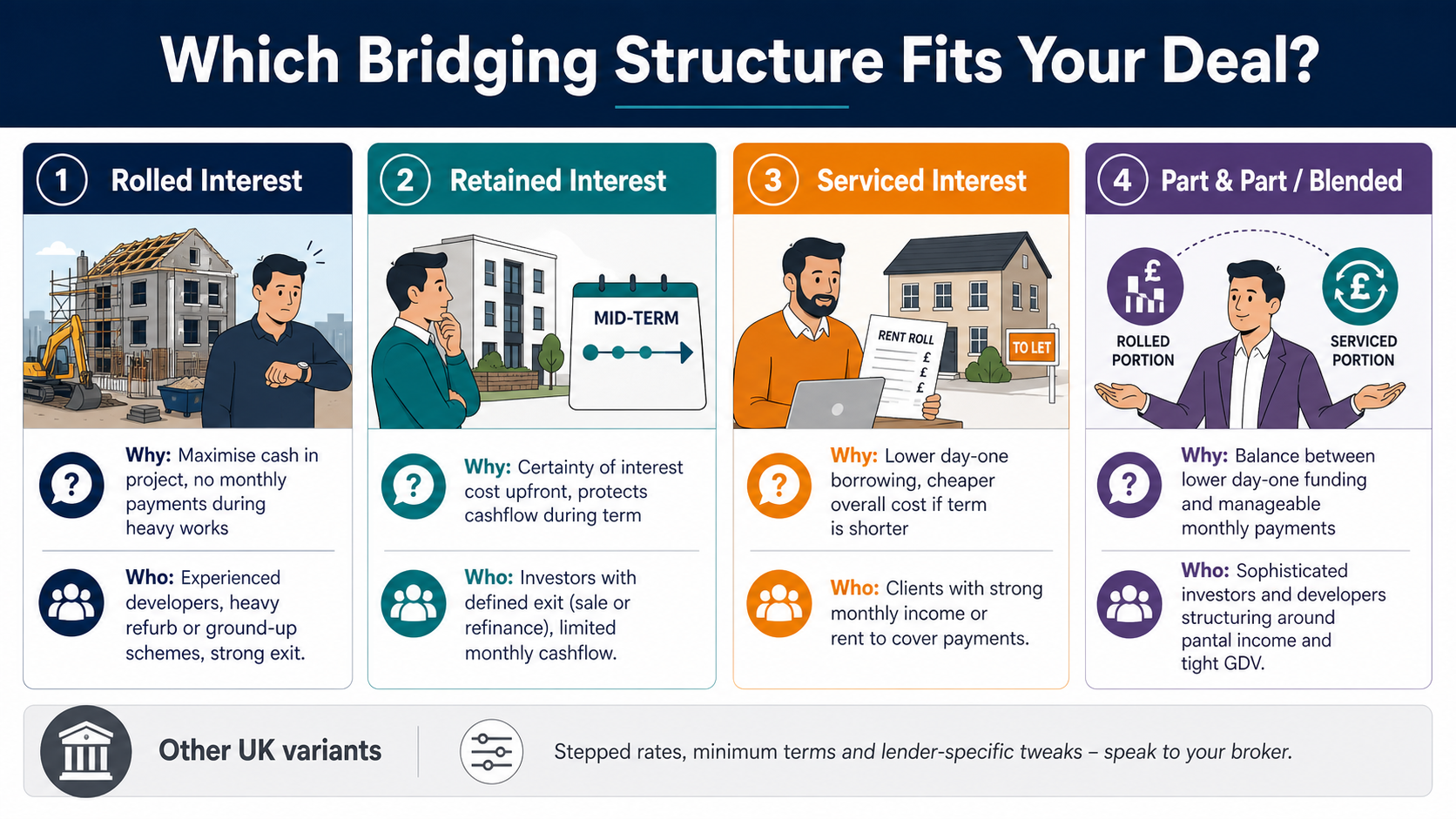
At James William & Co Capital, we act as your dedicated commercial mortgage and funding partner, offering bespoke debt structuring for large-scale acquisitions, developments, and complex refinances. Our deep expertise in bridging finance, development loans, and multi-layered debt stacks empowers you to tackle interest rate volatility, covenant requirements, and repayment pressures confidently. Don’t let financing complexities hold your UK property ambitions back. Explore how our capital concierge approach delivers rapid, tailored solutions by visiting James William & Co Capital today and secure the funding strategy that fits your unique investment goals.
Frequently Asked Questions
What is a commercial mortgage?
A commercial mortgage is a loan secured against property used for business purposes, financing assets such as office buildings, retail units, and industrial warehouses, rather than family homes.
How do commercial mortgages differ from residential mortgages?
Commercial mortgages differ primarily in underwriting criteria, loan terms, interest rates, and loan-to-value ratios. Lenders assess the business’s financial performance and property income potential rather than just personal credit scores.
What types of commercial mortgages are available?
There are several types of commercial mortgages, including owner-occupied mortgages, investment property mortgages, development finance, and bridging finance, each serving different investment needs and purposes.
What factors do lenders consider when assessing a commercial mortgage application?
Lenders typically evaluate the business’s financial health, property assessment, and the proposed loan structure, including equity contribution and exit strategy.
Recommended
Related Topics
Speak to a specialist
Discuss your finance with James directly
Whole-of-market specialist finance — bridging, development, commercial and residential. No call centres, no obligation. James reviews every enquiry personally.
New to specialist finance? How unbiased broker advice works · Deals we have completed
Explore Related Finance