
Published · Updated
role of due diligence in fundingDue Diligence in UK Property Funding: What Lenders Check
By James Dawes, CeMAP, Founder, James William & Co Capital

Many developers assume securing funding for a UK property project hinges primarily on personal creditworthiness or the strength of collateral. Whilst these factors matter, they represent only a fraction of what lenders scrutinise. Comprehensive due diligence examines financial viability, legal compliance, operational capacity and regulatory alignment. Without this rigorous process, both funders and developers expose themselves to avoidable risks that can derail projects or trigger catastrophic losses. This article explores the types of due diligence essential for UK property funding, their tangible benefits and how to apply them effectively across every capital layer.
Table of Contents
- Why Due Diligence Is Indispensable In UK Property Development Funding
- Structuring The Capital Stack And The Role Of Due Diligence In Each Layer
- Operational And Regulatory Due Diligence: Protecting Investors Beyond Numbers
- Applying Due Diligence For Successful Project Viability And Deliverability
- How James William & Co Capital Supports Due Diligence In Property Finance
- Frequently Asked Questions About Due Diligence In Funding
Key takeaways
| Point | Details |
|---|---|
| Risk reduction | Proper due diligence cuts loan default rates by significant margins, protecting capital |
| Capital stack assessment | Each funding layer demands tailored scrutiny to match its risk profile |
| Operational safeguards | Non-financial checks shield institutional investors from management and process failures |
| Regulatory evolution | Recent enforcement actions highlight the cost of inadequate due diligence |
| Viability focus | Realistic project assessments ensure plans remain deliverable within policy frameworks |
Why due diligence is indispensable in UK property development funding
Due diligence in property development finance encompasses four core pillars: financial analysis, legal review, operational assessment and viability testing. Financial due diligence scrutinises borrower balance sheets, cash flow projections and debt service coverage ratios. Legal checks verify title, planning permissions, contracts and compliance with building regulations. Operational assessments evaluate the developer’s track record, governance structures and project management capabilities. Viability testing ensures the scheme can deliver required affordable housing, infrastructure contributions and market returns simultaneously.
Rigorous due diligence reduces loan default risk substantially, creating tangible value for both funders and developers. Lenders avoid exposure to unviable schemes, whilst developers benefit from faster approvals and more competitive pricing when their projects withstand scrutiny. Conversely, inadequate checks have triggered spectacular failures. When lenders rely solely on property valuations or cursory credit reports, they miss critical warning signs such as overstated rental forecasts, planning delays or weak contractor performance histories.
Consider the consequences when due diligence falters. Projects stall mid-construction when developers lack sufficient working capital reserves, a risk that proper cash flow modelling would have flagged early. Planning appeals drag on for years because viability assessments failed to account for evolving affordable housing policies. Contractors abandon sites when payment terms prove unsustainable, a scenario robust operational checks would have prevented. Each failure imposes costs on multiple stakeholders and erodes confidence in the wider market.
“Comprehensive due diligence protects against the unforeseen risks that simple credit checks cannot capture, ensuring funding decisions rest on complete information rather than assumptions.”
The scope of due diligence extends beyond tick-box compliance. Effective assessments challenge assumptions, stress-test projections and identify contingencies. They examine whether the developer has secured all necessary consents, whether the construction programme allows adequate float for delays and whether exit strategies remain viable under adverse market conditions. This depth of scrutiny separates successful funding relationships from those that end in disputes or write-offs. For high-value development schemes, the upfront investment in thorough due diligence delivers returns many times over by preventing costly mistakes downstream. Understanding why use development finance uk helps contextualise these protective measures within the broader funding landscape.
- Financial checks verify borrower creditworthiness, project budgets and debt service capacity
- Legal reviews confirm clean title, valid permissions and enforceable contracts
- Operational assessments evaluate management competence and governance quality
- Viability testing ensures schemes meet policy requirements without undermining returns
Structuring the capital stack and the role of due diligence in each layer
UK property development capital stacks typically comprise three distinct layers, each carrying different risk profiles and requiring tailored due diligence. Senior debt covers 60-70% of total project costs and sits at the bottom of the stack with first charge security. Mezzanine finance contributes 10-20%, ranking behind senior debt but ahead of equity. Developer equity accounts for 10-20%, absorbing first losses and aligning developer interests with project success. As you ascend the stack, both risk and cost of capital increase, demanding progressively deeper scrutiny.
Senior lenders focus due diligence on borrower creditworthiness, security valuation and debt service coverage. They verify the developer’s financial strength through audited accounts, tax returns and bank references. Property valuations by RICS-registered surveyors confirm that loan-to-value ratios remain conservative. Cash flow models demonstrate that projected revenues can service interest payments and principal repayments comfortably, even under stress scenarios. Because senior debt enjoys priority in any enforcement, lenders can accept narrower margins provided core fundamentals remain sound.

Mezzanine providers and preferred equity investors conduct more granular operational and viability checks. They examine the developer’s project delivery history, assessing completion rates, cost control performance and dispute resolution track records. Planning viability assessments receive intense scrutiny because mezzanine returns depend on residual value after senior debt repayment. These investors probe whether affordable housing obligations, Section 106 contributions and construction cost inflation leave sufficient margin for their target returns. They also evaluate exit strategies, confirming that sales rates, rental yields or refinancing prospects justify the higher pricing they charge for subordinated positions.
| Capital layer | Typical proportion | Primary due diligence focus | Risk profile |
|---|---|---|---|
| Senior debt | 60-70% | Borrower credit, security value, debt service | Lowest risk, first charge |
| Mezzanine finance | 10-20% | Project viability, operational capacity, exit strategy | Medium risk, subordinated |
| Developer equity | 10-20% | Skin in game, alignment of interests | Highest risk, first loss |
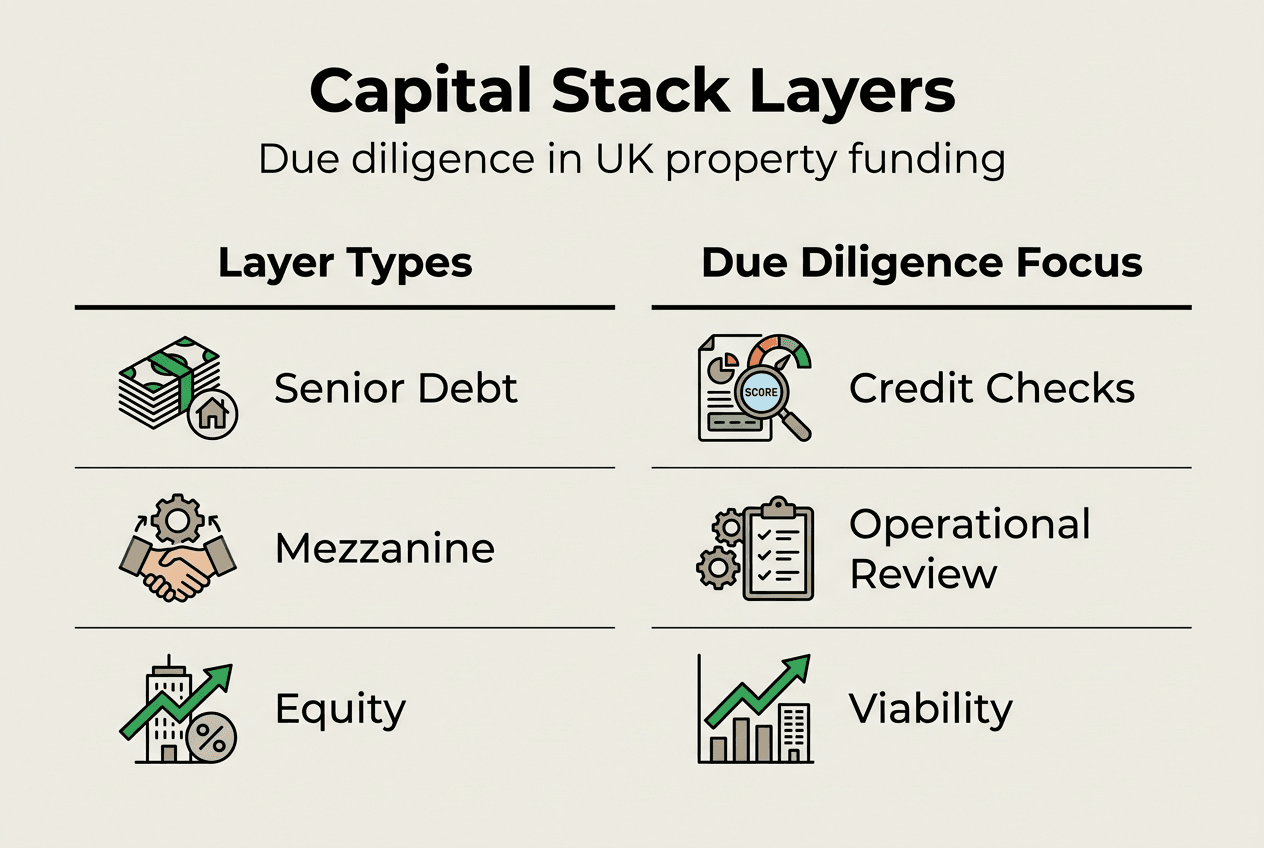
Effective capital stack structuring depends on aligning due diligence intensity with each layer’s risk exposure. Senior lenders may accept lighter operational checks because their downside protection comes from conservative loan-to-value ratios and first charge security. Mezzanine investors cannot rely on the same cushion, so they demand evidence that the developer can execute complex schemes on time and on budget. Equity participants scrutinise everything because their returns materialise only after all debt obligations are satisfied. Understanding how to structure development finance uk reveals how these layers interact in practice.
Pro Tip: Coordinate due diligence assessments across all capital providers early in the funding process. When senior lenders, mezzanine investors and equity partners share information and align their requirements, you avoid duplicative requests and accelerate approvals. This collaborative approach also surfaces potential conflicts before they derail negotiations, allowing you to address concerns whilst terms remain flexible. Exploring how to optimise real estate funding uk offers further strategies for streamlining multi-layered financing structures.
- Senior debt prioritises security value and borrower credit strength
- Mezzanine finance demands robust viability assessments and operational track records
- Developer equity aligns interests but requires evidence of project execution capability
- Coordinating due diligence across layers prevents delays and identifies conflicts early
Operational and regulatory due diligence: protecting investors beyond numbers
Operational due diligence examines the systems, processes and governance frameworks that determine whether a developer can deliver on financial projections. Whilst financial metrics reveal what a project should achieve, operational risk assessment evaluates whether the organisation possesses the capacity to execute. Institutional investors increasingly recognise that management failures, weak internal controls or inadequate compliance programmes can destroy value just as surely as adverse market movements.
Recent regulatory developments underscore this imperative. UK authorities have tightened oversight of loan notes and mini-bonds marketed to retail investors, responding to high-profile collapses where inadequate due diligence allowed unsuitable products to reach vulnerable savers. These enforcement actions signal that regulators expect robust checks before capital deployment, particularly when retail money enters opaque structures. For professional investors and developers, the message is clear: operational scrutiny protects reputations and preserves access to future funding.
The Godwin Capital case illustrates the catastrophic consequences of due diligence failures. Investor losses reached £157 million when operational weaknesses and governance lapses went undetected. Retail investors who trusted surface-level assurances discovered too late that underlying projects lacked viable business plans, proper financial controls or competent management. The collapse triggered regulatory investigations, reputational damage across the sector and lasting harm to investor confidence. Robust operational due diligence would have identified these red flags before capital commitments became irrevocable.
Effective operational checks probe multiple dimensions. They assess whether the developer maintains adequate financial reporting systems, segregates client funds appropriately and carries sufficient professional indemnity insurance. They verify that key personnel hold relevant qualifications and experience for the proposed scheme’s complexity. They examine whether the organisation has documented policies for risk management, health and safety compliance and stakeholder communication. They also evaluate whether governance structures provide independent oversight and challenge to executive decisions.
“Operational due diligence transforms abstract risk assessments into concrete evaluations of whether an organisation can deliver on its commitments, protecting investors from non-financial failures that financial models cannot predict.”
Transparency and compliance form the foundation of investor protection. Developers who maintain clear audit trails, publish regular performance reports and engage proactively with regulatory requirements signal their commitment to sound governance. Conversely, organisations that resist scrutiny, provide incomplete disclosures or dismiss compliance as bureaucratic burden raise immediate concerns. For institutional investors deploying substantial capital, these signals often matter more than marginal differences in projected returns. Learning about real estate funding sources uk developers guide helps contextualise these operational considerations within the broader funding ecosystem.
- Operational checks assess management capability, systems quality and governance strength
- Regulatory tightening follows high-profile failures where due diligence proved inadequate
- Godwin Capital’s collapse cost investors £157 million and damaged sector confidence
- Transparency and compliance signal organisational quality to sophisticated investors
Applying due diligence for successful project viability and deliverability
Viability assessments sit at the heart of effective due diligence, determining whether development schemes can satisfy policy requirements whilst delivering acceptable returns. The UK government guidance emphasises that cumulative policy costs must not undermine deliverability, creating a delicate balance between affordable housing obligations, infrastructure contributions and developer profit margins. Rigorous viability testing ensures this balance holds under realistic assumptions rather than optimistic projections.
A robust viability assessment follows a structured process. First, establish the development’s gross development value by analysing comparable sales evidence, rental yields and market absorption rates. Second, calculate total development costs including land acquisition, construction, professional fees, finance charges and contingencies. Third, deduct policy costs such as affordable housing provision, Section 106 agreements and Community Infrastructure Levy payments. Fourth, subtract these cumulative costs from gross development value to determine residual land value and developer profit. Finally, stress-test these calculations under adverse scenarios including cost inflation, sales delays and interest rate rises.
| Assessment stage | Key considerations | Common pitfalls |
|---|---|---|
| Gross development value | Comparable evidence, absorption rates, market cycles | Overoptimistic pricing, ignoring competition |
| Development costs | Construction rates, professional fees, contingencies | Underestimating inflation, inadequate float |
| Policy obligations | Affordable housing, infrastructure, sustainability | Failing to account for evolving requirements |
| Residual analysis | Land value, developer profit, stress testing | Optimistic assumptions, insufficient sensitivity |
Affordable housing requirements and infrastructure needs significantly impact viability outcomes. Local planning authorities increasingly demand higher affordable housing percentages, often 35% to 50% of total units, whilst simultaneously requiring contributions towards schools, transport and green spaces. Developers must demonstrate that these obligations remain deliverable without rendering schemes unviable. This requires transparent cost modelling, realistic revenue assumptions and constructive negotiation with planners. When viability assessments rest on solid evidence rather than wishful thinking, they facilitate faster planning approvals and smoother funding negotiations.
Pro Tip: Engage lenders and planning officers early in the viability assessment process, sharing draft models and inviting feedback before formal submissions. This collaborative approach identifies potential concerns whilst you retain flexibility to adjust schemes or negotiate terms. Early engagement also builds trust with stakeholders, demonstrating your commitment to transparency and deliverability. When funders see that your viability assumptions align with their own risk appetites, they price deals more competitively and approve funding faster. Reviewing property development funding tips uk developers provides additional strategies for optimising funding outcomes.
- Gather robust market evidence for revenue assumptions, using multiple comparable sources
- Build detailed cost models with line-by-line breakdowns and realistic contingencies
- Account for all policy obligations including affordable housing and infrastructure contributions
- Stress-test assumptions under adverse scenarios to confirm viability margins
- Engage lenders and planners early to align expectations and accelerate approvals
- Update assessments regularly as market conditions and policy requirements evolve
Realistic assumptions for costs, timelines and market conditions separate viable schemes from those destined for trouble. Construction cost inflation, labour shortages and supply chain disruptions have intensified since 2020, making historical cost benchmarks unreliable. Sales rates depend on mortgage availability, buyer confidence and local employment trends, all of which fluctuate unpredictably. Interest rate movements directly impact finance costs and buyer affordability simultaneously. Viability assessments that acknowledge these uncertainties and build appropriate buffers prove far more valuable than optimistic projections that ignore inconvenient realities.
How James William & Co Capital supports due diligence in property finance
Navigating the complexities of due diligence across multiple capital layers demands specialist expertise and established lender relationships. James William & Co Capital brings both to the table, acting as a debt structuring partner for UK property developers and institutional investors pursuing sophisticated funding solutions. Our capital concierge approach provides a single point of contact for end-to-end structuring, negotiation and execution, streamlining the due diligence process whilst ensuring all stakeholder requirements are satisfied.
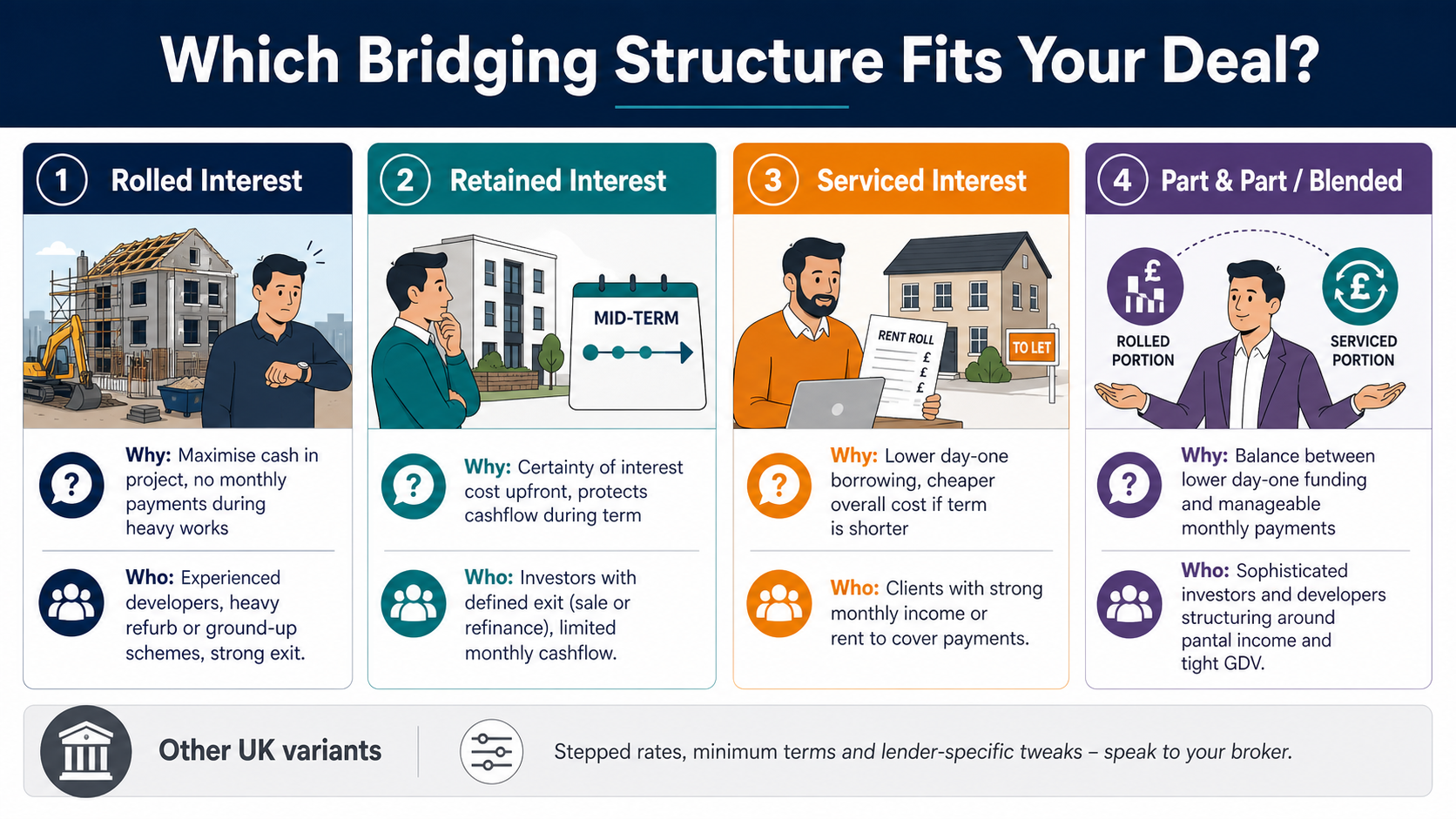
We arrange specialist property finance for large-scale acquisitions, ground-up developments and complex refinances, structuring bridging and development finance, commercial mortgages, mezzanine debt and JV equity. Our network of family offices, private credit funds and specialist lenders enables rapid deployment of tailored solutions, with testimonials highlighting our ability to execute under pressure. Explore our property finance services or review property finance case studies to see how rigorous due diligence supports successful outcomes for high-value real estate transactions.
Frequently asked questions about due diligence in funding
What are the main types of due diligence required for UK property development funding?
UK property development funding demands financial, legal, operational and viability due diligence. Financial checks verify borrower creditworthiness and project cash flows. Legal reviews confirm title, permissions and contracts. Operational assessments evaluate management capability and governance. Viability testing ensures schemes meet policy requirements whilst delivering acceptable returns.
How can investors verify the credibility of funding partners?
Investors should examine the funding partner’s track record, regulatory status and references from previous clients. Request audited accounts, professional indemnity insurance certificates and evidence of successful project completions. Verify memberships in professional bodies such as RICS or the Association of Short Term Lenders. Independent operational due diligence by specialist advisers provides additional assurance.
What lessons does the Godwin Capital collapse offer for due diligence?
The Godwin Capital failure demonstrates that superficial checks cannot substitute for rigorous operational and financial scrutiny. Investors must verify that underlying projects have viable business plans, competent management and proper financial controls. Retail investors particularly need independent advice before committing to complex structures. Regulatory oversight alone cannot prevent losses when due diligence proves inadequate.
How frequently should due diligence be updated during a project?
Due diligence should be refreshed at key milestones including planning approvals, construction commencement, practical completion and sales launches. Market conditions, policy requirements and project performance evolve continuously, making initial assessments obsolete. Quarterly reviews of financial performance, cost forecasts and sales progress allow early identification of emerging risks. Major changes such as contractor replacements or scope variations trigger immediate reassessment.
Can due diligence reduce the cost of capital in development deals?
Comprehensive due diligence demonstrably reduces funding costs by giving lenders confidence in project viability and developer capability. When assessments reveal robust financials, experienced management and realistic assumptions, lenders price deals more competitively. Transparent disclosure and proactive risk mitigation signal quality, allowing developers to negotiate better terms. The upfront investment in thorough due diligence typically delivers returns through lower interest rates and faster approvals.
Why do mezzanine lenders require more detailed operational checks than senior debt providers?
Mezzanine lenders occupy a subordinated position in the capital stack, meaning they absorb losses before senior debt holders but after equity. This intermediate risk profile demands deeper scrutiny of operational capability because mezzanine returns depend on successful project execution and residual value after senior debt repayment. Without the security cushion that senior lenders enjoy, mezzanine providers must verify that developers can deliver complex schemes on time and on budget.
Recommended
- James William & Co Capital | Specialist Property Finance
- James William & Co Capital | Specialist Property Finance
- James William & Co Capital | Specialist Property Finance
- James William & Co Capital | Specialist Property Finance
- Mortgage Regulation – Ensuring Safe Property Investments
- Role of Drainage Inspections in London: Cut Risks by 60%
Related Topics
Speak to a specialist
Discuss your finance with James directly
Whole-of-market specialist finance — bridging, development, commercial and residential. No call centres, no obligation. James reviews every enquiry personally.
New to specialist finance? How unbiased broker advice works · Deals we have completed
Explore Related Finance