
Published · Updated
explaining alternative lendingExplaining alternative lending for property developers
By James Dawes, CeMAP, Founder, James William & Co Capital

TL;DR:
- Alternative lending offers UK property developers faster, asset-focused capital from non-bank sources due to stricter bank regulations. It emphasizes rapid decision-making with lighter documentation, though often at a higher total cost, requiring careful modeling and thorough preparation. Successful use depends on early documentation, clear exit strategies, and strong lender relationships, integrating these funds as a permanent part of capital planning.
Alternative lending is defined as financing provided by sources outside traditional banks and building societies, including fintechs, private credit funds, and specialist property lenders. For UK property developers and real estate investors, understanding alternative loans is no longer optional. Regulatory tightening by the Prudential Regulation Authority and the FCA has made high-street bank lending slower and more restrictive, pushing serious developers toward non-bank capital. Shopify’s 2026 overview defines alternative lending as non-bank financing designed for borrowers who need quick funds or cannot meet traditional underwriting criteria. The result is a market where speed, flexibility, and deal-specific structuring matter far more than a clean payslip.
How does alternative lending work compared to traditional bank financing?
Traditional bank loans require extensive documentation, formal credit committee sign-off, and underwriting processes that routinely take 60 to 90 days on commercial transactions. Alternative lenders operate differently. They use digital platforms, lighter documentation requirements, and automated underwriting to compress decision timelines dramatically. Some alternative lenders can approve and fund within a single business day through fully digital onboarding. That speed is not a sign of lower standards. It reflects a different underwriting philosophy, one that prioritises asset quality and cash flow over personal financial history.

The trade-off is cost. Alternative lending products typically carry higher headline rates than equivalent bank products, and fees compound the difference. Origination fees, arrangement fees, and exit charges all increase the effective cost of capital beyond the advertised rate. For a developer acquiring a site on a tight timeline, that premium is often worth paying. For a long-term hold, it demands careful modelling.
Pro Tip: Always model the total cost of capital over the actual loan term, not just the headline rate. A 9% bridge loan held for six months costs less in absolute terms than a 6% bank loan with a 12-month minimum commitment and heavy early repayment charges.
The key practical difference between bank and alternative finance is where the underwriting emphasis falls. Banks assess the borrower. Alternative lenders, particularly in property, assess the asset and the deal. That shift opens doors for experienced developers who hold assets in SPVs, operate through offshore structures, or have complex income profiles that do not fit a standard affordability model.
What are the main types of alternative lending for property developers?
The types of alternative lending most relevant to UK property developers and investors fall into several distinct categories, each suited to different deal structures and timescales.
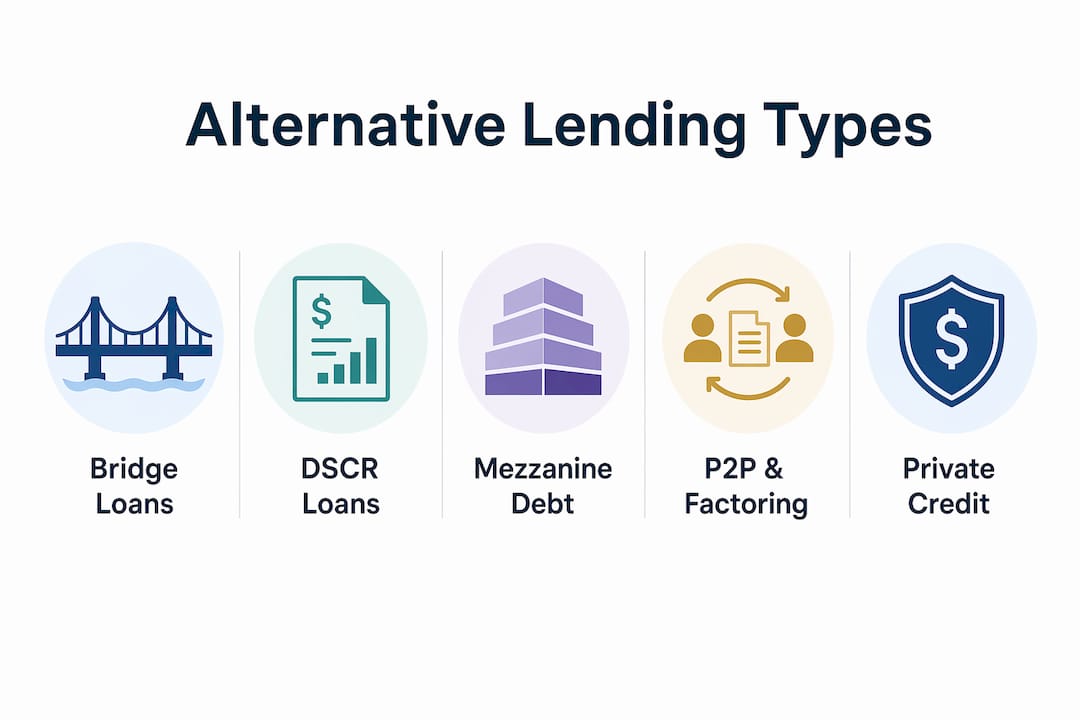
Bridge loans provide short-term secured finance, typically 3 to 24 months, used for acquisitions, refurbishments, or to unlock equity before longer-term refinancing. Bridge loans commonly close within 2 to 4 weeks, compared to 60 to 90 days for traditional commercial loans, provided borrowers arrive with deal-ready documentation. LTV caps for bridge loans in 2026 sit at 65% to 75% of as-is value, with riskier assets or first-time borrowers seeing lower caps of 60% to 65%.
DSCR loans (Debt Service Coverage Ratio loans) are underwritten on the rental income generated by the property rather than the borrower’s personal income. No P60s, no tax returns, no employment verification. These are covered in detail in the next section.
Mezzanine debt sits between senior debt and equity in the capital stack, typically used to stretch total leverage on development projects beyond what a senior lender will provide alone.
Peer-to-peer lending platforms and invoice factoring are more common in SME finance than in property, but they appear in working capital structures for development businesses.
| Product | Typical use | Loan term | Key advantage | Key risk |
|---|---|---|---|---|
| Bridge loan | Acquisition, refurb, equity release | 3 to 24 months | Speed of execution | Short term requires clear exit |
| DSCR loan | Buy-to-let, HMO, portfolio refinance | 5 to 30 years | No personal income check | Rate premium over bank products |
| Mezzanine debt | Ground-up development top-up | 12 to 36 months | Stretches total leverage | Expensive; subordinated position |
| Development finance | Ground-up construction | 12 to 36 months | Drawn down in stages | Monitored drawdowns add complexity |
For developers running multiple projects simultaneously, the ability to access real estate funding sources across this full spectrum is what separates a scalable business from a single-deal operation.
How do DSCR loans work and why are they popular with investors?
DSCR loans qualify borrowers based on whether the property’s rental income covers the debt service, typically requiring a DSCR of 1.20 or above. DSCR underwriting focuses on property cash flow rather than personal income, removing the need for W-2s, tax returns, or employment verification that conventional lenders require. For UK investors holding properties in limited companies or with complex self-employed income, this is a significant structural advantage.
The DSCR metric itself is calculated by dividing net operating income by total debt service. A property generating £60,000 per year in net rental income against £48,000 in annual mortgage payments has a DSCR of 1.25, which clears most lender thresholds. Lenders care about this ratio because it directly measures whether the asset pays for itself, independent of the borrower’s other financial activity.
The typical DSCR loan closing timeline runs 18 to 25 business days, with the main variable being borrower preparation rather than lender processing speed. Developers who order appraisals early and keep title and insurance clean routinely close in 15 to 21 days. Those who wait on appraisals or have title complications stretch to 30 to 45 days or beyond.
To close a DSCR loan efficiently, follow this sequence:
- Confirm the property’s current rent roll and ensure all leases are signed and up to date before approaching a lender.
- Order the appraisal on day one of the application process. Appraisal delays are the single most common cause of extended timelines.
- Prepare your entity documents upfront: certificate of incorporation, operating agreement, and any relevant LLC or SPV documentation.
- Arrange buildings insurance and confirm title is free of encumbrances before submission.
- Lock your rate as soon as it is offered. Rate lock windows are finite, and delays in locking expose you to market movement.
- Respond to all lender conditions within 24 hours. Borrower responsiveness is the primary driver of fast closings.
Pro Tip: If you are refinancing a portfolio, stagger your appraisal orders across properties by a week each. Simultaneous appraisals on multiple assets create bottlenecks with valuation firms and slow every loan in the stack.
What are the key costs and risks of alternative lending?
The headline interest rate on an alternative loan is rarely the full story. Origination fees alone can range from 0.5% to 6% of the loan amount, and when combined with arrangement fees, legal costs, and exit fees, the effective annual cost can sit 2% to 8% above the nominal rate. That gap matters enormously on large transactions. On a £2 million bridge loan, a 2% origination fee is £40,000 paid upfront before a single month of interest accrues.
The risks specific to alternative lending in property finance include:
- Short loan terms requiring a clear and credible exit strategy. A bridge loan without a confirmed refinance route or sale timeline is a liability, not an asset.
- Rate variability on some products, particularly those linked to SONIA or base rate, which can increase debt service costs mid-project.
- Refinancing risk when market conditions shift between drawdown and the planned exit date, leaving borrowers unable to refinance on acceptable terms.
- Fee stacking across multi-layered debt structures, where mezzanine and senior debt fees compound into a total cost that erodes project returns.
Comparing alternative lending costs requires normalising all fees into an effective annual rate. A loan with a 7% headline rate and 2% origination fee over a six-month term has an effective annualised cost materially higher than 9%. Most developers underestimate this until they run the numbers properly.
How to prepare for securing alternative finance efficiently
Preparation is the single variable most within a developer’s control when accessing alternative lending. Lenders make faster decisions when borrowers arrive organised. The following steps apply whether you are approaching a bridge lender, a DSCR provider, or a development finance house.
- Assemble your full documentation pack before making any approach: loan application, entity documents, property details, current leases, insurance certificates, and a clear statement of the exit strategy.
- Have a credible business plan ready for bridge and development finance applications. Bridge loan underwriting places significant weight on stabilised net operating income projections and the credibility of the borrower’s plan.
- Know your numbers. Arrive with a clear LTV calculation, projected DSCR, and total cost of capital modelled across the loan term.
- Work with a specialist broker who has direct relationships with the lenders relevant to your deal type. Access to property finance trends and lender appetite in real time is worth more than any rate comparison website.
- Move quickly once terms are agreed. Delays between heads of terms and formal application give lenders reason to reprice or withdraw.
Pro Tip: Keep a standing data room for your business: entity documents, accounts, and insurance certificates updated quarterly. When a deal moves fast, the difference between winning and losing the transaction is often how quickly you can send a complete pack.
Key takeaways
Alternative lending gives property developers and investors access to faster, more flexible capital by shifting underwriting emphasis from personal income to asset quality and cash flow.
| Point | Details |
|---|---|
| Alternative lending defined | Non-bank financing from fintechs, private credit funds, and specialist lenders focused on asset quality. |
| Speed advantage | Bridge loans close in 2 to 4 weeks; DSCR loans in 18 to 25 days with full borrower preparation. |
| DSCR underwriting | Rental income covers debt service; no personal income documents required, ideal for SPV structures. |
| True cost of capital | Origination fees of 0.5% to 6% increase effective APR by 2% to 8% above headline rates. |
| Preparation drives speed | Complete documentation, early appraisals, and 24-hour condition responses are the fastest route to close. |
Why alternative lending is reshaping UK property finance
I have structured deals across the full spectrum of UK property finance for over a decade, and the shift I have seen in the last three years is not incremental. It is structural. The PRA and FCA have tightened bank mortgage policy in ways that make high-street lenders genuinely unsuitable for most development transactions above a certain complexity threshold. That is not a criticism of the banks. It is simply a recognition that their risk appetite and their regulatory constraints no longer align with the pace at which serious developers need to move.
What I find most misunderstood about alternative lending is the assumption that speed implies risk. The opposite is often true. A specialist lender who underwrites on asset cash flow and has deep sector knowledge will frequently make a better-informed decision faster than a bank credit committee reviewing a deal type they see once a quarter. DSCR lenders, in particular, have built underwriting models that are more granular on rental income stress-testing than most high-street products I have seen.
The developers who use alternative finance most effectively treat it as a permanent part of their capital toolkit, not a fallback when the bank says no. They know which lender suits which deal type, they maintain relationships before they need them, and they arrive prepared. The ones who struggle are those who approach alternative lenders at the last minute with incomplete information and expect the speed advantage to compensate for their lack of preparation. It does not work that way.
My advice: optimise your funding approach before you need it, not during a live transaction under time pressure.
— James
How James William & Co structures alternative finance for UK developers
James William & Co Capital works with UK property developers and investors who need more than a rate comparison. The firm structures bridging finance, DSCR lending, mezzanine debt, and development finance across complex transactions involving SPVs, offshore vehicles, and multi-layered debt stacks. The approach is direct: one point of contact, lender relationships built over years, and execution at the speed the market demands.
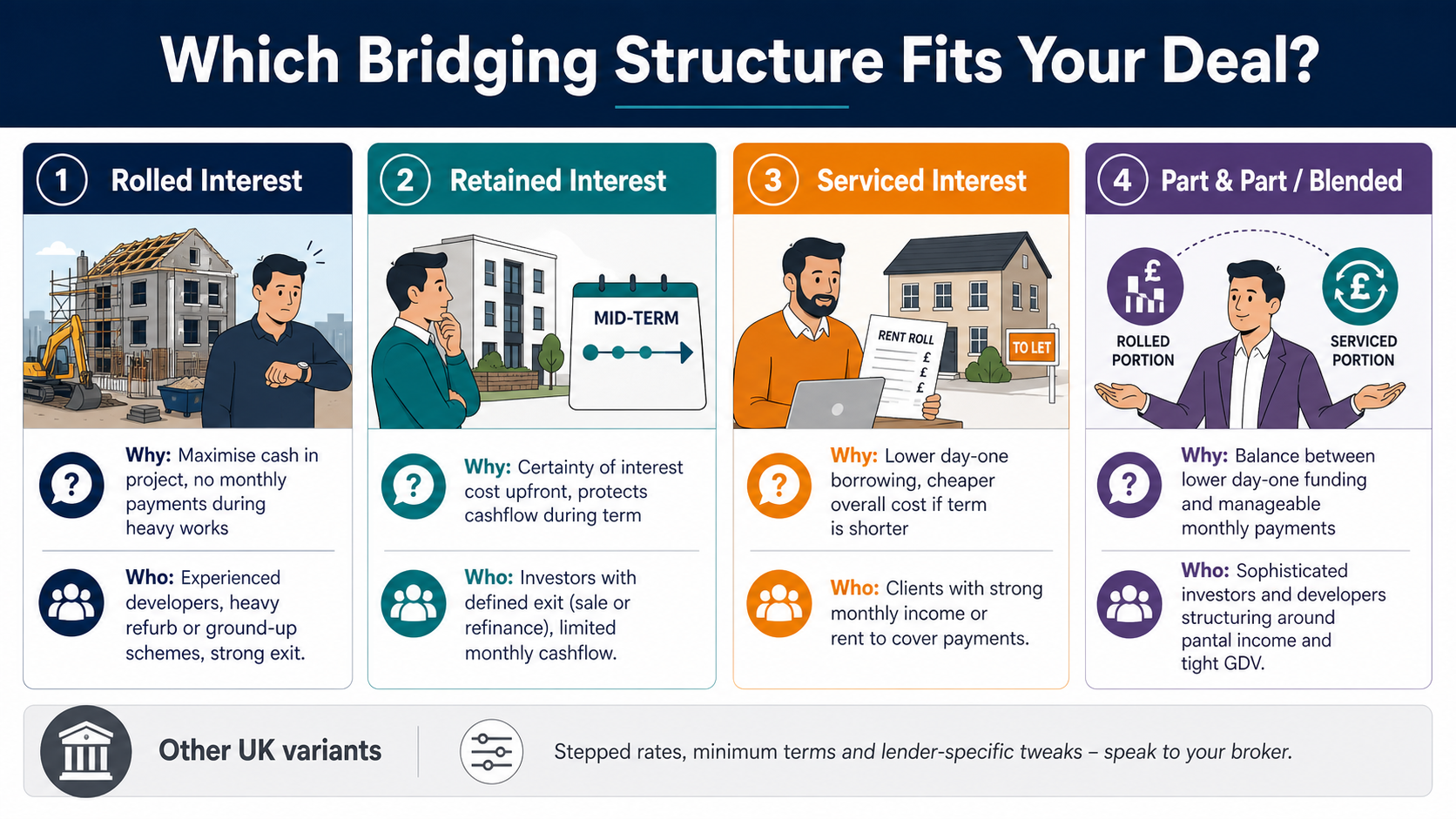
Whether you are acquiring a site on a short fuse, refinancing a portfolio into a more tax-efficient structure, or funding a ground-up scheme, James William & Co brings the right capital to the right deal. For developers and investors based in or operating across London, the firm’s specialist property finance team is available to structure and execute from day one.
FAQ
What is alternative lending in property finance?
Alternative lending refers to financing from non-bank sources such as private credit funds, fintechs, and specialist property lenders. It is designed for borrowers who need faster access to capital or whose financial profiles do not fit standard bank underwriting criteria.
How does a DSCR loan differ from a standard buy-to-let mortgage?
A DSCR loan is underwritten on the property’s rental income relative to its debt service, with no requirement for personal income documents such as tax returns or payslips. A standard buy-to-let mortgage typically requires personal income verification alongside rental income assessment.
How quickly can a bridge loan close in 2026?
Bridge loans can close in 2 to 4 weeks when borrowers arrive with complete documentation and a credible exit strategy. Traditional commercial loans from banks typically take 60 to 90 days for the same transaction.
What fees should I expect on an alternative loan?
Origination fees typically range from 0.5% to 6% of the loan amount, and when combined with arrangement, legal, and exit fees, the effective annual cost can be 2% to 8% above the headline interest rate. Always model total cost normalised over the actual loan term.
Is alternative lending regulated in the UK?
Some alternative lending products, particularly those secured against residential property, fall under FCA regulation. Commercial and development finance products are generally unregulated, which means borrowers carry greater responsibility for assessing terms and suitability independently.
Recommended
Related Topics
Speak to a specialist
Discuss your finance with James directly
Whole-of-market specialist finance — bridging, development, commercial and residential. No call centres, no obligation. James reviews every enquiry personally.
New to specialist finance? How unbiased broker advice works · Deals we have completed
Explore Related Finance