
Published · Updated
explaining loan syndicatesExplaining loan syndicates for property developers
By James Dawes, CeMAP, Founder, James William & Co Capital

TL;DR:
- A loan syndicate is a collaborative financing arrangement where multiple lenders fund a single loan to one borrower under a unified agreement. It enables large-scale property transactions that exceed the capacity of individual lenders and involves key roles such as the lead arranger, administrative agent, and syndicate lenders. Borrowers should understand the structure, roles, and obligations to manage covenant requirements and related risks effectively.
A loan syndicate is a collaborative financing structure where multiple lenders jointly fund a single loan to one borrower under unified contractual terms. In UK property finance, this arrangement is the standard mechanism for funding transactions that exceed what any single bank or credit fund can comfortably hold on its own balance sheet. Explaining loan syndicates matters because the structure shapes everything from your term sheet negotiation to your day-to-day covenant reporting. The lead arranger, administrative agent, and syndicate lenders each carry distinct responsibilities, and understanding those roles determines how you engage with your capital stack on large-scale acquisitions, ground-up developments, and complex refinances.
What is a loan syndicate and how does it work?
A syndicated loan is a single financing provided by a group of lenders coordinated by a lead arranger, with ongoing administration handled by an agent. The borrower receives one loan under one credit agreement, not separate bilateral facilities from each lender. That distinction matters practically. You negotiate once, sign once, and draw down once, even though five or ten institutions may be funding your project simultaneously.
The structure exists because large real estate transactions routinely exceed a single lender’s capacity or risk appetite. A £150 million ground-up residential scheme in London, for example, is too large for most specialist lenders to hold alone. Syndication spreads credit risk among lenders while financing one borrower, enabling access to capital that would otherwise be unavailable from any single source.
Governance in syndication is split between two distinct functions. The lead arranger controls structure and underwriting during origination. The administrative agent handles servicing and covenant tracking once the facility is live. Borrowers deal primarily with the administrative agent throughout the life of the loan.

Who are the key participants in a syndicated loan?
The roles within a syndicate are clearly defined, and each participant carries specific obligations under the credit agreement.
- Lead Arranger: Structures the loan, negotiates terms with the borrower, prepares the information memorandum, and assembles the syndicate of lenders. The lead arranger sets pricing, covenants, and repayment mechanics before other lenders join.
- Administrative Agent: Manages the facility post-closing. Agent duties include collecting borrower payments, distributing proceeds to lenders, monitoring covenant compliance, and resolving disputes between the borrower and the syndicate.
- Syndicate Lenders: Each lender commits to a defined share of the total facility. Their exposure is limited to that committed share, and they receive interest and fees proportionate to their participation.
- Security Trustee: In real estate transactions, a trustee often holds security on behalf of all lenders collectively, ensuring each lender’s exposure is protected under a single security package.
- Borrower: Deals primarily with the administrative agent rather than each lender individually. This consolidated counterparty arrangement simplifies day-to-day management considerably.
The credit agreement is the document that binds all of these parties together. It allocates control, mechanics, and protections among lenders, agents, and trustees to safeguard each lender’s interests under one facility.
How does the loan syndication process work?
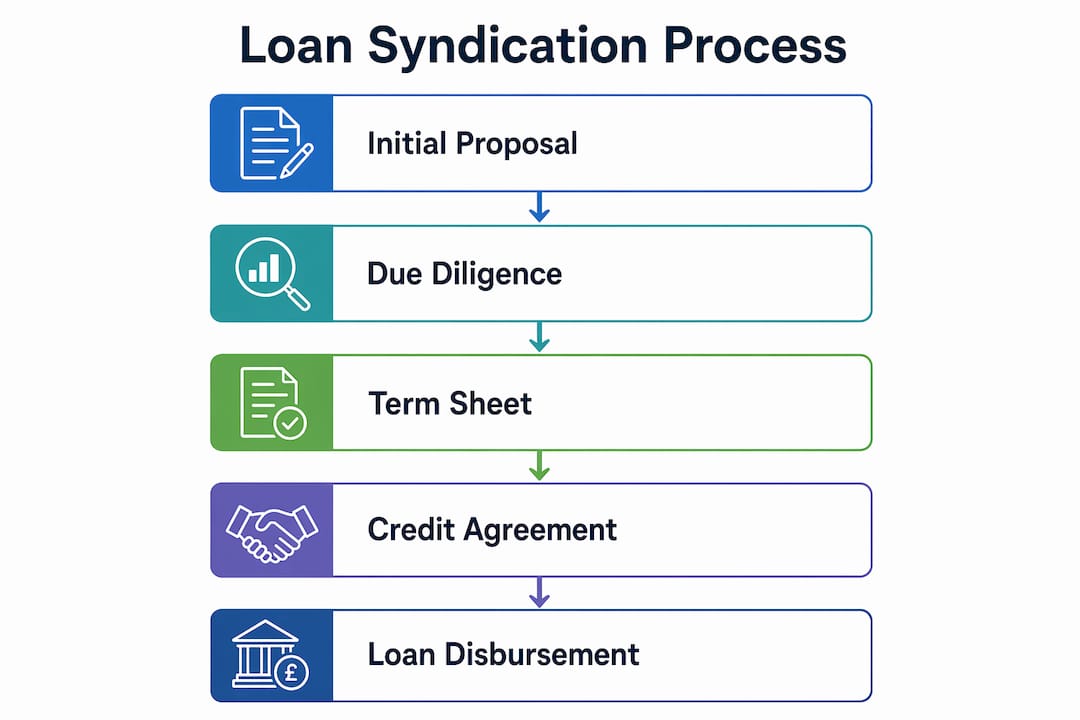
The syndication process unfolds in three phases: origination and term sheet negotiation, syndication and lender commitment, then closing and post-close administration. Each phase has distinct tasks and decision points.
-
Origination and Due Diligence. The borrower approaches a lead arranger, typically a bank or specialist debt adviser, with a financing requirement. The lead arranger conducts initial credit analysis, reviews the asset, the borrower’s track record, and the proposed capital structure.
-
Term Sheet Negotiation. The lead arranger produces a term sheet covering loan size, interest rate, repayment schedule, fees, and financial covenants. This document is negotiated directly between the borrower and the lead arranger. Early deal pricing and terms are locked at this stage, making initial structuring critical even though many lenders join later.
-
Syndication Phase. The lead arranger circulates an information memorandum to prospective lenders, inviting commitments. Lenders may join on a mandatory underwrite basis, where the lead arranger guarantees the full amount, or on a best-efforts basis, where the amount raised depends on lender appetite. Commitment letters are collected and allocations confirmed.
-
Credit Agreement Signing and Funding. All parties execute the syndicated credit agreement. Security is granted to the trustee. The facility is drawn down by the borrower, with each lender funding its committed share simultaneously.
-
Post-Closing Administration. The administrative agent takes over from the lead arranger. Covenant testing, interest payments, drawdown requests, and any waiver or amendment processes all run through the agent for the remainder of the facility term.
Pro Tip: Engage your debt adviser before the term sheet is issued, not after. The covenants and pricing locked at term sheet stage are extremely difficult to renegotiate once syndication has begun.
What loan structures and pricing terms are common?
Syndicated facilities in real estate finance take two primary forms, and the pricing mechanics differ meaningfully between them.
| Feature | Term Loan | Revolving Credit Facility |
|---|---|---|
| Structure | Drawn in full at closing, repaid on schedule | Drawn, repaid, and redrawn as needed |
| Use in Real Estate | Development finance, acquisition debt | Working capital, phased drawdowns |
| Pricing Benchmark | SONIA, SOFR, or EURIBOR plus margin | SONIA, SOFR, or EURIBOR plus margin |
| Repayment | Amortising or bullet at maturity | Revolving until facility expiry |
| Typical Fees | Arrangement, participation, administration | Commitment fee on undrawn amounts |
Interest may be fixed or floating, with fees covering arrangement, participation, and administration agreed at term sheet stage. In the UK market, SONIA (Sterling Overnight Index Average) has replaced LIBOR as the primary floating rate benchmark for sterling-denominated facilities. SOFR applies to dollar-denominated tranches, and EURIBOR remains standard for euro facilities.
Arrangement fees on syndicated real estate loans typically range from 1% to 2% of the total facility, paid upfront. Participation fees are distributed to syndicate lenders as compensation for their commitment. Administration fees are paid to the agent annually for ongoing servicing.
Pro Tip: Ask your lead arranger to model the all-in cost of funds including fees, not just the headline margin. A low margin with a high arrangement fee can be more expensive than a higher-margin facility with minimal fees, particularly on shorter-term development loans.
What are the benefits and pitfalls for real estate borrowers?
Loan syndicates offer genuine structural advantages for developers and investors working on large-scale projects. They also carry obligations that catch borrowers off guard.
The core benefits are:
- Access to larger capital. Syndicated loans enable financing for large-scale real estate projects that are impractical for single lenders. A £200 million mixed-use development in Manchester or Birmingham simply cannot be funded bilaterally by most UK lenders.
- Single counterparty management. Despite multiple lenders in the syndicate, you deal with one administrative agent. This consolidates your reporting, drawdown requests, and covenant discussions.
- Risk diversification for lenders. Each lender limits its exposure to its committed share. That appetite for participation is what makes the structure viable for borrowers needing large facilities.
- Standardised documentation. The Loan Market Association (LMA) publishes standard form credit agreements widely used in UK syndicated lending. LMA documentation reduces negotiation time and provides lenders with familiar, tested protections.
The pitfalls are equally real:
- Developers often misinterpret syndication as free lending capacity. Tighter reporting and covenant oversight accompany syndicated loans compared to bilateral facilities. The administrative agent enforces rigorous covenant management throughout the facility’s life.
- Covenant breaches in a syndicated facility require majority lender consent to waive, not just a conversation with your relationship manager. That process takes time and can delay your programme.
- Information covenants, including quarterly management accounts, annual audited financials, and development progress reports, are non-negotiable in most syndicated structures.
For context on how syndicated debt fits within a broader real estate debt strategy, the capital structure decisions made at origination determine your flexibility throughout the project.
Syndicated loans vs bilateral loans and participations
Understanding the differences between these three structures helps you choose the right arrangement for your transaction.
| Feature | Syndicated Loan | Bilateral Loan | Loan Participation |
|---|---|---|---|
| Number of Lenders | Multiple, from origination | One | Multiple, but after origination |
| Timing | Syndication before closing | Agreed bilaterally | Participation sold post-close |
| Borrower Relationship | Via administrative agent | Direct with lender | Direct with originating lender |
| Documentation | LMA syndicated credit agreement | Bilateral facility agreement | Participation agreement (borrower unaware) |
| Control | Majority lender voting | Single lender | Originating lender retains control |
| Flexibility | Lower post-close flexibility | Higher flexibility | Depends on participation terms |
Syndication happens upfront with multiple lenders funding directly, while participations occur after origination and bilateral loans involve one lender throughout. The practical implication for borrowers is significant. In a participation, you may not know your loan has been sold to other investors. In a syndicate, all lenders are disclosed and bound by the same credit agreement from day one.
Choose syndicated lending when your transaction size demands it, when you want transparent lender relationships, or when your advisers recommend LMA-standard documentation for institutional credibility. Choose bilateral facilities when speed and flexibility matter more than scale, particularly for bridging finance or shorter-term development loans where covenant flexibility is critical.
Key takeaways
Loan syndicates are the standard structure for large-scale UK property finance, combining multiple lenders under one credit agreement managed by an administrative agent.
| Point | Details |
|---|---|
| Single credit agreement | All syndicate lenders are bound by one LMA-standard document from day one. |
| Lead arranger locks terms early | Pricing, covenants, and fees are fixed at term sheet stage before lenders join. |
| Administrative agent is your contact | Post-closing, all payments, covenants, and requests run through the agent, not individual lenders. |
| Syndication is not free capacity | Tighter covenant enforcement and reporting obligations accompany every syndicated facility. |
| Choose structure to fit transaction | Syndicated loans suit large-scale deals; bilateral facilities offer more flexibility for shorter-term finance. |
What i have learned about syndicated loans in practice
The credit agreement is where deals are won or lost, and most borrowers do not read it carefully enough before signing. I have seen developers focus entirely on the headline margin and miss covenant packages that gave the syndicate majority voting rights over asset disposals. That is not a theoretical risk. It is a practical constraint on your exit strategy.
The administrative agent’s role is underestimated by almost every first-time syndicated borrower. Once the lead arranger has closed the deal and collected its arrangement fee, the agent becomes your primary relationship. The quality of that agent, their responsiveness, their willingness to process waiver requests efficiently, matters enormously over a three or four year development cycle.
The market trend I am watching closely in 2026 is the growing participation of private credit funds in UK syndicated real estate facilities. Family offices and debt funds are increasingly taking syndicate positions alongside traditional banks, particularly on development finance above £50 million. That changes the negotiating dynamic. Private credit lenders often accept tighter structures in exchange for higher margins, which can push up your all-in cost even when the headline terms look competitive.
My practical advice is straightforward. Engage a specialist debt structuring adviser before the term sheet is issued. Understand the structured property finance options available to your transaction before you commit to a syndicated structure. And read every covenant in the credit agreement before you sign it.
— James
How james william & co can structure your syndicated finance
James William & Co works with UK property developers, investors, and high-net-worth clients who need sophisticated debt structuring for large-scale transactions. If your project requires a syndicated facility, a multi-layered debt stack, or a complex refinance, the team has the lender relationships and structuring expertise to arrange it efficiently.
James William & Co’s network includes family offices, private credit funds, and specialist lenders actively deploying capital into UK real estate in 2026. Whether you are structuring a ground-up development, a large acquisition, or a specialist property finance solution in London or across the UK, James William & Co provides a single point of contact for end-to-end negotiation and execution. Contact the team to discuss your transaction.
FAQ
What is a loan syndicate in simple terms?
A loan syndicate is a group of lenders that jointly fund a single loan to one borrower under one credit agreement. The lead arranger structures the deal and the administrative agent manages it post-closing.
What does the administrative agent do in a syndicated loan?
The administrative agent collects borrower payments, distributes proceeds to lenders, monitors covenant compliance, and handles drawdown requests throughout the facility’s life.
How does syndicated lending differ from a bilateral loan?
A bilateral loan involves one lender and one borrower with direct documentation. A syndicated loan involves multiple lenders from origination, all bound by a single LMA-standard credit agreement.
What fees are typical in a syndicated real estate loan?
Arrangement fees, participation fees, and administration fees are standard. Arrangement fees on UK real estate syndications typically range from 1% to 2% of the total facility amount.
When should a property developer use a syndicated loan?
Use a syndicated loan when your transaction size exceeds a single lender’s capacity or risk appetite, typically on facilities above £50 million, or when institutional-grade LMA documentation is required by your capital structure.
Recommended
Related Topics
Speak to a specialist
Discuss your finance with James directly
Whole-of-market specialist finance — bridging, development, commercial and residential. No call centres, no obligation. James reviews every enquiry personally.
New to specialist finance? How unbiased broker advice works · Deals we have completed
Explore Related Finance