
Published · Updated
explaining loan to valueExplaining loan to value: a UK investor's guide
By James Dawes, CeMAP, Founder, James William & Co Capital

TL;DR:
- Loan-to-value measures the percentage of a property’s value financed by debt and influences mortgage rates. Maintaining a lower LTV can reduce interest costs and unlock better lending conditions, especially below the 80% threshold. Managing and tracking LTV proactively helps investors improve borrowing terms and mitigate risk over time.
Loan-to-value (LTV) is defined as the percentage of a property’s appraised value that is financed by debt. It is the single most important ratio in UK mortgage lending, used by banks, building societies, and specialist lenders to price risk, set interest rates, and determine how much they will lend. Whether you are buying your first home, refinancing a portfolio, or structuring a commercial acquisition, explaining loan to value correctly is the foundation of every financing decision you will make.

How is loan-to-value calculated and what does it mean?
The LTV formula is straightforward: divide the loan balance by the property’s appraised value, then multiply by 100. A £130,000 loan on a £150,000 property produces an LTV of 86.7%. That single number tells a lender how much of the asset is financed by debt and how much is covered by the borrower’s equity.
LTV and down payment are related but not the same thing. LTV reflects appraised value, not just the deposit paid. If a surveyor values a property lower than the agreed purchase price, your LTV rises even though your cash contribution stays the same. This distinction catches many borrowers off guard at the point of formal mortgage offer.
Here is how the calculation works in three common scenarios:
- Residential purchase. You buy a property for £300,000 with a £60,000 deposit. Your loan is £240,000. LTV = (240,000 / 300,000) × 100 = 80%.
- Refinance with appreciation. You originally borrowed £200,000 on a £250,000 property (80% LTV). The property is now worth £300,000 and your balance is £185,000. LTV = (185,000 / 300,000) × 100 = 61.7%.
- Commercial acquisition. A developer buys a commercial unit for £1,000,000 and borrows £700,000. LTV = 70%, sitting within the typical bank appetite for commercial lending.
Pro Tip: Always request the lender’s formal valuation figure before calculating your LTV. A surveyor’s down-valuation of even 5% can push you into a higher pricing band and cost thousands over the mortgage term.
What are the LTV benchmarks that affect your mortgage terms?
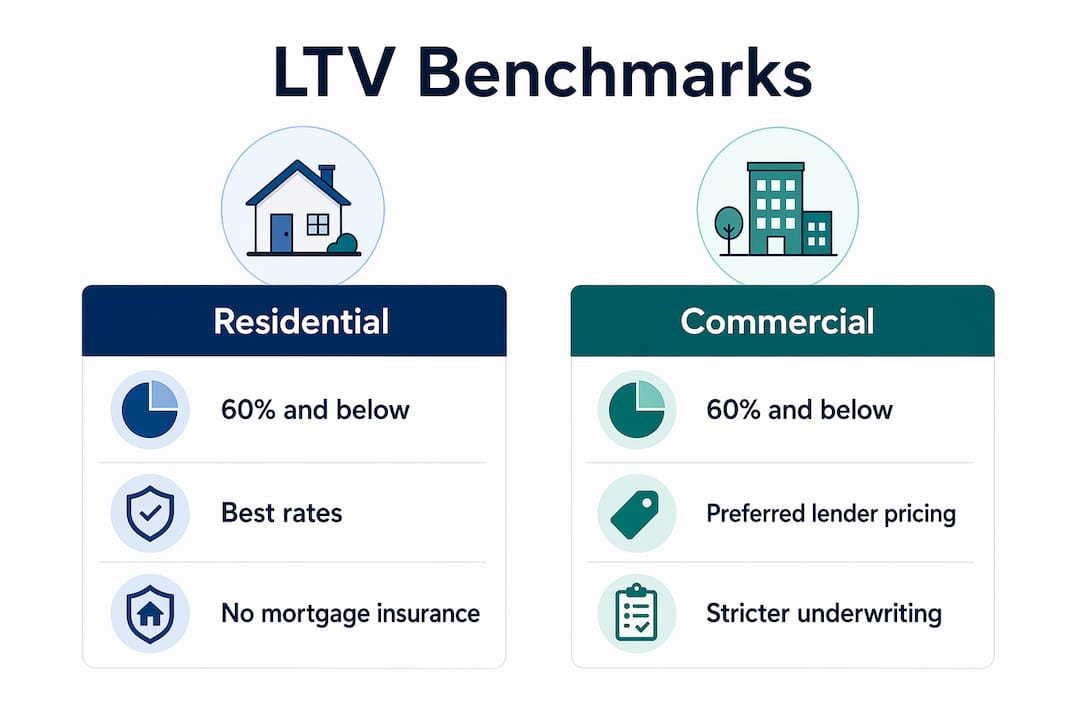
Lenders price mortgages in LTV bands, typically in 5% increments. The lower your LTV, the better the rate you receive. This is not a minor difference. Moving from 80% to 95% LTV can add 0.25%–0.75% to your interest rate through Loan-Level Price Adjustments (LLPAs). On a £500,000 loan over 25 years, that increment represents a material increase in total interest paid.
The table below shows how LTV bands map to typical lending conditions in the UK residential and commercial markets:
| LTV band | Residential impact | Commercial impact |
|---|---|---|
| 60% and below | Best available rates; no mortgage insurance | Preferred tier for conventional bank lending |
| 61%–75% | Competitive rates; strong lender choice | Standard range for conventional commercial loans |
| 76%–80% | Rates begin to step up; PMI threshold approached | Upper limit for many mainstream commercial lenders |
| 81%–90% | Higher rate tiers; PMI typically required | Bridge lenders active; bridge loan LTV up to 80% |
| 91%–95% | Highest rate tiers; limited lender panel | Specialist or mezzanine debt required |
The 80% LTV threshold is the most significant milestone in residential mortgage lending. Crossing below it removes the requirement for Private Mortgage Insurance and unlocks meaningfully lower rate tiers. For commercial property, conventional bank LTV limits sit at 65%–75%, with bridge lenders extending to 75%–80% for short-term transactions.
Key points to keep in mind when reviewing your LTV position:
- Every 5% reduction in LTV can move you into a cheaper pricing band.
- Lenders on the high street typically cap residential lending at 95% LTV.
- Commercial lenders assess LTV alongside asset class, location, and income profile.
- Specialist lenders and private credit funds will go higher than mainstream banks, but at a cost.
Pro Tip: If your LTV sits just above a pricing threshold, for example at 81% rather than 80%, it may be worth making a small additional capital payment before applying. Even a modest lump sum can shift you into a lower band and reduce your rate for the entire mortgage term.
How do lenders use LTV alongside other financial metrics?
LTV alone does not determine whether a loan is approved. Commercial lenders weigh DSCR and borrower experience alongside LTV to form a complete picture of risk. Understanding this broader framework helps you present a stronger application.
The key metrics lenders use alongside LTV are:
- Combined Loan-to-Value (CLTV). CLTV aggregates all secured debt on a property, including the primary mortgage, second charges, and any home equity lines of credit. A borrower with a 70% first charge and a 10% second charge has a CLTV of 80%. Lenders apply tighter caps to CLTV than to standalone LTV because total leverage is what matters for recovery in a default scenario.
- Debt Service Coverage Ratio (DSCR). DSCR measures whether the property’s income covers its debt obligations. A DSCR below 1.0 means the asset does not generate enough income to service the loan. Commercial lenders typically require a minimum DSCR of 1.25x, meaning income must exceed debt service by at least 25%.
- Borrower experience. For development finance and commercial transactions, lenders assess the track record of the borrower or developer. A strong portfolio of completed projects can offset a marginally higher LTV in the lender’s risk model.
- Multi-layer debt structures. Investors using mezzanine debt or preferred equity alongside a senior loan must account for the combined leverage across all tranches. A senior lender capped at 65% LTV may permit a mezzanine tranche to take total leverage to 80%–85%, but the blended cost of capital rises accordingly.
The practical implication is clear. A borrower with a 75% LTV, strong DSCR, and a proven track record will access better terms than one with a 70% LTV and weak income coverage. Lenders price the full risk picture, not just one number.
How can you improve your LTV position over time?
LTV is not fixed at the point of purchase. Two forces move it in your favour without any additional capital outlay: principal repayment and property price appreciation. Both reduce LTV and both create opportunities to refinance at better terms or release equity for further investment.
Here is a structured approach to managing and improving your LTV:
- Track your balance and valuation regularly. Request a formal valuation every two to three years, particularly in rising markets. A property that has appreciated significantly may have moved you into a lower LTV band without any additional repayment.
- Make targeted capital reductions. If you are close to a pricing threshold, a lump sum payment to reduce your balance below that threshold can deliver an immediate rate improvement on refinancing.
- Request PMI cancellation promptly. Once your LTV falls below 80%, servicers are legally required to respond to a cancellation request within 30 days. Do not wait for automatic removal. Submit the request as soon as your balance and valuation support it.
- Refinance at the right moment. Falling LTV combined with a strong credit profile creates the conditions for a materially better mortgage deal. Time your refinance to coincide with a formal valuation that reflects current market value.
- Consider multi-layered debt structures carefully. For property investors, adding a second charge or mezzanine tranche increases CLTV and total leverage. This can fund growth but must be modelled against the blended cost of capital and the impact on future refinancing options.
Pro Tip: When refinancing, instruct an independent RICS-registered surveyor rather than relying solely on the lender’s panel valuer. An independent valuation that supports a higher property value can make the difference between two pricing bands and save a significant sum over the new term.
The Bank of England uses LTV limits as a macro-prudential tool to manage credit cycles. When regulators tighten LTV caps, lenders follow. Staying below key thresholds not only improves your personal financing terms but also keeps you within the lending appetite of the widest possible panel of lenders, which matters most when you need to move quickly on an acquisition.
For investors building a portfolio, monitoring LTV across the entire book is as important as tracking individual assets. Rising values across a portfolio can create significant refinancing headroom. That headroom is deployable capital if you manage it proactively. You can explore how this applies to real estate debt structures in the context of UK property investment.
Key takeaways
The loan-to-value ratio is the primary measure of leverage in UK property finance, and managing it proactively determines both the cost and availability of your funding.
| Point | Details |
|---|---|
| LTV formula | Divide loan balance by appraised value and multiply by 100 to get your LTV percentage. |
| The 80% threshold | Falling below 80% LTV removes mortgage insurance and unlocks lower rate tiers in residential lending. |
| CLTV vs LTV | Combined LTV includes all secured debt on a property and attracts tighter lender caps than standalone LTV. |
| LTV bands and pricing | Lenders price in 5% increments; moving between bands can reduce your interest rate by 0.25%–0.75%. |
| Improving your LTV | Principal repayment, property appreciation, and timely refinancing all reduce LTV and improve your financing terms. |
Why LTV is the lever most investors underuse
I have spent years structuring property finance for developers and investors across the UK, and the same pattern appears repeatedly. Borrowers focus on the headline rate and overlook the LTV band driving it. They accept a rate at 82% LTV without asking whether a modest capital injection would take them to 80% and a materially cheaper deal.
The confusion between LTV and deposit size compounds this. Many borrowers assume their LTV is fixed by the cash they put in at purchase. It is not. A surveyor’s valuation can move it before you even complete. A rising market can move it in your favour years later. The borrowers who understand this treat LTV as a live metric, not a one-time calculation.
The Bank of England’s use of LTV as a countercyclical tool is worth taking seriously. When credit conditions tighten, lenders compress their LTV appetite fast. The investors who are already operating at conservative LTV levels find the market still open to them. Those who have stretched to maximum leverage find their options narrow sharply.
My view is this: LTV management is not just a financing tactic. It is a risk management discipline. Knowing your LTV across every asset in your portfolio, tracking it against current valuations, and acting on refinancing windows when they open is what separates investors who build durable portfolios from those who get caught out by a shift in lending conditions. You can see how this thinking applies to current market conditions in our overview of UK property finance trends.
— James
Work with James William & Co on your LTV strategy
Understanding your LTV position is one thing. Structuring finance around it to achieve the best possible terms is another discipline entirely.

James William & Co works with property investors, developers, and high-net-worth clients to arrange finance across the full LTV spectrum, from conventional residential mortgages to complex multi-tranche structures involving mezzanine debt and second charges. Whether you need to refinance at a lower LTV band, structure a commercial acquisition, or model a development stack, the team provides direct access to specialist lenders, private credit funds, and family offices. Speak to James William & Co about your next transaction through our specialist property finance service, or visit James William & Co Capital to explore the full range of funding solutions available.
FAQ
What is loan-to-value ratio in simple terms?
The loan-to-value ratio is the percentage of a property’s appraised value that is covered by a mortgage or loan. A £180,000 loan on a £200,000 property equals a 90% LTV.
How do I calculate my LTV?
Divide your outstanding loan balance by the property’s current appraised value and multiply by 100. For example, £150,000 divided by £200,000 equals 75% LTV.
What LTV do I need for the best mortgage rates in the UK?
Lenders award their best rates at 60% LTV and below. Rates step up incrementally at each 5% band above that threshold.
What is the difference between LTV and CLTV?
LTV measures a single loan against property value. CLTV combines all secured loans on the same property, including second charges and equity lines, to reflect total leverage.
Can my LTV change after I take out a mortgage?
Yes. LTV falls as you repay principal and as property values rise. Monitoring both allows you to refinance at a lower band or request removal of mortgage insurance once you cross the 80% threshold.
Recommended
Related Topics
Speak to a specialist
Discuss your finance with James directly
Whole-of-market specialist finance — bridging, development, commercial and residential. No call centres, no obligation. James reviews every enquiry personally.
New to specialist finance? How unbiased broker advice works · Deals we have completed
Explore Related Finance