
Published · Updated
explaining funding solutionsFunding Solutions: Unlocking UK Property Success
By James Dawes, CeMAP, Founder, James William & Co Capital

Securing the right capital can define whether your development moves swiftly from concept to completion or stalls under complexity. Large-scale projects in the United Kingdom require more than off-the-shelf financing, as high-net-worth property developers and institutional investors often contend with multi-layered structures, bespoke covenants, and shifting lender demands. This overview clarifies how tailored funding solutions and diverse finance structures shape project success, offering practical insight for those seeking precision and resilience in their next investment.
Table of Contents
- Defining Funding Solutions For UK Developers
- Types Of Property And Business Finance Structures
- How Multi-Layered Debt Stacks Work
- Eligibility, Key Requirements And Lender Criteria
- Risks, Costs And Common Pitfalls
Key Takeaways
| Point | Details |
|---|---|
| Tailored Funding Solutions | Developers must utilise bespoke capital strategies that align with their project’s unique requirements to avoid delays and maximise efficiency. |
| Diverse Financing Options | Understanding the spectrum of financing options, including debt and equity, is crucial for optimising costs and managing risk effectively. |
| Thorough Lender Preparation | Comprehensive documentation and clear project goals are essential when approaching lenders to secure favourable terms and avoid rejection. |
| Cost Management Awareness | Developers should anticipate and budget for various hidden costs associated with financing, which can significantly impact overall project expense. |
Defining Funding Solutions for UK Developers
Funding solutions for property developers aren’t a one-size-fits-all proposition. Your project’s stage, scale, and structure determine which capital sources work best for your needs.
At its core, funding solutions represent the tailored capital strategies that match your development timeline and financial requirements. Whether you’re acquiring land, financing ground-up construction, or refinancing existing assets, the right funding structure can mean the difference between rapid execution and stalled projects.
Understanding the Funding Spectrum
UK developers access capital across multiple channels. Traditional banks offer conventional mortgages for stabilised assets. Specialist lenders provide development finance for active construction phases. Bridging loans solve timing gaps between acquisitions and permanent funding.
Beyond debt, equity investment and mezzanine finance layer into complex structures. The UK funding landscape encompasses public schemes, private credit funds, and family office capital, each with distinct terms and covenant requirements.
Key funding categories include:
- Development finance for new construction projects
- Commercial mortgages for investment properties
- Bridging solutions for acquisition gaps
- Mezzanine debt for equity enhancement
- Asset finance for plant and equipment
- Structured multi-layered debt stacks
Why Tailored Solutions Matter
Generic funding rarely works for sophisticated developments. A £15 million mixed-use scheme needs different capital structures than a £2 million residential acquisition. Your developer status, track record, and project fundamentals all shift what lenders will offer.
Bespoke covenant packages reflect your specific circumstances. Perhaps you need covenant holidays during construction, or performance-based pricing that adjusts with market conditions. These nuances separate deals that close from deals that collapse.
Your funding solution must match your project timeline, exit strategy, and financial profile—not the other way around.
Institutional investors and high-net-worth developers increasingly recognise that multiple funding sources create resilience. Layering debt instruments—senior mortgages, mezzanine tranches, and equity components—distributes risk whilst optimising capital efficiency.
The best developers treat funding as a structural decision, not a transaction. How you finance a project shapes everything downstream: refinancing flexibility, investor exit timing, and asset quality.
Pro tip: Document your project’s unique requirements before approaching lenders. Clarity on timeline, exit strategy, and financial covenants accelerates approvals and improves pricing substantially.
Types of Property and Business Finance Structures
Property developers face a complex menu of financing options. Each structure carries different risk profiles, costs, and flexibility. Understanding which suits your project is critical.

Debt financing remains the foundation for most developments. Senior mortgages provide the lowest-cost capital but demand strong covenants and exit clarity. Bridging finance fills gaps between acquisition and permanent funding, typically lasting 12-24 months. Development finance sits between these, supporting construction phases with drawdown mechanics tied to project milestones.
Core Finance Categories
The UK property market relies on several primary structures:
The following table compares the main finance structures available to UK property developers, helping clarify their ideal use cases and risk considerations:
| Finance Structure | Typical Use Case | Key Benefit | Main Risk Factor |
|---|---|---|---|
| Senior Debt | Stabilised income properties | Lowest cost capital | Strict covenants |
| Bridging Finance | Short-term acquisition gaps | Quick access to funds | Higher interest rates |
| Development Finance | Ground-up construction | Drawdown linked to progress | Milestone delays |
| Mezzanine Debt | Capital boost for larger projects | Enhances returns, more funds | Subordinated repayments |
| Equity Investment | Risk-sharing with partners | Shared profits, flexibility | Dilutes developer control |
| Leasing Arrangements | Equipment and fixtures funding | Preserves working capital | Asset repossession risk |
- Senior debt – traditional mortgages with fixed terms and covenant packages
- Bridging loans – short-term capital for timing mismatches
- Development finance – construction-phase funding with milestone-based releases
- Mezzanine debt – subordinated tranches that enhance equity returns
- Equity investment – capital from partners or family offices with profit participation
- Leasing arrangements – asset-backed financing for equipment and fixtures
Debt vs Equity Considerations
Debt costs less than equity but creates fixed obligations. A 5% mortgage expense beats 20% equity returns, but debt requires reliable cash flow and exit certainty.
Equity partners accept longer payback periods in exchange for upside participation. They’re less concerned about annual distributions, more focused on exit multiples.
Real estate financing instruments span a broader spectrum than most realise. Property funds, REITs, and bonds offer institutional capital pathways, whilst private credit funds and family offices provide bespoke solutions for non-standard deals.
The right structure minimises your cost of capital whilst maintaining execution flexibility for your specific project timeline.
Multi-Layered Structures
Sophisticated developments stack multiple tranches. A £20 million project might layer £12 million senior debt at 3.5%, £5 million mezzanine at 8%, and £3 million equity. This optimises blended costs whilst distributing risk appropriately.
Finance structures must align with your business objectives, risk appetite, and growth stage. A speculative development demands different capital than a long-hold rental acquisition.
Offshore vehicles, covenant packages, and performance-based pricing all add sophistication. These details separate institutional-quality deals from opportunistic ventures.
Pro tip: Model multiple funding scenarios before committing to any lender. Different structures produce vastly different returns and refinancing options depending on market conditions at exit.
How Multi-Layered Debt Stacks Work
Multi-layered debt stacks are the engine of sophisticated property finance. They layer different debt tranches, each with distinct seniority, pricing, and terms, to optimise capital costs whilst distributing risk across lenders.
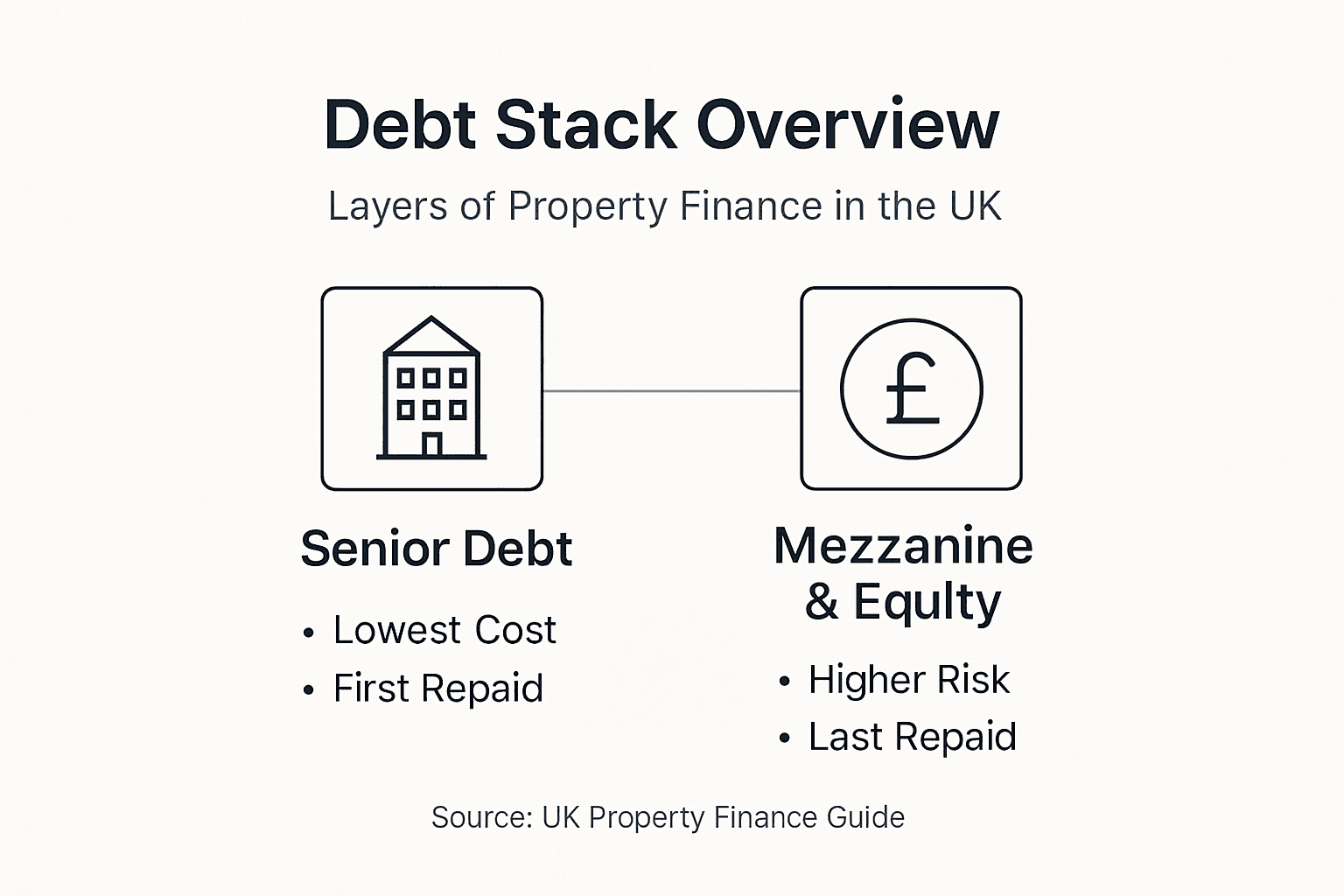
Think of it as a waterfall. Senior debt sits at the top, paid first. Mezzanine debt follows. Equity sits at the bottom, absorbing losses first but capturing upside last. Each layer has different risk, so pricing adjusts accordingly.
The Stack Structure
A typical structure looks like this:
- Senior debt – 60-70% loan-to-value, lowest interest rate, strict covenants
- Mezzanine debt – 15-25% of project cost, higher rates reflecting subordination
- Equity – 10-15% of project cost, no fixed return but profit participation
Senior lenders get paid first from rental income or exit proceeds. Mezzanine lenders sit in the middle, receiving their return only after senior debt. Equity holders wait until both debt tranches are satisfied.
Why Stack Rather Than Borrow Flat?
A single £10 million loan costs far more than layering £6 million senior plus £2.5 million mezzanine plus £1.5 million equity. Senior lenders accept lower rates because they’re first in line. Mezzanine lenders charge more because they’re subordinated. Equity requires highest returns because it’s riskiest.
Blended cost? Typically 4-6% across the stack versus 7-9% for a single facility.
Managing Complexity
Multi-layered debt structures involve carefully assessing priority, terms, and restructuring options to balance liquidity and solvency risks. Different lenders have competing interests. Senior lenders want protective covenants. Mezzanine lenders want performance triggers. Equity partners want flexibility.
Covenant packages must work across all layers. Cash sweep provisions define how surplus funds get distributed. Interest reserves cover shortfalls during construction.
Stacking debt requires alignment across multiple lender constituencies with competing interests—a capital concierge approach ensures smooth execution.
Environmental and Sustainability Considerations
Increasingly, lenders factor sustainability into their assessments. Environmental and nature-related financial risks affect pricing across debt layers. Green-certified developments attract lower rates. High-carbon assets face cost premiums or outright rejection from institutional lenders.
This means your stack structure must account for ESG compliance from inception.
Pro tip: Map covenant triggers and cash sweep mechanics before approaching lenders. Misalignment between senior and mezzanine terms kills deals faster than anything else.
Eligibility, Key Requirements and Lender Criteria
Lenders don’t hand capital to every developer who asks. They assess your credibility, project fundamentals, and ability to execute. Understanding what they scrutinise determines whether you secure funding or face rejection.
Elligibility starts with borrower credentials. Lenders want proven development experience, a clean financial history, and adequate equity in the deal. Project viability comes next—solid planning, realistic timelines, and clear exit strategies.
Core Lender Requirements
Specialist lenders evaluate multiple dimensions:
- Loan-to-value ratios – typically 60-75% for development, 70-80% for investment
- Developer track record – previous projects completed on time and on budget
- Equity contribution – your skin in the game, usually 10-30% depending on deal quality
- Project financials – detailed budgets, pro-formas, and sensitivity analysis
- Management capability – team experience across construction, sales, and finance
- Market viability – demand evidence for your product type and location
Documentation and Transparency
Lenders demand comprehensive documentation. Detailed business plans and financial projections demonstrating repayment capacity are non-negotiable. You’ll need three years of audited accounts, planning permission, building regulation sign-off, and professional valuations.
Covenant compliance matters enormously. Interest coverage ratios, loan-to-cost thresholds, and equity release triggers define your flexibility during the project.
Opacity kills deals. Full transparency about off-market purchases, related-party transactions, or development risks builds lender confidence.
Lenders assess three things simultaneously: your credibility, your project’s viability, and your exit strategy clarity.
Regulatory and Compliance Frameworks
Creditworthiness assessment, loan-to-value ratios, and regulatory compliance form the foundation of lender decision-making. Institutional investors face additional scrutiny around anti-money laundering, beneficial ownership disclosure, and sanctions screening.
Offshore structures require special attention. Lenders increasingly demand Know Your Customer documentation and transparency about beneficial owners across all entities in the funding stack.
ESG compliance is now a gating factor. Environmental risk, tenant quality, and sustainability credentials affect approval timelines and pricing. High-carbon assets face outright rejection from some institutional lenders.
Experience and Track Record
Your development history directly influences lender appetite. First-time developers face higher hurdles—stricter covenants, lower leverage, and premium pricing. Institutional developers with successful exits command better terms.
Pro tip: Create a one-page summary showing your three best completed projects with final outcomes, returns achieved, and timeline adherence. Lead with this whenever approaching new lenders.
Risks, Costs and Common Pitfalls
Funding comes with hidden expenses and genuine pitfalls. Most developers underestimate both. Understanding what can derail projects saves money and prevents catastrophic delays.
Costs extend far beyond interest rates. Arrangement fees, legal costs, valuation charges, and monitoring fees accumulate quickly. A £10 million facility might cost £200,000-£300,000 in upfront fees alone, excluding exit costs.
Direct Costs to Budget
Beyond interest, expect these expenses:
- Arrangement and commitment fees – typically 1-2% of facility size
- Legal and professional fees – £30,000-£75,000 for complex structures
- Valuation and surveyor costs – £5,000-£20,000 per property
- Monitoring and covenant compliance – quarterly or annual charges
- Refinance or exit fees – 0.5-1.5% of outstanding balance
- Lender’s solicitor and insurance – additional professional costs
These stack up. A £15 million development might incur £400,000+ in financing costs beyond interest, representing 2.7% of total project cost.
The following table outlines typical direct costs and their impact on the developer’s budget during a UK property project:
| Cost Type | Typical Range | Budget Impact |
|---|---|---|
| Arrangement/Commitment | 1–2% of facility | Reduces upfront cash for operations |
| Legal/Professional Fees | £30,000–£75,000 | Adds to fixed project expenses |
| Valuation/Surveyor | £5,000–£20,000+ | Required for lender approval |
| Monitoring/Covenant | £2,000–£8,000/year | Increases ongoing finance cost |
| Exit/Refinance | 0.5–1.5% of balance | Affects profitability at exit |
| Insurance/Other | Variable | May be overlooked by developers |
Execution and Construction Risks
Planning delays destroy timelines. A six-month delay on a £20 million project costs roughly £100,000 in extra interest and holding costs monthly. Covenant breaches trigger default clauses, forcing refinancing at worse rates.
Construction overruns are particularly damaging. Cost inflation, labour shortages, or material delays push budgets beyond what lenders approve. Interest reserves can cover temporary gaps, but extended delays exhaust them quickly.
Environmental and Sustainability Risks
Environmental degradation, regulatory fines, and required remediation increasingly impact asset values and financing costs. Contaminated land, flood risk, or poor energy performance ratings affect lender appetite and exit marketability.
Developers face potential regulatory fines for non-compliance with building standards. ESG misalignment now influences pricing; high-carbon projects attract premium rates or rejection entirely.
The costliest mistake: underestimating timeline risk and failing to build adequate contingency reserves for construction delays.
Common Pitfalls
Misaligned covenant packages create friction between senior and mezzanine lenders. Overly tight covenants limit flexibility during construction. Cash flow forecasts that prove optimistic trigger covenant breaches before projects finish.
Undercapitalisation is fatal. Insufficient equity contribution forces additional borrowing at worse rates. Related-party transactions that aren’t fully transparent poison lender relationships and trigger deal collapse.
Poor communication between development finance structuring partners creates misaligned expectations. Lock timely agreement on drawdown mechanics, interest reserves, and exit triggers before funds deploy.
Pro tip: Build 15-20% contingency into construction budgets and maintain six months of interest reserves. This buffer prevents covenant breaches during inevitable delays.
Unlock Tailored Funding Solutions with Expert Support
Navigating the complexities of UK property finance requires more than generic lending options. If you find yourself facing challenges like assembling multi-layered debt stacks, managing covenant packages, or optimizing your development finance for large-scale acquisitions, you are not alone. Many property developers and investors need precise, bespoke funding strategies that align perfectly with their project timelines, exit plans, and risk profiles.
At James William & Co Capital, we act as your dedicated debt structuring partner. Our capital concierge approach ensures rapid, customised structuring of bridging loans, mezzanine debt, and commercial mortgages—perfectly designed for sophisticated projects that demand financial agility and clarity. Whether it is ground-up developments or complex refinances, we provide a single point of contact to guide you through every step with confidence.
Discover how we can help you achieve resilient, cost-efficient funding for your UK property ventures. Explore our tailored solutions and unlock smoother financing pathways that protect your project’s success.
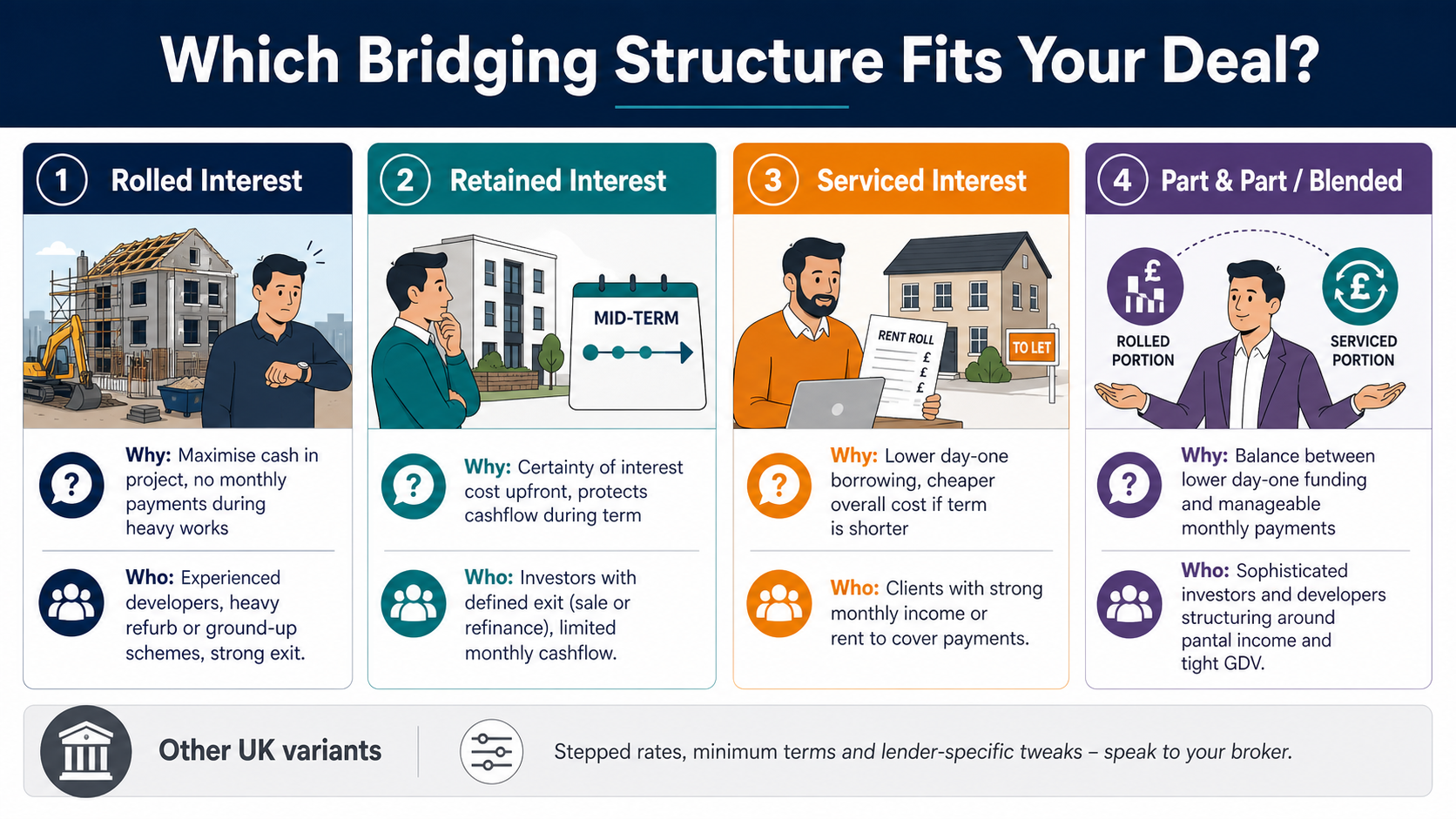
Take control of your property financing today. Contact James William & Co Capital to structure your bespoke development finance solution with seasoned expertise and decisive execution.
Frequently Asked Questions
What are the different types of funding solutions available for property developers?
Funding solutions for property developers include development finance, commercial mortgages, bridging loans, mezzanine debt, equity investment, and leasing arrangements. Each structure serves different project needs and risk profiles.
How do I determine the best funding structure for my property development project?
The best funding structure depends on your project’s stage, scale, and specific financial requirements. Assess the project timeline, exit strategy, and financial covenants to tailor the funding solution that best fits your needs.
What risks should I consider when seeking funding for property development?
Key risks include planning delays, construction overruns, and environmental compliance issues. Additionally, underestimating costs and failing to align covenant packages can lead to project delays and financial strain.
What documentation do lenders typically require for property development financing?
Lenders usually require comprehensive documentation, including detailed business plans, financial projections, proof of previous project experience, planning permissions, audited accounts, and compliance with financial covenants.
Recommended
Related Topics
Speak to a specialist
Discuss your finance with James directly
Whole-of-market specialist finance — bridging, development, commercial and residential. No call centres, no obligation. James reviews every enquiry personally.
New to specialist finance? How unbiased broker advice works · Deals we have completed
Explore Related Finance