
Published
how to access private credit fundsHow to access private credit funds in 2026
By James Dawes, CeMAP, Founder, James William & Co Capital

TL;DR:
- Accessing private credit funds in the UK requires investors to meet strict eligibility criteria and understand the specific fund structures and liquidity profiles. These funds offer flexible debt solutions that can complement or replace traditional bank financing but involve risks like illiquidity and complex fee arrangements. Successful investment depends on thorough due diligence, aligning fund terms with project timelines, and working with experienced advisers to navigate subscription and redemption processes effectively.
For UK property developers and investors, traditional bank finance has become increasingly restrictive. Loan-to-value ratios have tightened, credit committees move slowly, and complex projects rarely fit neatly into a high-street lender’s criteria. Knowing how to access private credit funds has become a genuinely useful skill. These funds offer flexible, often bespoke debt solutions that can sit alongside or replace conventional finance. But accessing them is not as simple as opening a savings account. There are eligibility hurdles, fund structures to understand, and liquidity trade-offs that can catch even experienced investors off guard.
Table of Contents
- Key takeaways
- How to access private credit funds: eligibility first
- Fund structures and what they mean for you
- Step-by-step: the fund access process
- Managing risk when investing in private credit
- Private credit within your broader property finance strategy
- My perspective on private credit access for UK developers
- How Jwcapital can help you access private credit
- FAQ
Key takeaways
| Point | Details |
|---|---|
| Accreditation comes first | You must meet investor eligibility criteria before accessing most private credit fund options. |
| Fund structure determines liquidity | Interval, tender offer, and closed-ended funds each offer different redemption terms that affect your exit timing. |
| Capital calls require planning | Funds draw down committed capital over time, so aligning call schedules with project cash flows is critical. |
| Due diligence is non-negotiable | Governance, fee structures, and underlying asset quality must be assessed before committing capital. |
| Private credit complements other debt | Used alongside specialist finance, private credit funds can strengthen a developer’s overall funding stack. |
How to access private credit funds: eligibility first
Before you can begin investing in private credit, you need to establish whether you qualify. Most private credit funds are restricted to accredited or sophisticated investors, and the criteria are more specific than many developers expect.
In the UK, the Financial Conduct Authority uses categories such as “high net worth individual” and “self-certified sophisticated investor” to define eligible participants. These broadly align with SEC-style income or net worth tests used in the United States, which require annual income of at least $200,000 or a net worth exceeding $1,000,000 excluding a primary residence. Professional licence holders, such as those with Series 7 or Series 65 qualifications, may also qualify. UK equivalents typically involve FCA-regulated status or demonstrable investment experience.
Once you confirm eligibility, the minimum capital commitment is the next consideration. HNW and UHNW investors typically encounter minimum investments ranging from £250,000 to several million pounds, depending on the fund’s strategy and target investor base. Some funds structured for broader access set lower thresholds, but these are the exception rather than the rule.
The subscription process itself involves several layers of documentation:
- Completion of a formal subscription agreement
- Know Your Customer (KYC) and anti-money laundering (AML) verification
- Accreditation confirmation, often requiring supporting financial statements
- Acknowledgement of the fund prospectus or offering memorandum
Access to detailed fund information is often gated behind eligibility confirmation, meaning you must first demonstrate you qualify before receiving full documentation. This is standard practice and not a barrier to be frustrated by. It is simply how these markets are structured.
Pro Tip: Work with a specialist adviser who can pre-qualify you across multiple funds simultaneously, rather than approaching each fund individually. This saves considerable time and avoids repeated KYC submissions.
| Eligibility criteria | Typical requirement |
|---|---|
| Net worth (excluding primary residence) | £750,000 or above |
| Annual income | £100,000 or above (UK HNW threshold) |
| Minimum investment | £250,000 to £2,000,000+ |
| Documentation required | KYC, AML, accreditation proof, signed subscription documents |
| Investor classification | FCA-defined HNW or sophisticated investor |
Fund structures and what they mean for you
Not all private credit fund options are built the same. The structure of the fund you choose will determine how easily you can get your money in, and more importantly, how and when you can get it out.
Closed-ended private credit funds
These are the most common structure for institutional-grade private credit. Capital is committed upfront, locked in for a defined term (typically five to ten years), and returned as the underlying loans are repaid. They offer no early redemption. For developers with a long investment horizon and stable liquidity, this structure can deliver the strongest risk-adjusted returns.

Interval funds
Interval and tender offer funds were designed to give retail and accredited investors access to illiquid credit strategies with some degree of structured liquidity. Interval funds operate on fixed repurchase schedules, typically quarterly or semi-annually, and generally allow redemptions of between 5% and 25% of outstanding shares per window. If redemption requests exceed that cap, they are fulfilled on a pro-rated basis. This means you may not get your full redemption in one window.
Tender offer funds
Tender offer funds give the fund’s board discretion over the timing and size of repurchase offers. This makes them more flexible in theory, but less predictable in practice. They tend to carry higher minimum investments and are better suited to sophisticated investors who understand that redemption timing is subject to market conditions. Planning for staged, partial exits rather than immediate full redemption is the realistic expectation.
Business development companies (BDCs)
BDCs are a publicly traded hybrid that provides exposure to private credit through a listed vehicle. They are accessible to a wider range of investors and offer daily liquidity, but they trade at premiums or discounts to net asset value and carry the volatility of public markets. For a specialist debt allocation within a property finance strategy, BDCs offer a useful entry point.
Pro Tip: Match fund structure to your project timeline. If you are deploying capital into a three-year development, a fund with a seven-year lock-up is a structural mismatch regardless of how attractive the returns look on paper.
| Fund type | Liquidity | Minimum investment | Investor suitability |
|---|---|---|---|
| Closed-ended fund | None until maturity | High (£500k+) | Institutional, UHNW |
| Interval fund | Fixed quarterly/semi-annual windows | Moderate (£100k+) | Accredited, HNW |
| Tender offer fund | Discretionary, board-determined | High (£250k+) | Sophisticated investors |
| BDC (listed) | Daily (exchange-traded) | Low (retail accessible) | Broad investor base |
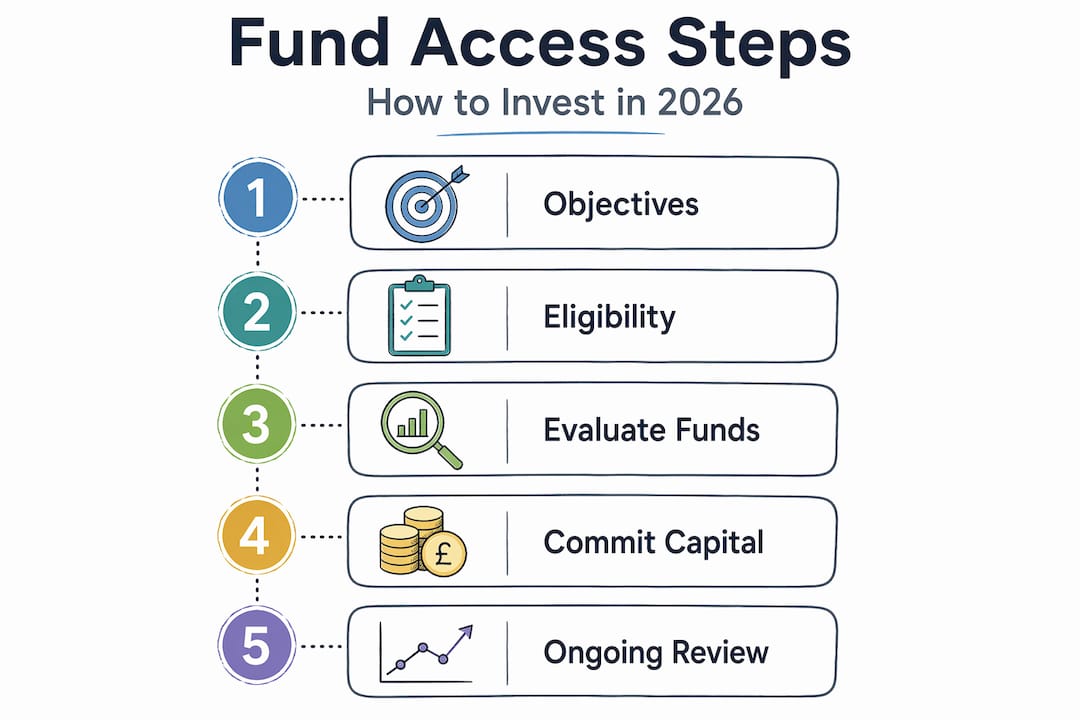
Step-by-step: the fund access process
Understanding the mechanics of how to invest in private credit is one thing. Executing the process correctly is another. Here is how it works in practice.
-
Define your investment objectives. Clarify what role private credit plays in your broader funding strategy. Are you seeking yield, diversification, or a specific credit exposure tied to real estate? Your answer determines which fund type and strategy is appropriate.
-
Identify suitable funds. Research funds aligned with your goals, liquidity needs, and risk appetite. This includes reviewing capital raising practices and understanding the fund’s underlying asset focus, whether direct lending, real estate debt, or mezzanine credit.
-
Complete investor qualification. Submit your KYC, AML documentation, and accreditation evidence. Some funds require a financial adviser or placement agent to sponsor your application.
-
Review the offering documents. Read the private placement memorandum or prospectus carefully. Pay particular attention to the fee structure (management fees, performance fees, and any redemption charges), the capital call schedule, and the fund’s redemption policy.
-
Sign the subscription agreement and commit capital. Your capital is not deployed immediately. Funds typically call capital over several years, meaning your committed amount is drawn down in tranches as the fund identifies and executes investments.
-
Manage the J-curve. In the early years of a private credit fund, returns are typically negative or flat as fees are paid and capital is deployed. Fund performance reaches a trough around year four on average, with cash flows turning positive around year seven. This is the J-curve, and it is entirely normal.
-
Monitor and manage redemptions. Track redemption windows, submit requests within the required notice periods, and plan for pro-rated outcomes during periods of high redemption demand.
Pro Tip: Model your capital call schedule against your project cash flow requirements before committing. A mismatch between when the fund draws capital and when you need liquidity for a development can create real pressure.
| Step | Key action |
|---|---|
| Objectives | Define role of private credit within your funding strategy |
| Fund selection | Match fund structure to investment horizon and liquidity needs |
| Qualification | Submit KYC, AML, and accreditation documentation |
| Document review | Scrutinise fees, capital call schedule, and redemption terms |
| Subscription | Sign agreement and commit capital |
| Capital calls | Model draw-down timing against project cash flow |
| Ongoing management | Monitor redemption windows and fund performance |
Managing risk when investing in private credit
The biggest mistake developers make when accessing credit funds is treating them like bank deposits. They are not. The risks are real, and managing them requires deliberate planning.
Illiquidity is the most obvious risk. Redemption caps and discretionary liquidity windows mean that in a stress scenario, you may only recover a portion of your investment across multiple redemption periods. This is not a failure of the fund. It is the structure working as intended, because the underlying assets cannot be liquidated overnight.
Governance matters more than many investors realise. Well-structured funds carry independent boards, SEC or FCA reporting obligations, and leverage limits designed to protect investors and align incentives. Funds without these protections carry substantially higher risk.
Key risk mitigation strategies to apply before and after commitment:
- Verify the fund’s regulatory status and oversight structure before subscribing
- Assess the underlying loan book: sector concentration, borrower quality, and loan-to-value ratios
- Understand the full fee load, including management fees, performance fees, and any hurdle rates
- Model multiple capital call scenarios against your project cash flow, not just the base case
- Avoid over-allocating to illiquid strategies relative to your total liquidity position
- Review the fund’s track record through at least one market cycle if available
Pro Tip: Ask the fund manager directly how redemptions were handled during the 2020 market dislocation. Their answer will tell you more about governance culture than any prospectus.
Private credit within your broader property finance strategy
Private credit is not a standalone solution. It works best as one layer within a well-structured property finance approach that combines multiple debt sources to match different project needs.
Private credit is a broad category, and direct lending is just one subset. Real estate investors should distinguish between funds focused on mortgage-backed credit, mezzanine debt, and whole loan strategies, as each carries different risk and return profiles relevant to property projects.
Situations where private credit funds are particularly useful for UK developers include:
- Projects too complex or large for high-street lenders but not large enough for institutional bond markets
- Developments requiring flexible covenant structures or non-standard security arrangements
- Investors seeking yield from credit exposure without direct property ownership
- Situations where speed of execution matters and bank credit committees are too slow
Staying across UK property finance trends in 2026 is equally important. Regulatory changes affecting fund structures, FCA categorisation rules, and shifts in credit market conditions all affect how accessible and suitable private credit funds are at any given point.
My perspective on private credit access for UK developers
I have worked with developers who approached private credit funds with the same mindset they bring to a bank meeting. They expected a quick decision, clear terms, and predictable drawdowns. The reality is more nuanced, and the gap between expectation and experience is where most problems arise.
What I have consistently found is that the liquidity question is underestimated at the point of commitment and overestimated at the point of exit. Developers focus on getting capital in and assume they can get it out when needed. In practice, interval and tender offer funds are built around the illiquidity of the underlying assets, not the convenience of the investor. That is not a criticism. It is a structural reality that needs to be planned for.
The developers who use private credit most effectively treat it as a long-term allocation within a diversified funding stack, not a short-term liquidity tool. They work with advisers who understand the subscription mechanics, model the capital call timing carefully, and select fund structures that genuinely align with their project horizons. Professional advisory support is not optional here. The documentation alone, let alone the strategic alignment, requires specialist knowledge to navigate correctly.
My honest view is that private credit funds represent one of the most interesting and genuinely useful financing tools available to serious UK property investors right now. But they reward preparation and penalise assumptions.
— James
How Jwcapital can help you access private credit
At Jwcapital, we work directly with UK property developers and investors who need more than a standard mortgage broker. Our network spans family offices, private credit funds, and specialist lenders, giving our clients access to funding structures that most advisers simply cannot reach.

Whether you are exploring specialist property finance in London or building a multi-layered debt stack for a ground-up development, we act as your single point of contact for structuring, negotiation, and execution. Our wealth planning services include private credit fund access advisory, helping you identify the right fund structures, complete the subscription process efficiently, and align capital call timing with your project requirements. If you are ready to explore private credit as part of your funding strategy, get in touch with the Jwcapital team today.
FAQ
What qualifies you to invest in a private credit fund?
Most private credit funds require investors to meet accredited or sophisticated investor criteria, typically based on net worth, income thresholds, or professional financial qualifications. In the UK, FCA-defined categories such as “high net worth individual” apply.
How liquid are private credit fund investments?
Liquidity depends on fund structure. Closed-ended funds offer no early redemption, while interval and tender offer funds provide limited, scheduled liquidity windows where only a fixed percentage of shares can be redeemed per period.
What is the J-curve in private credit investing?
The J-curve describes the pattern where fund returns are initially negative or flat as fees are paid and capital is deployed, before turning positive in later years. Fund performance typically troughs around year four and cash flows turn positive around year seven.
How do capital calls work in private credit funds?
Capital calls are scheduled drawdowns of your committed capital over time, rather than a single upfront payment. Funds draw capital as they identify and execute investments, so you need to model call timing against your own cash flow requirements.
Can private credit funds be used alongside traditional property finance?
Yes. Private credit funds work effectively as one layer within a broader funding stack, complementing bridging finance, commercial mortgages, and mezzanine debt for complex UK property transactions.
Recommended
Related Topics
Speak to a specialist
Discuss your finance with James directly
Whole-of-market specialist finance — bridging, development, commercial and residential. No call centres, no obligation. James reviews every enquiry personally.
New to specialist finance? How unbiased broker advice works · Deals we have completed
Explore Related Finance