
Published · Updated
how to negotiate bespoke covenantsHow to negotiate bespoke covenants in property finance
By James Dawes, CeMAP, Founder, James William & Co Capital

TL;DR:
- Bespoke covenants are individually negotiated loan conditions tailored to a borrower’s specific financial profile. Effective negotiation involves thorough preparation, focusing on key terms, and clear legal documentation to balance lender security and borrower flexibility. Ongoing compliance management and proactive lender communication are essential to avoid defaults and protect loan terms.
Bespoke covenants are individually negotiated loan conditions tailored to a specific borrower’s financial profile, business model, and asset class rather than applied from a standard template. In UK property finance, knowing how to negotiate bespoke covenants is the difference between a debt package that supports your growth and one that creates unnecessary default risk. The standard industry term for this process is “tailored covenant negotiation,” and it sits at the heart of well-structured development finance, commercial mortgages, and private credit deals. James William & Co structures these packages daily across complex, multi-layered transactions for developers, investors, and high-net-worth clients.
How to negotiate bespoke covenants: preparation comes first
Entering a covenant negotiation without the right data is the fastest route to a weak deal. Lenders set the opening terms. Your job is to replace generic conditions with ones that reflect your actual financial position.
Thorough preparation requires four things before you sit at the table.
- Gather your core financial metrics. Calculate your Debt Service Coverage Ratio (DSCR), loan-to-value, and liquidity position across the last two to three years. Lenders test these figures. You need to know them better than they do.
- Build a covenant register. Map every proposed obligation to an internal owner who will track compliance. Formal covenant registers prevent accidental breaches caused by fragmented communication or missed reporting deadlines.
- Analyse historical volatility. If your revenue is seasonal or project-driven, document it. This evidence justifies requests for trailing 12-month (LTM) measurement periods rather than point-in-time monthly tests.
- Draft a term sheet first. Standard term sheets serve as negotiation starting points and are routinely modified to include bespoke add-backs or alternative metric definitions. Agreeing material commercial points before legal drafting prevents costly delays.
Pro Tip: Identify your two or three must-change covenant items before the first meeting. Focusing on critical items while conceding on less material terms builds goodwill and produces better outcomes than fighting every clause.
This preparation phase also informs your real estate funding strategy from the outset, ensuring your covenant requests align with the wider debt structure.

How to structure covenants that balance lender security and borrower flexibility
The most durable covenant packages contain fewer, better-targeted conditions rather than a long list of restrictions. Excessive restrictive covenants impair borrower agility and increase the risk of technical defaults. That outcome serves neither party.
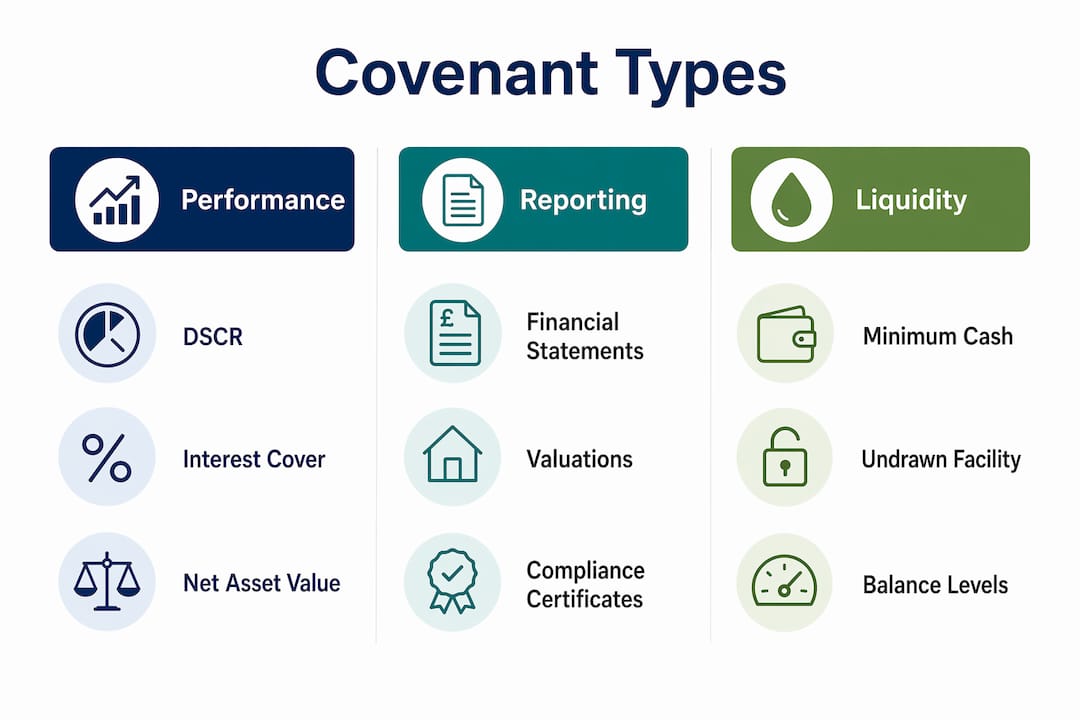
The three core covenant types
Performance covenants test financial ratios such as DSCR, interest cover, or net asset value. These are the most negotiated items in property finance because they directly affect your ability to operate.
Reporting covenants set deadlines for financial statements, valuations, and compliance certificates. Negotiate these to align with your existing governance calendar, not the lender’s preferred schedule.
Liquidity covenants require minimum cash or undrawn facility balances. These are often set at generic levels. Tie them to your actual working capital cycle instead.
Customising definitions
Private credit deals increasingly accept bespoke financial covenant definitions when supported by clear borrower data. Permitted add-backs, such as one-off costs or development-phase expenditure, can be carved out of EBITDA calculations. LTM metrics smooth seasonal volatility without reducing lender protection.
The table below contrasts typical standard covenant features with bespoke alternatives.
| Feature | Standard covenant | Bespoke covenant |
|---|---|---|
| Testing frequency | Monthly, point-in-time | Quarterly or trailing 12-month |
| DSCR calculation | Gross income basis | Adjusted for permitted add-backs |
| Breach consequence | Immediate event of default | Cure period of 30–90 days |
| Reporting deadline | Fixed calendar dates | Aligned to borrower governance cycle |
| Liquidity threshold | Generic minimum balance | Tied to project cash flow profile |
Pro Tip: Align every proposed covenant threshold to your last two years of audited accounts. Lenders accept data-backed arguments far more readily than requests unsupported by evidence.
Shifting from monthly to quarterly or LTM testing can reduce administrative burdens significantly while maintaining effective compliance testing. That reduction in overhead is a concrete benefit you can present to your own board.
What steps to follow during the negotiation itself
Effective negotiation of tailored covenants follows a clear sequence. Skipping phases creates the “ambiguity gap,” where agreed commercial terms fail to appear in the final legal draft. Complex bespoke agreements often undergo more than ten rounds of redlining when commercial terms are unclear at the outset. That is expensive and avoidable.
Follow these phases in order.
- Intensive fact-finding. Share financial models, asset valuations, and business plans with the lender before any terms are proposed. The more context a lender has, the more receptive they are to tailored conditions.
- Nonbinding term sheet. Agree all material commercial points in writing before instructing solicitors. This document is not legally binding, but it anchors the negotiation and prevents scope creep.
- Redlining rounds. Expect multiple drafts. Prioritise your two or three key items in every round. Concede on secondary points early to build momentum.
- Explicit memorialisation. Agreed bespoke terms must be explicitly written into the final contract. Implicit understandings do not survive the handoff from deal-makers to lawyers.
- Legal review with specialist counsel. A solicitor experienced in property conveyancing and contract terms will identify gaps between the term sheet and the draft facility agreement before execution.
During redlining, address lender concerns directly rather than dismissing them. If a lender insists on a tight DSCR threshold, propose a cure period rather than a lower ratio. That concession costs you less operationally while satisfying the lender’s credit committee.
Key tactics during live negotiation:
- Use your historical financial data as the primary argument for every bespoke request.
- Never accept a definition without reading it against your actual accounts.
- Request that all defined terms appear in a single definitions schedule within the agreement.
- Confirm that cure rights apply to financial covenant breaches, not just reporting failures.
The structuring of development finance follows the same logic: the more precisely terms are defined upfront, the fewer disputes arise during the loan term.
How to monitor and enforce bespoke covenants after signing
Signing the agreement is not the end of the process. Covenant compliance requires active management throughout the loan term.
The foundation is a formal covenant register. Each obligation needs an assigned internal owner, a testing date, and a document checklist. Relying on memory or fragmented communication is a frequent cause of default events due to missed obligations. A register eliminates that risk.
Best practices for post-signing compliance:
- Set calendar reminders at least 30 days before each reporting deadline.
- Run a shadow compliance test one quarter before each formal test date to identify problems early.
- Maintain a live model that tracks DSCR, LTV, and liquidity against covenant thresholds in real time.
- Document every lender communication in writing, including informal calls.
When a potential breach is identified, act before the formal test date. Most bespoke covenant packages include cure periods of 30–90 days. Cure rights with grace periods are highly effective in preventing immediate loan defaults. Use that window to present a remediation plan to the lender rather than waiting for a formal notice.
Waivers and amendments are available tools, but they carry a cost. Lenders typically charge a fee and may tighten other conditions in exchange. Proactive communication before a breach is always cheaper than a waiver negotiation after one.
Pro Tip: Schedule a quarterly call with your lender even when there are no compliance issues. Consistent communication builds the relationship capital you need when a genuine problem arises.
Key takeaways
Effective bespoke covenant negotiation requires data-led preparation, targeted term selection, explicit legal documentation, and active post-signing compliance management.
| Point | Details |
|---|---|
| Prepare financial data first | Gather DSCR, LTV, and liquidity metrics before any negotiation begins. |
| Focus on two or three key terms | Concede on secondary items to secure the covenants that matter most. |
| Use LTM and add-back definitions | Bespoke metric definitions reduce volatility and administrative burden. |
| Memorialise every agreed term | Implicit understandings do not transfer to legal drafts without explicit wording. |
| Build a formal covenant register | Assign internal owners to each obligation to prevent accidental breaches. |
What I have learned from structuring bespoke covenant packages
The most common mistake I see is treating covenant negotiation as a legal exercise rather than a financial one. Developers hand the term sheet to their solicitor and assume the commercial terms will survive intact. They rarely do without deliberate management of the handoff.
The deals that close cleanly share one characteristic: the borrower arrived with a data room, not a wish list. When you can show a lender two years of audited accounts, a cash flow model stress-tested at 20% below projection, and a clear rationale for every bespoke request, the negotiation becomes a technical conversation rather than a confrontation.
The other lesson is about relationship management. Lenders have credit committees. The person across the table from you is often your advocate inside that committee, not your opponent. Giving them the data and the narrative they need to defend your terms internally is as important as the terms themselves.
The UK property finance market in 2026 is showing genuine appetite for tailored covenant structures, particularly in private credit and family office lending. That appetite exists because borrowers with strong data are making compelling cases. The framework is there. The question is whether you use it.
— James
How James William & Co structures bespoke covenant packages
James William & Co works as a debt structuring partner for UK developers, investors, and high-net-worth clients who need more than a standard facility agreement. The firm’s specialist property finance service covers the full negotiation cycle, from term sheet preparation and lender selection through to covenant drafting and post-signing compliance frameworks.
For clients requiring multi-layered debt stacks, mezzanine positions, or JV equity alongside bespoke covenant packages, James William & Co provides a single point of contact across the entire structure. The firm’s network of private credit funds, family offices, and specialist lenders means tailored terms are achievable at pace, even on complex transactions. Speak to the team about your next deal and how a structured covenant package can protect your position from day one.
FAQ
What are bespoke covenants in property finance?
Bespoke covenants are individually negotiated loan conditions tailored to a specific borrower’s financial profile rather than drawn from a standard template. They replace generic thresholds with terms aligned to the borrower’s actual business model and asset class.
How many covenant terms should I negotiate?
Focus on two or three critical items such as DSCR calculation methodology, cure periods, and reporting deadlines. Conceding on less critical items while insisting on key changes produces better outcomes and preserves the lender relationship.
What is a cure period and why does it matter?
A cure period is a defined window, typically 30–90 days, during which a borrower can remedy a covenant breach before it becomes a formal event of default. Negotiating cure rights into your agreement is one of the most valuable protections available.
How do I prevent accidental covenant breaches?
Build a formal covenant register that maps each obligation to an internal owner with a testing date and document checklist. Running a shadow compliance test one quarter before each formal test date identifies problems before they become defaults.
Can lenders accept bespoke financial metric definitions?
Private credit lenders accept bespoke add-backs and carve-outs when the borrower provides clear financial data evidencing the necessity. LTM metrics and permitted add-backs are standard negotiating points in well-structured UK property finance deals.
Recommended
Related Topics
Speak to a specialist
Discuss your finance with James directly
Whole-of-market specialist finance — bridging, development, commercial and residential. No call centres, no obligation. James reviews every enquiry personally.
New to specialist finance? How unbiased broker advice works · Deals we have completed
Explore Related Finance