
Published · Updated
how to source capital partnersHow to source capital partners for property development
By James Dawes, CeMAP, Founder, James William & Co Capital

Securing the right capital partners for large-scale UK property development projects remains one of the most challenging yet critical tasks facing developers and high-net-worth investors today. Whether you’re structuring a ground-up residential scheme, acquiring a commercial portfolio, or refinancing a complex mixed-use asset, the capital stack you assemble will determine both your project’s viability and your long-term returns. This guide provides a practical framework for preparing your proposition, identifying suitable partners, and structuring deals that align financial goals with operational control.
Table of Contents
- Key takeaways
- Understanding the challenge: why sourcing capital partners matters
- Preparing to attract capital partners: business plans, equity, and track record
- Sourcing capital partners: practical strategies and key channels
- Managing partnerships: structuring deals and mitigating risks
- Explore specialist property finance solutions with James William & Co Capital
- Frequently asked questions
Key Takeaways
| Point | Details |
|---|---|
| Networking with partners | Sourcing capital partners hinges on building relationships with platforms, brokers and family offices who can supply funding or co investment opportunities. |
| Understand capital stack | Senior debt typically accounts for 60-70 per cent of GDV, mezzanine 10-20 per cent, and equity 10-40 per cent, with senior debt capped at 65-70 per cent to guard against downside. |
| Clear debt and equity terms | Agree early on covenants, guarantees and equity splits to align expectations and reduce partnership risk. |
| Explore alternative funding | Crowdfunding and specialist lenders are increasingly important sources alongside traditional finance. |
Understanding the challenge: why sourcing capital partners matters
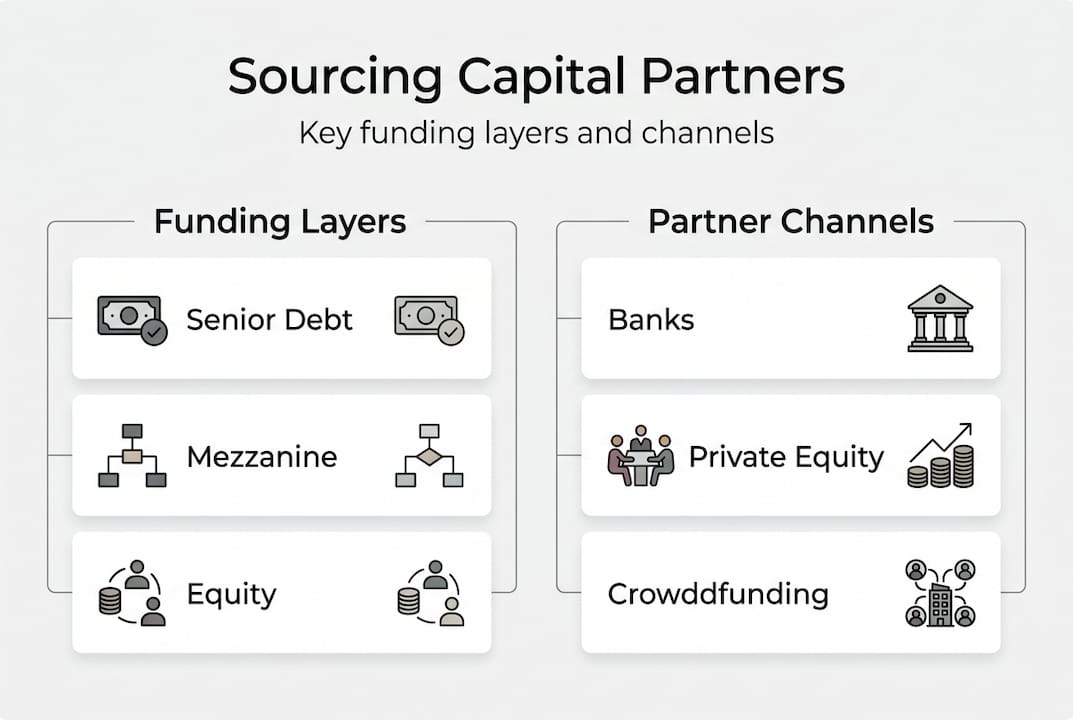
Property development capital typically comprises multiple layers, each serving distinct risk and return profiles. Senior debt forms 60-70% of gross development value or loan-to-cost, with mezzanine finance contributing 10-20% and developer equity or high-net-worth investor contributions filling the remaining 10-40%. Lenders cap senior debt at 65-70% GDV to protect downside exposure, forcing developers to source additional capital from partners who accept higher risk in exchange for equity upside or enhanced interest returns.
Balancing cost, control, and risk across this capital stack presents several challenges. Senior debt offers the lowest cost of capital but imposes strict covenants and personal guarantees. Mezzanine lenders charge higher rates, typically 10-15% annually, but subordinate their security to senior lenders. Equity partners or joint venture investors demand profit shares ranging from 20-50%, diluting developer returns whilst providing essential gap funding. Strategic alignment becomes paramount as mismatched expectations around project timelines, exit strategies, or risk tolerance can derail even well-capitalised schemes.
Developers must also navigate the preferences of different capital providers. Institutional lenders favour established track records and pre-sold units, whilst family offices may prioritise long-term relationships and co-investment opportunities. Private credit funds seek higher yields through complex structures, often accepting second-charge positions or development management fees in lieu of equity. Understanding these nuances allows you to target partners whose mandates align with your project profile, increasing the likelihood of securing terms that preserve both control and profitability.
Key considerations when evaluating potential capital partners include:
- Financial capacity to fund the full commitment without refinancing risk
- Track record in similar asset classes, geographies, or development scales
- Appetite for active involvement versus passive investment
- Exit timeline alignment with your planned hold or disposal strategy
- Willingness to provide flexible covenant packages or milestone-based drawdowns
Exploring real estate debt options early in the planning process helps you map viable capital structures before approaching partners, ensuring your proposition meets market expectations whilst safeguarding your strategic objectives.
Preparing to attract capital partners: business plans, equity, and track record
No capital partner will commit funds without rigorous due diligence on your project’s commercial viability and your ability to execute. Robust business plans with GDV and cost forecasts, track records, pre-sales or lettings, and personal equity contributions form the foundation of any successful capital raise. Your business plan must include detailed financial models showing monthly cashflows, sensitivity analyses for cost overruns or sales delays, and credible exit valuations supported by comparable transactions.
Equity contribution expectations vary by lender and project risk, but most senior lenders require developers to inject 20-40% of total project costs. This skin-in-the-game demonstrates commitment and aligns your interests with capital providers. For speculative residential schemes without pre-sales, lenders may demand 30-35% equity, whilst forward-funded or pre-let commercial projects can secure finance with 20-25% contributions. High-net-worth investors often leverage personal assets or cross-collateralise existing portfolios to meet these thresholds, whilst professional developers may syndicate equity requirements across multiple family office partners.
Demonstrating prior successes through verifiable track records significantly enhances your credibility. Lenders and equity partners scrutinise completed projects, focusing on delivery timelines, budget adherence, and realised versus forecast returns. If you lack an extensive track record, partnering with experienced development managers or showcasing pre-sales data can mitigate perceived execution risk. For example, securing 40% pre-sales on a residential scheme or signing a 15-year lease with a covenant tenant on a commercial project provides tangible evidence of market demand.
Essential components of a compelling capital raise package include:
- Executive summary articulating project vision, market opportunity, and competitive advantage
- Detailed site analysis with planning status, constraints, and remediation costs
- Construction programme with phased delivery milestones and contractor credentials
- Sales and marketing strategy supported by agent valuations and absorption rates
- Risk register identifying key threats and mitigation measures
- Management team CVs highlighting relevant sector experience and past performance
Pro tip: Commission an independent monitoring surveyor’s report before approaching lenders. This third-party validation of your cost plan and programme demonstrates professionalism and accelerates due diligence timelines.
Understanding development finance structuring principles ensures your proposition aligns with lender appetites and maximises leverage whilst maintaining acceptable debt service coverage ratios.
Sourcing capital partners: practical strategies and key channels
Identifying and engaging suitable capital partners requires a multi-channel approach combining digital platforms, specialist intermediaries, and direct relationship building. Networking via platforms like Fundsurfer, specialist brokers such as Willow Private Finance and Aria Finance, and targeting high-net-worth individuals or family offices represents the primary mechanics for sourcing development capital in the UK market.

Online platforms have democratised access to capital, enabling developers to present projects to hundreds of accredited investors simultaneously. Fundsurfer, Property Partner, and Crowdcube facilitate both debt and equity raises, with typical minimum investments ranging from £10,000 to £100,000. These platforms handle regulatory compliance, investor communications, and funds administration, charging fees of 3-5% on successful raises. Whilst crowdfunding suits smaller schemes or gap funding requirements, institutional-scale projects still require direct engagement with larger capital providers.
Specialist brokers offer invaluable market intelligence and lender introductions. Firms like Willow Private Finance, Aria Finance, and James William & Co Capital maintain relationships with hundreds of lenders, including high-street banks, challenger banks, private credit funds, and family offices. Brokers assess your project against lender appetites, structure propositions to maximise competitiveness, and negotiate terms on your behalf. Their fees, typically 1-2% of the facility size, are often justified by the time saved and improved terms secured.
Direct outreach to high-net-worth individuals and family offices requires a more personalised approach. Self-administered family offices increasingly allocate capital to property development, seeking returns of 15-25% annually through mezzanine debt or joint venture equity. Building relationships through industry events, professional networks, and warm introductions from accountants or solicitors proves most effective. When approaching family offices, emphasise capital preservation, downside protection through senior debt coverage, and alignment with their investment thesis, whether that’s income generation, capital growth, or portfolio diversification.
Step-by-step process for evaluating and approaching potential partners:
- Map your capital requirements across senior debt, mezzanine, and equity layers
- Research potential partners’ investment criteria, including ticket sizes, geographies, and asset classes
- Prepare tailored pitch materials highlighting alignment with their stated preferences
- Initiate contact through warm introductions or formal submission processes
- Present your proposition in a concise 15-minute meeting, focusing on opportunity and risk mitigation
- Respond promptly to due diligence requests with comprehensive documentation
- Negotiate terms collaboratively, seeking win-win structures rather than adversarial positions
Pro tip: Maintain a capital partner pipeline with at least three active relationships per funding layer. This ensures competitive tension and provides fallback options if primary sources withdraw.
| Funding source | Typical cost | Speed | Control impact | Best suited for |
|---|---|---|---|---|
| Senior debt | 5-8% p.a. | 8-12 weeks | Low | Core project funding |
| Mezzanine debt | 10-15% p.a. | 6-10 weeks | Medium | Gap funding, leverage boost |
| JV equity | 20-50% profit share | 4-8 weeks | High | Projects lacking track record |
| Crowdfunding | 3-5% platform fee + 8-12% investor return | 4-6 weeks | Low-Medium | Smaller schemes, marketing benefit |
| Family office | 12-20% p.a. or equity stake | 6-12 weeks | Variable | Flexible, relationship-based deals |
Exploring diverse capital raising practices and understanding the full spectrum of real estate funding sources positions you to optimise your capital stack for each project’s unique risk-return profile.
Managing partnerships: structuring deals and mitigating risks
Once you’ve identified suitable capital partners, structuring the partnership with clarity and foresight prevents disputes and ensures aligned incentives throughout the project lifecycle. Debt proves cheaper but dilutes control less, whilst joint ventures add expertise but risk partner disputes, mitigated via clear JV agreements and dispute resolution mechanisms.
Debt financing, whether senior or mezzanine, preserves your equity ownership and decision-making authority. Lenders receive fixed interest payments and security over the asset but have no claim on profits beyond contractual returns. This structure suits developers with strong track records who can service debt obligations and wish to retain full upside. However, debt increases financial risk, as interest accrues regardless of project performance, and lenders can enforce security if covenants are breached.
Joint venture equity partnerships involve sharing both risk and reward. Equity partners contribute capital in exchange for profit shares, often calculated as a percentage of net proceeds after senior and mezzanine debt repayment. JVs provide more than just funding, as partners frequently offer development expertise, market intelligence, or operational support. The trade-off is diluted control and potential conflicts over strategy, timelines, or exit decisions. Successful JVs require meticulous legal documentation addressing decision-making hierarchies, profit waterfalls, and deadlock resolution.
Essential clauses in joint venture agreements include:
- Capital call procedures specifying contribution amounts, timing, and default consequences
- Voting rights and reserved matters requiring unanimous or supermajority approval
- Profit distribution waterfalls detailing preferred returns, profit splits, and promote structures
- Exit mechanisms including tag-along, drag-along, and first refusal rights
- Dispute resolution processes such as mediation, expert determination, or arbitration
- Good leaver and bad leaver provisions addressing partner departure scenarios
Maintaining control whilst accessing partner capital requires careful negotiation. Consider structures where you retain operational control through a development management agreement, with partners holding veto rights only on major decisions like budget increases over 10%, contractor changes, or scheme redesigns. Alternatively, tiered profit shares incentivise performance, for example, you receive 70% of profits up to a 20% IRR, reverting to 50/50 above that threshold.
“Clear, comprehensive joint venture agreements are your first line of defence against partnership disputes. Invest in experienced property solicitors who understand development risk and can draft provisions that protect your interests whilst remaining attractive to capital partners.”
Risk mitigation extends beyond legal documentation. Regular reporting, transparent decision-making, and proactive communication build trust and prevent misunderstandings. Establish governance frameworks with monthly board meetings, quarterly financial reviews, and milestone-based reporting. When conflicts arise, address them immediately through structured dialogue rather than allowing resentment to fester.
Understanding the nuances of debt versus JV equity and applying lessons from bridging finance deals ensures you structure partnerships that deliver both capital efficiency and operational flexibility.
Explore specialist property finance solutions with James William & Co Capital
Navigating the complexities of capital partner sourcing and deal structuring demands specialist expertise and market access. James William & Co Capital operates as a capital concierge for UK property developers, investors, and high-net-worth clients, arranging sophisticated funding for large-scale acquisitions, ground-up developments, and complex refinances. Our network spans family offices, private credit funds, and specialist lenders, enabling us to structure multi-layered debt stacks, mezzanine facilities, and joint venture equity tailored to your project’s unique requirements.
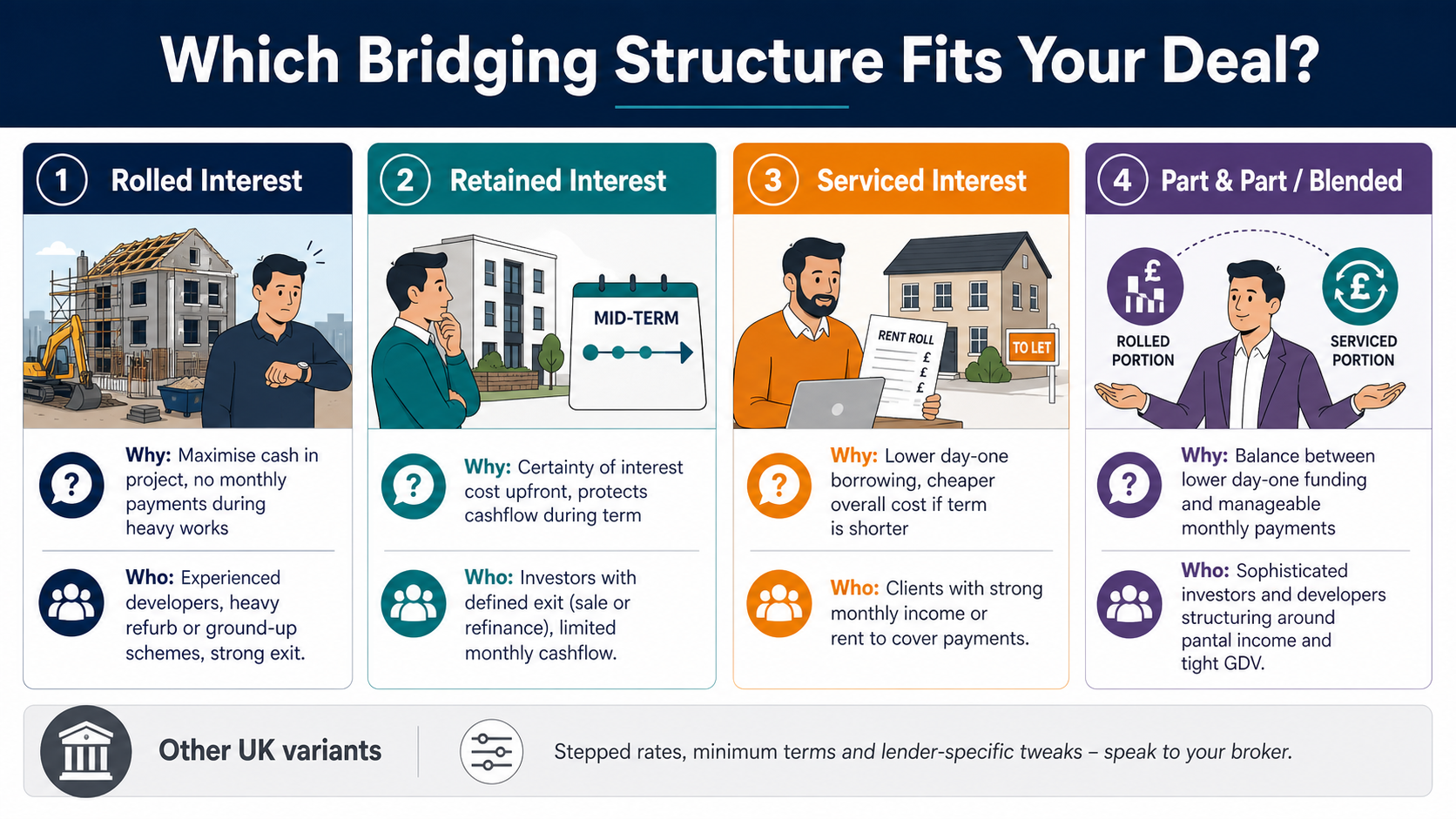
Whether you’re seeking bridging finance for a time-sensitive acquisition, development finance for a phased residential scheme, or mezzanine debt to bridge a funding gap, our team delivers rapid, bespoke solutions. We handle end-to-end structuring, negotiation, and execution, providing a single point of contact throughout the capital raising process. Explore our specialist property finance capabilities, review our property finance services, or examine property finance case studies demonstrating our ability to execute under pressure.
Frequently asked questions
What types of capital partners are most common in UK property development?
Senior lenders, including high-street banks and challenger banks, provide the largest capital layer at 60-70% loan-to-value. Mezzanine lenders and private credit funds fill the gap between senior debt and equity, whilst family offices and high-net-worth individuals contribute joint venture equity for higher-risk projects. Crowdfunding platforms have emerged as alternative sources for smaller schemes.
How much personal equity do developers typically need to contribute?
Most lenders require developers to inject 20-40% of total project costs as personal equity. Speculative residential schemes without pre-sales typically demand 30-35% contributions, whilst forward-funded or pre-let commercial projects may accept 20-25%. This equity demonstrates commitment and aligns developer interests with capital providers. Understanding property funding sources helps you plan equity requirements early.
What are key risks in joint venture partnerships and how to avoid them?
Partner disputes over strategy, timelines, or exit decisions represent the primary risk in joint ventures. Mitigate this through comprehensive JV agreements detailing decision-making hierarchies, profit waterfalls, and dispute resolution mechanisms. Regular communication, transparent reporting, and alignment on project objectives prevent misunderstandings. Include exit clauses like tag-along and drag-along rights to facilitate clean separations if conflicts prove irreconcilable.
Can alternative funding sources replace traditional lenders?
Alternative sources like crowdfunding and peer-to-peer lending complement rather than replace traditional lenders. They excel at filling funding gaps, providing mezzanine capital, or financing smaller projects that fall outside institutional appetites. However, large-scale developments still require senior debt from established lenders due to capital scale, covenant structures, and regulatory requirements. A blended approach combining traditional and alternative sources often delivers optimal capital efficiency.
What preparation is essential before approaching capital partners?
Prepare a robust business plan with detailed financial forecasts, construction programmes, and risk analyses. Demonstrate credible track records through completed projects or experienced team members. Secure planning permissions or pre-sales data to reduce perceived execution risk. Commit personal equity of 20-40% to show skin-in-the-game. Commission independent monitoring surveyor reports to accelerate due diligence. This preparation significantly increases your success rate and improves negotiated terms.
Recommended
Related Topics
Speak to a specialist
Discuss your finance with James directly
Whole-of-market specialist finance — bridging, development, commercial and residential. No call centres, no obligation. James reviews every enquiry personally.
New to specialist finance? How unbiased broker advice works · Deals we have completed
Explore Related Finance