
Published · Updated
how to source family office capitalHow to source family office capital for UK developers
By James Dawes, CeMAP, Founder, James William & Co Capital

TL;DR:
- Family offices are patient, relationship-focused investors that require a tailored, trust-based approach for real estate funding. Successful sourcing involves qualified pipelines, legal compliance, relationship-building, and presenting deals aligned with their governance and reporting needs. Common pitfalls include cold outreach, misaligned documentation, and underestimating rigorous due diligence processes.
Family offices represent some of the most patient, well-capitalised, and relationship-driven investors available to UK real estate developers. Yet most developers approach them the wrong way, treating them like institutional funds or worse, sending cold emails. Knowing how to source family office capital requires a fundamentally different mindset. This is not transactional fundraising. It is private capital acquisition built on trust, governance alignment, and a deep understanding of how these entities think, decide, and allocate.
Table of Contents
- Key takeaways
- How to source family office capital: understanding the landscape
- Building your targeted family office pipeline
- Effective outreach and relationship-building
- Presenting your deal to fit family office requirements
- Common pitfalls when raising family office capital
- My experience working with family offices
- How James William & Co can help you access the right capital
- FAQ
Key takeaways
| Point | Details |
|---|---|
| Family offices are not funds | They operate under bespoke governance and investment policy statements that must be understood before any approach. |
| Build a qualified pipeline first | Use verified databases and warm introductions before making any direct contact with decision-makers. |
| Lead with co-investment structures | 60 to 75% of family office deals are club or co-investment transactions, not standalone commitments. |
| Legal compliance is non-negotiable | Outreach must respect securities law exemptions and jurisdiction rules to avoid disqualifying yourself from the outset. |
| Reporting readiness accelerates trust | Developers who provide portfolio-level reporting and governance transparency reduce friction and speed up evaluation. |
How to source family office capital: understanding the landscape
Before you can attract family office funding, you need to understand who you are actually dealing with. The term “family office” covers enormous diversity. A single family office (SFO) manages the wealth of one ultra-high-net-worth family and typically operates with a small, principals-only team. A multi-family office (MFO) serves several wealthy families under one structure, often with a more professionalised investment team.
What unites them is governance. Family offices behave like investment committees with strict risk boundaries, not opportunistic funds chasing yield. Most operate under a documented investment policy statement (IPS) that governs acceptable risk, illiquidity tolerance, concentration limits, and sometimes ESG exclusions. An IPS without clear real estate mandates means your pitch will stall regardless of how compelling your returns look.
Top-performing family offices allocate around 46% of assets to alternative investments, with real estate a core component. They deploy that capital through several mechanisms:
- Direct investments: Purchasing assets outright, often in commercial or residential property
- Co-investments: Partnering alongside a lead developer or fund for a single deal
- Club deals: Small groups of family offices pooling capital around a shared opportunity
- Separately managed accounts (SMAs): Bespoke vehicles giving the family greater control and reporting visibility
Understanding the wealth origin of a particular family also matters. A family that built its fortune through property development will assess your deal very differently from one that generated wealth through technology or manufacturing. Their familiarity with the asset class shapes the questions they ask and the due diligence depth they require.
Building your targeted family office pipeline
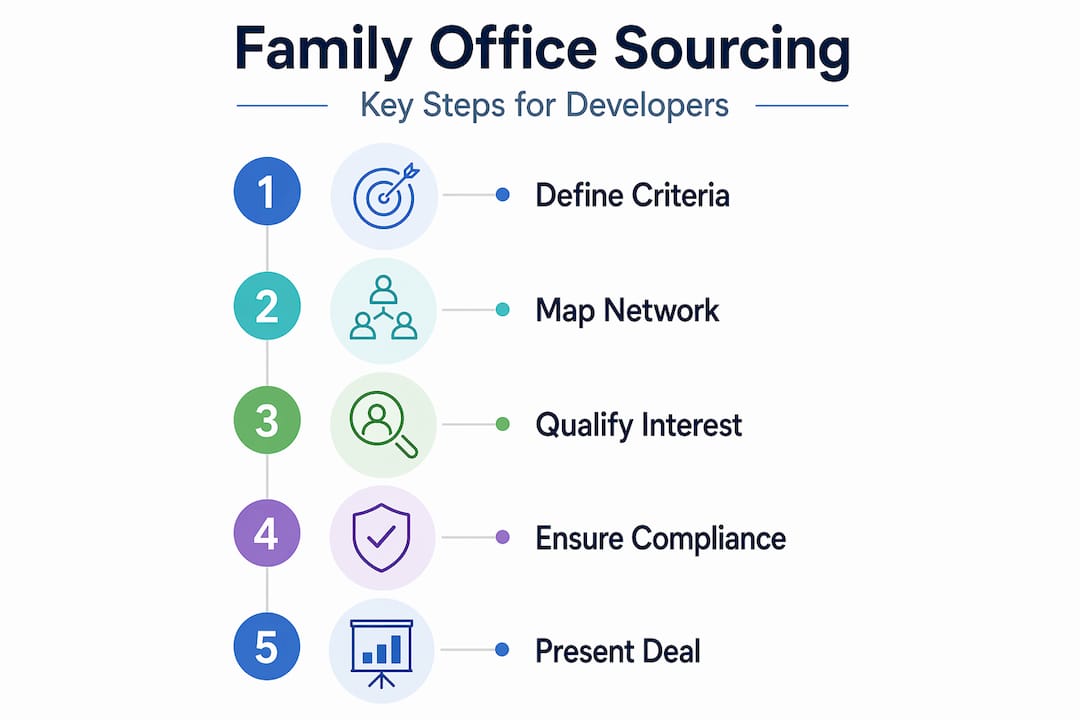
Preparation separates successful family office capital raising from wasted outreach. The first task is creating a qualified prospect list, not a generic contact sheet. Platforms like FINTRX and AdvizorPro provide verified family office investment preferences and confirmed decision-maker contacts, which eliminates the guesswork of cold approaches.

When building your pipeline, focus on three filtering criteria. Does this family office have a documented real estate mandate? What ticket sizes have they committed to historically? And who is the actual decision-maker, as it is frequently not the most visible name associated with the family.
Pro Tip: Do not target family office databases purely by asset size. A £500 million family office with a specific UK residential development mandate is a far better prospect than a £2 billion office with no property allocation.
Mapping warm introduction paths via LinkedIn, shared advisers, and professional networks is the most productive use of your prospecting time. Family offices receive unsolicited approaches daily and rarely act on them. A referral from a trusted solicitor, accountant, or fellow developer who has transacted with that office changes the entire dynamic.
Legal compliance is a gating factor that many developers overlook entirely. Outreach must comply with securities law exemptions and avoid general solicitation under equivalent UK regulations. In practice, this means every communication must be directed at a pre-existing relationship or facilitated through compliant channels. Breaching this does not just risk a failed raise. It can disqualify you permanently from working with that office.
For a broader view of real estate funding methods that complement family office capital, understanding where family money fits within a wider capital stack is worth considering early.
Effective outreach and relationship-building
The instinct for many developers is to lead with the deal. Resist it. Family office investment sourcing works on a relationship-first principle that cannot be shortcut. The most effective approach follows a clear sequence:
- Establish a genuine warm introduction through a mutual adviser, co-investor, or industry contact before any formal conversation.
- Start with a listening call, not a pitch. Understand their current allocation, what they have recently committed to, and what their CIO or principal is actively exploring.
- Identify a lead investor before opening a round to multiple families. Securing a lead or anchor investor first dramatically improves conversion rates among subsequent family offices.
- Propose a co-investment or club deal structure from the outset. Presenting a deal designed for a single large cheque misses how most family offices prefer to deploy capital.
- Offer principal-level transparency. Family offices want direct access to the developer or asset manager, not a layer of intermediaries. Turnkey vetted deals with principal contact are a genuine competitive advantage.
Pro Tip: Expect diligence timelines to be longer and committee-based, often spanning eight to sixteen weeks for a first commitment. Build this into your fundraising schedule rather than treating it as a delay.
The biggest mistake developers make is confusing polite interest with intent. Family offices are unfailingly courteous. A soft “we’ll review this internally” frequently means it has gone no further than the inbox. Regular, non-pushy follow-up that adds value, such as a relevant market update or a portfolio performance note, keeps you visible without being intrusive.
Presenting your deal to fit family office requirements
Your pitch document is not the problem. What is usually the problem is that it was written for an institutional fund, not a family office. These are distinct audiences with different governance priorities. Aligning your presentation to a family office’s actual decision-making framework is where most capital raising best practices diverge from standard fundraising advice.
Tailor your proposition around these specific requirements:
- Map explicitly to their IPS. If their policy states a maximum 20% illiquidity tolerance, your five-year hold period needs to be framed within their existing portfolio context, not justified in isolation.
- Address ESG and concentration preferences directly. Many family offices have moved well beyond token ESG statements. If your development has sustainability credentials, certifications, or energy performance targets, these belong in the executive summary, not as a footnote.
- Offer portfolio-level reporting from day one. Developers who provide reporting compatible with consolidation tools such as Addepar reduce evaluation friction and signal operational maturity.
- Structure governance and control options clearly. Deal structures should match the family office’s desire for control, whether that is preferred equity, GP co-invest, or a common equity position with board or advisory rights.
- Demonstrate responsiveness. Family offices rarely allocate to developers who take days to return calls. Speed of communication is read as a signal of how you will manage their capital.
The family office direct real estate model is about reducing complexity. Family offices deploy capital through structures that integrate tracking, ownership mapping, and cash flow visibility. Showing you can support that infrastructure from the start removes one of their biggest objections.
Common pitfalls when raising family office capital
Most family office capital raising fails not because the deal is bad, but because the approach is wrong. The errors tend to cluster around the same categories:
- Generic outreach. Sending the same deck to fifty family offices with minor name changes signals that you have not done your homework. They notice immediately.
- Skipping the warm introduction. Attempting direct outreach without a credible relationship path puts you in the unsolicited pile. Very few deals are done from cold contact.
- Misunderstanding legal boundaries. Communications must respect legal limitations around what constitutes general solicitation. Non-compliance is a deal-killer, and in some cases a regulatory matter.
- Underestimating governance requirements. Developers accustomed to working with private individuals or traditional lenders are often surprised by the documentation, reporting, and committee involvement that family offices require.
- No reporting infrastructure. Walking into a diligence call unable to describe how you will provide quarterly portfolio reports and cash flow updates tells the office you are not ready for this type of capital partner.
“The families that write the largest cheques are also the ones with the most rigorous processes. Match their professionalism or lose the deal.”
My experience working with family offices
I have spent years helping UK developers put together funding structures that include family office capital, and the pattern I keep seeing is the same: a developer with a genuinely strong deal undersells themselves through poor preparation and then blames the family office for being “too slow” or “too complicated.”
In my experience, the offices that seem most difficult to access are often the most rewarding to work with once you are in. They are patient, they understand long development cycles, and when they commit, they rarely pull out over minor market movements. That is not typical of many other capital sources.
What I have learned is that presentation of governance capability matters as much as the returns modelling. A family that built its wealth over three generations is not going to hand capital to someone who cannot explain their reporting structure. I have also found that knowing who introduced you to a particular family, and why that person is credible to them, often matters more than anything in the information memorandum.
The compliance dimension is one that developers consistently underestimate. Getting the outreach mechanics wrong before you have even had the first conversation can permanently damage your credibility with an office. That damage spreads quickly within networks where these families often know each other.
— James
How James William & Co can help you access the right capital
Securing family office capital for a large-scale UK property development requires the right introductions, the right structure, and the right representation. At James William & Co, our capital concierge approach means you get a single point of contact who understands both the developer’s objectives and the family office’s governance requirements.
We work with a network of family offices, private credit funds, and specialist lenders to structure multi-layered capital solutions for acquisitions, ground-up developments, and complex refinances. Whether you need mezzanine debt, JV equity, or a co-investment round designed specifically for family office participation, we have experience arranging it. Browse our case studies to see how we have executed under pressure, or explore our specialist property finance services to understand how we can work with you on your next deal.
FAQ
What is a family office and how does it invest in property?
A family office is a private wealth management structure serving one or more ultra-high-net-worth families. They invest in property through direct acquisitions, co-investments, club deals, and separately managed accounts, often guided by a formal investment policy statement.
How long does family office diligence typically take?
Diligence is usually committee-based and can span eight to sixteen weeks for a first commitment. Developers should build this into their fundraising timeline from the outset rather than expecting quick decisions.
Do I need a warm introduction to approach a family office?
In practice, yes. Cold outreach rarely converts. The best routes are through shared advisers, professional networks, or a referral from a developer who has previously transacted with that office.
What deal structures do family offices prefer for real estate?
Most favour co-investments and club deals, with over 60% of transactions structured collaboratively. They also want clear governance options, whether preferred equity, GP co-invest, or managed accounts with reporting rights.
What compliance risks should developers be aware of when raising from family offices?
Outreach must avoid general solicitation and comply with applicable exemptions. Any communication directed at a family office without a pre-existing substantive relationship can constitute a breach of fundraising regulations, with serious legal and reputational consequences.
Recommended
Related Topics
Speak to a specialist
Discuss your finance with James directly
Whole-of-market specialist finance — bridging, development, commercial and residential. No call centres, no obligation. James reviews every enquiry personally.
New to specialist finance? How unbiased broker advice works · Deals we have completed
Explore Related Finance