
Published · Updated
how to structure debt stackHow to structure a debt stack for UK property deals
By James Dawes, CeMAP, Founder, James William & Co Capital

TL;DR:
- A debt stack is a layered capital arrangement used to finance real estate projects, ordered by priority and risk. Correctly structuring the capital stack determines project funding, solvency, and return distribution among parties involved.
A debt stack is the layered arrangement of capital used to finance a real estate development, ordered by repayment priority and risk profile. Knowing how to structure a debt stack correctly determines whether a project gets funded, stays solvent, and delivers returns to every party involved. For UK developers and investors working on large-scale acquisitions, ground-up schemes, or complex refinances, the capital stack (the industry’s standard term for this structure) is the single most consequential decision made before a spade hits the ground. Senior debt, mezzanine finance, preferred equity, and sponsor equity each occupy a distinct position, and sizing them correctly from the outset defines the entire project’s risk architecture.
How to structure a debt stack: the core layers explained

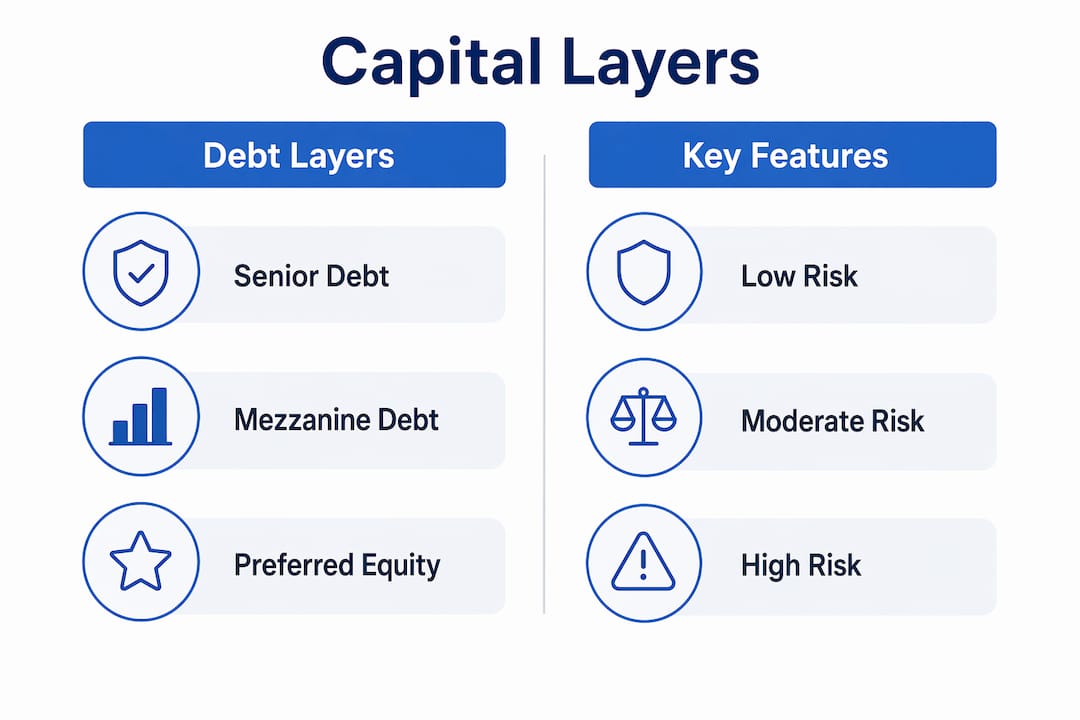
A well-structured capital stack for projects exceeding £10 million typically contains four distinct layers, each with its own risk, return, and control characteristics. Senior debt sits at 50–65% LTC, carries the lowest risk, and prices at roughly 5–8% per annum. It is the anchor layer. Every other tranche is sized around what the senior lender will underwrite.
Mezzanine debt occupies the next position, typically covering 5–15% of loan-to-cost and priced at 10–14%. It carries higher risk than senior debt because it sits behind it in the repayment waterfall. Preferred equity follows, also covering 5–15% LTC but targeting 12%+ IRR. It behaves like debt in its priority position but like equity in its governance rights.
LP equity and GP equity sit at the base of the stack and absorb the first losses. LP investors typically target 15–25%+ IRR. GP or sponsor equity is usually 2–10% of project cost, with returns driven by the promote structure rather than a fixed rate.
Comparing the four main capital layers
| Layer | Typical LTC | Target Return | Risk Level |
|---|---|---|---|
| Senior debt | 50–65% | 5–8% p.a. | Lowest |
| Mezzanine debt | 5–15% | 10–14% p.a. | Medium-high |
| Preferred equity | 5–15% | 12%+ IRR | Medium-high |
| LP equity | 15–30% | 15–25%+ IRR | High |
| GP equity | 2–10% | Promote-driven | Highest |
The combination you choose directly affects your refinancing options, your covenant headroom, and how much control you retain if the project runs into difficulty.
How do you size and sequence debt tranches correctly?
Senior debt sizing is the starting point, and it must reflect what a lender will actually underwrite under stress, not what your pro forma says you need. Conservative lenders underwrite at 50–60% LTC for development projects. That figure anchors the entire stack. Attempting to push a senior lender beyond their stress-tested comfort zone weakens the whole structure from the top down.
Once senior debt is locked, the funding gap becomes clear. That gap is the difference between total development cost and the senior facility. Developers then choose how to fill it: mezzanine debt, preferred equity, additional sponsor equity, or a combination. Each option carries a different cost and a different set of implications for control.
The practical sequencing runs as follows:
- Confirm total development cost using a fully costed appraisal, including contingency and finance costs.
- Agree the senior debt facility based on lender underwriting criteria, not project ambition.
- Calculate the funding gap between senior proceeds and total cost.
- Assess subordinate capital options by comparing mezzanine debt, preferred equity, and increased sponsor equity on cost, control, and execution risk.
- Model the full waterfall to confirm each party’s return at base case, downside, and stress scenarios.
- Negotiate intercreditor terms before closing any tranche, not after.
Sponsors who increase equity contributions or trim project scope to reduce the funding gap produce more credible stacks. Lenders and mezzanine providers both respond better to a developer who has skin in the game.
Pro Tip: Never size your senior debt to its absolute maximum. Leaving headroom below the lender’s ceiling preserves covenant flexibility and gives you room to manoeuvre if costs overrun during construction.
What are the key risks when structuring a multi-layered debt stack?
The most underestimated risk in a multi-layered debt stack is acceleration. Mezzanine lenders hold rigid remedies, including cash sweeps and equity foreclosure, triggered by covenant breaches. The cure windows are short. A developer who misses a reporting covenant or breaches an LTV threshold can find their equity pledge enforced before they have time to remedy the position.
Preferred equity carries a different risk profile. Preferred equity documents can be structured softly, excluding aggressive acceleration language and limiting the investor’s right to remove the GP. This makes preferred equity a more developer-friendly instrument in uncertain execution environments, provided the terms are negotiated correctly at the outset.
Managing multiple capital partners introduces a further layer of complexity. Each party holds different rights, different remedies, and different return expectations. Intercreditor agreements govern the relationship between senior and subordinate lenders, but they are only as effective as the discipline applied to covenant compliance throughout the project lifecycle.
Key risk factors to monitor across the stack:
- Acceleration triggers: Understand every covenant in every facility document before signing.
- Cash sweep provisions: Know when surplus cash is trapped versus distributable.
- Equity pledge enforcement: Mezzanine lenders can take control of the SPV. Preferred equity investors generally cannot.
- Governance rights: Preferred equity investors may hold consent rights over major decisions even without enforcement powers.
- Refinancing risk: A stack built for construction finance may not refinance cleanly at practical completion without restructuring.
The cost of subordinate capital is not just the interest rate. It includes the management complexity of multiple capital partners with conflicting rights and remedies. Mismanaging those relationships can jeopardise a project despite adequate financing.
Pro Tip: In projects with uncertain planning, phased delivery, or contractor risk, prioritise softly structured preferred equity over mezzanine debt. The additional negotiation time at heads of terms is worth it.
How do you optimise a complex multi-tranche capital stack?
The most common mistake developers make is building a stack around the cheapest available capital rather than the most appropriate capital. Cheap mezzanine debt with aggressive covenants costs far more than its headline rate when it triggers an enforcement event at month eighteen of a twenty-four-month build.
Multi-tranche capital structures combining asset-based lending, unitranche facilities, and payment-in-kind tranches are increasingly common in middle-market deals. As of Q4 2025, 38% of middle-market leveraged buyouts used multi-tranche structures with layered pricing and collateral advance rates. That trend has reached UK property development, where family offices and private credit funds now routinely participate alongside traditional development lenders.
The following table shows how stack composition should shift with project risk profile:
| Project type | Recommended senior LTC | Subordinate layer | Sponsor equity floor |
|---|---|---|---|
| Low-risk residential conversion | 60–65% | Preferred equity | 15% |
| Ground-up residential scheme | 55–60% | Mezzanine or pref equity | 20% |
| Mixed-use development | 50–55% | Preferred equity | 25% |
| Speculative commercial | 45–50% | Increased sponsor equity | 30%+ |
Post-closing stack management is as important as the initial structure. Covenant compliance, cash flow reporting, and lender communication must be treated as active disciplines, not administrative tasks. A developer who maintains lender confidence through transparent reporting retains far more flexibility when problems arise than one who goes quiet.
Four practical steps to maintain stack integrity post-close:
- Build a covenant calendar covering every reporting date and financial test across all facilities.
- Monitor LTV and LTC ratios monthly against each lender’s trigger levels.
- Communicate proactively with all capital partners when costs shift or timelines extend.
- Model refinancing scenarios from month six onwards so you are never surprised at practical completion.
Optimising real estate funding requires treating the stack as a living structure, not a one-time arrangement. The developers who execute cleanly are those who manage their capital relationships with the same rigour they apply to their construction programme.
Key takeaways
Structuring a debt stack correctly requires anchoring senior debt at lender-underwritten levels, filling the funding gap with appropriate subordinate capital, and managing covenant risk across every layer throughout the project.
| Point | Details |
|---|---|
| Anchor on senior debt | Size senior debt at what lenders will underwrite under stress, typically 50–60% LTC. |
| Fill the gap deliberately | Choose between mezzanine debt, preferred equity, and sponsor equity based on control and execution risk, not just cost. |
| Preferred equity over mezzanine | Softly structured preferred equity limits acceleration risk and protects GP control in uncertain projects. |
| Manage intercreditor terms early | Negotiate intercreditor agreements before closing any tranche to avoid conflicting remedies later. |
| Monitor post-close | Maintain a covenant calendar and communicate proactively with all capital partners throughout the build. |
What I have learned from structuring debt stacks in the UK market
The developers who get into trouble are rarely the ones who chose the wrong project. They are the ones who built a capital stack that looked efficient on paper but had no resilience when execution deviated from plan.
I have seen mezzanine debt used where preferred equity would have been the right instrument, purely because the mezzanine rate was thirty basis points lower. That saving evaporated the moment a planning condition caused a six-week delay and triggered a cash sweep. The developer spent three months negotiating a waiver that should never have been necessary.
Softly structured preferred equity paired with conservative senior debt is, in my experience, the most resilient combination for institutional-grade UK development. It costs slightly more in headline terms. It costs far less when the project hits a bump.
The 2026 market has reinforced this view. Developers and founders are using flexible capital stacks to preserve control and cap table integrity by layering debt and equity deliberately rather than reactively. That is exactly the right approach. Stack design should be a considered decision made at the outset, not a series of compromises made under funding pressure.
My consistent advice to developers is this: spend more time on the term sheet for your subordinate capital than you think is necessary. The governance rights, cure periods, and acceleration language in that document will define your options for the next two years.
— James
Structure your debt stack with James William & Co
Structuring a multi-layered debt stack for a large UK development requires more than a spreadsheet model. It requires lender relationships, intercreditor expertise, and the ability to negotiate subordinate capital terms that protect your position throughout the build. James William & Co operates as a dedicated debt structuring partner for UK property developers, investors, and high-net-worth clients, arranging senior debt, mezzanine finance, preferred equity, and JV equity across complex schemes. Working with a network of private credit funds and family offices, the team delivers specialist property finance solutions structured around your project, not a lender’s standard product. Explore how James William & Co can structure your next deal at jwcapital.co.uk.
FAQ
What is a debt stack in property development?
A debt stack is the layered arrangement of capital financing a development project, ordered by repayment priority. It typically includes senior debt, mezzanine or preferred equity, and sponsor equity, each priced according to its risk position.
How much senior debt can I raise for a UK development?
Senior lenders typically underwrite at 50–60% of loan-to-cost for development projects. The exact figure depends on the lender’s stress-test criteria, the asset type, and the sponsor’s track record.
What is the difference between mezzanine debt and preferred equity?
Mezzanine debt is secured against an equity pledge in the SPV and carries rigid enforcement remedies, including equity foreclosure. Preferred equity sits in a similar risk position but can be structured with softer governance terms and without hard acceleration triggers.
How do I fill the funding gap above senior debt?
The funding gap can be filled with mezzanine debt, preferred equity, increased sponsor equity, or a combination. The right choice depends on execution risk, cost tolerance, and how much control you are prepared to share with a subordinate capital provider.
When should I start planning my capital stack?
Capital stack planning should begin at the feasibility stage, before planning is secured. Lender underwriting criteria, subordinate capital availability, and development finance structuring all influence project viability and should inform the appraisal from day one.
Recommended
Related Topics
Speak to a specialist
Discuss your finance with James directly
Whole-of-market specialist finance — bridging, development, commercial and residential. No call centres, no obligation. James reviews every enquiry personally.
New to specialist finance? How unbiased broker advice works · Deals we have completed
Explore Related Finance