
Published · Updated
how to underwrite complex loansHow to underwrite complex loans: a 2026 guide
By James Dawes, CeMAP, Founder, James William & Co Capital
TL;DR:
- Complex loan underwriting involves evaluating layered risks in borrower profiles, collateral, and exit strategies to accurately assess potential losses. A structured workflow, combined with fintech tools and clear risk identification, enables professionals to efficiently analyze the interactions between risk factors and make informed decisions. Proper documentation of key risks, assumptions, and contingency plans is essential for portfolio management and regulatory compliance.
Complex loan underwriting is the structured process of evaluating credit risk across multi-layered borrower profiles, non-standard income sources, and high-value collateral where a single-variable assessment will always fall short. For financial professionals working across UK property development, leveraged acquisitions, and commercial refinances, mastering this process separates profitable portfolio decisions from costly misclassifications. The core discipline here is not just credit analysis. It is risk differentiation: knowing which factors can actually drive a loss and which are merely noise. This guide covers the full complex loan underwriting process, from workflow structure and fintech tools to credit decisioning frameworks and condition management.
How to underwrite complex loans: what makes them different
Standard residential mortgages follow a relatively linear path. Complex loans do not. The term “complex credit” is the recognised industry label for facilities where risk is layered, dynamic, and often correlated across multiple variables simultaneously. Construction loans, leveraged buyouts, nonprofit borrowers, ground-up development finance, and commercial investment properties all fall into this category.

What makes these cases genuinely harder to assess is not volume of documentation. It is the interaction between risk factors. A borrower’s debt-to-income ratio may look acceptable in isolation, but when combined with a speculative exit strategy, a thinly capitalised guarantor, and a volatile asset class, the combined risk profile is exponentially more complex than any single metric suggests. Traditional checkbox underwriting misses this entirely.
Key distinctions in complex credit assessment include:
- Layered risk: Multiple risk factors interact rather than sitting independently, requiring scenario analysis rather than ratio checking.
- Dynamic risk: Conditions change during the loan lifecycle. A construction loan drawn over 18 months carries different risk at month three than at month fifteen.
- Correlated risk: Market conditions, borrower performance, and collateral value can all deteriorate simultaneously, as seen in leveraged credits during rate cycles.
- Exit dependency: Many complex loans rely on a specific exit event, such as a sale or refinance, rather than ongoing cash flow. This makes Plan B assessment non-negotiable.
The practical implication is this: underwriting strategies for complex loans must be built around understanding the loss mechanism, not just the approval criteria. If you cannot articulate how this loan fails, you have not finished underwriting it.
How to structure the underwriting workflow for complex loans
The standard four-stage workflow covers application and pre-approval, collateral valuation, income and asset verification, and the underwriting decision with funding. For complex loans, each stage carries significantly more weight and requires more deliberate process design.
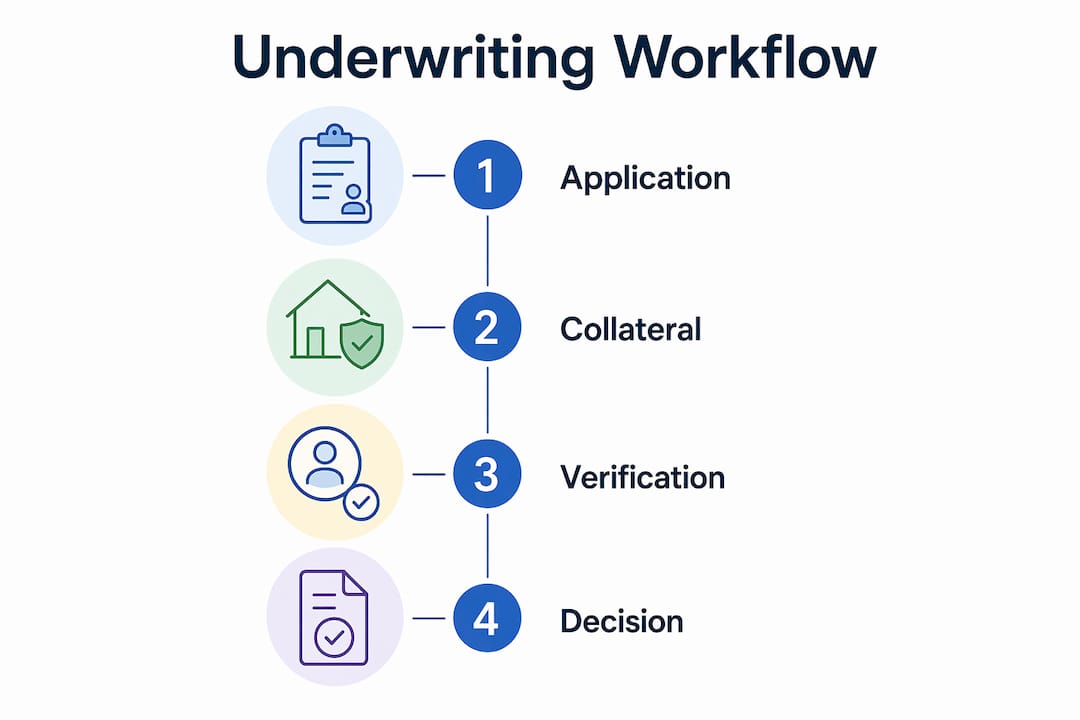
Stage 1: Application and pre-approval. For complex credits, this stage must capture loan purpose, proposed capital structure, borrower entity type, and any offshore or SPV involvement. Incomplete information here creates compounding delays downstream.
Stage 2: Collateral review. Valuation methodology matters. A ground-up development site requires a gross development value assessment, not a simple comparable sales analysis. Commercial investment properties require a review of lease covenants, void risk, and tenant covenant strength.
Stage 3: Income and asset verification. This is where fintech platforms have transformed the process. Tools like Plaid connect directly to borrowers’ bank accounts, reducing manual document collection from days to minutes while enabling real-time fraud detection. For complex borrowers with multiple income streams, SPV distributions, or overseas earnings, this speed and accuracy is material.
Stage 4: Decision and funding. The decision stage for complex loans rarely produces a clean approve or decline. It produces a conditional approval with a list of requirements that must be satisfied before drawdown.
| Feature | Manual underwriting | Automated underwriting |
|---|---|---|
| Typical timeline | 10 to 25 days, plus condition responses | Milliseconds to initial decision |
| Best suited for | Complex income, unusual structures, borderline cases | Standard profiles with clean data |
| Output | Detailed credit write-up with conditions | Approve, deny, or refer with condition list |
| Human judgement | Central to every decision | Applied only at referral stage |
| Risk of error | Inconsistency across underwriters | Misclassification of genuinely complex cases |
Approximately 15 to 20% of mortgage files undergo some form of manual review, typically triggered by income verification failures, complex employment structures, or fraud alerts. This figure is higher for commercial and development finance, where manual review is the norm rather than the exception.
Pro Tip: Design your manual review queue to receive only complete files. Incomplete submissions entering manual review create the single biggest source of underwriting delay in complex loan portfolios. Build a pre-submission checklist specific to each loan type before the file moves to the underwriter.
What credit metrics and decisioning frameworks apply to complex loans?
Loan-to-value ratio and debt-to-income ratio remain the starting point, but they are insufficient on their own for complex credit assessment. A 65% LTV on a speculative development site carries more risk than an 80% LTV on a fully let prime commercial investment. Context and exit pathway matter more than the ratio itself.
Credit decisioning engines produce approve, deny, or refer outputs in milliseconds. For complex loans, the refer outcome is the most common and the most important. A referral is not a failure. It is the system correctly identifying that human judgement is required. The triggers for referral typically include:
- Borderline credit scores that sit within policy tolerance but carry qualitative concerns
- Unverifiable income from self-employment, distributions, or overseas sources
- Complex employment structures such as contractor arrangements or multiple directorships
- Collateral types outside standard valuation models
- Loan purposes involving development, conversion, or speculative exit strategies
For leveraged lending specifically, regulatory expectations require underwriters to assess not just current coverage ratios but the borrower’s capacity to de-lever over time and bring the capital structure to sustainability. Static ratios at origination tell you very little about a leveraged credit’s performance over a three to five year hold period.
The credit write-up for a complex loan must do more than summarise the numbers. It must articulate the loan purpose, the primary repayment source, the secondary repayment source, the key risk driver, and the borrower’s exit strategy. Attaching underwriting terms and conditions to the decision letter makes the approval defensible and creates a clear audit trail for portfolio management. For UK real estate debt specifically, covenant packages and reporting requirements should be documented at this stage, not negotiated after drawdown.
How to manage risk assessment: key risks versus trigger risks
The most consequential skill in complex loan underwriting is the ability to separate key risks from trigger risks. This distinction is what separates experienced credit analysts from those who react to every alarm in a complex file.
A key risk is the factor that directly drives the loss mechanism. A trigger risk is an event that may increase the probability of a problem but does not itself cause the impairment. Consider a construction loan where the development has pre-leased tenants. A tenant entering administration is a trigger risk. It is alarming and worth monitoring. But the key risk is the borrower’s ability to refinance or sell the completed asset at a value sufficient to repay the facility. If that exit pathway remains intact, the trigger event does not produce a loss.
Misclassifying trigger risks as key risks produces two bad outcomes. Underwriters either decline viable credits because they react to noise, or they spend disproportionate time analysing factors that cannot actually cause a loss. Both outcomes damage portfolio quality.
Practical techniques for separating the two include:
- Loss mechanism mapping: Write out explicitly how this loan produces a loss. Work backwards from the loss event to identify which single factor is most directly responsible.
- Assumption stress testing: Identify the two or three assumptions the underwriting relies on most heavily. Test what happens when each one fails independently and in combination.
- Exit pathway analysis: For any loan dependent on a sale or refinance exit, model the minimum asset value and market conditions required for the exit to succeed.
Pro Tip: Write an explicit underwriting memo for every complex credit that states the key risk in one sentence, the loss mechanism in two sentences, and the contingency strategy in three. This forces clarity and creates a reference point for portfolio review if conditions change post-origination.
Underwriting memos that justify loss drivers, assumptions, and borrower exit strategies are not administrative overhead. They are the primary tool for communicating credit quality to credit committees, investors, and regulators. For bridging and development finance, where exit risk is the dominant concern, a well-constructed memo is often the difference between a credit committee approval and a referral back for further analysis.
What are the common challenges in underwriting complex loans?
Document-heavy verification remains the primary bottleneck in complex loan underwriting. A leveraged acquisition involving an SPV, multiple guarantors, and offshore equity can generate hundreds of pages of financial information before the underwriter has assessed a single risk factor.
Fintech verification tools address part of this problem. Digital connectivity to borrower bank accounts and payroll systems reduces the manual document collection burden, freeing underwriters to focus on judgement rather than administration. The efficiency gain is not marginal. It is structural.
Condition management is the second major challenge. Automated underwriting systems routinely generate condition lists of five to twenty items before a clear-to-close is issued. For complex loans, this list is longer and the conditions are more substantive. Responding to conditions thoroughly and promptly is the single most controllable variable in underwriting timeline.
Common pitfalls and how to address them:
- Incomplete initial submissions: Resolve by building loan-type-specific document checklists that borrowers and brokers complete before submission.
- Unusual income structures triggering unnecessary manual review: Resolve by pre-qualifying income documentation standards with the borrower before application.
- Condition responses that partially address requirements: Resolve by assigning a single point of contact on the borrower side with authority to gather and submit all conditions.
- Loan declines on complex credits: If declined, applicants receive specific reasons and may reapply with restructured terms or additional security. A decline on a complex credit is often a structuring problem rather than a credit quality problem.
For professionals working on real estate funding strategies, understanding where the underwriting process is most likely to stall allows you to front-load the work that matters and compress the overall timeline.
Key takeaways
Effective complex loan underwriting requires separating key risks from trigger risks, applying structured workflows, and using both technology and professional judgement in combination.
| Point | Details |
|---|---|
| Separate key from trigger risks | Identify the direct loss mechanism rather than reacting to every risk signal in the file. |
| Use fintech for verification | Digital bank connectivity reduces document collection from days to minutes, freeing underwriters for analysis. |
| Write explicit credit memos | State the key risk, loss mechanism, and exit strategy clearly in every complex credit write-up. |
| Manage conditions proactively | Condition lists of five to twenty items are standard; prompt and complete responses control the timeline. |
| Apply regulatory standards | Leveraged lending requires de-levering capacity assessment, not just static coverage ratios at origination. |
What I have learned from structuring complex credits
The professionals who underwrite complex loans well share one habit: they are comfortable sitting with uncertainty long enough to understand it properly. The instinct in complex credit is to resolve ambiguity quickly, either by approving with conditions or declining and moving on. Both responses can be wrong if the underlying risk analysis is incomplete.
What I have found, working across ground-up developments, leveraged acquisitions, and multi-tranche debt stacks, is that the quality of the underwriting memo predicts the quality of the decision more reliably than any single financial metric. When an underwriter can articulate the loss mechanism in two sentences, they have done the work. When they cannot, no amount of ratio analysis will compensate.
Technology has genuinely improved the process. Fintech verification tools have removed the administrative drag that used to consume underwriter time on document collection. But the judgement layer, the part that separates a viable complex credit from a disguised problem, remains entirely human. Treating automated referrals as failures rather than as invitations for proper analysis is the most common mistake I see in complex loan portfolios.
The other point worth making is this: complexity is not a reason to decline. It is a reason to analyse more carefully. Some of the strongest credits in a well-managed portfolio are complex ones, precisely because the analysis required to approve them deters less disciplined lenders and creates better pricing and terms for those who do the work properly.
— James
How James William & Co can support your complex credit structuring
James William & Co Capital works with UK property developers, institutional investors, and high-net-worth clients on exactly the type of complex credits this guide addresses. From ground-up development finance and leveraged acquisitions to multi-tranche debt stacks involving mezzanine, senior debt, and JV equity, the firm structures and negotiates facilities where standard lenders stop.
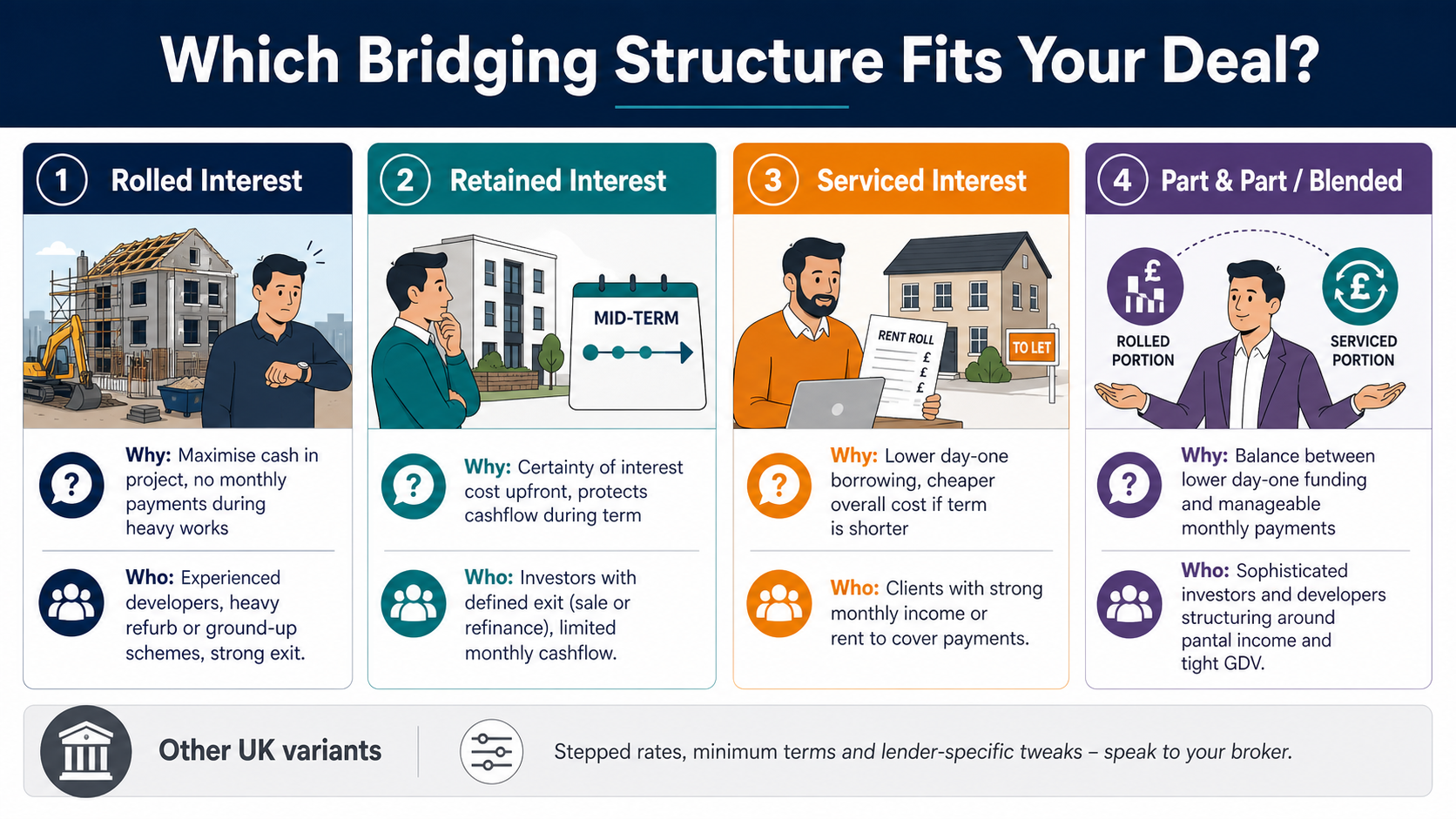
The capital concierge approach means a single point of contact manages the full underwriting and execution process, from initial credit assessment through to drawdown. For professionals who need specialist property finance in London or across the UK, James William & Co brings lender relationships, structuring expertise, and execution speed to transactions that require all three. If your next deal involves a complex credit profile, speak to the team before you submit elsewhere.
FAQ
What is the difference between key risks and trigger risks in loan underwriting?
A key risk is the factor that directly causes a credit loss, such as a borrower’s inability to refinance at exit. A trigger risk is an event that may increase concern but does not itself produce the impairment, such as a tenant default in a pre-let development.
How long does complex loan underwriting typically take?
Standard business loan underwriting takes 24 to 72 hours for straightforward cases, but complex loans involving manual review, condition lists, and multi-party verification typically take 10 to 25 days or longer depending on documentation quality.
When does a credit decisioning engine refer a loan for manual review?
Referrals are triggered by borderline credit scores, unverifiable income, complex employment structures, or collateral types outside standard models. A referral indicates the system requires human judgement, not that the application has failed.
What should a complex loan underwriting memo include?
An effective underwriting memo states the loan purpose, primary and secondary repayment sources, the key risk driver, the loss mechanism, and the borrower’s exit strategy. This structure makes the decision defensible and supports portfolio monitoring post-origination.
How does fintech improve the complex loan underwriting process?
Fintech platforms that connect directly to borrower bank accounts reduce manual document collection from days to minutes and enable real-time fraud detection, allowing underwriters to concentrate on risk analysis rather than data gathering.
Recommended
Related Topics
Speak to a specialist
Discuss your finance with James directly
Whole-of-market specialist finance — bridging, development, commercial and residential. No call centres, no obligation. James reviews every enquiry personally.
New to specialist finance? How unbiased broker advice works · Deals we have completed
Explore Related Finance