
Published · Updated
long-income property finance typesLong-income property finance types: a UK investor's guide
By James Dawes, CeMAP, Founder, James William & Co Capital

TL;DR:
- Long-income property finance in the UK focuses on long-term loans secured against income-producing real estate, emphasizing property cash flow over borrower income. The main types include permanent commercial mortgages, CMBS conduit loans, DSCR loans, bridge loans, and mini-perm loans, each suited for different asset profiles and risk levels. Investors must carefully sequence financing stages and model exit costs to avoid refinancing risks and maximize returns.
Long-income property finance refers to long-term, income-focused lending secured against stabilised, income-generating real estate assets. In the UK market, this category covers permanent commercial mortgages, CMBS conduit loans, DSCR loans, and transitional products such as bridge and mini-perm facilities. Lenders prioritise DSCR and NOI coverage over borrower personal income, which shifts the entire underwriting logic toward the asset rather than the individual. For property investors and developers planning long-term holds or refinancing exits, understanding these long-income property finance types is not optional. It is the foundation of every sound capital structure.
1. What are the main long-income property finance types?

The UK market offers five core structures for income property financing. Each suits a different asset profile, hold period, and risk appetite.
Permanent commercial mortgages
Permanent commercial mortgages are the bedrock of long-income lending. Terms run 5–10+ years with amortisation periods of 25–30 years, secured against stabilised, operating properties. Life insurers and pension funds dominate this space, preferring non-recourse or limited-recourse structures tied directly to property income.
Pros:
- Low default risk due to income-producing collateral
- Long amortisation reduces monthly debt service pressure
- Fixed or floating rate options available
Cons:
- Strict stabilisation requirements before qualification
- Prepayment can be costly depending on lender terms
- Slower to close than transitional products
CMBS conduit loans
CMBS conduit loans offer fixed-rate, non-recourse debt with typical terms of 5, 7, or 10 years, amortised over 25–30 years. The loans are pooled and sold as bonds, which gives investors rate certainty but removes lender flexibility post-closing. Servicing is handled by a third-party servicer, not the originating lender.
Pros:
- Non-recourse structure protects borrower assets
- Competitive fixed rates tied to bond market pricing
- Suitable for large, stabilised commercial assets
Cons:
- Defeasance or yield-maintenance penalties make early exit expensive
- Servicer restrictions limit lease modifications and capital expenditure approvals
- Not suitable for assets with unstable or transitional income
DSCR loans
DSCR loans qualify on property cash flow alone, bypassing borrower income documentation entirely. This makes them the preferred tool for investors scaling residential rental portfolios or small multifamily assets. Closing timelines are faster than agency alternatives, though the rate premium is typically 50–150 basis points above conventional products.
Pros:
- No personal income verification required
- Fast closing supports portfolio scaling
- Flexible underwriting suits complex ownership structures
Cons:
- Rate premium versus agency or life company finance
- Loan size limits restrict use on larger assets
- Less suitable for commercial or mixed-use properties
Bridge loans
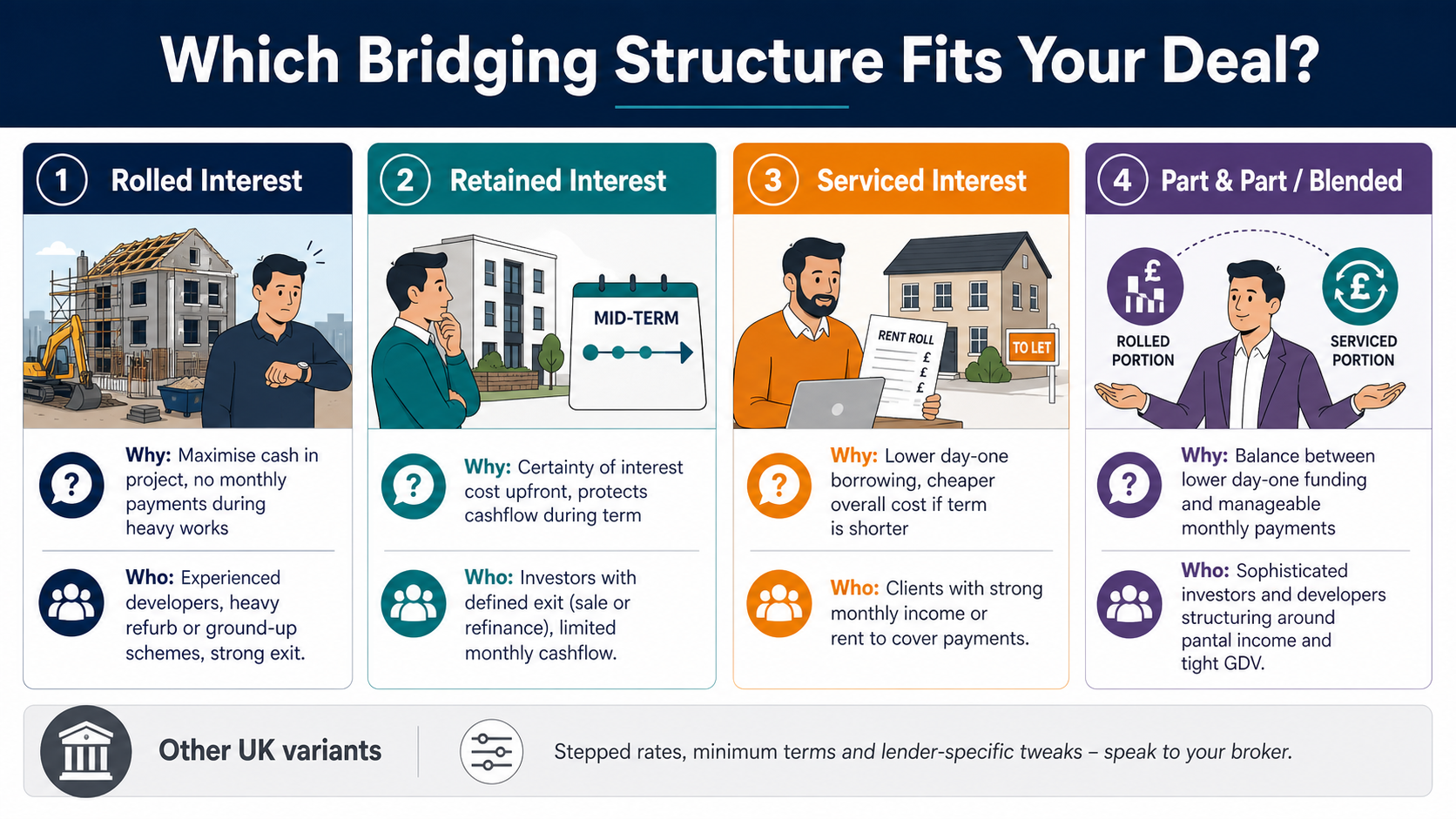
Bridge loans cover the gap between construction completion and permanent finance, typically running 1–3 years at higher floating rates. They are not long-income products in themselves, but they are the entry point into the long-income financing sequence for assets that are not yet stabilised.
Pros:
- Fast to arrange and draw
- Flexible covenants during lease-up period
- Interest-only structures preserve cash during stabilisation
Cons:
- Higher cost than permanent finance
- Refinancing risk if stabilisation takes longer than projected
- Lender may require take-out commitment before drawdown
Mini-perm loans
Mini-perm loans sit between bridge and permanent finance, with terms of 2–5 years and possible extension options tied to performance milestones. They give developers time to stabilise income without committing to full permanent loan terms prematurely. Rates are fixed or floating depending on lender and market conditions.
Pro Tip: Match your mini-perm term to your realistic lease-up timeline, not your optimistic one. Lenders will stress-test your assumptions, and extension options are not guaranteed.
2. How do long-income finance options compare on terms, risk, and lender profiles?
Choosing between income property financing options requires a direct comparison of term length, rate structure, recourse, and lender type. The table below sets out the key differences.
| Finance type | Typical term | Rate type | Recourse | Primary lender | Risk profile |
|---|---|---|---|---|---|
| Permanent commercial mortgage | 5–10+ years | Fixed or floating | Non-recourse or limited | Life insurers, pension funds | Low default risk, interest rate risk |
| CMBS conduit loan | 5, 7, or 10 years | Fixed | Non-recourse | CMBS conduits, bond market | Low default risk, high prepayment cost |
| DSCR loan | 5–30 years | Fixed or adjustable | Recourse | Specialist lenders, private credit | Moderate, cash flow dependent |
| Bridge loan | 1–3 years | Floating | Full recourse | Banks, debt funds | Higher, transitional asset risk |
| Mini-perm loan | 2–5 years | Fixed or floating | Recourse or limited | Banks, specialist lenders | Moderate, stabilisation dependent |
The most misunderstood risk in long-term property loans is the amortisation versus term mismatch. A 10-year term on a 30-year amortisation schedule leaves a large balloon payment at maturity. Investors must model refinancing costs at that point, including the possibility of higher rates or tighter lending conditions.
CMBS loans carry a specific exit risk. Defeasance and yield-maintenance requirements mean that breaking a CMBS loan early can cost more than the interest saving justifies. Non-recourse positioning trades flexibility for institutional features. Investors who value the ability to sell or refinance opportunistically should weigh this carefully before committing to a CMBS structure.
Permanent loans carry lower default risk because the collateral is an operating, income-generating asset. The primary risk is interest rate exposure over the loan term, particularly for floating-rate structures.
Pro Tip: Model your exit strategy before you sign the term sheet. The cost of breaking a CMBS loan or refinancing a balloon at an inopportune moment can materially erode returns.
3. What transitional financing options lead into long-income finance?
Properties not yet stabilised cannot qualify for permanent long-income products. Developers and investors must sequence their finance correctly to avoid default and preserve the option to access favourable permanent terms later.
The standard sequence runs as follows:
- Construction loans: Short-term, floating-rate facilities with milestone-based drawdowns. High risk, high cost, and fully recourse. Used during the build phase before any income is generated.
- Bridge loans: 1–3 year facilities that cover the lease-up period after practical completion. The asset is generating some income but has not yet reached the occupancy or DSCR thresholds required by permanent lenders.
- Mini-perm loans: 2–5 year intermediate facilities that give the asset time to reach full stabilisation. Extension options tied to performance metrics provide a safety valve if lease-up takes longer than planned.
- Permanent finance: The end-state product. Life insurers, pension funds, and CMBS conduits step in once the asset demonstrates consistent, auditable income.
Securing construction loans with take-out commitments from permanent lenders is the most effective way to manage sequencing risk. A take-out commitment gives the construction lender confidence that the exit is pre-arranged, which often improves construction loan terms. It also forces the developer to engage with permanent lenders early, surfacing any structural issues before they become expensive problems.
Staged financing with construction and interim loans transitioning to permanent products is the standard risk management approach for UK developers working on ground-up or major refurbishment projects. Skipping stages to save cost rarely works. Lenders see through optimistic stabilisation assumptions.
4. Which finance types best suit different investment scenarios?
The best financing for rental properties and commercial assets depends on property type, scale, and hold strategy. There is no universal answer, but there are clear patterns.
Small multifamily and residential rental portfolios
DSCR loans are the most practical tool for investors building residential rental portfolios. DSCR loans enable portfolio scaling by qualifying on property income alone, which removes the personal income ceiling that limits conventional mortgage borrowing. Investors with complex ownership structures, offshore vehicles, or SPV arrangements benefit most from this flexibility.
Large commercial and retail assets
CMBS conduit loans suit stabilised, large-format commercial assets where the borrower wants fixed-rate certainty and non-recourse protection. The bond-market pricing mechanism often produces competitive rates for high-quality assets. The trade-off is the loss of flexibility post-closing.
Hospitality and niche assets
Hotels, serviced apartments, and other operational real estate present underwriting challenges that most permanent lenders avoid. Income volatility, management dependency, and sector-specific risks push these assets toward specialist debt funds or private credit rather than life company or CMBS finance. Real estate debt options for niche assets require bespoke structuring.
Refinancing and balloon risk management
Investors approaching a loan maturity should begin refinancing conversations at least 12 months before the balloon date. Commercial loans require careful management of amortisation and balloon risk, particularly in rising rate environments. Locking in a new permanent facility early removes market timing risk from the equation.
Pro Tip: Match your debt structure to your property’s cash flow stability. A volatile income stream and a fixed-rate CMBS loan with defeasance penalties is a combination that destroys value at exit.
For a broader view of property finance structures available to UK developers, the range of products extends well beyond the five types covered here.
Key takeaways
The most effective long-income property finance strategy sequences transitional and permanent products to match the asset’s income maturity, with lender type and recourse structure chosen to fit the investor’s exit plan.
| Point | Details |
|---|---|
| Permanent loans suit stabilised assets | Life insurers and pension funds lend on proven income, not borrower salary. |
| CMBS loans trade flexibility for certainty | Fixed rates and non-recourse come at the cost of expensive prepayment penalties. |
| DSCR loans accelerate portfolio growth | Qualifying on property cash flow removes the personal income ceiling for investors. |
| Sequencing finance reduces development risk | Construction, bridge, and mini-perm loans must be arranged in the correct order. |
| Model the balloon before you sign | Refinancing costs at maturity can erode returns if not planned from day one. |
The financing mistake I see most often
Most investors I speak to focus almost entirely on the rate. They compare headline numbers across lenders and choose the cheapest option. That is the wrong frame entirely.
The question that actually matters is: what does this loan cost me at exit? A CMBS loan priced 30 basis points below a bank loan looks attractive on day one. Three years later, when a tenant vacates and you want to sell, the defeasance calculation can run to seven figures. The rate advantage evaporates instantly.
The other pattern I see repeatedly is under-investment in the transitional phase. Developers secure construction finance and assume the bridge-to-permanent transition will be straightforward. It rarely is. Lease-up takes longer than the model, the permanent lender’s DSCR threshold is not met, and the bridge lender starts charging default interest. The solution is always the same: engage permanent lenders before you need them, not after.
The UK property finance market in 2026 is more lender-diverse than it was five years ago. Private credit funds have filled gaps that banks vacated after 2022. That is genuinely good news for investors. But more options also means more complexity, and complexity rewards preparation.
The investors who consistently get the best terms are the ones who arrive at lender conversations with a fully modelled debt stack, a clear exit strategy, and a realistic stabilisation timeline. Lenders respond to preparation. They price risk, and a well-prepared borrower is a lower-risk borrower.
— James
Long-income property finance with James William & Co
James William & Co arranges long-term, income-focused property finance for investors and developers across the UK, from permanent commercial mortgages and CMBS structures to DSCR facilities and staged development finance.
The firm’s capital concierge approach means you have a single point of contact for the full debt stack, from construction through to permanent refinancing. James William & Co works with life insurers, pension funds, private credit funds, and specialist lenders to structure finance that fits the asset, not just the borrower. For investors and developers seeking specialist property finance in London and across the UK, James William & Co delivers structured solutions at speed.
FAQ
What is long-income property finance?
Long-income property finance is long-term lending secured against stabilised, income-generating real estate. Lenders underwrite on property cash flow rather than borrower personal income.
Which lenders provide long-income commercial mortgages in the UK?
Life insurers, pension funds, and CMBS conduits dominate permanent long-income lending, focusing on stabilised assets with auditable income histories.
What is the difference between a bridge loan and a mini-perm loan?
Bridge loans run 1–3 years and cover the immediate post-construction period. Mini-perm loans extend this phase to 2–5 years, giving assets more time to reach the income thresholds required by permanent lenders.
Are CMBS loans available for UK commercial property?
CMBS conduit lending is more prevalent in the US market. UK investors typically access equivalent fixed-rate, non-recourse structures through life company lenders or specialist debt funds rather than bond-market conduits.
What does DSCR mean in property finance?
DSCR stands for Debt Service Coverage Ratio. It measures whether a property generates enough net income to cover its loan repayments, and it is the primary underwriting metric for income property loans.
Recommended
Related Topics
Speak to a specialist
Discuss your finance with James directly
Whole-of-market specialist finance — bridging, development, commercial and residential. No call centres, no obligation. James reviews every enquiry personally.
New to specialist finance? How unbiased broker advice works · Deals we have completed
Explore Related Finance