
Published · Updated
explaining multi-layered financingMulti-Layered Financing Explained for UK Developers
By James Dawes, CeMAP, Founder, James William & Co Capital

Complex property projects in London often demand more than traditional funding approaches. As London’s market shifts and capital requirements rise, savvy developers turn to multi-layered financing structures that blend senior debt, mezzanine finance, bridging loans, and equity. This article unpacks how layered capital strategies can optimise funding, enhance deal flexibility, and reduce risk in challenging environments, drawing on proven UK-specific models and regulatory insights.
Table of Contents
- Multi-layered Financing In Property Deals
- Types Of Debt Stacks And Equity Layers
- Structuring Multi-layered Finance For Projects
- Legal And Regulatory Requirements For Uk Financing
- Risks, Mistakes, And Mitigation Strategies
Key Takeaways
| Point | Details |
|---|---|
| Multi-layered Financing | Successful property deals often utilise multiple layers of financing to optimise capital structure and reduce risk. |
| Role of Senior Debt | Senior debt provides the foundation, typically covering 50-70% of project value with the lowest cost of capital. |
| Importance of Mezzanine Finance | Mezzanine finance bridges funding gaps not covered by senior debt, accepting higher risk for commensurate returns. |
| Risks of Over-Leverage | A well-structured financing stack should maintain an equity buffer to mitigate risks from construction overruns and market fluctuations. |
Multi-layered financing in property deals
Complex property transactions rarely rely on a single funding source. Instead, successful London developers stack multiple financing layers—each serving a distinct purpose within the capital structure. This approach transforms how you acquire, develop, and refinance significant real estate assets.
Multi-layered financing combines different debt instruments and equity components into a coordinated whole. Think of it as building financial scaffolding: senior debt forms the foundation, mezzanine finance fills the middle, and equity anchors the top. Each layer has distinct terms, risk profiles, and cost implications.
Why does this matter for your deals? Because a single lender rarely provides 100% of required capital. By structuring development loans and multi-layer debt arrangements, you unlock capital that wouldn’t otherwise be available, optimise your cost of capital, and maintain flexibility as project conditions change.
The Foundation: Senior Debt
Senior debt sits at the bottom of your capital stack. Traditional bank mortgages and development loans occupy this space. These lenders have first claim on assets and cash flow, so they accept the lowest interest rates—typically 4-6% for quality projects.
Key characteristics of senior debt:
- First security position on property and assets
- Most stringent lending criteria and covenant packages
- 5-10 year terms with repayment from sales or refinancing
- Typically covers 50-70% of project value
- Lowest cost of capital in your stack
For acquisition deals, senior lenders fund the bulk of purchase price. For development schemes, they cover land, construction, and hard costs. These loans form your financial bedrock.
The Middle Layer: Mezzanine Finance
Mezzanine debt sits between senior lending and equity. It’s subordinated to senior debt but senior to equity, creating a unique risk-return profile. Mezzanine lenders accept higher risk in exchange for double-digit returns—typically 12-18%.
Mezzanine finance bridges gaps senior lenders won’t fill. Perhaps your senior lender maxes out at 65% loan-to-value, but your deal needs 85% total leverage. Mezzanine finance covers that 20% gap.
Mezzanine characteristics:
- Second charge on property assets
- Higher interest rates reflecting subordinated position
- Often includes equity kickers or profit participation
- Flexible covenants compared to senior lenders
- 3-5 year terms matching development cycles
You’ll encounter specialist mezzanine funds, family offices, and institutional investors providing this layer. They’re comfortable with development risk because the return compensates for waiting behind senior lenders in a default scenario.
The Equity Component
Equity sits at the top. You, your partners, or joint venture investors contribute equity capital. This is the riskiest layer—equity holders only receive returns after debt obligations are met.
Equity provides:
- Absorbs downside risk protecting debt holders
- Typically targets 15-30% returns (or more)
- Demonstrates your commitment to lenders
- Often required as 10-25% of total capital
- May come from your own funds or external partners
Higher equity contributions strengthen your borrowing capacity. Lenders see skin-in-the-game as commitment to project success.
This table summarises the typical roles and business impact of each capital layer in multi-layered property financing:
| Capital Layer | Role in Deal | Risk Exposure | Impact on Flexibility |
|---|---|---|---|
| Senior Debt | Main project funding | Lowest (first claim) | Restricts flexibility |
| Mezzanine | Fills funding gap | Medium (subordinated) | Adds leverage options |
| Bridging | Temporary solution | High (short term) | Enhances timing agility |
| Equity | Final risk buffer | Highest (last claim) | Maximises lender trust |
Bridging Finance in the Stack
Development financing has become increasingly layered, with bridging loans often acting as temporary layers within multi-phase transactions. Bridging covers acquisition gaps, refinance shortfalls, or phases before permanent funding closes.
Bridging characteristics:
- Short-term facility (12-36 months typically)
- Higher cost (8-15%) reflecting temporary nature
- Quick deployment for time-sensitive opportunities
- Rolls into permanent financing or project sale proceeds
- Provides flexibility between capital stack transitions
Savvy developers use bridging strategically. Exchange contracts while permanent lender approvals process. Acquire properties with bridging, then refinance into development finance once plans obtain planning permission.
Structuring matters as much as sourcing. The wrong layer arrangement doubles your costs and restricts flexibility; the right structure accelerates deals and maximises returns.
Pro tip: Work backwards from your exit. If selling in 24 months, ensure mezzanine and bridging terms align with sale timing. Mismatched maturity dates create refinancing pressure when you’re vulnerable.
Types of debt stacks and equity layers
Different property deals demand different capital structures. A straightforward acquisition stacks differently than a ground-up development. Understanding common stack configurations helps you match financing to your specific transaction.
Debt stacks aren’t arbitrary arrangements. They reflect project risk, developer experience, exit timelines, and lender appetite. The right structure reduces costs; the wrong one creates complications that derail deals or destroy returns.
Think of stacking as a conversation between what you need and what lenders will provide. Your architect designs the building; you design the financing to support it.
The Standard Two-Layer Stack
Simple deals often use two layers: senior debt plus equity. You find this in stabilised acquisitions where risk is minimal and cash flow predictable.
Two-layer structure:
- Senior loan covering 60-75% of purchase price
- Equity covering 25-40%
- No mezzanine complexity
- Lower total cost (fewer intermediaries)
- Fastest closing timeline
A maturing London office building with strong tenants might use this approach. Senior lenders feel comfortable. You’re confident about valuations. No subordinated debt layers complicate negotiations.
The Three-Layer Stack: Adding Mezzanine
Development deals typically require three layers. Senior debt, mezzanine finance, and equity layers work together to deploy capital efficiently across different risk profiles.
Three-layer breakdown:
- Senior debt: 60-65% loan-to-value
- Mezzanine: 15-20% of total capital
- Equity: 15-25% of total capital
Your £50 million development deal becomes £30 million senior, £10 million mezzanine, £10 million equity. Each layer funds different project phases. Senior covers land and foundations. Mezzanine bridges the construction gap. Equity demonstrates commitment.

This structure unlocks leverage senior lenders alone won’t provide whilst managing overall cost of capital.
High-Leverage Stacks: Four or More Layers
Ambitious developers sometimes stack four or five layers for maximum deployment. Picture a complex mixed-use scheme with acquisition timing pressure, planning risk, and extended construction.
High-leverage stacks might include:
- Senior A loan (55-60%)
- Mezzanine A (12-15%)
- Mezzanine B (10-12%)
- Bridging (5-10%)
- Equity (8-10%)
Each layer serves a purpose. Senior A funds the core acquisition. Mezzanine A covers early construction. Mezzanine B backfills if costs exceed budget. Bridging handles timing gaps. Equity demonstrates control and commitment.
Complex stacks cost more to arrange and manage. Interest rates stack upwards. You pay arrangement fees on each layer. But for deals otherwise impossible to fund, the added cost becomes worthwhile.
Acquisition vs Development Stack Differences
Acquisitions typically use simpler stacks. Risk is known—the building exists, tenancy is set, income is proven. Lenders feel confident with two or three layers.
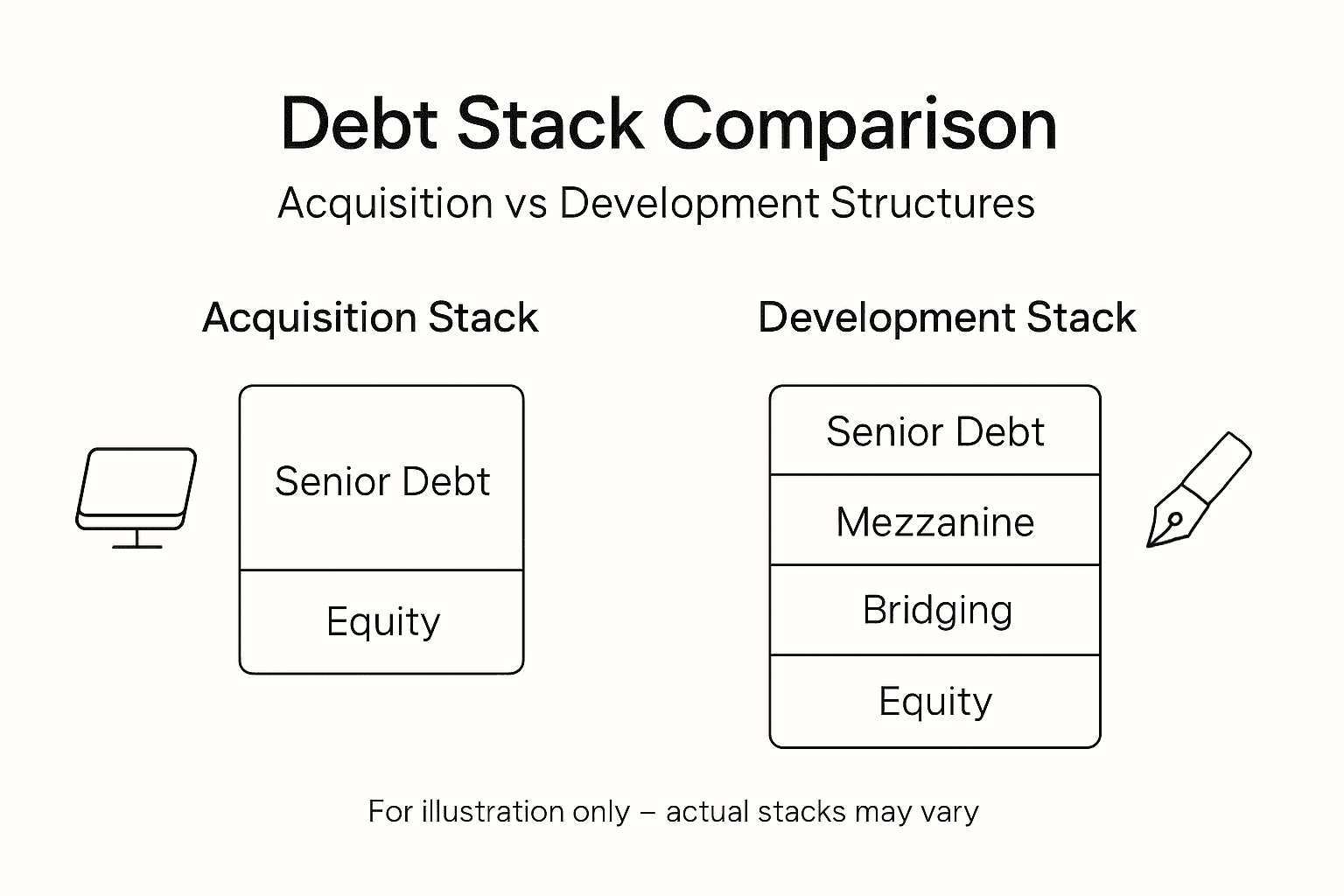
Developments demand more layers. Construction risk, planning risk, and market risk require diversified capital sources. Lenders insist on equity buffers. Subordinated debt holders accept higher returns for that risk.
Bridging appears frequently in development stacks. Acquisition financing often excludes it entirely (you close with permanent capital).
Here is a comparison of stack types for property acquisition versus development projects:
| Stack Type | Acquisition Projects | Development Projects |
|---|---|---|
| Layers Used | Two or three (senior, equity) | Three to five (multiple debt) |
| Risk Complexity | Low, predictable income | High, planning and build risk |
| Leverage Levels | Moderate, stable returns | Higher, variable returns |
| Common Bridging | Rarely included | Often used for transitions |
Stack complexity should match project risk and timeline, not maximise leverage for its own sake. A simpler stack with higher certainty often closes faster and cheaper than a complex stack struggling for approval.
Pro tip: Document your ideal stack before approaching lenders. Show senior lenders exactly what mezzanine you’ve secured—it demonstrates you’ve solved their leverage constraint. Mezzanine providers want to see senior commitments confirming they won’t fund an under-leveraged deal.
Structuring multi-layered finance for projects
Structuring requires discipline. You’re orchestrating multiple capital sources, each with competing interests, different maturity dates, and distinct return expectations. Misalign one layer and the entire deal collapses.
Start with your exit. Work backwards. If you’re selling in three years, your longest-dated debt must mature by year three. If costs run 15% over budget, can your mezzanine layer absorb it? These decisions cascade through every other layer.
Structuring isn’t guesswork. It’s problem-solving with numbers.
Define Your Capital Requirement First
You cannot structure financing without knowing exactly how much capital you need. Vague estimates create chaos.
Calculate precisely:
- Land acquisition or purchase price
- Construction costs (hard and soft)
- Professional fees (architects, engineers, legal)
- Planning and regulatory compliance
- Working capital and contingency
- Interest carry during construction
- Refinance or sale costs at exit
Add 10-15% contingency on top. Add another 5% for refinance costs. Now you have your true capital requirement. This number determines your entire stack.
A £40 million project becomes £50 million with contingency and costs. You don’t have a £40 million financing problem; you have a £50 million one.
Match Debt Maturity to Project Timeline
Maturity mismatch kills deals. Your senior loan matures in five years. Your development completes in four years. That’s fine. Your mezzanine matures in three years but construction runs to year four? You’re refinancing under pressure when valuations are uncertain.
Maturity planning:
- Senior debt: Matches or exceeds your exit timeline
- Mezzanine: Extends 6-12 months beyond project completion
- Bridging: Covers specific gaps, not entire project
- Equity: Perpetual (no maturity pressure)
Longer-dated debt costs more. Shorter-dated debt costs less but creates refinance risk. The right maturity structure balances cost against certainty.
Layer Interest Costs Strategically
Each layer has a different cost. Senior costs 5-7%. Mezzanine costs 12-18%. Bridging costs 8-15%. Equity expects 15-30% returns.
Higher leverage means more high-cost debt. Your blended cost of capital rises. Too much cheap senior debt? You underutilise capital and leave returns on the table.
Calculate your blended rate:
- Multiply each layer by its cost
- Sum all costs
- Divide by total capital
- Compare to your project’s return expectations
If your deal returns 12% but blended cost is 13%, the deal fails. You need better economics or a simpler (cheaper) stack.
Covenant Packages and Financial Covenants
Each lender imposes covenants. Senior lenders want strict financial ratios. Mezzanine lenders relax them slightly. You need flexibility as circumstances change.
Common covenants:
- Loan-to-value thresholds
- Interest coverage ratios
- Debt service coverage ratios
- Cash reserve requirements
- Construction budget overrun limits
Negotiate these before funding closes. A restrictive covenant you breach mid-construction creates cross-default risk across your entire stack. Understanding debt structures means grasping how these covenants interconnect across layers.
The best-structured deal has the fewest covenants creating the most flexibility, not the lowest interest rate creating the most cost pressure.
Pro tip: Create a waterfall model showing how funds flow in (at funding close) and how they deploy throughout your project timeline. This prevents under-funding gaps and shows lenders you’ve thought through cash management completely.
Legal and regulatory requirements for UK financing
UK property financing operates within a strict regulatory framework. The Financial Conduct Authority (FCA), Prudential Regulation Authority (PRA), and various UK legislation govern how lenders structure deals, what they can lend, and how they assess borrower risk.
Understand these rules. Breach them and deals collapse. Ignore them and you face enforcement action, loan acceleration, or personal liability.
Regulation protects lenders but also protects you. Clear rules mean predictable behaviour from capital providers.
FCA and PRA Regulatory Framework
The FCA regulates financial conduct. The PRA regulates prudential matters—essentially, whether lenders have enough capital to cover losses. Both bodies set rules that flow downstream to your financing.
Key regulatory points:
- Lenders must hold adequate capital reserves
- Senior debt requires stronger capital backing than mezzanine
- Loan documentation must meet specific standards
- Lenders must assess borrower creditworthiness thoroughly
- Conduct rules prohibit misleading lending practices
These rules increase compliance costs for lenders, which flows into your borrowing costs. A cheaper lender might face higher regulatory burden, pushing rates up. Conversely, well-capitalised lenders absorb regulatory costs more efficiently.
Loan Documentation Standards
UK financial regulations influence loan documentation requirements, ensuring consistency and protecting both lender and borrower interests. Standard clauses address security, covenants, representations, and remedies.
Documentation typically includes:
- Security over assets (first or second charge)
- Financial covenants (loan-to-value, interest cover ratios)
- Information covenants (quarterly accounts, budget updates)
- Undertakings (insurance, maintenance, compliance)
- Events of default (what triggers acceleration)
- Representations (warranties about your company, project, and financials)
Negotiating documentation costs time and money. Standard terms move faster. Pushing back on every clause slows closing and increases legal fees without meaningful benefit.
Money Laundering and Know Your Customer (KYC)
Anti-money laundering (AML) rules require lenders to verify your identity and source of funds. This isn’t bureaucracy—it’s a legal requirement enforceable through substantial fines.
Expect lenders to request:
- Beneficial ownership documentation
- Source of funds evidence
- Company formation and directorship records
- Personal tax returns (for significant equity contributors)
- Professional references and track record evidence
Provide this information proactively. Delays from incomplete KYC submissions push closing dates back weeks. Complete packages close faster.
Capital Adequacy for Multi-Layered Structures
Senior lenders face higher capital requirements than mezzanine providers. This regulatory burden makes senior lending less profitable per pound, explaining why senior rates remain lower despite their secured position.
Mezzanine lenders operate outside banking regulations (often). They deploy capital more flexibly, accepting higher risk for correspondingly higher returns. This regulatory asymmetry shapes market pricing.
Regulatory compliance costs money. Cheaper structures often mean shortcuts on due diligence or documentation. Expensive structures reflect thorough compliance. Pay for the latter; cheaper deals collapse later.
Pro tip: Prepare comprehensive KYC packages before approaching lenders. Include beneficial ownership structures, recent accounts, bank statements showing source of funds, and director identification documents. Early submission prevents closing delays when lenders request missing information.
Risks, mistakes, and mitigation strategies
Multi-layered financing introduces complexity. More layers mean more moving parts, more conflicting interests, and more ways deals fail. Understanding risks transforms you from reactive crisis-manager to proactive strategist.
Three categories of risk exist: structural risks (how layers interact), market risks (what happens if property values fall), and execution risks (does your team deliver on time and budget). Mitigate all three simultaneously or one weakness cascades through your entire deal.
Intercreditor Conflicts and Priority Disputes
When projects fail, lenders fight over assets. Senior lenders want to sell immediately and recover capital. Mezzanine lenders want time to restructure and preserve their investment. Intercreditor agreements establish creditor priorities and rules governing how they interact during financial distress.
Without intercreditor agreements, court battles consume assets faster than restructuring. Establish these agreements at funding close, not when problems emerge.
Key intercreditor provisions:
- Subordination (who has priority)
- Standstill periods (time to restructure before senior enforces)
- Consent rights (who must approve asset sales)
- Information sharing (what each lender knows)
- Amendment restrictions (preventing secret side deals)
Comprehensive intercreditor arrangements cost £20-50k in legal fees. That’s cheap compared to £5 million legal bills from lender disputes.
Over-Leverage and Insufficient Equity Buffers
You stack too much debt when equity buffers disappear. Construction costs run 20% over budget. Valuations fall 15%. Suddenly your equity cushion evaporates and mezzanine lenders become exposed to downside.
Mistakes in leverage:
- Underestimating construction contingency
- Ignoring soft costs and professional fees
- Assuming exit prices based on optimistic valuations
- Stacking more debt than market fundamentals justify
Mitigation requires building contingency into every estimate. Add 15% to hard costs. Add 8% to soft costs. Model downside scenarios where you still maintain 15% equity cushion.
Maturity Mismatches and Refinance Risk
Rising default rates in debt funds reflect poor maturity management. Your mezzanine matures before your senior. Your bridging expires before permanent financing closes. You’re refinancing into a weak market with negative leverage.
Maturity management strategy:
- Map each layer’s maturity date
- Plan your exit or refinance 6-12 months before maturity
- Build covenant flexibility for timing slippage
- Negotiate extension options before origination
- Maintain market relationships with alternative lenders
Lenders will offer extension options at origination for 0.5-1% cost. Buy them. They’re insurance against refinance pressure when markets turn.
Construction Budget Overruns
Projects run over budget. Weather delays. Labour shortages. Material price volatility. Supply chain disruptions. Factor these realities into your contingency.
Mitigation:
- Fixed-price construction contracts (contractor bears risk)
- Phased draws tied to completion milestones
- Contingency reserves held back until final completion
- Monthly cost tracking against budget
- Lender approval for budget overruns above thresholds
Multi-layered deals fail not from one catastrophic event, but from accumulation of small mistakes: missing contingency here, maturity mismatch there, insufficient equity buffer everywhere.
Pro tip: Stress-test your deal across three scenarios: base case (your plan works perfectly), bear case (construction costs run 20% over, rents fall 10%), and catastrophic case (costs plus 25%, rents fall 20%). If you still service debt in the bear case, you’ve structured correctly.
Master Multi-Layered Financing with Expert Guidance
Navigating multi-layered financing in UK property deals demands precision and strategic structuring. The complexities of senior debt, mezzanine finance, bridging loans and equity layers require a trusted partner who understands how to align maturities, manage covenants and optimise your cost of capital. Without expert advice, you risk costly delays, over-leverage and refinancing headaches.
At James William & Co Capital, we specialise in structuring sophisticated funding for UK developers, investors and high-net-worth clients. Whether you need seamless bridging finance solutions, tailored mezzanine debt or bespoke covenant packages, our capital concierge approach delivers rapid, flexible financing designed around your exit strategy. Discover how working with a dedicated debt structuring partner can turn your layered financing challenges into competitive advantage. Begin your journey to optimised capital stacks today at James William & Co.
Frequently Asked Questions
What is multi-layered financing in property deals?
Multi-layered financing refers to the practice of using multiple sources of funding, including senior debt, mezzanine finance, and equity, to finance property transactions. This approach helps developers optimise their cost of capital and maintain flexibility throughout the project.
What are the main components of a multi-layered financing structure?
The primary components are senior debt at the bottom, mezzanine finance in the middle, and equity at the top. Senior debt has the lowest risk and cost, mezzanine finance fills gaps and has a higher risk and return profile, while equity is the riskiest layer that absorbs downside risk for lenders.
How does mezzanine finance differ from senior debt?
Mezzanine finance is subordinated to senior debt, meaning it has a higher risk profile and typically comes with higher interest rates. While senior debt covers the majority of a project’s financing at lower costs, mezzanine finance helps bridge the funding gaps that senior lenders may not cover, often with returns between 12-18%.
Why is it important to structure financing correctly for property deals?
Correctly structuring financing is crucial as it minimizes costs and maximises returns. An improper arrangement can lead to increased interest rates, refinancing pressures, and ultimately, might jeopardise the project’s success. A well-structured layer approach aligns with project timelines and risk factors, enhancing flexibility.
Recommended
Related Topics
Speak to a specialist
Discuss your finance with James directly
Whole-of-market specialist finance — bridging, development, commercial and residential. No call centres, no obligation. James reviews every enquiry personally.
New to specialist finance? How unbiased broker advice works · Deals we have completed
Explore Related Finance