
Published · Updated
how to negotiate commercial mortgagesNegotiating a UK Commercial Mortgage: A 2026 Guide
By James Dawes, CeMAP, Founder, James William & Co Capital

Securing favorable terms on complex UK commercial mortgages remains a persistent challenge for developers and institutional investors. Many face rejections, delayed approvals, and unfavorable pricing because of inadequate preparation and weak negotiation tactics. This guide walks you through the complete negotiation process, from essential preparation through executing winning strategies, troubleshooting setbacks, and selecting optimal financing structures to secure better rates and streamlined approvals.
Table of Contents
- Prerequisites And Preparation Before Negotiation
- Step-By-Step Commercial Mortgage Negotiation Process
- Common Mistakes And Troubleshooting In Mortgage Negotiations
- Expected Outcomes, Timelines, And Success Metrics
- Trade-Offs And Alternative Financing Approaches
- Enhance Your Commercial Mortgage Strategy With James William & Co Capital
- Frequently Asked Questions
Key Takeaways
| Point | Details |
|---|---|
| Preparation drives success | Thorough documentation increases approval likelihood and negotiation leverage, including business plans and financial forecasts. |
| Broker expertise delivers measurable gains | Specialist brokers secure rates 0.5-1.0% lower and 20% faster approvals compared to direct lender approaches. |
| Common mistakes cause 30% rejections | Underestimating timeframes and incomplete documentation lead to rejection in up to 30% of UK commercial mortgage cases. |
| Typical approval takes 6 to 12 weeks | Success benchmarks include deposits at or below 30% and interest rates between 4.2% and 6%. |
| Multi-layer financing reduces costs | Strategic use of mezzanine debt and bridging loans can cut overall capital costs by up to 15%. |
Prerequisites and Preparation Before Negotiation
Before engaging lenders, you must assemble comprehensive financial and legal documentation. UK commercial mortgage underwriters scrutinize your ability to service debt and manage property cash flows rigorously. Weak preparation triggers delays, inflated pricing, or outright rejections.
Start with at least two years of audited financial accounts demonstrating consistent profitability and stable cash reserves. Lenders assess your trading history to gauge repayment capacity. If your accounts show volatility or thin margins, expect tougher terms or higher deposits.
Deposit requirements typically range from 20% to 40% of the property purchase price, varying by lender risk appetite and property type. Higher deposits reduce lender exposure, often unlocking better interest rates and more flexible covenants. Your credit profile and business experience also weigh heavily. Established developers with proven track records secure preferential treatment, while newer operators face stricter scrutiny and larger equity contributions.
A detailed, property-specific business plan is non-negotiable. Include realistic financial forecasts, occupancy assumptions, rental income projections, and exit strategies. Generic or overly optimistic plans raise red flags and weaken your negotiating position. To optimise real estate funding, tailor every forecast to the asset class and location.
Essential Documentation Checklist:
- Two years of audited accounts and tax returns
- Detailed business plan with property-specific forecasts
- Credit reports for all guarantors and directors
- Property valuation and survey reports
- Legal title documents and planning permissions
- Proof of deposit funds and anti-money laundering checks
Documentation errors account for a significant share of application failures. Missing valuations, unsigned forms, or incomplete financial disclosures can derail negotiations even when the underlying deal is sound. Engage legal counsel experienced in UK property and mortgage law early. They identify compliance gaps, structure personal guarantees properly, and negotiate covenant terms that protect your interests.
Pro Tip: Compile a digital data room with all documentation organized by category before approaching lenders. This accelerates due diligence, signals professionalism, and strengthens your negotiating credibility.
| Document Type | Purpose | Typical Requirement |
|---|---|---|
| Audited Accounts | Verify profitability and cash flow | 2 years minimum |
| Business Plan | Demonstrate viability and repayment capacity | Property-specific, detailed forecasts |
| Credit Reports | Assess borrower risk profile | All directors and guarantors |
| Property Valuation | Establish security value | RICS-qualified surveyor |
| Legal Title | Confirm ownership and encumbrances | Full title investigation |
Step-by-Step Commercial Mortgage Negotiation Process
With preparation complete, you can execute a systematic negotiation strategy designed to secure optimal terms while minimizing approval time. The UK commercial mortgage market is fragmented across high street banks, specialist lenders, family offices, and private credit funds. Each lender category has distinct appetites, pricing models, and structuring preferences.
Begin by researching lenders aligned with your property type, transaction size, and risk profile. High street banks favor stabilized assets with strong covenants, while specialist lenders accommodate higher-risk developments or complex structures. Mismatched lender selection wastes time and weakens your position.
Engaging a specialist commercial mortgage broker early delivers measurable advantages. Brokers access wholesale rates unavailable to direct applicants, benchmark terms across multiple lenders simultaneously, and negotiate on your behalf. Their market intelligence on lender appetite and recent pricing trends informs smarter positioning.
Negotiation Process Steps:
- Identify target lenders: Match property type, loan size, and risk profile to lender appetite through broker networks or direct research.
- Prepare negotiation pitch: Summarize financial strength, business track record, property fundamentals, and repayment strategy in a concise executive summary.
- Submit formal applications: Provide complete documentation packages to shortlisted lenders, coordinating timing to create competitive tension.
- Negotiate core terms: Focus on interest rate, loan duration, repayment structure, early repayment charges, and financial covenants.
- Structure multi-layer finance: Integrate senior debt with mezzanine finance, bridging loans, or equity to structure development finance that optimizes cost and flexibility.
Your negotiation pitch must emphasize financial strength and operational expertise. Highlight successful past projects, tenant quality, location advantages, and realistic exit strategies. Quantify rental yields, debt service coverage ratios, and loan-to-value metrics conservatively to build lender confidence.
Core negotiation points include interest rate spreads over base rates, fixed versus variable pricing, loan term length, and amortization schedules. Negotiate covenants carefully. Overly restrictive debt service coverage or loan-to-value maintenance covenants can trigger technical defaults even when the property performs adequately. Push for covenant flexibility tied to realistic performance benchmarks.
Multi-layer financing structures combine senior commercial mortgages with subordinated mezzanine debt or short-term bridging loans. This approach fills equity gaps, preserves liquidity, and can reduce overall capital costs by balancing cheaper senior debt with targeted higher-cost junior tranches. Structuring requires coordination across multiple lenders and careful intercreditor agreements, but the cost savings and flexibility often justify the complexity.
Pro Tip: Request term sheets from at least three lenders simultaneously. Use competing offers to negotiate better pricing and more favorable covenants, especially on early repayment penalties and covenant headroom.
Common Mistakes and Troubleshooting in Mortgage Negotiations
Even experienced developers stumble during commercial mortgage negotiations. Recognizing common errors and implementing practical fixes prevents costly delays and preserves deal momentum.
Underestimating application complexity and timeframes causes rejections in up to 30% of UK cases. Many applicants assume residential mortgage timelines apply, only to face extended underwriting, multiple valuation rounds, and legal negotiations stretching months. Build in buffer time. If your acquisition has a tight completion deadline, start mortgage negotiations at least three months ahead.

Ignoring credit score impacts undermines negotiation leverage. Personal and corporate credit histories influence pricing and deposit requirements significantly. Review credit reports for all directors and guarantors before applying. Dispute inaccuracies and address outstanding issues proactively. Lenders view poor credit management as a red flag for operational discipline.
Incomplete documentation packages trigger avoidable delays. Missing valuations, unsigned personal guarantee forms, or outdated financial statements force lenders to issue conditional offers or pause underwriting entirely. Cross-check every document against lender checklists before submission. Avoid real estate funding pitfalls by anticipating documentation gaps early.
Common Errors and Fixes:
- Error: Submitting generic business plans without property-specific analysis. Fix: Tailor every plan to the asset class, location, and tenant profile.
- Error: Overlooking ongoing operational costs in cash flow forecasts. Fix: Include maintenance reserves, void periods, and interest rate buffers in projections.
- Error: Poor communication with lenders during underwriting. Fix: Assign a single point of contact and respond to queries within 24 hours.
- Error: Inflexible negotiation stance on minor covenant terms. Fix: Prioritize deal-breaking issues and concede on less material points to maintain momentum.
“Many commercial mortgage rejections stem not from poor property fundamentals but from inadequate preparation and communication during the application process. Developers who treat lender engagement as a partnership rather than an adversarial negotiation consistently secure better outcomes.”
Troubleshooting setbacks requires swift diagnosis and decisive action. If a lender rejects your application, request detailed feedback on specific concerns. Address valuation shortfalls by commissioning second opinions or adjusting purchase price. If covenant terms prove unworkable, explore alternative lenders with more flexible underwriting or consider restructuring the transaction to improve metrics.
Expected Outcomes, Timelines, and Success Metrics
Setting realistic expectations for negotiation timelines and achievable terms helps you plan transaction execution and measure success objectively. UK commercial mortgage approvals typically require six to twelve weeks from initial application to final offer, assuming complete documentation and straightforward underwriting.
Complex transactions involving multiple properties, offshore structures, or non-standard security can extend timelines to four or five months. Factor in legal completion time, usually an additional four to six weeks, when planning acquisition schedules. Broker involvement compresses these timelines by pre-qualifying lenders and streamlining documentation review.
Success benchmarks vary by property type and borrower profile, but competitive outcomes in 2026 include deposits at or below 30%, interest rates between 4.2% and 6%, and loan terms extending 15 to 25 years. Prime London assets with strong covenants achieve pricing at the lower end, while secondary markets or higher-risk profiles trend toward upper ranges.
Loan-to-value ratios directly influence cost and negotiability. LTVs above 70% typically incur rate premiums and stricter covenants, while LTVs below 60% unlock preferential pricing and greater flexibility. Balancing deposit size against the opportunity cost of tying up equity requires careful analysis of project returns and alternative deployment options.
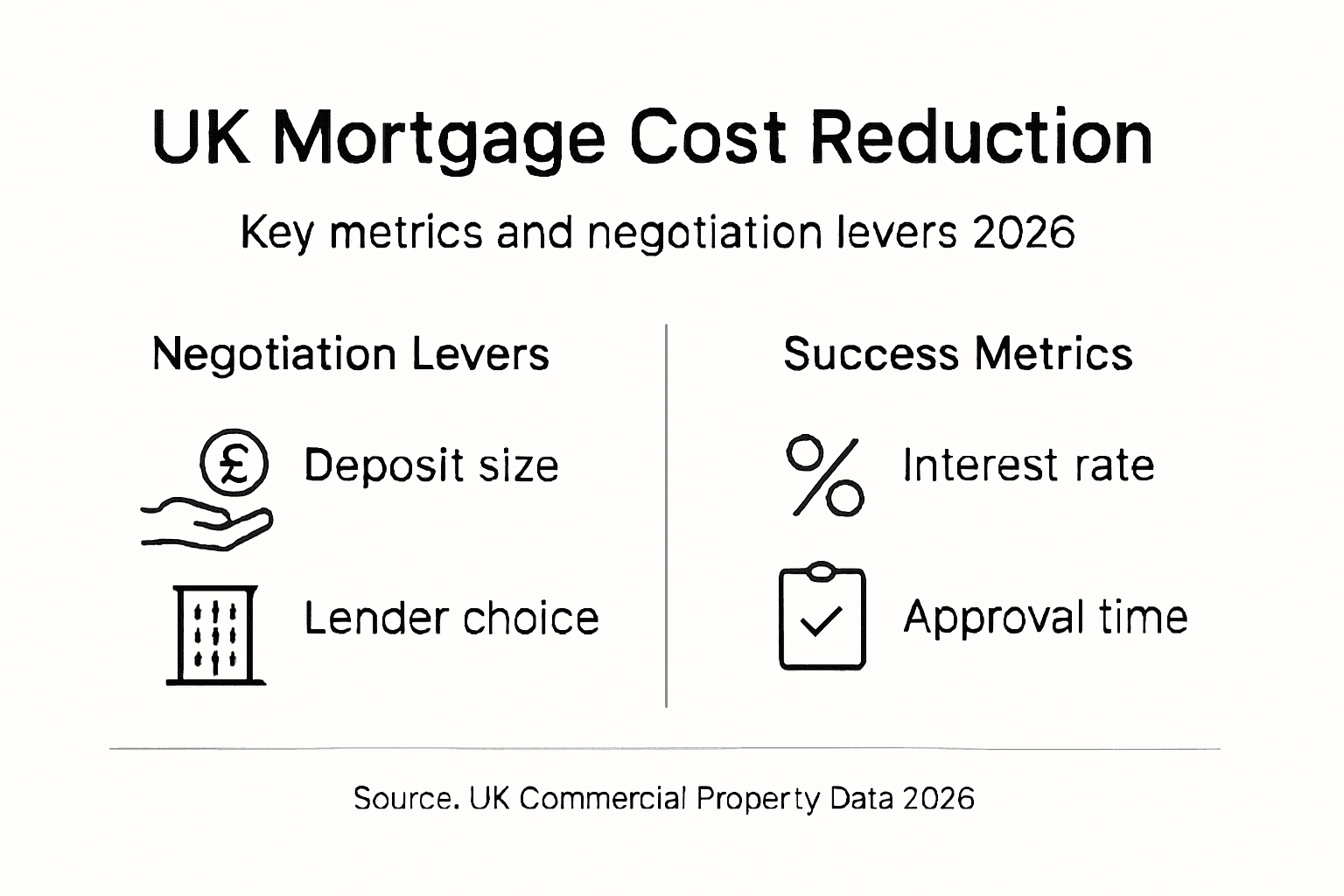
Broker use correlates strongly with faster approvals and better pricing. Developers working with specialist brokers report approval timelines 20% shorter and interest rates 0.5% to 1.0% lower compared to direct lender approaches. Brokers’ ability to position applications strategically and negotiate from strength delivers measurable value that typically exceeds their fees.
Multi-layer financing structures incorporating mezzanine debt or bridging loans can reduce overall capital costs by up to 15% when structured properly. By layering senior debt at lower rates with targeted junior tranches, you optimize weighted average cost of capital while preserving flexibility for project-specific needs. This approach requires coordination across lenders and careful intercreditor agreements but pays dividends in cost savings and strategic optionality.
| Metric | Competitive Outcome | Influencing Factors |
|---|---|---|
| Interest Rate | 4.2% to 6% | Property type, borrower profile, LTV ratio |
| Deposit Requirement | 20% to 30% | Lender risk appetite, asset quality, borrower experience |
| Loan Term | 15 to 25 years | Asset class, amortization structure, exit strategy |
| Approval Timeline | 6 to 12 weeks | Documentation completeness, broker involvement, underwriting complexity |
| Covenant Flexibility | Moderate to High | Lender type, negotiation skill, competitive tension |
To explore broader property finance trends UK 2026, stay informed on regulatory changes, lender appetite shifts, and emerging financing products that can inform your strategy.
Trade-Offs and Alternative Financing Approaches
Selecting the optimal financing structure requires balancing competing priorities around cost, flexibility, speed, and risk allocation. No single approach suits every transaction. Understanding trade-offs empowers you to tailor financing to project-specific needs and risk tolerance.
Fixed rate mortgages provide payment predictability and protection against interest rate volatility but typically cost 0.5% to 1.5% more than variable rate equivalents. If you prioritize cash flow certainty or anticipate rising rates, fixed pricing makes sense despite the premium. Variable rates offer potential savings if base rates decline but expose you to payment increases that can stress project cash flows.
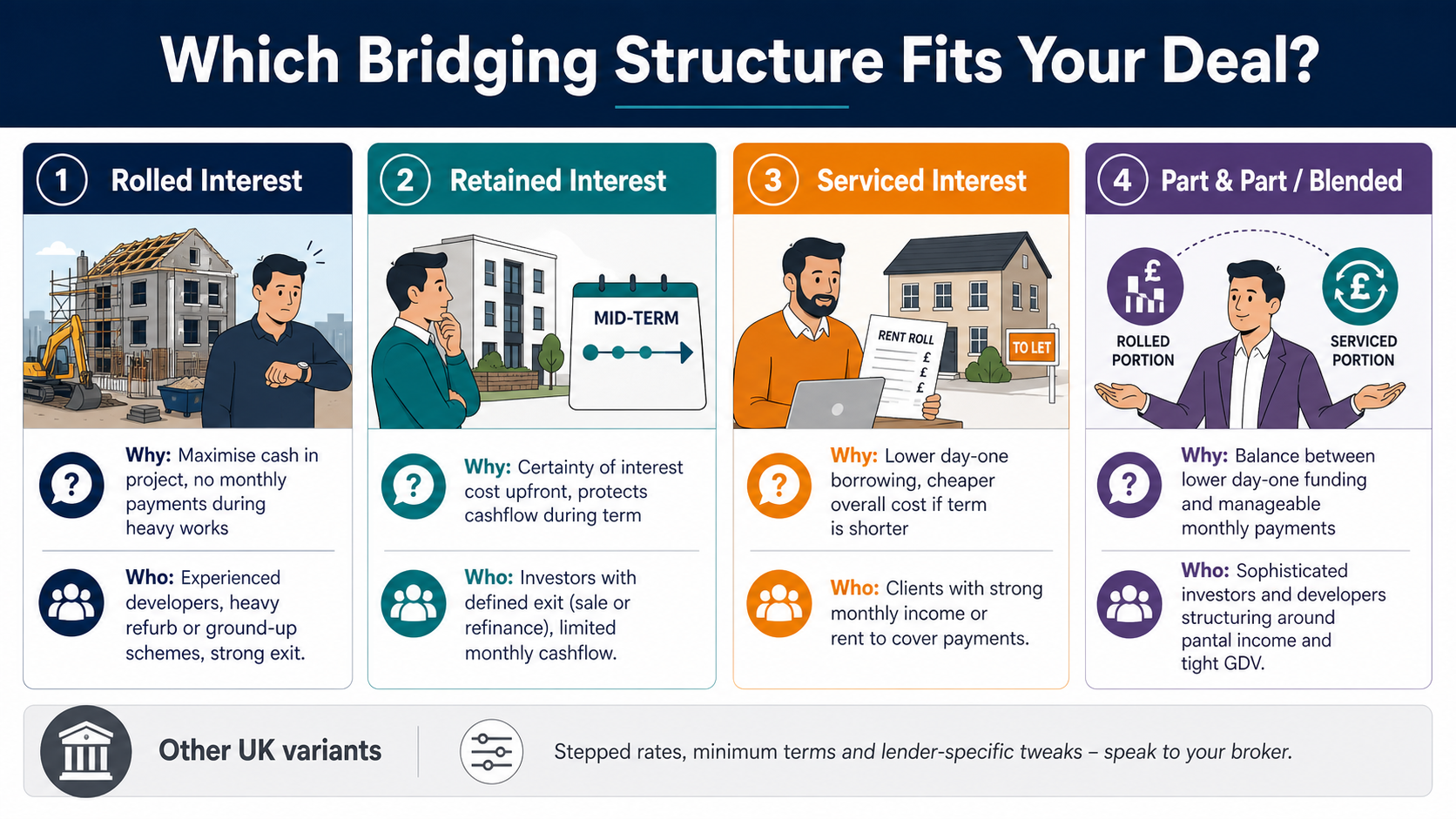
Mezzanine finance and bridging loans augment primary commercial mortgages when deposit requirements exceed available equity or when acquisition speed matters. Mezzanine debt sits subordinate to senior mortgages, commanding higher rates (typically 8% to 15%) but enabling higher overall leverage. Bridging loans provide short-term capital (usually six to 24 months) at premium rates, allowing you to secure properties quickly before refinancing into longer-term mortgages. To understand arranging bridging finance, focus on clear exit strategies and realistic refinancing timelines.
Financing Trade-Offs:
- Fixed vs. Variable Rates: Predictability and rate protection versus potential cost savings and payment flexibility.
- High vs. Low LTV: Lower equity requirements and preserved liquidity versus better pricing and covenant flexibility.
- Senior Only vs. Multi-Layer Debt: Simplicity and lower cost versus higher leverage and strategic flexibility.
- Bank vs. Specialist Lender: Competitive pricing and relationship benefits versus faster approvals and creative structuring.
Risk allocation strategies in multi-layer financing stacks require careful negotiation of intercreditor agreements, subordination terms, and security priorities. Senior lenders demand first charge over property assets and restrictive covenants on junior debt. Mezzanine lenders negotiate control rights that activate if performance deteriorates. Balancing these interests while preserving operational flexibility demands experienced legal and financial structuring.
Trade-offs between financing speed, cost, and flexibility vary by project urgency and risk profile. Acquisition opportunities with tight deadlines may justify premium bridging finance despite higher costs. Long-term hold strategies prioritize low-cost senior debt even if approval takes longer. Development projects benefit from multi-layer structures that stage capital drawdowns and minimize interest carry during construction.
Selecting financing aligned with your project scale, cash flow sensitivity, and risk appetite requires comprehensive analysis of total cost of capital, covenant restrictions, prepayment flexibility, and refinancing options. For a complete overview of UK real estate funding sources and property finance types UK, explore how different instruments serve distinct strategic objectives.
| Financing Type | Typical Cost | Speed | Best Use Case |
|---|---|---|---|
| Senior Commercial Mortgage | 4.2% to 6% | 6 to 12 weeks | Long-term hold, stabilized assets |
| Mezzanine Debt | 8% to 15% | 4 to 8 weeks | Gap equity, high-leverage transactions |
| Bridging Loan | 0.75% to 1.5% monthly | 2 to 4 weeks | Quick acquisitions, pre-refinancing |
| Development Finance | 6% to 10% + arrangement fees | 8 to 16 weeks | Ground-up construction, heavy refurbishment |
Enhance Your Commercial Mortgage Strategy with James William & Co Capital
Navigating complex UK commercial mortgage negotiations requires specialist expertise, lender relationships, and strategic structuring capabilities. James William & Co Capital delivers tailored advisory services for developers and institutional investors seeking optimized financing terms and streamlined approvals. Our broker network accesses wholesale rates and creative structures unavailable through direct lender channels.
We structure multi-layer financing combining senior debt, mezzanine capital, and bridging solutions to minimize cost while preserving flexibility. Our capital concierge approach provides end-to-end support from initial lender matching through final completion, ensuring every negotiation detail aligns with your strategic objectives. Explore our real estate funding sources guide and types of property finance to inform your next financing decision with proven strategies and market intelligence.
Frequently Asked Questions
What is the typical UK commercial mortgage negotiation timeline?
UK commercial mortgage approvals generally require six to twelve weeks from application to final offer, assuming complete documentation and straightforward underwriting. Complex transactions involving multiple properties or non-standard security can extend timelines to four or five months. Engaging specialist brokers compresses these timelines significantly by pre-qualifying lenders and streamlining review processes.
How can using a specialist broker benefit my mortgage negotiation?
Specialist brokers secure interest rates 0.5% to 1.0% lower and achieve approvals approximately 20% faster compared to direct lender approaches. They access wholesale pricing, benchmark terms across multiple lenders simultaneously, and negotiate on your behalf using market intelligence on recent pricing and lender appetite. Their expertise in positioning applications strategically delivers measurable cost savings and faster execution.
What are common pitfalls to avoid during negotiation?
Underestimating application complexity and incomplete documentation cause rejections in up to 30% of UK cases. Other frequent errors include ignoring credit score impacts, overlooking ongoing operational costs in forecasts, poor lender communication, and inflexible negotiation stances on minor covenant terms. Addressing these issues through thorough preparation, proactive credit monitoring, and clear communication preserves deal momentum and improves approval odds.
How do multi-layer financing options impact mortgage negotiations?
Multi-layer financing combining senior commercial mortgages with mezzanine debt or bridging loans can reduce overall capital costs by up to 15% when structured properly. This approach optimizes weighted average cost of capital by layering cheaper senior debt with targeted higher-cost junior tranches, filling equity gaps while preserving liquidity. However, coordination across multiple lenders and careful intercreditor agreements add complexity that requires experienced structuring.
What factors influence mortgage interest rates in the UK market?
UK commercial mortgage rates typically range between 4.2% and 8% depending on property type, borrower profile, and loan-to-value ratio. Prime assets with strong covenants and experienced borrowers achieve lower pricing, while secondary markets or higher-risk profiles command premiums. Fixed rates cost 0.5% to 1.5% more than variable equivalents, and lender type (high street bank versus specialist) also affects pricing significantly.
How important is credit history in commercial mortgage negotiations?
Personal and corporate credit histories significantly influence pricing, deposit requirements, and covenant flexibility. Lenders view poor credit management as a red flag for operational discipline and repayment capacity. Review credit reports for all directors and guarantors before applying, dispute inaccuracies proactively, and address outstanding issues to strengthen negotiating leverage and avoid inflated pricing or rejection.
Recommended
Related Topics
Speak to a specialist
Discuss your finance with James directly
Whole-of-market specialist finance — bridging, development, commercial and residential. No call centres, no obligation. James reviews every enquiry personally.
New to specialist finance? How unbiased broker advice works · Deals we have completed
Explore Related Finance