
Published · Updated
property development tipsProperty development finance selection guide for UK in 2026
By James Dawes, CeMAP, Founder, James William & Co Capital

Securing finance for large UK property developments in 2026 demands far more than a standard mortgage application. Property development finance solutions like bridging loans, development finance, mezzanine debt, and joint venture equity offer tailored structures for complex projects. This guide equips developers with selection criteria, product comparisons, and strategic recommendations to choose optimal funding structures that align with project stages, risk profiles, and capital requirements.
Table of Contents
- Selection Criteria: Choosing The Right Property Development Finance
- Bridging Loans With Refurbishment Drawdowns
- Development Finance For Construction And Land Acquisition
- Mezzanine Finance And Joint Venture Equity
- Comparison And Situational Recommendations For Uk Property Development Finance
- Explore Specialist Property Finance Solutions With James William & Co Capital
- Frequently Asked Questions About Property Development Finance In The Uk
Key takeaways
| Point | Details |
|---|---|
| Selection criteria matter | Loan-to-Value (LTV), Loan-to-Cost (LTC), and Gross Development Value (GDV) are essential metrics influencing finance options. |
| Bridging suits refurbishments | Short-term loans with staged drawdowns support refurbishment projects needing speed and flexibility. |
| Development finance covers builds | Comprehensive loans fund land acquisition and construction over 12 to 36 months for ground-up projects. |
| Layered capital optimises stacks | Mezzanine debt and JV equity bridge funding gaps when senior debt reaches limits. |
| Specialists offer speed | Private credit funds and specialist lenders deliver faster decisions and flexible terms in 2026. |
Selection criteria: choosing the right property development finance
Choosing the right finance starts with understanding key metrics that shape your options. Loan-to-Value (LTV), Loan-to-Cost (LTC), and Gross Development Value (GDV) are essential metrics that lenders use to assess risk and determine advance rates. LTV measures the loan amount against the property’s current or projected value, whilst LTC compares the loan to total project costs including land, construction, and fees. GDV estimates the completed property’s market value, helping lenders gauge profit potential and exit viability.
Project stage and complexity directly influence which property finance selection criteria apply. Early-stage land acquisitions typically require lower LTV ratios, whilst construction phases unlock higher advance rates as value increases. Complex mixed-use schemes or conversions demand flexible lenders comfortable with phased valuations and bespoke covenants. Simple refurbishments often secure faster approvals with streamlined documentation.
Evaluate lenders on flexibility, funding speed, cost of capital, and risk appetite. Traditional banks offer lower rates but slower processes and rigid criteria. Specialist lenders and private credit funds provide rapid decisions, creative structures, and tolerance for higher-risk profiles, albeit at premium rates. Your exit strategy must align with loan terms, whether refinancing to long-term commercial mortgages, selling on completion, or retaining for rental income. Development funding tips emphasise matching repayment profiles to project timelines.
Prioritise selection criteria by importance:
- Project stage determines whether bridging, development, or layered finance fits best
- LTV and LTC ratios dictate how much equity you need upfront
- Funding speed impacts whether you can secure time-sensitive opportunities
- Cost of capital affects overall project viability and return on investment
- Lender flexibility matters for complex projects requiring bespoke terms
- Exit strategy compatibility ensures smooth refinancing or repayment on completion
Bridging loans with refurbishment drawdowns
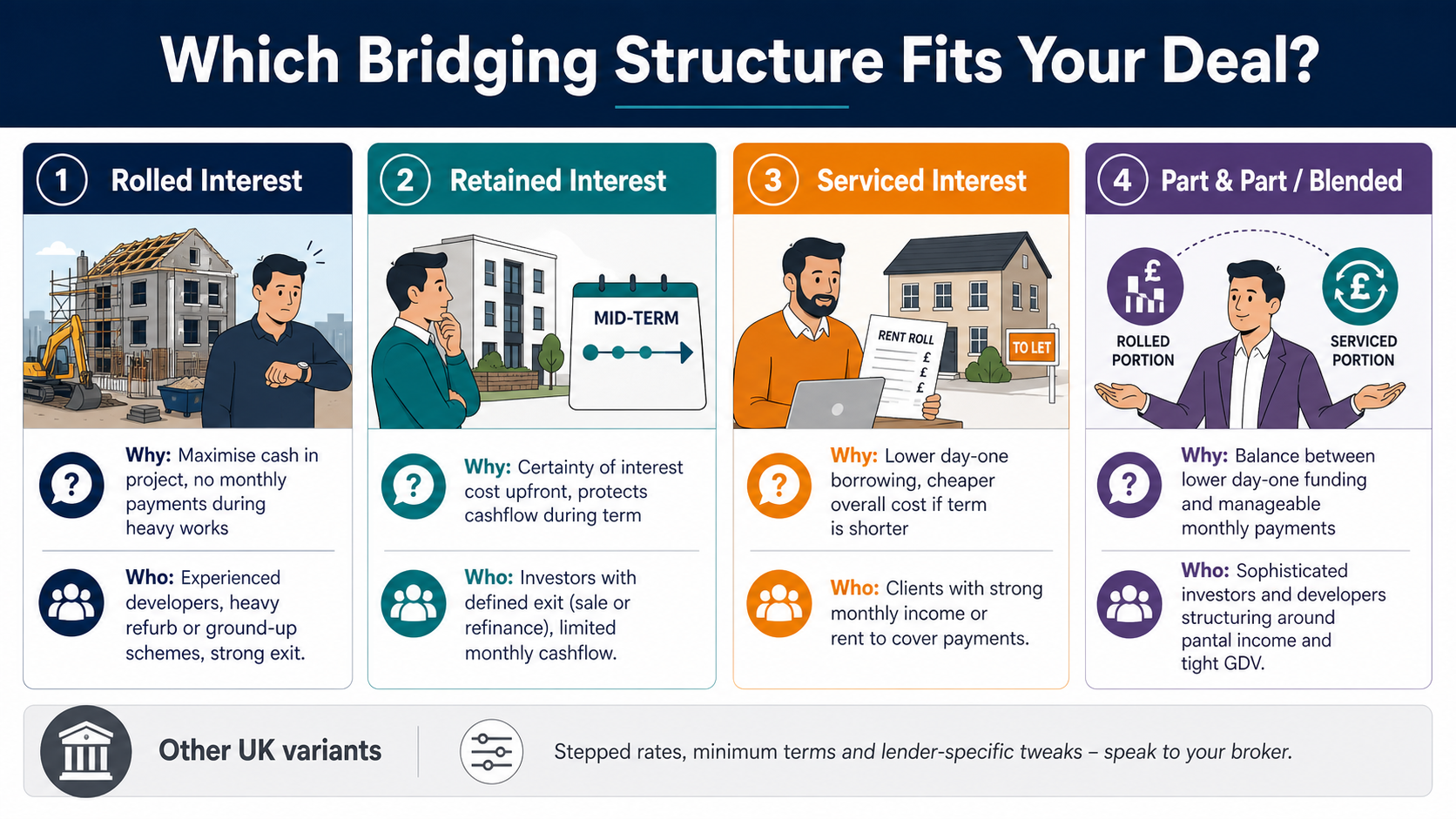
Bridging loans deliver short-term capital for refurbishment projects, typically spanning 6 to 18 months with interest rolled up to preserve cash flow during works. These bridging loan structures suit developers acquiring properties requiring substantial upgrades before sale or long-term refinance. Interest roll-up means you pay nothing monthly, with all charges settled on exit, keeping liquidity intact for contractor payments and unforeseen costs.
Staged refurbishment drawdowns align funding releases with verified milestone completions, ensuring capital arrives precisely when needed for each phase. Lenders inspect progress before releasing tranches, linking disbursements to kitchen installations, structural works, or final finishes. Bridging loans typically provide up to 75% LTV for refurbishment projects with staged drawdowns linked to milestones, making them ideal for heavy conversions, HMO upgrades, or mixed-use rehabilitations.
Key benefits include:
- Speed of approval, often within days rather than weeks for urgent acquisitions
- Flexibility in property condition, accepting non-mortgageable assets rejected by high street lenders
- Interest roll-up preserving working capital throughout the refurbishment period
- Up to 75% LTV on purchase price plus 100% of verified refurbishment costs
- Suitability for complex projects like listed building conversions or commercial-to-residential changes of use
Lenders require detailed refurbishment schedules, contractor quotes, and clear exit strategies before approval. Arranging bridging finance involves demonstrating credible refinance routes or confirmed buyer interest to satisfy repayment security. Exit strategies typically involve refinancing to a standard buy-to-let mortgage once works complete and the property becomes mortgageable, or selling at market value to repay the loan plus rolled interest.
Development finance for construction and land acquisition
Development finance provides comprehensive funding for ground-up construction projects, covering both land acquisition and build costs through a single facility. Development finance typically covers 60-80% of the land purchase plus verified staged construction costs over 12-36 months, making it the primary choice for new builds, housing estates, and major commercial schemes. Loan terms extend longer than bridging facilities, accommodating construction timelines that span multiple seasons.

Advance rates on land purchases range from 60% to 80% of acquisition cost, requiring developers to inject equity upfront. Construction costs receive staged drawdowns triggered by quantity surveyor valuations at key milestones like foundations, superstructure, weatherproofing, and completion. This structure protects lenders by ensuring funds flow only as verified value enters the scheme, whilst giving developers predictable capital for contractor payments.
| Finance Component | LTV/LTC Ratio | Typical Advance |
|---|---|---|
| Land purchase | 60-80% LTV | Upfront on completion |
| Construction costs | 100% LTC | Staged on QS certification |
| Professional fees | 100% LTC | As incurred and verified |
| Contingency | 0-10% LTC | Held in reserve, drawn if needed |
Development finance suits ground-up builds where construction represents the majority of project cost and value creation. Development finance benefits include alignment between funding releases and physical progress, reducing overpayment risk. Lenders appoint monitoring surveyors who inspect works and certify each drawdown request, ensuring costs match progress. You only pay interest on drawn amounts, keeping finance costs proportional to capital deployed.
Key features include:
- Loan terms from 12 to 36 months matching realistic construction schedules
- Interest charged only on drawn balances, not the full facility
- Flexible exit strategies including refinance, forward sale, or investment hold
- Advance rates responding to scheme risk, location, and market conditions
Verified costs form the foundation of drawdown releases. Lenders require detailed cost breakdowns, contractor quotes, and professional certifications before each release. Structured development finance demands rigorous project management to maintain drawdown schedules and avoid delays that increase interest costs.
Mezzanine finance and joint venture equity
Mezzanine finance operates as a subordinate debt layer sitting between senior debt and equity in the capital stack. Mezzanine finance carries higher interest rates than senior debt and is used to fill funding gaps when equity is limited, typically charging 12% to 20% annually depending on risk. This second-charge position accepts lower security priority in exchange for higher returns, enabling developers to access additional capital without diluting ownership through equity partners.
Joint venture equity reduces reliance on expensive debt layers by introducing capital partners who share profits in exchange for funding contributions. JV structures suit developers with strong track records but limited cash reserves, allowing them to scale operations without exhausting personal liquidity. Equity partners may be family offices, institutional investors, or developer consortiums seeking exposure to specific schemes or geographies.
Combining mezzanine debt and JV equity optimises capital stacks for complex projects:
- Senior debt covers 60% to 70% of costs at lowest interest rates
- Mezzanine debt fills 10% to 20% of the gap at premium rates
- JV equity provides remaining 10% to 20%, sharing profits rather than charging interest
- Developer equity minimises external capital costs and retains control
Pro Tip: Negotiate mezzanine terms with flexibility clauses allowing early repayment without penalties if senior refinance or sales proceeds arrive sooner than expected, reducing expensive debt exposure.
Layered funding structures become essential when structuring property finance for capital-intensive schemes where senior debt alone cannot cover costs. Lenders cap senior facilities at conservative LTV ratios, creating funding shortfalls on ambitious projects. Mezzanine and equity layers bridge these gaps, enabling schemes to proceed that would otherwise stall. This approach particularly suits high-value urban regeneration, mixed-use developments, and speculative builds where pre-sales are limited.
Mezzanine providers assess borrower strength, senior lender security, and exit viability before committing. They seek schemes with clear profit margins exceeding combined debt costs, ensuring repayment capacity. UK finance trends 2026 show growing appetite from private credit funds for subordinate positions, reflecting confidence in experienced developers and selective markets.
Comparison and situational recommendations for UK property development finance
Comparing finance options side by side clarifies which products align with specific project needs, timelines, and risk appetites. The table below summarises key characteristics across bridging loans, development finance, mezzanine debt, and joint venture equity.
| Finance Type | Loan Term | Interest Rate | LTV/LTC | Funding Speed | Best Fit |
|---|---|---|---|---|---|
| Bridging loans | 6-18 months | 0.6%-1.5% monthly | Up to 75% LTV | Days to 2 weeks | Fast refurbishments, conversions |
| Development finance | 12-36 months | 6%-12% annually | 60-80% land, 100% build | 4-8 weeks | Ground-up new builds, estates |
| Mezzanine debt | 12-24 months | 12%-20% annually | 10-20% additional | 3-6 weeks | Filling senior debt gaps |
| Joint venture equity | Project duration | Profit share | 10-30% project cost | 6-12 weeks | Capital-intensive schemes |
Situational recommendations guide finance selection based on project characteristics:
- Fast refurbishments and opportunistic acquisitions: Choose bridging loans for speed, flexibility, and acceptance of non-standard properties needing immediate capital
- Ground-up new builds and housing estates: Select development finance for comprehensive land and construction coverage with staged drawdowns matching build progress
- Projects exceeding senior debt limits: Layer mezzanine debt to bridge funding gaps without diluting ownership or extending timelines
- Capital-intensive urban regeneration: Structure joint venture equity with institutional partners to access scale capital whilst sharing risk and expertise
- Complex mixed-use schemes: Combine senior, mezzanine, and equity layers to optimise cost of capital across different risk tranches
Specialist lenders and private credit funds dominate finance trends 2026 for development projects requiring speed and non-standard structures. These providers offer faster decisions, creative covenant packages, and appetite for complex deals rejected by traditional banks. They assess schemes on merits rather than rigid scorecards, valuing developer experience and market positioning alongside financial metrics.
Decision criteria from earlier sections reinforce practical application: prioritise project stage to filter compatible products, evaluate LTV/LTC ratios against equity availability, assess funding speed against acquisition timelines, and match exit strategies to loan terms. Optimising real estate funding demands aligning every finance layer with project economics, risk tolerance, and strategic objectives.
Explore specialist property finance solutions with James William & Co Capital
James William & Co Capital structures specialist property finance for complex UK developments, arranging bridging loans, development finance, mezzanine debt, and layered capital stacks tailored to large-scale projects. Our network spans family offices, private credit funds, and specialist lenders, delivering rapid approvals and flexible terms that institutional developers demand. Whether you’re securing a time-sensitive refurbishment opportunity or structuring multi-layered finance for ground-up construction, our capital concierge approach provides a single point of contact for end-to-end execution.
Explore our finance services and review property finance case studies showcasing proven solutions for high-value transactions. We execute at speed under pressure, structuring sophisticated funding that aligns with your project timelines and profit objectives.
Frequently asked questions about property development finance in the UK
What is the difference between bridging and development finance?
Bridging loans provide short-term capital for refurbishments or interim purchases, typically lasting 6 to 18 months with interest rolled up. Development finance covers both land acquisition and construction costs over 12 to 36 months with staged drawdowns, making it suited for ground-up builds. Bridging prioritises speed and flexibility, whilst development finance benefits include comprehensive coverage of build costs through verified milestone releases.
When should I consider mezzanine finance or joint venture equity?
Consider mezzanine finance when senior debt reaches lender LTV limits but you need additional capital without diluting ownership. Joint venture equity suits capital-intensive projects where sharing profits with partners reduces expensive debt layers and spreads risk. Both options work best on schemes with strong profit margins exceeding combined financing costs.
How important are detailed project plans in securing finance?
Detailed project plans are critical for securing development finance and staged drawdowns. Lenders require comprehensive cost schedules, contractor quotes, professional certifications, and clear exit strategies before approval. Thorough planning demonstrates project viability, reduces lender risk, and accelerates drawdown approvals once construction begins.
What refinancing options exist after project completion?
After completion, developers typically refinance to long-term commercial mortgages or standard buy-to-let facilities if retaining properties for income. Alternatively, selling completed units repays development finance and realises profits. Some developers use bridging exits to secure extended terms whilst arranging permanent finance, maintaining flexibility during lease-up or sales periods.
Can specialist lenders provide faster decisions than traditional banks?
Specialist lenders consistently deliver faster decisions, often approving deals within days to two weeks compared to traditional banks requiring months. They assess schemes on merits rather than rigid criteria, accept non-standard properties, and structure creative solutions for complex projects. This speed advantage proves essential for time-sensitive acquisitions and competitive bidding scenarios in 2026.
Recommended
Related Topics
Speak to a specialist
Discuss your finance with James directly
Whole-of-market specialist finance — bridging, development, commercial and residential. No call centres, no obligation. James reviews every enquiry personally.
New to specialist finance? How unbiased broker advice works · Deals we have completed
Explore Related Finance