
Published · Updated
property finance trends 2026Property Finance Trends 2026: Impact on UK Real Estate
By James Dawes, CeMAP, Founder, James William & Co Capital

Securing the right capital mix can determine whether a major real estate opportunity in the United Kingdom becomes a portfolio milestone or a missed chance. High-value property acquisitions and complex development deals now require more than just deep pockets. With evolving lending rules, local regulatory shifts, and the rapid rise of private credit, understanding property finance in 2026 means seeing where innovation meets compliance. This article highlights the critical funding trends and regulatory pressures reshaping large-scale property investments for the next generation of British market leaders.
Table of Contents
- Defining Property Finance In The 2026 UK Market
- Emerging Funding Types And Structures
- New Lender Dynamics And Private Credit Growth
- Evolving Regulatory Pressures And Compliance
- Risks, Costs And Mitigating Exposure
Key Takeaways
| Point | Details |
|---|---|
| Sophisticated Funding Mechanisms | The 2026 UK property finance landscape will feature enhanced funding types, including collaborative investment platforms and hybrid equity-debt instruments, necessitating adaptive capital strategies. |
| Strategic Compliance Imperatives | Investors must adopt proactive compliance strategies to navigate an increasingly complex regulatory environment concerning building safety and energy efficiency. |
| Evolving Risk Management Frameworks | Investors should implement dynamic risk assessment models that incorporate predictive analytics to address new financial exposures, especially climate-related risks. |
| Partnership with Private Credit Providers | Establishing relationships with private credit sources will ensure access to flexible and tailored funding options, as traditional banking models face constraints. |
Defining Property Finance in the 2026 UK Market
Property finance in the 2026 UK market represents a sophisticated landscape of strategic capital deployment, where high-net-worth investors and developers navigate increasingly complex funding ecosystems. Property finance fundamentally involves the strategic arrangement of capital to acquire, develop, and optimise real estate assets, with nuanced approaches tailored to specific investment objectives.
The UK property finance market in 2026 will be characterised by several key dynamics that distinguish it from previous years. Regional investment variations will play a critical role, with investors required to understand localised market conditions, regulatory environments, and potential yield differentials. These regional nuances demand a granular approach to capital allocation.
Key characteristics of property finance in 2026 include:
- Sophisticated multi-layered debt structuring
- Increased emphasis on transparent risk assessment
- Growing importance of sustainability credentials
- Enhanced digital documentation and verification processes
- Greater regulatory scrutiny of lending practices
Investors must recognise that property finance is no longer a simple transactional process but a strategic partnership involving complex risk management. The most successful developers will leverage bespoke funding solutions that align precisely with their specific project requirements, considering factors like location, development stage, and potential return profiles.
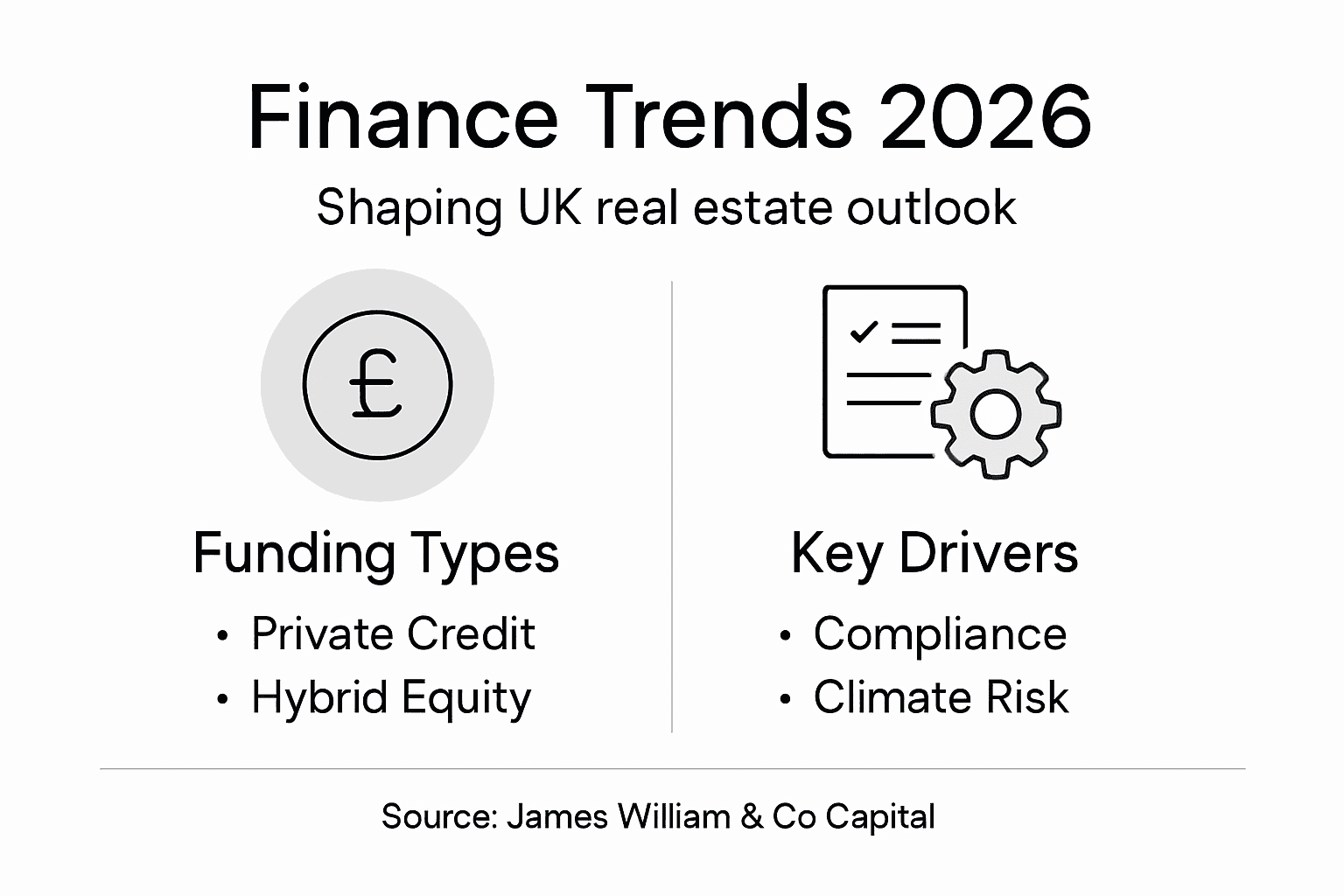
Pro tip: Develop a comprehensive understanding of local market microeconomics before committing significant capital to any property finance initiative.
Emerging Funding Types and Structures
The UK property finance landscape in 2026 is experiencing a transformative shift in funding mechanisms, with innovative structures replacing traditional financing models. Emerging funding types are increasingly sophisticated, reflecting the complex demands of modern property development and investment strategies.

Local government funding strategies are playing a pivotal role in reshaping property finance, with over £4 billion in targeted support for housing and infrastructure projects. These emerging structures demonstrate a nuanced approach to capital deployment that goes beyond conventional lending models.
Key emerging funding types include:
- Collaborative investment platforms
- Sustainability-linked finance products
- Hybrid equity-debt instruments
- Digital asset-backed property financing
- Community investment schemes
- Tokenised real estate investment structures
The most significant trend in property finance is the rise of blended capital structures. These sophisticated funding models combine multiple financing sources, allowing developers to optimise capital efficiency and risk management. Institutional investors, private equity funds, and government-backed initiatives are converging to create more flexible and adaptive funding ecosystems.
Complex property finance requires a strategic approach that balances risk, return, and innovative capital structuring.
Investors must develop a comprehensive understanding of these emerging funding mechanisms, recognising that traditional debt-only models are becoming increasingly obsolete. The ability to construct multi-layered, adaptive funding strategies will distinguish successful property investors in the 2026 marketplace.
Pro tip: Continuously monitor emerging funding innovations and develop flexible investment frameworks that can quickly adapt to new financing technologies and structures.
New Lender Dynamics and Private Credit Growth
The UK real estate lending market is experiencing a profound transformation, with private credit emerging as a critical alternative to traditional banking models. Structural shifts in lending have fundamentally reshaped the capital acquisition landscape for property investors and developers.
Private credit has rapidly evolved from a niche financing option to a mainstream funding mechanism. By 2023, the sector was valued at approximately £1.58 trillion, driven by several key factors that distinguish it from conventional lending approaches. These include:
- Increased regulatory constraints on traditional banks
- Demand for more flexible financing solutions
- Higher yield potential for investors
- Ability to provide tailored lending packages
- Faster decision-making processes
- More sophisticated risk assessment techniques
The emerging lender dynamics reflect a nuanced ecosystem where alternative credit providers are filling critical gaps left by risk-averse institutional banks. Traditional lenders have progressively reduced their real estate lending exposure, creating substantial opportunities for private credit funds to develop more innovative and adaptable funding structures.
Here’s a comparison of traditional banking finance versus private credit in the 2026 UK property sector:
| Aspect | Traditional Banking | Private Credit |
|---|---|---|
| Regulatory Flexibility | Highly constrained by regulation | More adaptable, fewer restrictions |
| Speed of Approval | Often slow and bureaucratic | Rapid decision-making processes |
| Funding Structure | Standardised lending packages | Customised, tailored solutions |
| Risk Appetite | Generally risk-averse | Willing to address niche risks |
| Yield Potential | Lower returns for investors | Higher yield opportunities |
| Borrower Relationship | Transactional, formal | Collaborative partnership model |
Private credit represents a permanent, sophisticated financing solution that transcends traditional lending limitations.
Investors and developers must recognize that these new lending dynamics require a more strategic approach to capital acquisition. The ability to navigate and leverage these emerging funding mechanisms will be crucial for success in the 2026 property market.
Pro tip: Cultivate relationships with multiple private credit providers to ensure access to diverse and flexible funding options.
Evolving Regulatory Pressures and Compliance
The UK property investment landscape in 2026 is characterised by an increasingly complex regulatory environment that demands sophisticated compliance strategies. Financial services regulation represents a delicate balancing act between promoting growth and maintaining rigorous financial safeguards.
Key regulatory developments are reshaping the property investment ecosystem, with particular emphasis on several critical areas of focus:
- Enhanced building safety standards
- Stricter energy efficiency requirements
- More comprehensive consumer protection measures
- Increased transparency in financial reporting
- Advanced operational resilience protocols
- Heightened financial crime prevention mechanisms
The regulatory landscape demands that property investors and developers adopt a proactive approach to compliance. Traditional reactive strategies are no longer sufficient, with regulators expecting comprehensive, forward-looking risk management frameworks that anticipate potential challenges before they emerge.
The following table summarises major regulatory hotspots for UK property investors in 2026:
| Regulatory Focus Area | Primary Impact | Investor Challenge |
|---|---|---|
| Building Safety | Higher compliance costs | Adapting to new standards |
| Energy Efficiency | Retrofit investment required | Measuring long-term returns |
| Financial Reporting | Increased transparency demands | Implementing reporting systems |
| Operational Resilience | Enhanced continuity planning | Establishing robust frameworks |
| Financial Crime Prevention | Strengthened due diligence | Ongoing monitoring processes |
Compliance is no longer a box-ticking exercise but a strategic imperative for sustainable property investment.
Institutional investors are increasingly recognising that navigating these complex regulatory requirements requires sophisticated internal capabilities. The ability to interpret and implement evolving regulatory frameworks will become a significant competitive advantage in the 2026 property market.
Pro tip: Invest in robust compliance infrastructure and develop a dedicated team capable of interpreting and implementing complex regulatory requirements.
Risks, Costs and Mitigating Exposure
The UK property investment landscape in 2026 demands sophisticated risk management strategies that go beyond traditional financial assessment models. Mortgage lending forecasts indicate a complex environment where proactive risk mitigation is not just advisable, but essential for sustained investment success.
Key risk categories that investors must carefully navigate include:
- Affordability pressures
- Interest rate volatility
- Climate-related financial risks
- Insurance coverage limitations
- Regulatory compliance exposures
- Market liquidity challenges
The financial risk landscape requires investors to develop multi-dimensional risk assessment frameworks that integrate quantitative analysis with forward-looking predictive modelling. Traditional linear risk evaluation approaches are becoming increasingly inadequate in addressing the nuanced challenges of contemporary property investment.
Comprehensive risk management is not an optional strategy, but a fundamental requirement for sustainable property investment.
Climate risk represents a particularly critical dimension of exposure, with potential implications for property valuation, insurance costs, and long-term investment viability. Institutional investors must develop robust stress testing methodologies that account for evolving environmental challenges and potential market disruptions.
Pro tip: Implement dynamic risk assessment models that integrate predictive analytics, scenario planning, and continuous monitoring to effectively mitigate emerging financial exposures.
Navigate Complex Property Finance Trends with Expert Support
Understanding the evolving landscape of property finance in the UK for 2026 means confronting sophisticated challenges like multi-layered debt structuring, private credit growth, and heightened regulatory demands. If you are a property developer, investor or high-net-worth client facing the need to balance risk, secure flexible funding and comply with new regulations, relying on strategic expertise is essential. Key pain points such as bridging finance complexities, bespoke covenant packaging and blended capital structures are no longer obstacles when guided by experienced professionals.
James William & Co Capital specialises in delivering tailored solutions that address these very challenges. With a network spanning family offices, private credit funds and specialist lenders, we arrange everything from mezzanine debt and commercial mortgages to JV equity and asset finance. Our capital concierge approach ensures you have a single point of contact managing your structured finance needs, enabling faster decision-making and execution. Explore our tailored mortgage and funding advisory services and discover how we help clients optimise their capital stacks amid increasing regulatory pressures.

Ready to transform your UK property financing strategy by partnering with experts who understand the latest trends and risks? Visit James William & Co Capital today and secure the funding solutions that position your investments for success in 2026 and beyond.
Frequently Asked Questions
What are the key characteristics of property finance in 2026?
Property finance in 2026 is characterised by sophisticated multi-layered debt structuring, transparent risk assessment, sustainability credentials, enhanced digital verification processes, and greater regulatory scrutiny of lending practices.
How has private credit changed the UK real estate lending market?
Private credit has emerged as a critical alternative to traditional banking models, offering flexible financing solutions, tailored lending packages, and faster decision-making processes, significantly filling the gaps left by conventional lenders.
What are some emerging funding types in the property finance sector?
Emerging funding types include collaborative investment platforms, sustainability-linked finance products, hybrid equity-debt instruments, digital asset-backed property financing, community investment schemes, and tokenised real estate investment structures.
How can investors mitigate risk in the 2026 property investment landscape?
Investors should implement dynamic risk assessment models that integrate predictive analytics, scenario planning, and continuous monitoring. Key risk categories to navigate include affordability pressures, interest rate volatility, and climate-related financial risks.
Recommended
- James William & Co Capital | Specialist Property Finance
- James William & Co Capital | Specialist Property Finance
- James William & Co Capital | Specialist Property Finance
- James William & Co Capital | Specialist Property Finance
- Real Estate Investment Trends 2026: What New Investors Need to Know | Bold Street AI
- 7 Latest Real Estate Technology Trends Shaping 2025-26 2026
Related Topics
Speak to a specialist
Discuss your finance with James directly
Whole-of-market specialist finance — bridging, development, commercial and residential. No call centres, no obligation. James reviews every enquiry personally.
New to specialist finance? How unbiased broker advice works · Deals we have completed
Explore Related Finance