
Published · Updated
property refinance workflowProperty refinance workflow: a 2026 investor's guide
By James Dawes, CeMAP, Founder, James William & Co Capital

TL;DR:
- Mastering the property refinance workflow involves thorough financial modelling, proper documentation, and understanding lender requirements to ensure timely and successful closings. Complete, organized documentation and adherence to seasoning and DSCR criteria are critical, while premature or incomplete applications often lead to delays or deal failures. Investors should carefully assess whether refinancing adds value through cost analysis and Net Present Value calculations before proceeding.
The property refinance workflow is a structured, multi-stage process through which property owners replace an existing loan with new financing to extract equity, reduce borrowing costs, or reposition a portfolio. For UK investors and developers, mastering this process is the difference between recovering capital efficiently and watching returns erode through delays, missed thresholds, or poor timing. The workflow spans initial financial modelling, documentation assembly, lender underwriting, and final closing. Each stage carries specific requirements, and skipping any one of them typically extends timelines or kills deals entirely.
What documents do you need before refinancing a property?
Preparation is the single biggest variable in how quickly a refinance completes. A standard DSCR refinance closes within 15–21 days when documentation is complete. That timeline extends significantly when investors arrive at the lender’s desk with gaps in their file.
The core document set for an investment property refinance includes:
- Signed lease agreements for all tenancies, showing current rent, term, and tenant details
- Rent receipts or bank statements confirming rent collected, not just agreed. Lenders verify actual income, not projected figures
- Six months of personal and business bank statements demonstrating cash flow and reserves
- Current buildings insurance certificate and, where applicable, landlord liability cover
- Council tax bills and utility accounts confirming occupancy status
- Renovation invoices and contractor receipts if the property has been improved since purchase
- Photo ID and proof of address for all borrowers and directors on the title
- Existing mortgage statement showing current balance, rate, and any prepayment penalty schedule
Occupancy verification matters more than most investors expect. Lenders evaluate cash-flowing, stabilised properties and will not accept a signed lease as proof of income if rent collection has not begun. This distinction catches investors off guard, particularly those refinancing shortly after a tenancy starts.
Pro Tip: Organise your documents into a single digital folder labelled by category before approaching any lender. Brokers at James William & Co routinely see deals delayed by two to four weeks simply because investors cannot locate renovation invoices or historic bank statements at short notice.
What is the step-by-step property refinance process?
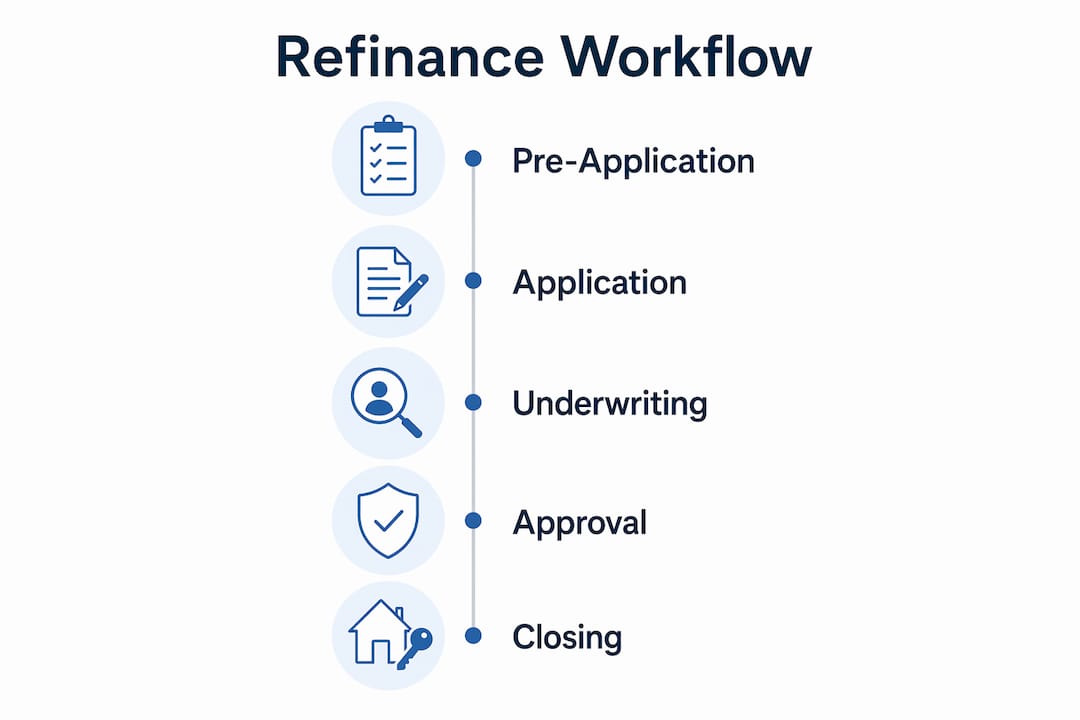
The real estate refinance process follows a logical sequence, but each stage has its own timeline and dependencies. Understanding the full arc prevents the most common mistake: assuming the process is faster than it is.
-
Financial modelling (weeks 1–2). Before contacting any lender, run your numbers. Experienced investors model multiple loan scenarios covering conservative, target, and maximum outcomes across metrics including cash-out amount, monthly PITIA (principal, interest, tax, insurance, and association fees), Debt Service Coverage Ratio (DSCR), and post-closing reserves. This step defines your negotiating position.
-
Renovation and stabilisation (months 1–6). For properties acquired through a buy, refurbish, refinance, and rent strategy, the renovation and lease-up period must be completed before the refinance application begins. The full cycle from purchase to refinance typically runs 8–12 months, including renovation, lease-up, and seasoning.
-
Title seasoning (month 6 from purchase). Seasoning requires a six-month title hold from the original purchase date, not from renovation completion. This is a hard requirement with most lenders and should not be treated as negotiable.
-
Formal application and document submission (week 1–2 of application). Submit your complete document pack to the lender or broker. Incomplete files restart the clock.
-
Appraisal ordering (weeks 2–3). The lender commissions an independent valuation. Appraisal timelines vary by property type and location. Commercial and mixed-use assets typically take longer than standard residential buy-to-let.
-
Underwriting and credit review (weeks 3–5). The lender’s credit team reviews income, DSCR, loan-to-value, and borrower profile. Queries at this stage are normal. Respond within 24 hours to avoid delays.
-
Loan offer and legal completion (weeks 5–7). Once credit is approved, solicitors handle title searches, redemption of the existing mortgage, and registration of the new charge. Completion typically follows within one to two weeks of the formal offer.
| Stage | Activity | Typical Duration |
|---|---|---|
| Pre-application | Financial modelling and document assembly | 1–2 weeks |
| Stabilisation | Renovation, lease-up, and seasoning | 6–12 months |
| Application | Document submission and lender review | 1–2 weeks |
| Appraisal | Independent valuation | 1–2 weeks |
| Underwriting | Credit assessment and queries | 2–3 weeks |
| Legal completion | Solicitor work and drawdown | 1–2 weeks |
How do you evaluate whether refinancing makes financial sense?
The property loan approval process begins with the lender’s criteria, but the decision to refinance must begin with your own numbers. Too many investors apply without first confirming the deal is worth doing.

Closing costs typically range between 2–5% of the new loan amount. The break-even point is calculated by dividing total closing costs by the monthly saving from the new rate. If that break-even period exceeds your planned hold period, the refinance destroys value rather than creating it.
The widely cited “1% rate reduction rule” is a dangerous shortcut. Proper refinance decisions rely on Net Present Value calculations that account for the time value of money, total costs, and the full savings profile over the hold period. A 0.8% rate reduction on a large loan with low closing costs can outperform a 1.2% reduction on a loan with high arrangement fees and a long break-even.
Prepayment penalties are the most frequently overlooked cost. Penalties on existing loans can consume 1–2 years of savings, making a refinance value-destructive if not modelled in advance. DSCR loan structures often carry step-down penalty schedules, where the penalty reduces each year. Timing your refinance to coincide with a step-down anniversary can save a material sum.
Pro Tip: Before approaching any lender, build a simple spreadsheet comparing your current loan’s total cost of capital over your remaining hold period against the new loan’s equivalent figure. Include arrangement fees, legal costs, and any exit penalties on both sides. The result will tell you whether the refinance is worth pursuing before you spend a penny on valuations.
Post-refinance, lenders require a DSCR of 1.20 or above and at least six months of PITIA reserves held in accessible accounts. Falling below either threshold after closing creates covenant risk and limits your ability to refinance again in the near term.
What are the most common mistakes in the refinance application workflow?
Most refinance failures are predictable. The same errors appear repeatedly across investor profiles and property types.
-
The timeline fantasy. Investors routinely underestimate how long the full cycle takes. Relying on lender exceptions for seasoning or DSCR is a structural mistake. Build your business plan around standard requirements, not best-case exceptions.
-
Confusing leases signed with rent collected. A lease agreement is not income evidence. Lenders require verified rent receipts showing actual payments received. Applying before rent collection is established will result in a declined application or a lower loan amount than modelled.
-
Ignoring tax and insurance escrow. Many investors calculate their new monthly payment based on principal and interest alone. Lenders assess PITIA, which includes property tax and insurance. Omitting these figures produces an inaccurate DSCR and can invalidate your pre-application modelling.
-
Misreading seasoning start dates. Seasoning is measured from the purchase date, not the date renovation completed or the date a tenant moved in. Investors who begin the refinance process at month five, expecting to close at month six, frequently find the lender’s clock does not align with their own.
-
Poor communication with lenders and brokers. Underwriting queries left unanswered for several days can push a deal into the next credit committee cycle, adding weeks to the timeline. Treat every lender query as urgent.
Refinancing is not mere paperwork. It is an audit of your investment assumptions, and lenders are the auditors.
For investors working across multiple UK real estate funding sources, understanding how each debt layer interacts with refinance timing is critical. Bridging loans, mezzanine debt, and senior facilities each carry different seasoning, prepayment, and covenant structures that affect when and how you can refinance.
Key takeaways
A successful property refinance workflow depends on verified income evidence, accurate financial modelling, and strict adherence to lender seasoning and DSCR requirements before any application is submitted.
| Point | Details |
|---|---|
| Document completeness drives speed | A full document pack at submission closes a DSCR refinance in 15–21 days. |
| Seasoning starts at purchase | The six-month seasoning clock runs from purchase date, not renovation completion. |
| NPV beats the 1% rule | Use Net Present Value modelling to confirm a refinance adds value after all costs. |
| DSCR and reserves are non-negotiable | Lenders require a DSCR of 1.20 or above and six months of PITIA reserves post-closing. |
| Prepayment penalties must be modelled | Step-down penalty schedules can consume years of savings if not factored into the decision. |
Why most investors get the refinance workflow wrong
Having structured refinances across a wide range of UK property types, from single buy-to-let assets to multi-unit commercial portfolios, the pattern I see most often is not a lack of knowledge. It is a lack of discipline in applying what investors already know.
The biggest error is treating the refinance workflow as a transaction rather than a process. Investors who model multiple loan scenarios before picking up the phone to a lender are in a fundamentally stronger position. They know their walk-away point, their target terms, and the minimum DSCR they can accept. Investors who skip that step are negotiating blind.
I am also consistently surprised by how many experienced investors underestimate the importance of optimising their real estate funding structure before a refinance, not during it. The time to review your debt stack is six months before you intend to refinance, not six weeks. That window gives you time to address covenant issues, build reserves, and ensure rent collection history is sufficient for underwriting.
Conservative modelling is not pessimism. It is the only way to avoid being caught short on reserves or DSCR after closing. I always recommend clients model the deal at a rate 0.5% above the quoted rate and at 90% of projected rental income. If the deal still works under those conditions, it is worth pursuing.
— James
How james william & co can support your refinance strategy
Refinancing a property, particularly a complex investment or development asset, requires more than a standard mortgage broker. James William & Co structures bespoke refinancing solutions for UK property investors, developers, and high-net-worth clients across residential, commercial, and mixed-use portfolios. Whether you are refinancing out of a bridging loan, restructuring a multi-asset portfolio, or extracting equity from a stabilised development, the team provides end-to-end support from initial financial modelling through to legal completion. Speak to a specialist at James William & Co’s London property finance team to review your refinance options and structure the most efficient route to capital recovery.
FAQ
How long does a property refinance take in the UK?
A standard investment property refinance with complete documentation closes within 15–21 days from application. The full cycle from purchase to refinance, including renovation and seasoning, typically runs 8–12 months.
What DSCR is required to refinance an investment property?
Most lenders require a minimum DSCR of 1.20, meaning rental income must cover at least 120% of the monthly mortgage payment. Lenders also require at least six months of PITIA reserves held post-closing.
What is title seasoning and why does it matter?
Title seasoning is the minimum period a borrower must hold title before a lender will use the appraised value for a cash-out refinance. The standard requirement is six months from the original purchase date, not from renovation completion.
What are closing costs on a property refinance?
Closing costs on a refinance typically range between 2–5% of the new loan amount. Divide total closing costs by the monthly saving to calculate your break-even period, and only proceed if that period falls within your planned hold.
What are complex refinances in UK property finance?
Complex refinances involve multi-layered debt structures, offshore ownership vehicles, commercial or mixed-use assets, or borrowers with non-standard income profiles. They require specialist brokers such as James William & Co, who can structure bespoke covenant packages and access private credit markets beyond high-street lenders.
Recommended
Related Topics
Speak to a specialist
Discuss your finance with James directly
Whole-of-market specialist finance — bridging, development, commercial and residential. No call centres, no obligation. James reviews every enquiry personally.
New to specialist finance? How unbiased broker advice works · Deals we have completed
Explore Related Finance