
Published · Updated
real estate finance strategies7 Essential Real Estate Finance Strategies for UK Developers
By James Dawes, CeMAP, Founder, James William & Co Capital

Structuring property development finance in the UK is often more complex than it first appears. Whether you are seeking your first commercial mortgage, analysing multi-layered debt structures, or forming joint venture partnerships, small missteps can cost both time and money. Each funding route comes with distinct terms, risks, and opportunities that directly shape your project’s success and long-term returns.
This guide is designed to give you sharp, actionable techniques for managing every stage of your real estate financing. You will discover how to balance different debt layers, optimise commercial mortgage arrangements, and build robust equity partnerships that keep all parties protected. Ready to uncover the strategies professionals use to navigate the UK’s sophisticated property finance market? The solutions you need are just ahead.
Table of Contents
- 1. Understand Multi-Layered Debt Structures
- 2. Leverage Bridging and Development Finance
- 3. Optimise Commercial Mortgage Arrangements
- 4. Utilise Mezzanine Debt for Enhanced Leverage
- 5. Incorporate Offshore Vehicles for Tax Efficiency
- 6. Structure JV Equity Partnerships Effectively
- 7. Tailor Covenant Packages to Protect Interests
Quick Summary
| Takeaway | Explanation |
|---|---|
| 1. Understand Multi-Layered Debt Structures | Layering different debt types can amplify returns while managing risks effectively. |
| 2. Effectively Use Bridging and Development Finance | Bridging finance is useful for quick acquisitions, while development finance supports longer-term projects. |
| 3. Optimise Commercial Mortgage Terms | Negotiate key factors like loan-to-value ratios and repayment structures to reduce costs. |
| 4. Tailor Covenant Packages | Customised covenants that reflect project specifics can enhance operational flexibility. |
| 5. Utilize Mezzanine Debt Effectively | Mezzanine financing increases leverage, boosting equity returns while managing total borrowing. |
1. Understand Multi-Layered Debt Structures
Multi-layered debt structures are the backbone of sophisticated property financing in the UK. Rather than relying on a single loan, developers and investors stack different types of debt in a specific order, each with different risk profiles, interest rates, and repayment terms. This approach unlocks significantly larger acquisition and development capacity than traditional financing alone.
Think of it like building a pyramid. The base consists of senior debt, which holds the most secure position and attracts the lowest interest rates from high street banks and institutional lenders. Above that sits mezzanine finance, which occupies a middle ground between debt and equity, accepting higher risk in exchange for higher returns. Additional layers might include vendor financing, bridging loans, or equity partnerships. Each layer serves a specific purpose in your capital structure.
Why does this matter for your investment strategy? When you layer debt correctly, you amplify your returns on equity without necessarily increasing total risk. For example, a £10 million acquisition might be financed with £6 million senior debt at 4.5%, £2.5 million mezzanine debt at 7.5%, and £1.5 million equity. Your equity holders benefit from appreciation across the entire £10 million asset value whilst the debt providers receive their fixed returns. This is leverage working in your favour.
Understanding the mechanics of these structures requires knowing how different debt sources work together. Senior lenders focus on property value, loan to value ratios, and whether cash flows cover their required interest payments. They want predictable security. Mezzanine providers, by contrast, look at overall project returns and junior creditor protection. They’re comfortable with more volatility in exchange for equity upside.
The financial modelling involved is where sophistication matters. You need to track how each debt layer amortises, calculate loan to value ratios at different stages, and stress test your cash flows against interest rate changes and development delays. Senior and mezzanine debt financial modelling requires understanding how debt prioritisation works when cash is tight and how covenant breaches in one layer affect others. A single cash flow miscalculation can cascade through your entire stack, triggering cross default clauses.
For your practical application, start by mapping your typical project and asking yourself where a multi-layered approach adds value. Does your project generate sufficient cash flow to support layered debt? Can you achieve better overall pricing by splitting funding sources? Are there tax efficiency gains from the specific structure you’re considering? Large scale acquisitions and ground up developments almost always benefit from this approach because they involve substantial capital requirements and extended timelines.
The operational covenants in multi-layered structures deserve particular attention. Senior lenders typically require straightforward financial metrics, loan to value maintenance, and interest cover ratios. Mezzanine lenders often include equity cash sweep provisions, meaning excess cash flows get returned to reduce their debt faster. Understanding these nuances during structuring prevents nasty surprises later when a successful development generates cash flow but gets locked into mandatory debt repayment rather than distributions to equity.
Consider also how market conditions affect your layered structure. During rising interest rate cycles, mezzanine providers become more conservative, potentially widening their required spreads. This might push you toward more senior debt, but senior lenders simultaneously tighten their loan to value requirements. Structuring flexibility allows you to adapt as conditions change.
Tip profesional Build your multi-layered structure with a 0.5 to 1.5 percent margin buffer between your project’s internal rate of return and the combined cost of all debt layers. This ensures the deal remains viable if market conditions soften before completion, protecting your equity investment from being squeezed by rising debt costs.
2. Leverage Bridging and Development Finance
Bridging and development finance represent two distinct but complementary funding mechanisms that unlock significant value for property developers. Bridging finance provides short-term funding to bridge gaps in your acquisition timeline, whilst development finance structures long-term debt around the construction phase and forward completion. Understanding when and how to deploy each is critical to your project success.
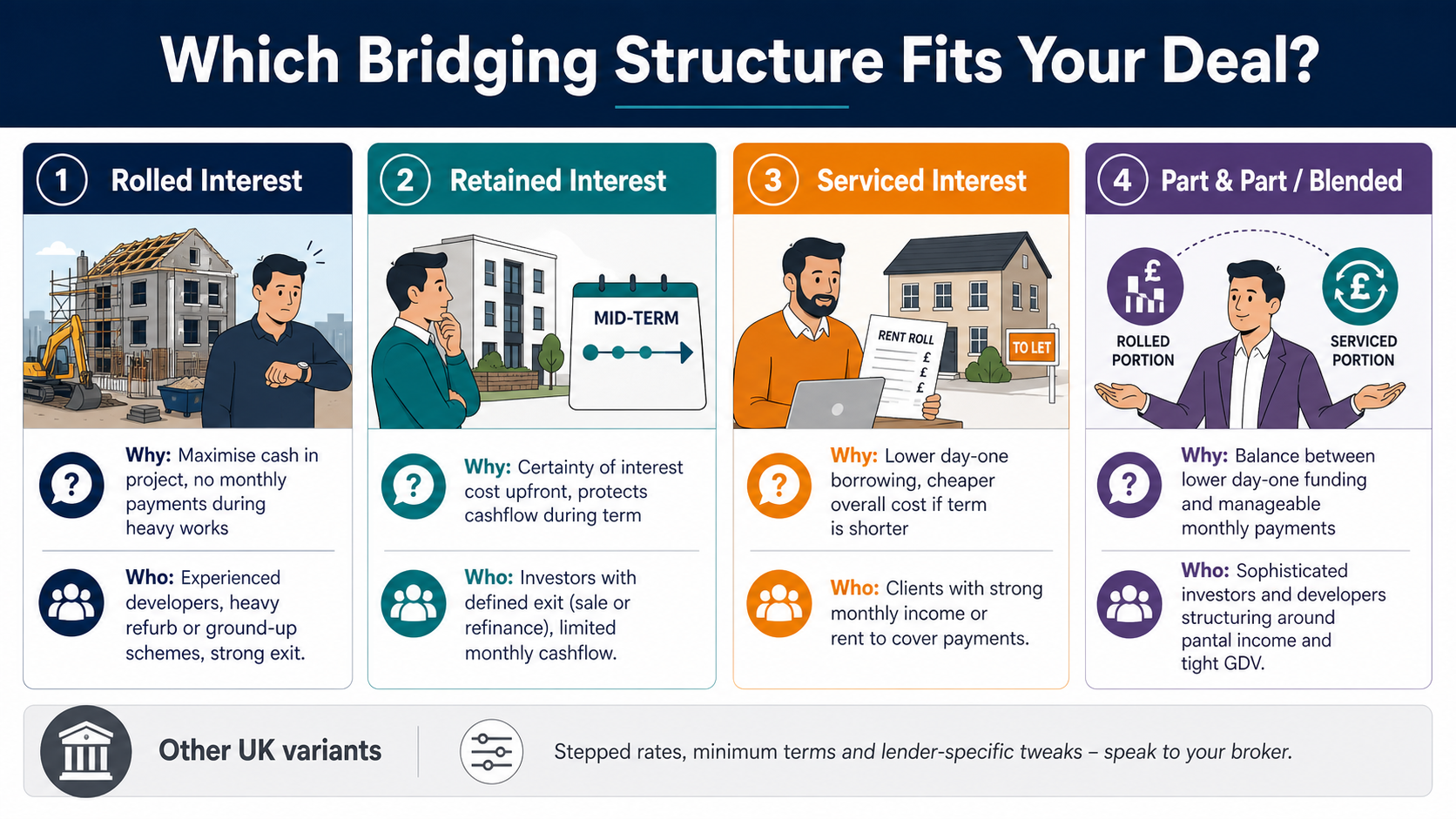
Bridging finance works like this: you identify an acquisition opportunity but lack immediate equity or your primary funding hasn’t completed. A bridging lender provides interim capital at higher interest rates, typically for 6 to 24 months. Once your permanent financing closes or you complete a property sale, you repay the bridging loan. The cost is higher than traditional mortgages, but the speed and flexibility justify the premium. For competitive acquisitions in tight markets, bridging finance often determines whether you secure the deal or lose it to faster competitors.
Development finance, by contrast, is structured specifically around construction timelines and cash flow milestones. Rather than one fixed loan amount, development finance typically releases capital in tranches as you hit agreed construction phases. The lender monitors progress against development agreements, environmental clearances, and pre-letting achievements. This staged drawdown reduces the lender’s risk whilst protecting your cash position during the build phase.
Why should you care about the distinction? Each serves a different problem. If you’re acquiring a prime site that others are chasing, bridging finance gets you across the finish line quickly. But if you’re financing a ground-up development that requires 18 to 36 months to complete, development finance provides the structured, long-term capital you actually need. Mixing them strategically amplifies your competitive advantage.
Consider a practical scenario. You identify a £15 million commercial development opportunity with six-month exclusivity. Your permanent development funding won’t be in place for eight weeks. You deploy a £12 million bridging facility for four months at 1.5% monthly interest. Total bridging cost is around £180,000. Once your development finance completes, the bridge exits, and you repay those borrowed funds. That £180,000 is expensive, but it bought you access to a deal generating £3 million profit. The mathematics work.
Development finance pricing typically ranges from 0.5% to 1.5% above base rate, significantly cheaper than bridging. But it requires more extensive preparation. Your lender needs detailed construction programmes, contractor warranties, professional consultants’ appointments, and evidence of pre-lets or end-buyer commitments. This documentation takes time to assemble. Starting this process early makes the difference between smooth funding delivery and delays that cost money.
The structure of your development finance also affects your flexibility during construction. Some lenders tie drawdowns strictly to certification of progress by your architect or quantity surveyor. Others include contingency facilities for cost overruns. Some require you to maintain minimum cash reserves. Understanding these terms before committing allows you to plan cash flows accurately and avoid the nightmare scenario where construction hits delays and you’ve depleted available funds.
Bridging and development finance also interact with your broader capital structure. If you’re stacking senior debt with mezzanine finance, bridging might cover the acquisition gap whilst development finance and permanent financing cover the build. Alternatively, development finance might be your senior debt, with mezzanine covering any cost overruns. The layering decisions you made previously now influence which financing products make sense here.
One often overlooked aspect is the exit strategy embedded in your bridging and development terms. Bridging finance must exit cleanly when permanent funding completes. If permanent lenders won’t accept your development site because construction hasn’t started, or if your development finance won’t advance because the build is behind schedule, you’re trapped. Stress-testing these exit scenarios before commitment prevents costly surprises.
For larger portfolios, establishing relationships with specialist development lenders accelerates future funding. These lenders understand your track record, your risk management approach, and your typical projects. When you approach them with a new development, they move faster than banks encountering you for the first time. Development finance specialists often have appetite for staged developments and portfolio approaches that high street banks decline.
Tip profesional Arrange bridging and development finance simultaneously rather than sequentially. Request bridge facilities that include exit options triggered by development finance completion, and ensure your development lender has approved your bridge structure before you sign the acquisition agreement. This parallel approach prevents financing gaps that could force you to renegotiate terms under pressure.
3. Optimise Commercial Mortgage Arrangements
Commercial mortgages form the backbone of property development finance for most UK developers, yet many fail to optimise the terms that matter most. The difference between a well-structured mortgage and an average one can save you tens of thousands of pounds across the life of your loan, not to mention providing the operational flexibility your projects demand.
When you approach a commercial mortgage, you’re essentially negotiating multiple variables simultaneously. Interest rate is obviously critical, but it’s only one component. Loan to value ratio determines how much you can borrow against your asset. Covenant packages define what operational metrics you must maintain. Repayment structures affect your cash flow profile. Flexibility clauses determine whether you can refinance, prepay, or amend terms without penalties. Most developers focus narrowly on rate and miss the bigger picture.
Loan to value ratio is where many deals either succeed brilliantly or fail quietly. A 65 percent loan to value mortgage on a £20 million commercial property provides £13 million of funding. But if you can negotiate 75 percent, you unlock £15 million, suddenly making a project that wasn’t viable become attractive. Conversely, if your lender demands 55 percent because they see risk in your tenant covenant or market segment, you need to accept it or find different capital. Understanding your lender’s appetite for different property types and tenant profiles helps you pitch the right deal to the right lender.
Interest rate negotiations matter, obviously, but the conversation is more sophisticated than simply requesting a lower percentage. Fixed versus variable rates offer different advantages. Fixed rates provide certainty, protecting your cash flow projections against interest rate rises. Variable rates cost less upfront but expose you to refinancing risk when rates spike. Some developers lock in fixed rates during construction, then refinance to variable once stabilised. Others hold fixed throughout, accepting the premium for absolute certainty. Your project timeline and risk tolerance guide which approach makes sense.
Amortisation schedules directly affect your development cash flows. Some mortgages require full amortisation during the loan term, meaning you pay principal and interest throughout. Others use interest-only periods during construction, then shift to amortisation post-completion. This flexibility keeps cash available for development costs rather than forcing debt repayment during the build phase. Getting this structure right prevents the nightmare scenario where your project generates surplus cash but it’s already committed to accelerated debt repayment.
Covenant packages require careful attention because breach triggers can cascade quickly. Your lender might require interest cover ratios, meaning rental income must cover interest costs by a specific multiple. They might mandate minimum cash reserves. Some require loan to value ratio maintenance, forcing you to inject equity if property values decline. Understanding these covenants before commitment allows you to model whether your project can sustain them throughout different market cycles. A covenant you breached inadvertently becomes a lender negotiation where you’ve lost leverage.
Early engagement with potential lenders shapes better outcomes. Rather than finalising your project and then seeking finance, bring lenders into the conversation earlier. Show them your team, your track record, your development programme, and your underwriting. Lenders who understand your approach from the start negotiate more flexibly on terms that matter to your specific situation. They also provide faster funding because they’ve already resolved concerns and built comfort with your project.
The timing of your mortgage request also affects terms. If you’re refinancing a stabilised asset, lenders focus on current cash flows and collateral value. If you’re financing a development pre-completion, they scrutinise your cost estimates and contractor experience more heavily. If you’re acquiring an asset before repositioning, they evaluate your business plan carefully. Matching your mortgage request to the appropriate lending window makes a material difference in pricing and structure.
Consider also the relationship between your commercial mortgage and other debt layers. If you’re stacking mezzanine finance on top, senior mortgage lenders tighten their loan to value requirements because they’re now further from the collateral. If your primary lender is involved in your multi-layered structure, they have clearer visibility into how their loan sits in the stack and price accordingly. Transparency about your overall financing reduces negotiation friction.
Flexibility clauses embedded in your mortgage terms unlock significant optionality. Some mortgages include prepayment rights without penalty, allowing you to refinance quickly if better rates emerge. Others include flexibility to add properties to the security pool, making future acquisitions simpler. Some allow covenant relaxation if specific milestones are hit. Negotiating these options upfront costs very little but provides enormous optionality as your business evolves.
Professional structuring advice genuinely saves money. Understanding how commercial mortgages work involves assessing property valuations, your creditworthiness, and market conditions in ways most developers approach intuitively rather than systematically. A professional broker who has structured hundreds of deals identifies which lenders have genuine appetite for your specific situation, which terms are negotiable versus fixed, and where you’re leaving money on the table. This expertise typically costs a small percentage of loan amount but saves multiples of that through better pricing and structure.
Tip profesional Request your commercial mortgage facility 12 to 16 weeks before you need it, even if that means the funds sit on deposit for a period. This timeline allows lenders to conduct proper due diligence, negotiate terms without time pressure, and commit to rates with confidence, resulting in better pricing than rushing into facility agreements under deadline stress.
4. Utilise Mezzanine Debt for Enhanced Leverage
Mezzanine debt sits in the middle ground between senior debt and equity, offering you a powerful tool to amplify returns without maxing out your bank borrowing capacity. Rather than accepting lower loan to value ratios from traditional lenders, mezzanine finance allows you to deploy additional leverage at the cost of higher interest rates, ultimately delivering superior equity returns on successful projects.
Think of your financing pyramid again. Senior debt occupies the safest position with the lowest returns. Equity sits at the top with the highest risk and highest potential returns. Mezzanine debt bridges this gap, accepting more risk than senior lenders tolerate but offering better security than pure equity. This positioning makes mezzanine finance extraordinarily useful when you’ve exhausted traditional bank lending but still have substantial project upside.
The mechanics work like this. Suppose you’re acquiring a £20 million commercial property. A traditional bank offers 65 percent loan to value, providing £13 million. Your equity contribution sits at £7 million. But mezzanine lenders will advance an additional £2 million at 8 to 10 percent interest, secured behind the senior debt but ahead of equity. This reduces your required equity to £5 million whilst you now control the same £20 million asset. Your equity has just become far more leveraged.
Why does this matter? Your returns scale with leverage. If your project generates £2 million profit, that’s a 28 percent return on £7 million equity versus a 40 percent return on £5 million equity. The mezzanine debt costs you roughly £160,000 to £200,000 annually, but the enhanced equity return more than covers that cost. This is leverage working precisely as intended.
Mezzanine lenders think differently than bank lenders. Banks focus on property value and whether rental income covers debt service. Mezzanine providers focus on overall project returns and whether equity has genuine skin in the game. They want to see that you personally stand to lose money if the project underperforms. This perspective allows them to accept risk that traditional lenders won’t touch. They’re comfortable with development risk, tenant concentration, and market volatility because their return compensates for that exposure.
The covenant packages on mezzanine debt reflect this higher risk tolerance. Rather than strict loan to value maintenance, mezzanine lenders often include cash sweep provisions. If your project generates surplus cash, a portion flows directly to mezzanine debt repayment. This accelerates their exit whilst protecting them if your asset underperforms. Some mezzanine facilities include equity upside participation, meaning lenders receive a small percentage of profits above their fixed return. This aligns incentives and gives lenders confidence in your project success.
Cost is obviously a consideration. Mezzanine rates typically run 2 to 4 percent above senior debt rates. If senior rates are 4.5 percent and mezzanine rates are 7.5 percent, you’re paying premium pricing. But that premium buys you something valuable: the ability to do deals that wouldn’t work with senior debt alone. A project generating 12 percent returns can easily absorb 7.5 percent mezzanine cost and still deliver attractive equity returns. A project generating only 8 percent returns cannot.
Timing matters significantly with mezzanine finance. Early stage development projects attract different mezzanine pricing than stabilised assets. If you’re acquiring a completed building with established tenants, mezzanine lenders price competitively because their risk is lower. If you’re financing a development pre-completion, mezzanine rates widen because they’re now exposed to construction risk, cost overruns, and tenant delivery uncertainty. Planning your mezzanine facility around these risk windows optimises your borrowing cost.
Mezzanine finance also allows you to maintain senior lender requirements more comfortably. If a bank will only lend on 65 percent loan to value because they’re concerned about market downturn, adding mezzanine debt above their facility solves that problem without forcing the bank to accept loan to value they’re uncomfortable with. The senior lender’s position remains secure, their loan to value stays conservative, and you access additional leverage. Everyone’s comfortable because the deal structure addresses each lender’s specific concerns.
One critical aspect is understanding when to deploy mezzanine versus when to simply accept lower leverage. Mezzanine debt makes sense when your project generates sufficient returns to cover both senior and mezzanine costs comfortably. It makes sense when you’re capital constrained and leverage unlocks additional transactions. It makes sense when traditional lenders have capped their appetite. But if you’re stretching to make equity returns work, mezzanine debt that costs 7.5 percent becomes a drag on returns rather than an enhancer.
Structuring mezzanine facilities also requires attention to subordination, default provisions, and exit mechanics. Your mezzanine lender needs clarity on what happens if senior debt is refinanced. They need to understand whether they can force equity distribution if project cash exceeds targets. They need to know if they can accelerate repayment or convert to equity if the project stalls. These technical provisions determine whether mezzanine lenders actively support your project or become adversarial stakeholders during stress.
Mezzanine providers often bring additional value beyond capital. Experienced mezzanine lenders have invested across portfolios of real estate projects and understand what makes developments succeed or fail. They can identify risks in your business plan that banks might miss, and they can suggest structural improvements that tighten your project. This advisory benefit sometimes justifies the premium cost independent of the leverage benefit itself.
For large portfolios, establishing relationships with mezzanine providers creates significant optionality. Rather than sourcing new mezzanine lenders for each transaction, you build trust with proven providers who understand your approach and move quickly when opportunities emerge. This familiarity accelerates funding and often reduces pricing as providers develop confidence in your execution.
Tip profesional Size your mezzanine facility to cover your maximum downside risk rather than your full leverage gap, ensuring you retain meaningful equity at risk even with mezzanine funding. This alignment protects your mezzanine lender’s interests, strengthens your bargaining position on pricing, and keeps your personal incentives sharply focused on project success.
5. Incorporate Offshore Vehicles for Tax Efficiency
Offshore vehicles have become standard practice for UK property developers managing substantial asset portfolios, particularly when dealing with international capital sources and complex ownership structures. Properly structured offshore entities can deliver meaningful tax efficiency, asset protection, and operational flexibility that purely domestic structures cannot match.
The core principle is straightforward. An offshore vehicle is a legal entity incorporated in a jurisdiction outside the UK, typically in locations like the British Virgin Islands, Luxembourg, or Malta. Your UK development company or property holding company operates as a subsidiary of or in partnership with this offshore entity. Rather than all profits, asset ownership, and liabilities sitting in the UK taxable environment, they’re distributed across jurisdictions with different tax treatments.
Why would you do this? Consider a scenario where your development company generates £5 million in profits annually. UK corporation tax currently sits at 25 percent, meaning £1.25 million flows to the Exchequer. But if that same company is owned by an offshore holding vehicle, the profit structure changes. The UK development company pays dividends to the offshore parent rather than retaining profits. Those dividends may be subject to different tax treatment depending on jurisdiction and treaty arrangements between the UK and your chosen offshore location.
The tax efficiency operates at multiple levels. First, some offshore jurisdictions offer territorial taxation systems, meaning only locally generated income is taxed. A Luxembourg holding company, for instance, doesn’t pay tax on dividends received from UK subsidiaries if those dividends meet specific conditions. This allows you to defer or eliminate taxation at the holding company level. Second, many offshore jurisdictions negotiate tax treaties with the UK that reduce withholding taxes on dividend payments. Rather than 20 percent withholding tax on dividends leaving the UK, treaty provisions might reduce this to 5 percent or zero depending on structure. Third, some jurisdictions offer specific incentives for holding companies or IP structures that create additional tax efficiencies.
Asset protection represents another critical benefit. If your offshore holding company owns UK property through a UK subsidiary, creditors can pursue the subsidiary but struggle to pierce through to the parent. In disputes or litigation, this separation provides meaningful protection. If a tenant sues your development company, the parent company’s assets sit protected offshore. This layering has become standard practice for institutional investors managing large portfolios precisely because it limits contagion from operational risks.
Currency management also becomes simpler with offshore vehicles. If your investors are based in Europe, the United States, or Asia, holding assets through an offshore entity denominated in their currency reduces foreign exchange exposure. Rather than converting capital into pounds sterling on arrival and back into their home currency on exit, they maintain their currency throughout. This isn’t tax driven, but it’s a genuine operational benefit that materialises when you’re managing multi-currency transactions.
The practical implementation requires professional advice. You cannot simply create an offshore company and expect tax efficiency to materialise automatically. HMRC scrutinises structures carefully, particularly those involving tax avoidance. The structure must have genuine commercial substance, not purely tax motivation. This means the offshore entity actually operates and makes business decisions rather than simply holding assets passively. Your advisors must ensure the structure complies with current tax legislation, including recent anti-avoidance rules like Pillar Two global minimum taxation standards.
Lenders need comfort with your offshore structure before advancing capital. Many institutional lenders accept offshore ownership because it’s standard practice, but they require clear security documentation that they hold valid charges against both the UK subsidiary and the offshore parent. Bridging lenders sometimes take a narrower view and prefer purely UK structures for simplicity. Understanding your lender’s position on offshore ownership before structuring prevents costly renegotiation.
Due diligence requirements have intensified significantly. When you incorporate an offshore vehicle, you’re navigating enhanced due diligence requirements under anti-money laundering regulations. You’ll need to provide beneficial ownership information, source of funds documentation, and evidence of legitimate business purpose. This compliance overhead is unavoidable but manageable if anticipated from the start. Trying to retrofit compliance after the fact creates delays and potential rejection from regulators.
The ongoing compliance burden requires attention. Offshore vehicles must file annual accounts, maintain corporate records, and comply with local regulatory requirements. If you’re using Luxembourg holding structures, you must file Luxembourg tax returns. If you’re using British Virgin Islands companies, you must maintain compliance with BVI regulations. This isn’t onerous, but it’s real work that most UK developers underestimate. Working with accountants experienced in offshore structures simplifies this significantly.
Multi-layered structures can incorporate offshore vehicles strategically without creating unnecessary complexity. You might hold UK development subsidiaries through a Luxembourg holding company, which is itself owned by a British Virgin Islands parent company held by your high-net-worth investors. Each layer serves a specific tax, operational, or commercial purpose. Over-engineering structures creates compliance risk and costs money without delivering additional benefit.
Recent changes in tax legislation have made some previously attractive structures less valuable. The reduction of corporate tax rates to 25 percent in the UK has narrowed the gap between UK and some offshore jurisdictions. The introduction of global minimum taxation means that even structures that previously deferred UK tax indefinitely now face minimum tax exposure. Understanding the current tax landscape matters more than historical structures.
Consultation with tax advisors must happen before you commit to structure. Advisors can model different structures and show you exactly what tax efficiency is achievable versus what’s theoretical. They can identify which jurisdictions offer genuine benefits for your specific situation rather than generic solutions. They can ensure your structure survives HMRC challenge if it’s ever scrutinised. This advisory investment upfront prevents catastrophic problems later.
Professional offshore structuring should address tax efficiency, asset protection, and operational simplicity simultaneously. If your structure only delivers tax benefits without commercial substance, HMRC will challenge it aggressively. If it’s so complicated that your team struggles to administer it, the costs destroy the benefits achieved.
Tip profesional Involve your tax advisors and your lenders simultaneously when considering offshore structures, ensuring each stakeholder understands and accepts your approach before you incur the costs of implementation. This parallel consultation prevents discovering mid-transaction that a lender won’t accept your structure or that tax authorities view it differently than your advisors anticipated.
6. Structure JV Equity Partnerships Effectively
Joint venture equity partnerships allow you to access larger deals, share capital requirements, and distribute risk across multiple parties whilst maintaining development control. Yet poorly structured JVs create conflict, operational paralysis, and financial disputes that destroy value faster than bad markets ever could. Getting the structure right from inception determines whether your partnership thrives or collapses under stress.
A joint venture differs fundamentally from a simple debt or equity investment. Rather than a lender advancing capital and taking fixed returns, or a passive investor writing a cheque and waiting for distributions, a JV partner actively participates in project decision-making, capital calls, and operational management. This active involvement creates both opportunity and risk. Done well, JV partners bring complementary skills, capital, and market access that make deals significantly better. Done poorly, they create veto points that freeze decisions when quick action matters most.
The foundation of effective JV structuring is absolute clarity on what each partner contributes and what each partner receives. One partner might contribute the land, another the development expertise, another the capital. Rather than assuming these contributions balance somehow, explicitly document the value of each. If Partner A contributes a £5 million site, Partner B contributes £3 million development costs, and Partner C contributes £2 million capital, the profit split should reflect these contributions proportionally. Vagueness here breeds resentment when the deal outperforms expectations and partners dispute who deserves credit.
Governance frameworks determine how decisions actually get made. Most JVs establish a management committee with representatives from each major partner. This committee approves budgets, contractor selections, major design changes, and financing decisions. But you need clarity on what decisions require unanimous consent versus what can proceed with simple majority votes. If every decision requires unanimous approval, one difficult partner can paralyse the project. If all decisions require only majority approval, minority partners feel marginalised and resentful. The balanced approach typically reserves major decisions (budget overruns above a threshold, sale of the asset, financing changes) for unanimous consent whilst delegating operational decisions to the managing partner or management committee.
Capital contribution mechanics require careful attention. Some JVs require equal capital calls at specific milestones. Others allow partners with greater risk appetite to invest more and own larger profit percentages. Some cap individual partner contributions and bring in mezzanine finance when capital requirements exceed partners’ commitments. The structure you choose affects leverage, returns, and which partners control exit decisions. A partner who has invested £10 million out of £15 million total typically controls exit timing and strategy because they have maximum exposure to market timing risk.
Profit and loss allocation should mirror risk exposure. If partners have equal capital contributions, equal profit splits typically make sense. If one partner contributed expertise and management rather than capital, their allocation might be lower but should still reflect meaningful value. Effective joint venture structures require clear allocation of roles and responsibilities, ensuring each partner understands exactly what value they’re providing and what returns they’ll receive. Ambiguity here creates arguments when projects succeed or fail.
Exit strategy deserves as much attention as entry strategy. What happens if one partner wants to exit before completion? Can they sell their stake to an external buyer or is it restricted to other JV partners? What price mechanism applies? What happens if you can’t agree on an exit timing? Some JVs include shotgun clauses where one partner can force an exit at a stated price, requiring the other partner either to accept the price or to buy the exiting partner’s stake at that same price. This mechanism forces price realism and prevents extended disputes about valuation.
Conflict resolution mechanisms prevent disputes from destroying partnerships. Rather than heading immediately to litigation which costs money and kills projects, most effective JVs include tiered dispute resolution. First, the partners attempt to resolve disagreements directly. If that fails, they escalate to the management committee. If that fails, they might pursue mediation or expert determination before litigation becomes necessary. This structured approach costs far less and preserves relationships even when disagreements occur.
Financing interactions with JV structures require lender comfort. Many lenders are familiar with JV structures and have standard terms for them. But some traditional lenders become uncomfortable with multiple partners making decisions and want clear operational control vested in one partner. You might structure your JV with one operational partner who holds day to day control, with financial decisions reserved for the partnership. Lenders then deal primarily with the operational partner whilst being comfortable that significant decisions require broader partner consent.
Tax structuring within JVs can be complex. If partners have different tax positions (some are UK entities, others are offshore), the JV entity might be established in a jurisdiction that’s tax efficient for all partners. A UK limited partnership might be controlled by offshore entities, allowing efficient distributions. Or a Luxembourg holding company might own multiple country JVs. These structures require professional tax and legal advice to ensure compliance and efficiency.
One often overlooked element is how the JV interacts with the broader capital stack. If you have senior debt, mezzanine debt, and JV equity, the JV agreement must coordinate with lending documents. Lenders need clear priority in cash flows, so JV agreements must ensure that debt service payments happen before equity distributions. Some JV agreements include provisions allowing mezzanine lenders to enforce cash sweeps that override equity distribution rights. Thinking through these interactions prevents nasty surprises when your project generates cash and lenders demand repayment that wipes out expected equity distributions.
Operational clarity prevents daily conflict. Who makes decisions about contractor selections, design changes, or cost overruns? Most JVs designate one partner as managing partner with day to day authority. This partner attends site meetings, approves invoices, and makes tactical decisions. Other partners receive regular reporting and monthly financials but don’t participate in weekly decisions. This balance gives partners visibility without creating paralysis.
For portfolio approaches involving multiple JVs, establishing template JV agreements saves legal costs and creates consistency. Rather than negotiating fresh terms for each partnership, use a framework agreement that partners customise for specific projects. This approach scales significantly better than bespoke negotiation for every transaction.
Tip profesional Document JV governance and profit distribution in writing before partners commit capital, ensuring all parties sign off on how decisions will be made and how profits will be divided. Written agreements prevent false assumptions from poisoning relationships when projects stress or outperform, and they provide legal clarity if disputes emerge.
7. Tailor Covenant Packages to Protect Interests
Covenants are the operational rules embedded in your loan documents that define how you can operate your business during the loan term. Generic covenant packages designed for average projects often constrain high-performing developers unnecessarily, whilst poorly tailored covenants leave lenders uncomfortable and more likely to enforce restrictions aggressively. Bespoke covenant packages aligned with your specific project and track record unlock operational flexibility whilst maintaining genuine lender protection.
Think of covenants as the guardrails lenders install to manage their risk. A lender advancing £15 million against a development project needs confidence that you won’t strip cash from the project, take on dangerous additional debt, or abandon the development midway. Financial covenants set specific thresholds you must maintain. Operational covenants restrict certain actions. Reporting covenants ensure lenders stay informed. The question isn’t whether you’ll have covenants, but whether they’re calibrated to your actual business or whether they’re one-size-fits-all restrictions that don’t reflect your situation.
Financial covenants typically focus on metrics that lenders can measure objectively. Interest cover ratio requires that your cash flow covers interest payments by a specified multiple, often 1.25x to 1.5x. Loan to value maintenance requires that you don’t let property values drop relative to outstanding debt. Minimum cash reserve requirements ensure you maintain liquidity for contingencies. Debt service coverage ratio requires that net operating income covers total debt service by a specific margin. Each covenant addresses a legitimate lender concern, but the thresholds matter enormously.
Consider a development project generating £2 million annual cash flow against £1.2 million annual debt service. That’s 1.67x interest cover. A lender might require 1.5x coverage, which you comfortably meet. But if they require 2.0x coverage, you need to generate £2.4 million cash flow to stay compliant. You might hit compliance challenges if market conditions soften. The difference between reasonable and unreasonable covenants often comes down to specific percentages or multiples.
Operational covenants restrict what you can do with your asset. You might covenant not to take additional debt without lender consent. You might covenant not to change your property’s use or tenant mix materially. You might covenant to maintain insurance at specific levels. You might covenant to not sell or refinance without lender approval. These restrictions protect the lender but also constrain your flexibility. A blanket prohibition on refinancing prevents you from taking advantage of falling rates. A prohibition on debt without consent prevents you from accessing mezzanine finance for expansion.
The sophistication of covenant tailoring reflects your track record and the lender’s confidence in your business. If you’re a first time developer with limited transaction history, lenders approach covenants defensively. They apply standard terms because they lack confidence in your ability to navigate stress. As you build track record and deliver successful projects, sophisticated lenders offer more flexible covenant packages because they trust your management capabilities. They know that excessive covenant restrictions actually increase default risk by preventing you from managing your business effectively.
Breach provisions deserve particular attention because they determine what happens when you violate a covenant. Some breaches are technical, meaning they’re triggered by formula but don’t reflect genuine financial distress. Others indicate genuine problems. A good covenant package includes remedial periods allowing you to cure breaches within reasonable timeframes. If you’re 0.05x below interest cover for one quarter, a responsive lender might allow 90 days to restore compliance rather than triggering default immediately. This grace period prevents technical defaults from escalating into lender takeover.
Bespoke covenant packages designed for property-specific risks reflect the actual operational characteristics of your project rather than generic assumptions. A luxury residential development has different risks than an industrial warehouse. A long-let office building has different stress scenarios than a student accommodation scheme. Tailoring covenants to these specifics means your covenants actually measure relevant metrics rather than forcing you into compliance structures that don’t fit your business.
Reporting covenants obligate you to provide financial statements, budgets, and operational reports at specified intervals. Monthly reporting requirements during construction make sense because things move fast. Quarterly reporting on stabilised assets might be excessive and creates unnecessary administrative burden. Annual reporting on mature performing assets reflects that things have stabilised. Matching reporting frequency to the project stage reduces your administrative costs without reducing lender visibility.
Negotiating covenant flexibility requires understanding lender motivations. Senior lenders want assurance that cash flows cover their interest payments and that property values don’t collapse. If you can demonstrate strong tenant covenants, stable cash flows, and limited development risk, lenders relax financial covenants because their risk is genuinely lower. If your project includes construction risk or tenant delivery uncertainty, tighter covenants make sense because the actual risk justifies them. Aligning covenant strictness to actual risk creates more sustainable agreements.
One critical area is covenant interactions across multiple debt layers. If you have senior debt with strict financial covenants and mezzanine debt with even tighter covenants, you might face a cascade where breaching senior covenants triggers mezzanine defaults automatically. Or you might face a situation where senior lender covenant compliance leaves no cash for mezzanine compliance. Professional structuring ensures that covenants across layers work together rather than creating impossible reconciliation.
Amendment provisions determine whether covenants can change as your business evolves. Some loan documents allow covenant amendment only with lender written consent, which gives lenders permanent leverage. Others include provisions allowing covenant relaxation if specific performance milestones are hit. A development covenant might automatically relax when you achieve 80 percent pre-letting, recognising that your risk profile has fundamentally improved. Building flexibility for changed circumstances prevents future disputes.
Market cycles also affect covenant reasonableness. A covenant structure reasonable in a rising market might become unsustainable if the market softens. Rather than requesting lender consent to amend covenants in distressed circumstances, some developers negotiate covenant ratchets built into the original facility. You might covenant to maintain 1.5x interest cover in a stable market, with the requirement automatically tightening to 1.25x if interest rates rise above a specified threshold, reflecting the changed economics. This mutual flexibility prevents surprises.
The most effective covenant packages give lenders genuine comfort whilst preserving your operational flexibility. If covenants are so restrictive that managing market downturns requires constant lender consent, you’ve lost control of your business despite owning it. If covenants are so loose that lenders worry about deteriorating performance, you’ve damaged the lending relationship.
Tip profesional Request that your lender identify the specific risks they’re trying to manage with each covenant, then propose alternative measurements or thresholds that address those risks more directly. Lenders often apply boilerplate covenants without thinking through whether they’re actually measuring the risks that matter for your specific project.
Below is a comprehensive table summarising strategies and key insights extracted from the article on advanced property financing frameworks and considerations.
| **Section** | **Key Topic** | **Main Insights** |
|---|---|---|
| 1. Multi-Layered Debt Structures | Debt Hierarchies | Leverage distinct debt types like senior and mezzanine loans to optimise financing structure. |
| 2. Bridging and Development Finance | Finance Purpose | Use bridging for short-term acquisition needs and development finance for staged capital supply during project phases. |
| 3. Commercial Mortgage Optimisation | Loan Adaptations | Structure repayment and covenant flexibility to enhance financial stability during project execution. |
| 4. Mezzanine Debt Utilisation | Leverage Amplification | Employ mezzanine debt to increase potential equity returns while managing risk exposure effectively. |
| 5. Offshore Vehicle Structuring | Tax Efficiency | Implement offshore entities for potential tax and asset protection benefits, ensuring legal compliance. |
| 6. Joint Venture Equity Partnerships | Collaborative Ventures | Define partner contributions and governance structures to ensure equitable profit and risk sharing. |
| 7. Covenant Tailoring | Customised Loan Terms | Negotiate covenants that align lender protection with operational flexibility to prevent financial strain. |
Unlock Your Property Development Potential with Specialist Finance Solutions
Navigating the complex world of UK property development finance requires expert insight into multi-layered debt structures, bridging finance, mezzanine lending and bespoke covenant packages. If you are striving to optimise leverage, tailor covenant terms or incorporate offshore vehicles for tax efficiency this article highlights key challenges that James William & Co Capital is uniquely positioned to solve. As a specialist mortgage broker and debt structuring partner, we understand how to structure development finance, commercial mortgages and JV equity with precision to protect your returns and accelerate deal execution.
Discover how working with James William & Co Capital grants you access to a network of family offices, private credit funds and specialist lenders who deliver rapid bespoke funding for large-scale acquisitions and complex refinances. Whether you need expert advice on mezzanine debt layering, or tailored bridging finance solutions for your next ground-up project trust us as your capital concierge for end-to-end property finance structuring. Visit James William & Co Capital today to secure competitive finance arrangements that keep your projects moving forward with confidence.
Explore our range of services at https://jwcapital.co.uk to take the first step towards smarter real estate financing.
Frequently Asked Questions
What are multi-layered debt structures, and how can they benefit my property investment?
Multi-layered debt structures involve stacking different types of debt, such as senior and mezzanine finance, to maximise your acquisition and development capacity. By strategically layering your debt, you can potentially amplify your returns on equity. Consider analysing your existing projects to determine if implementing a multi-layered debt structure could improve your financial outcomes.
How do I determine the right balance of bridging and development finance for my projects?
Balancing bridging finance and development finance involves assessing the timelines and requirements of each project. Use bridging finance for quick acquisitions while employing development finance during construction, allowing for structured capital release as milestones are met. Evaluate your project timelines and consider how each financing method can complement the other effectively.
What key factors should I negotiate when applying for a commercial mortgage?
When applying for a commercial mortgage, focus on negotiating interest rates, loan to value ratios, and covenant packages. Examine how each of these factors impacts your overall financing costs and operational flexibility. Request your mortgage facility 12 to 16 weeks in advance to allow for thorough negotiations and secure better terms.
How can I effectively use mezzanine debt to enhance project leverage?
Mezzanine debt can amplify your returns by providing additional financing that sits between senior debt and equity. By utilising mezzanine finance, you can leverage your equity while managing risk—enhancing returns when project performance meets or exceeds expectations. Assess your projected returns to ensure that the cost of mezzanine debt aligns with your financing strategy.
What are the advantages of incorporating offshore vehicles in my real estate financing structure?
Incorporating offshore vehicles can offer tax efficiency, asset protection, and operational flexibility for your property ventures. These structures help mitigate UK taxation on profits by distributing income across jurisdictions. Consult with tax advisors to model various offshore structures and identify potential tax benefits tailored to your specific circumstances.
How can I ensure my joint venture equity partnerships are structured to prevent conflicts?
Effective joint venture (JV) structures require clarity on contributions, profit allocation, and governance frameworks to avoid conflicts. Define roles and expectations in writing, focusing on how decisions are made and profits are distributed. Draft these agreements before partners commit capital to minimise disputes during challenging project phases.
Recommended
- James William & Co Capital | Specialist Property Finance
- James William & Co Capital | Specialist Property Finance
- James William & Co Capital | Specialist Property Finance
- James William & Co Capital | Specialist Property Finance
- Yigal Realty
- Property Law Explained: What UK Owners Must Know | Ali Legal
- 7 Essential Tenant Management Best Practices for Landlords - Rental Income Insurance
Related Topics
Speak to a specialist
Discuss your finance with James directly
Whole-of-market specialist finance — bridging, development, commercial and residential. No call centres, no obligation. James reviews every enquiry personally.
New to specialist finance? How unbiased broker advice works · Deals we have completed
Explore Related Finance