
Published · Updated
role of institutional investorsRole of institutional investors in UK property finance 2026
By James Dawes, CeMAP, Founder, James William & Co Capital

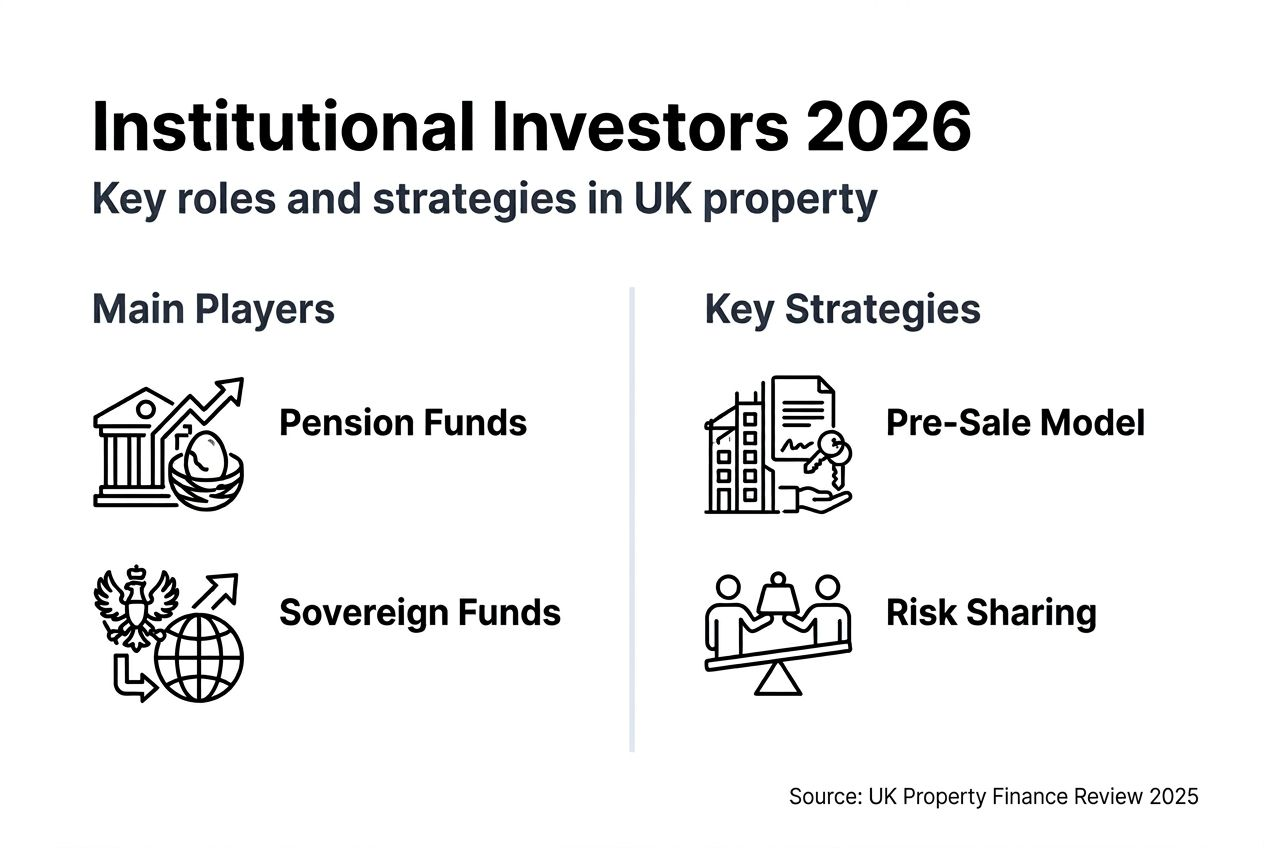
While traditional banks once dominated UK property finance, institutional investors now own around one third of the nation’s commercial real estate and are rapidly reshaping residential development funding. Pension funds, sovereign wealth vehicles, and private equity are no longer passive lenders. They are active co-investors, demanding pre-sales, setting ESG benchmarks, and rewriting the rules of capital deployment in 2026.
Table of Contents
- The Rise Of Institutional Investors In UK Property Markets
- Investment Strategies And Pre-Sale Requirements: The Cautious Approach
- The Impact Of Pension Reforms And Evolving Ownership Structures
- Government Role And Emerging Opportunities For Institutional Investment
- How James William & Co Capital Supports Institutional Property Investment
Key takeaways
| Point | Details |
|---|---|
| Institutional dominance | Pension funds and sovereign wealth funds now control substantial shares of UK residential and commercial property assets. |
| Pre-sale requirements | Investors increasingly require 50-70% of units sold off-plan before construction begins to mitigate risk. |
| Pension reforms reshape strategy | The shift from defined benefit to defined contribution schemes reduces direct real estate holdings and alters investment horizons. |
| Government facilitation | Homes England’s National Housing Bank targets over £50 billion in private capital through debt and guarantee products. |
| ESG and regulatory factors | Environmental standards and compliance increasingly influence institutional property investment decisions. |
The rise of institutional investors in UK property markets
Institutional investors are increasingly present as both funders and owners across UK residential housing, a trend accelerated by financialisation under neoliberal policies over the past two decades. Pension funds, sovereign wealth funds, insurance companies, and private equity have moved beyond passive lending to direct ownership and active portfolio management. This shift is particularly visible in build-to-rent and purpose-built student accommodation, where stable yields and long-term capital appreciation align with institutional return profiles.
Commercial real estate follows a similar pattern. Overseas investors hold around one third of UK commercial property, while private equity funds control 8% after significant post-pandemic growth. The diversification of ownership has introduced new capital sources but also complex governance structures and varied risk appetites. Logistics warehouses, data centres, and innovation hubs attract substantial capital as institutions seek exposure to sectors resilient to economic cycles and aligned with technological evolution.
Understanding property finance trends 2026 uk reveals how these investors shape funding terms, development timelines, and exit strategies. The asset focus has broadened beyond traditional offices and retail to include sectors driven by demographic change and digital infrastructure. Key investor types and their preferred segments include:
- Pension funds favouring build-to-rent and affordable housing for stable income streams
- Sovereign wealth funds targeting prime commercial assets and mixed-use developments
- Private equity pursuing value-add opportunities in logistics, life sciences, and student housing
- Insurance companies allocating capital to long-lease commercial and infrastructure-linked property
This evolving landscape requires developers and asset managers to align project structures with institutional expectations, including covenant strength, reporting transparency, and sustainability credentials. The real estate debt uk property market increasingly reflects these preferences, with senior lenders and mezzanine providers structuring terms around institutional co-investment and forward funding models.
Investment strategies and pre-sale requirements: the cautious approach
Institutional investors are adopting more conservative strategies in response to construction cost inflation and tighter finance availability. Pre-sale of 50% or more of a development’s units before construction begins has become a standard requirement to reduce market and execution risk. This threshold provides evidence of demand, secures cash flow, and aligns developer incentives with investor return expectations. The approach has grown more prevalent as material costs, labour shortages, and regulatory compliance add uncertainty to project budgets.
The ‘golden brick’ sales model involves 60-70% of units sold off-plan, a figure that reflects the cautious environment in 2026. Investors view pre-sales as proof of concept and a hedge against downside scenarios where unsold stock erodes returns. For developers, this creates pressure to launch marketing campaigns earlier, price competitively, and offer incentives that balance investor demands with buyer appeal.
Pro Tip: Start pre-sale marketing at planning approval stage and set realistic pricing based on comparable schemes to hit institutional thresholds without sacrificing margin.
Key benefits and challenges of pre-sale requirements include:
- Reduced financing risk through demonstrated market demand and committed buyer deposits
- Improved project viability assessments for lenders and equity partners
- Enhanced cash flow visibility enabling phased construction and drawdown planning
- Marketing pressure requiring early spend and potentially discounted pricing to achieve targets
- Market timing risk if demand softens between pre-sale and practical completion
| Development type | Typical pre-sale requirement | Investment condition |
|---|---|---|
| Build-to-rent | 40-50% forward-funded | Long-lease covenant strength |
| Residential for sale | 60-70% off-plan | Buyer deposit protection |
| Mixed-use | 50-60% commercial pre-let | Anchor tenant credit rating |
| Student housing | 30-40% forward-funded | University partnership |
Understanding how to optimise real estate funding uk in this context means structuring deals that satisfy institutional pre-sale criteria while maintaining flexibility for developers to capture market upside. Mezzanine and preferred equity layers can bridge gaps when pre-sales fall short, but these come with higher costs and stricter covenants.
The impact of pension reforms and evolving ownership structures
UK pension scheme reforms are reshaping institutional property investment patterns. Defined benefit schemes are de-risking through liability transfers to insurance bulk annuity markets, reducing direct real estate holdings as schemes move into run-off. This trend limits new capital inflows from traditional pension sources and shifts the investor base towards defined contribution schemes, which favour liquid, diversified funds over direct property ownership.

Defined contribution schemes have shorter investment horizons and greater liquidity needs, making them less suited to illiquid, long-hold property assets. The result is reduced appetite for direct development finance and increased reliance on pooled vehicles and REITs that offer more frequent redemption windows. This evolution affects market dynamics, as fewer institutional buyers for large, bespoke developments can lengthen sales processes and compress pricing for sponsors seeking exits.
Key reform impacts on investment strategy and asset management include:
- Reduced direct property allocations as DB schemes transfer liabilities and wind down portfolios
- Increased focus on liquid property funds and listed vehicles by DC schemes prioritising member flexibility
- Greater reliance on third-party fund managers and platform providers to access property exposure
- Shift towards core, income-producing assets with shorter payback periods over speculative development
Pro Tip: Monitor pension regulation updates and engage early with DC-focused fund managers who can aggregate capital for institutional-scale transactions.
The transition creates opportunities for family offices, sovereign funds, and private credit providers to fill the capital gap left by retreating pension schemes. However, these sources often demand higher returns, more control, and bespoke structuring that increases transaction complexity. Understanding capital advisory uk property finance becomes essential for navigating this fragmented landscape and matching project characteristics with available capital sources.
Government role and emerging opportunities for institutional investment
Government initiatives play a crucial role in facilitating institutional capital deployment by de-risking projects and enhancing infrastructure. Mega-event urbanism reduces risk through state-led infrastructure improvements and demand certainty linked to events like the Olympics or international expositions. These interventions create investable opportunities in residential rental, mixed-use, and commercial sectors that might otherwise lack the scale or certainty to attract institutional backing.
Homes England’s National Housing Bank represents a significant 2026 development. The initiative aims to unlock over £50 billion of additional private capital through expanded debt, equity, and guarantee products supporting housing and mixed-use schemes. By providing credit enhancement and co-investment, the Bank lowers entry barriers for institutional investors wary of development risk or unfamiliar local markets. This public-private partnership model aligns government housing targets with institutional return requirements, creating a mutually beneficial framework.
Government mechanisms supporting institutional investment include:
- Direct loan facilities offering below-market rates for qualifying affordable and mixed-tenure developments
- Credit guarantees reducing senior debt risk and improving loan-to-value ratios for institutional lenders
- Equity co-investment providing cornerstone capital that crowds in private institutional participation
- Planning fast-track processes for strategic sites reducing time risk and holding costs
- Infrastructure investment in transport, utilities, and amenities enhancing site viability and asset value
| Financing option | Risk profile | Typical terms | Institutional appeal |
|---|---|---|---|
| Traditional senior debt | Moderate | 60-65% LTV, floating rate | Limited without strong sponsor |
| Government-backed guarantee | Low | 70-75% LTV, reduced margin | High due to credit enhancement |
| Homes England equity | Low to moderate | Minority stake, profit share | Very high, provides validation |
| Private mezzanine | High | 75-85% LTC, fixed return | Selective, requires strong exit |
These structures offer pathways for institutional investors to participate in sectors like affordable housing, build-to-rent, and regeneration that align with ESG mandates while achieving acceptable risk-adjusted returns. Exploring real estate funding sources uk developers guide reveals how to layer public and private capital effectively, optimising cost and control while satisfying institutional governance requirements.
How James William & Co Capital supports institutional property investment
Institutional property investors require sophisticated finance partners who understand evolving capital markets and can structure bespoke solutions at pace. James William & Co Capital specialises in arranging specialist property finance for institutional investors, asset managers, and professional developers navigating the complex UK market in 2026.

Our capital concierge approach provides a single point of contact for multi-layered debt stacks, mezzanine facilities, and JV equity structures that align with institutional return profiles and governance standards. We work with family offices, private credit funds, and specialist lenders to deliver rapid, tailored solutions for large-scale acquisitions, ground-up developments, and complex refinances. Explore our finance case studies to see how we have executed under pressure for institutional clients, or review our capital finance services to understand how we structure funding that meets your strategic objectives.
FAQ
What defines an institutional investor in UK property markets?
Institutional investors include pension funds, sovereign wealth funds, insurance companies, and private equity funds deploying large capital sums into property. They typically seek long-term, stable returns through direct ownership, funds, or co-investment structures.
How do pension reforms impact institutional property investment?
The shift from defined benefit to defined contribution schemes alters investment horizons and reduces direct property holdings. De-risking via bulk annuity transfers decreases market liquidity as pension funds sell assets and limit new commitments.
What role does government play in facilitating institutional investment?
Government de-risks projects through infrastructure investment and mega-event urbanism that enhances demand certainty. Homes England’s National Housing Bank improves access to debt and guarantees, unlocking over £50 billion in private capital for housing and mixed-use schemes.
What are the main risks institutional investors face in UK property markets?
Valuation subjectivity and market fluctuations can affect portfolio returns and exit timing. Liquidity constraints arise from large asset sizes and long holding periods, while regulatory changes around environment, finance, and planning affect strategy and compliance costs.
Why are pre-sale requirements now standard in institutional development finance?
Pre-sales demonstrate market demand and reduce execution risk in a climate of rising construction costs and tighter finance. Investors require 50-70% of units sold off-plan to validate feasibility and secure cash flow before committing development capital.
Recommended
Related Topics
Speak to a specialist
Discuss your finance with James directly
Whole-of-market specialist finance — bridging, development, commercial and residential. No call centres, no obligation. James reviews every enquiry personally.
New to specialist finance? How unbiased broker advice works · Deals we have completed
Explore Related Finance