
Published
role of credit ratings in propertyRole of credit ratings in property finance explained
By James Dawes, CeMAP, Founder, James William & Co Capital

TL;DR:
- Credit ratings influence borrowing costs, asset valuations, and market access across UK property finance. They affect individual, tenant, and market-wide risk assessments, shaping investment decisions and capital flows. However, investors must analyze property and market risks separately from credit ratings, as ratings are only a snapshot of financial probability.
Credit ratings are a standardised measure of financial reliability that directly shape how lenders price risk, how investors assess deals, and how developers access capital across the UK property market. Whether you are arranging a commercial mortgage, structuring a development facility, or acquiring a single-tenant net lease asset, the role of credit ratings in property finance touches every layer of the transaction. Ratings issued by agencies such as S&P Global, Fitch Ratings, and Moody’s govern institutional capital flows, while personal credit scores determine individual borrowing costs. Understanding both is not optional for serious investors. It is the foundation of every financing decision you will make.
How do credit ratings affect property loan eligibility?
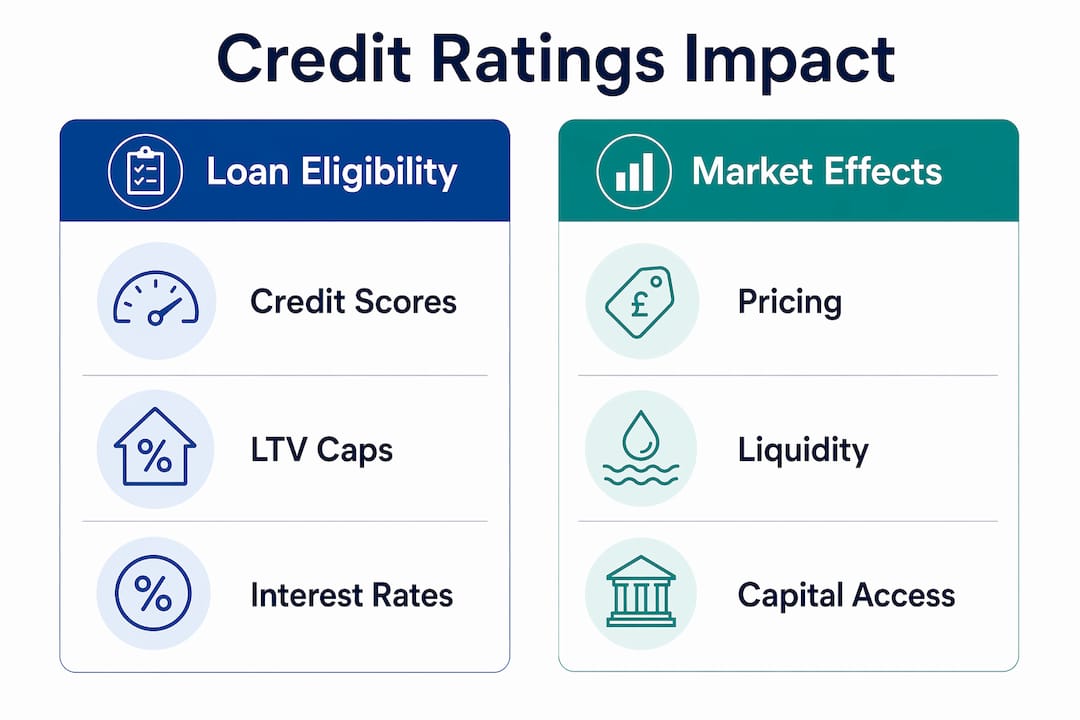
Personal credit scores set the floor for what you can borrow and at what cost. Institutional rental property loans require a minimum credit score of 650, with scores above 740 attracting interest rates 1 to 1.5 percentage points lower. On a £400,000 loan, that difference equates to monthly savings of £300 to £400. That is a material sum across a five-year hold.

Credit score tiers also govern Loan-to-Value caps. Scores in the 620–659 range typically cap LTV at 70%, while scores of 740 or above unlock LTV caps of 75%. A higher LTV means less equity required at entry, which directly affects your return on equity. For investors deploying capital across multiple assets, that 5-point LTV difference compounds quickly.
Lenders use tri-merge credit reports to determine your qualifying score. They pull reports from Experian, Equifax, and TransUnion, then use the middle figure. If your three scores are 625, 638, and 645, your qualifying score is 638. Repairing a single bureau error can shift that middle score above a key threshold and change your loan terms entirely.
Pro Tip: Use rapid rescoring before submitting a loan application. This process, available through mortgage brokers, can update your credit file within 30 to 90 days after you correct errors or pay down balances. Timing this correctly can move you into a better rate tier before the lender runs their final credit check.
| Credit score range | Typical LTV cap | Rate adjustment vs 740+ |
|---|---|---|
| 620–659 | 70% | +1.0 to +1.5 percentage points |
| 660–699 | 72% | +0.5 to +1.0 percentage points |
| 700–739 | 73% | +0.25 to +0.5 percentage points |
| 740 and above | 75% | Base rate |
Even DSCR loans, which qualify borrowers on property cash flow rather than personal income, still treat investor credit scores as a primary factor for pricing and risk assessment. Adding a co-signer with a stronger credit profile can improve access to these facilities when your own score falls short.
Why do tenant credit ratings matter in commercial property?
In commercial real estate, the tenant’s credit rating often matters more than the borrower’s personal score. Investment-grade tenant ratings are defined as BBB- or Baa3 or higher, using S&P and Moody’s scales respectively. Tenants rated at this level signal a low probability of default on lease obligations. That signal directly reduces lender risk, compresses cap rates, and widens the pool of institutional investors eligible to participate in the deal.
Speculative-grade tenants, those rated below BBB-, face a different financing environment. Lenders typically require higher capital reserves, charge wider credit spreads, and restrict access to certain funding structures. For a developer or investor holding a single-tenant net lease asset, a tenant downgrade from investment grade to speculative grade can reprice the entire asset overnight.
Credit tenant lease financing takes this logic to its conclusion. In this structure, lenders underwrite the tenant’s credit more heavily than the property itself. The lease becomes the primary collateral, and the tenant’s rating directly informs amortisation schedules, reserve requirements, and lender appetite. A long-term lease with a BBB-rated tenant can unlock financing terms that a vacant or multi-let building simply cannot match.
Benefits of higher tenant credit quality for investors include:
- Lower cap rates, which translate to higher asset valuations at exit
- Access to a broader range of institutional buyers and investment funds
- Tighter financing spreads and longer amortisation periods
- Reduced lender scrutiny on property-specific factors
- Eligibility for securitisation structures such as commercial mortgage-backed securities
Understanding real estate debt structures in the UK context helps investors position assets to attract the right lender profile from the outset.
Income-stream risk vs residual property risk: what is the difference?
This distinction is where many investors make expensive mistakes. A credit rating tells you the likelihood that a tenant will continue paying rent. It does not tell you what the building is worth if that tenant leaves. These are two separate risks, and conflating them distorts your underwriting.
A credit rating evaluates the probability of an obligor continuing payments. It does not assess market value loss, liquidity risk, or property-specific factors affecting residual value. A supermarket chain rated A by S&P may be an excellent income-stream bet. But if the building is a single-purpose retail unit in a declining town centre, the residual value risk is entirely separate and potentially severe.
Residual property value depends on factors that credit ratings ignore entirely. Location quality, building specification, planning flexibility, alternative use potential, and local market depth all determine what you can sell or re-let the asset for if the tenant exits. A long lease to a strong tenant can mask these risks for years before they surface at refinance or sale.
Pro Tip: Run two separate underwriting models for every commercial acquisition. The first should stress-test the income stream by modelling tenant default scenarios. The second should value the property on vacant possession, using comparable evidence for the building in its current specification. The gap between these two figures is your real risk exposure.
| Risk type | What it measures | Key factors | Credit rating relevance |
|---|---|---|---|
| Income-stream risk | Probability of rent payment | Tenant financial health, lease length, break clauses | High: rating directly signals this risk |
| Residual property risk | Asset value if vacant | Location, specification, alternative use, market depth | Low: rating does not capture this risk |
Developers and investors must separate these two risk categories to avoid overvaluing lease security at the expense of residual property risks. The UK property finance trends emerging in 2026 show lenders increasingly stress-testing both dimensions independently, particularly on single-let commercial assets.
How do credit ratings shape property market pricing and liquidity?
Credit ratings do not just affect individual transactions. They shape the pricing and availability of capital across the entire property finance market. Commercial mortgage-backed securities rely on ratings from S&P, Fitch, and Moody’s to determine bond pricing, investor eligibility, and the volume of capital flowing into property finance. A downgrade to a CMBS tranche can trigger forced selling by institutional investors whose mandates restrict sub-investment-grade holdings.
Even outside securitisation, ratings act as a pricing reference. Banks and insurance companies use investment-grade thresholds to set internal credit spreads on commercial property loans. A borrower or tenant sitting just above the BBB- threshold accesses a materially different cost of capital than one sitting just below it. A single-notch downgrade can widen credit spreads, increase cap rates, and raise borrowing costs simultaneously.
Credit ratings shape real estate market behaviour in several concrete ways:
- Institutional investors with investment-grade mandates exit assets when tenant ratings fall below BBB-, creating forced supply and price pressure
- CMBS issuance volumes contract when rating agencies tighten criteria, reducing available capital for large-scale property finance
- Cap rate compression in prime markets is partly driven by the concentration of investment-grade tenants, which attracts lower-cost institutional capital
- Bank loan pricing on commercial property reflects internal credit models calibrated against agency rating scales, even for unrated borrowers
- Regulatory capital requirements for banks increase when property loan books contain higher concentrations of sub-investment-grade exposure
For developers seeking real estate funding sources in the UK, understanding where your project sits in the credit quality spectrum determines which lender pools are accessible and at what price.
Key takeaways
Credit ratings in property finance determine borrowing costs, asset valuations, and capital access at every level, from personal credit scores to corporate tenant ratings and CMBS markets.
| Point | Details |
|---|---|
| Personal credit score thresholds | Scores above 740 unlock the lowest rates and highest LTV caps on investment property loans. |
| Tenant investment-grade status | BBB- or above compresses cap rates and widens access to institutional financing and securitisation. |
| Two separate risk categories | Income-stream risk and residual property risk require separate underwriting models for accurate deal assessment. |
| Market-wide pricing effects | A single-notch rating downgrade can raise cap rates, widen spreads, and trigger institutional selling simultaneously. |
| Tri-merge qualifying score | Fixing one bureau error can shift your middle score above a key threshold and change your loan terms. |
Credit ratings are a tool, not a verdict
Most investors treat credit ratings as a binary pass or fail. They are not. They are a snapshot of financial probability at a point in time, and the property market punishes those who treat them as permanent truth.
I have seen developers walk away from excellent assets because a tenant’s rating had slipped to BB+, one notch below investment grade. The building was well-located, the lease had eight years to run, and the tenant’s underlying business was sound. The rating was a lagging indicator of a problem that had already been resolved. The investor who bought it instead made a strong return.
The reverse is equally dangerous. I have watched investors pay sharp prices for long-leased assets with A-rated tenants, only to discover at refinance that the building had almost no alternative use value. The income stream was secure. The residual risk was catastrophic. The credit rating told them nothing about the second problem.
The practical lesson is this: use credit ratings as your starting point for risk assessment, not your finishing point. A strong personal credit score gets you to the table. A strong tenant credit rating improves your terms. But neither replaces a thorough analysis of the asset itself, the market it sits in, and the exit options available to you. Investors who build that discipline into every deal make better financing decisions and avoid the traps that catch those who rely on ratings alone.
— James
Specialist property finance from James William & Co
Understanding credit ratings is one part of structuring a deal well. Executing it at the right cost, with the right lender, and at speed is another matter entirely.

James William & Co Capital works with UK property investors and developers to structure financing across the full credit spectrum, from investment-grade commercial acquisitions to complex development facilities where personal and corporate credit profiles both play a role. Whether you need a specialist property finance solution for a London acquisition or a multi-layered debt stack for a ground-up scheme, the team provides a single point of contact for structuring, negotiation, and execution. Speak to James William & Co to put your credit position to work in the right deal structure.
FAQ
What is the minimum credit score for a UK investment property loan?
Most institutional lenders require a minimum credit score of 650 for rental property loans, with scores above 740 attracting the most competitive rates and highest LTV caps.
What does investment-grade tenant mean in commercial property?
An investment-grade tenant holds a credit rating of BBB- or Baa3 or higher from S&P or Moody’s. This signals a low default risk and typically results in lower cap rates and better financing terms for the property owner.
How does a tenant credit downgrade affect property value?
A single-notch downgrade below investment grade can widen credit spreads, increase cap rates, and reduce the pool of eligible institutional buyers, all of which put downward pressure on the asset’s market value.
What is a tri-merge credit report and why does it matter?
A tri-merge report combines scores from Experian, Equifax, and TransUnion, with lenders using the middle figure as the qualifying score. Correcting an error on one bureau’s report can raise this middle score above a key lending threshold.
Do DSCR loans ignore personal credit scores?
No. DSCR loans qualify borrowers based on property cash flow, but investor credit scores remain a primary factor in determining interest rates, loan terms, and lender appetite, even in income-based qualification structures.
Recommended
Related Topics
Speak to a specialist
Discuss your finance with James directly
Whole-of-market specialist finance — bridging, development, commercial and residential. No call centres, no obligation. James reviews every enquiry personally.
New to specialist finance? How unbiased broker advice works · Deals we have completed
Explore Related Finance