
Published · Updated
role of specialist lendersRole of Specialist Lenders in UK Property Finance
By James Dawes, CeMAP, Founder, James William & Co Capital

Nearly one third of all British real estate transactions now rely on specialist lenders for flexible funding solutions that mainstream banks simply cannot match. For property developers and investors dealing with complex deals or tight timelines, traditional approaches often fall short. This overview reveals how British specialist lenders deliver personalised financing for ambitious projects, demonstrating the strategic advantages and rapid execution available for those who think beyond conventional banking.
Table of Contents
- Defining Specialist Lenders In Property Finance
- Types Of Specialist Lending And Key Distinctions
- How Specialist Lending Works For Developers
- Eligibility, Due Diligence, And Lending Criteria
- Risks, Costs, And Strategic Benefits For Investors
Key Takeaways
| Point | Details |
|---|---|
| Specialist Lenders Focus on Niche Markets | They provide targeted financing solutions for complex property needs, unlike traditional banks, which focus on standard borrower profiles. |
| Tailored Risk Assessment | Specialist lenders employ personalised evaluation methods that consider individual circumstances rather than relying solely on standard credit scoring. |
| Bespoke Product Offerings | They offer a diverse range of financing solutions, including bridging loans and development finance, tailored to unique investment requirements. |
| Comprehensive Due Diligence | Rigorous assessments of borrower capabilities, market dynamics, and property valuations are essential for securing specialist lending. |
Defining Specialist Lenders in Property Finance
Specialist lenders represent a sophisticated segment of the UK financial landscape, providing targeted mortgage solutions beyond traditional banking frameworks. Unlike conventional high street banks, these financial entities focus on serving niche market segments with complex financing requirements. The Council of Mortgage Lenders highlights that these lenders collectively account for a significant portion of flexible property finance options in the United Kingdom.
Specialist lenders distinguish themselves through their ability to assess risk and provide funding where mainstream financial institutions might hesitate. Their expertise encompasses supporting borrowers with non-standard property profiles, including unique real estate investments, development projects with complex structures, and scenarios involving challenging credit histories. These lenders typically offer more personalised assessment processes, leveraging sophisticated risk evaluation techniques that go beyond standard credit scoring models.
The core characteristics of specialist property finance lenders include exceptional flexibility, rapid decision-making capabilities, and a willingness to consider individual circumstances. They often serve property developers, high-net-worth investors, and entrepreneurs seeking bespoke financing solutions that traditional banking channels cannot accommodate. Their product ranges might include bridging loans, development finance, commercial mortgages, and complex refinancing structures tailored to specific investor needs.
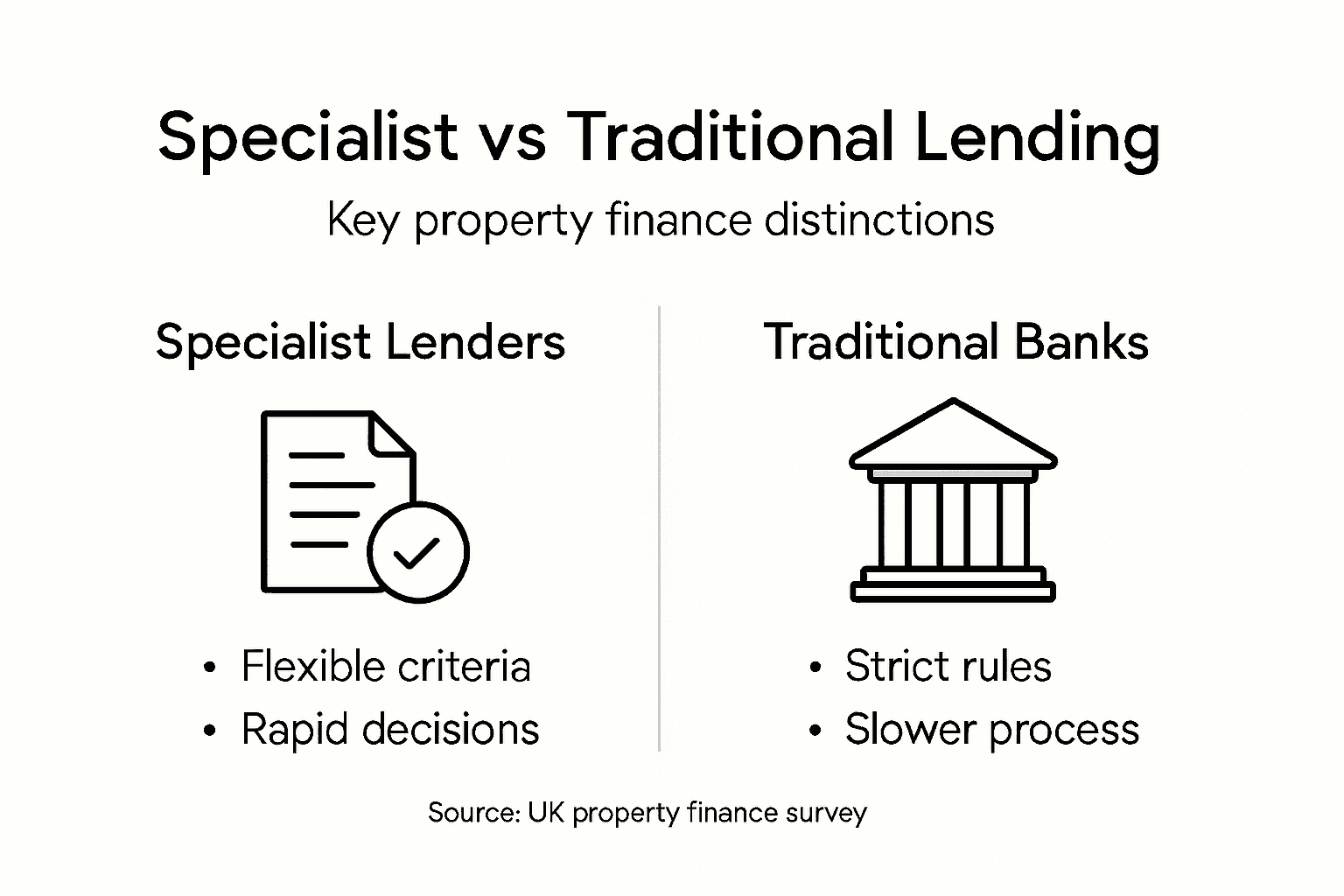
Here is a comparison of specialist lenders and traditional banks in property finance:
| Criteria | Specialist Lenders | Traditional Banks |
|---|---|---|
| Risk Assessment | Personalised, flexible models | Standardised credit scoring |
| Speed of Decision | Rapid, tailored processes | Slower, structured pipelines |
| Eligible Properties | Non-standard and complex cases | Mainly prime and standard assets |
| Borrower Profile | Developers, unique investors | Mainstream, low-risk borrowers |
| Product Range | Bespoke, niche finance options | Limited, standard loan products |
Pro Tip: When exploring specialist property finance options, always conduct comprehensive due diligence and compare multiple lender offerings to ensure you secure the most appropriate financing structure for your specific investment requirements.
Types of Specialist Lending and Key Distinctions
Specialist lending in property finance encompasses diverse financing approaches that address unique market segments and complex investment requirements. Project finance and income-producing real estate finance represent two primary categories with distinctly different risk profiles and underwriting methodologies. These lending types demonstrate the nuanced landscape of specialist financial products designed to support sophisticated property investment strategies.
Within the UK mortgage industry, specialist lenders provide a range of targeted financial products that extend far beyond conventional banking offerings. These include bridging loans, development finance, and financing for non-standard properties. Each lending type carries specific risk characteristics and interest rate structures tailored to address unique borrower requirements. The mortgage lending landscape includes multiple categories such as:
- Bridging loans for short-term property acquisitions
- Development finance for ground-up construction projects
- Commercial property investments
- Refinancing for complex property portfolios
- Loans for properties with unique structural characteristics
The distinguishing factor of specialist lenders lies in their ability to evaluate risk through more personalised and flexible assessment processes. Unlike traditional banks, these financial institutions can provide funding solutions for scenarios involving challenging credit histories, complex ownership structures, or unconventional property types. Their underwriting models incorporate sophisticated risk evaluation techniques that consider individual circumstances rather than relying solely on standardised credit scoring mechanisms.
Pro Tip: When exploring specialist lending options, meticulously compare multiple lender offerings and carefully assess the specific terms, interest rates, and flexibility of each potential financing solution.
How Specialist Lending Works for Developers
Specialist lending for property developers represents a sophisticated financial approach that addresses the unique challenges of real estate development. Unlike traditional banking models, these specialised financial solutions provide developers with flexible capital structures designed to accommodate the complex and cyclical nature of property development projects. The funding process focuses on comprehensive project evaluation, including detailed assessments of land acquisition potential, construction feasibility, and strategic exit strategies.
The development finance framework typically encompasses multiple critical stages of property development:
- Initial land acquisition funding
- Pre-construction infrastructure investments
- Phased construction capital deployment
- Interim refinancing options
- Final exit strategy financing
Specialist lenders differentiate themselves by offering nuanced risk assessment methodologies that consider the intricate dynamics of property development. Government-supported financing initiatives have further enhanced the landscape, creating collaborative funding models that support regional developers and accelerate housing infrastructure delivery. These lenders examine multiple dimensions beyond traditional credit scoring, including developer track record, project design, market positioning, and potential return on investment.

Pro Tip: Cultivate comprehensive financial documentation and a robust project prospectus to demonstrate your development’s viability and increase your chances of securing specialist lending.
Eligibility, Due Diligence, and Lending Criteria
Specialist lending criteria represent a sophisticated framework of comprehensive evaluations designed to mitigate financial risks and ensure robust investment potential. These rigorous assessments go beyond traditional lending approaches, incorporating multiple layers of scrutiny that examine the intricate details of property development projects, borrower capabilities, and market dynamics.
The lending evaluation process typically involves a multifaceted assessment across several critical dimensions:
- Borrower financial history and creditworthiness
- Project feasibility and market positioning
- Detailed property valuation and asset quality
- Comprehensive risk profiling
- Loan-to-value ratio calculations
- Debt service coverage potential
- Developer’s professional track record
Under regulatory valuation standards, specialist lenders conduct exhaustive due diligence that extends far beyond conventional credit checks. This approach involves meticulous examination of legal title verifications, property inspections, and sustainable market value assessments. The process emphasises transparency, conservative estimation, and a holistic view of potential investment risks and opportunities, ensuring that each financing decision is founded on robust, data-driven insights.
Pro Tip: Prepare a comprehensive portfolio documenting your project’s financial projections, market research, and risk mitigation strategies to significantly enhance your lending eligibility.
Risks, Costs, and Strategic Benefits for Investors
Property investment risks represent a complex landscape of potential challenges and opportunities that demand sophisticated strategic understanding. Investors must navigate a multifaceted environment where financial considerations intersect with broader market dynamics, regulatory frameworks, and emerging economic trends. The intricate nature of specialist lending requires a nuanced approach to risk assessment and strategic planning.
The primary risk categories for property finance investors include:
- Market volatility and cyclical fluctuations
- Regulatory and compliance uncertainties
- Environmental and sustainability challenges
- Technological disruption in real estate markets
- Macroeconomic shifts affecting property valuations
- Geopolitical factors influencing investment landscapes
- Potential changes in lending regulations
Beyond traditional financial metrics, modern property investment strategies must incorporate comprehensive risk management frameworks that extend beyond monetary considerations. Strategic investors increasingly recognise the importance of holistic assessment methodologies that blend financial analysis with broader environmental, social, and governance (ESG) considerations. This approach enables more resilient investment strategies that can adapt to rapidly changing market conditions and emerging economic challenges.
The following table summarises potential strategic benefits of specialist lending for property investors:
| Strategic Benefit | Description | Typical Impact |
|---|---|---|
| Enhanced Flexibility | Financing adapts to complex project needs | More projects become fundable |
| Competitive Advantage | Access to rapid, tailored funding | Secures deals ahead of competitors |
| Improved Risk Management | Custom structures reduce unforeseen risks | Greater investment resilience |
| Portfolio Diversification | Financing for varied and unique asset types | Broader investment opportunities |
Pro Tip: Develop a dynamic risk management strategy that incorporates scenario planning, maintains financial flexibility, and consistently monitors both micro and macroeconomic indicators affecting property investment landscapes.
Unlock Specialist Lending Solutions for Your UK Property Projects
Navigating the complex world of specialist lenders can be challenging, especially when your property investment or development demands bespoke financing solutions beyond conventional banks. Whether you are facing non-standard property profiles, require bridging loans, or need tailored development finance with multi-layered debt structures, understanding the nuances of specialist lending is crucial for success. Key concerns such as rapid decision-making, flexible credit assessments, and tailored covenant packages must be addressed to secure the most advantageous funding.
At James William & Co Capital, we understand these challenges intimately. We offer a “capital concierge” style service that simplifies access to a wide network of specialist lenders, family offices, and private credit funds. Our expertise enables us to structure bridging finance, commercial mortgages, mezzanine debt and JV equity tailored specifically for high-net-worth investors and professional developers aiming for large-scale acquisitions and complex refinances. We are committed to delivering speedy, personalised solutions that reflect your individual project needs and mitigate the risks highlighted in the specialist lending landscape.
Transform your approach to specialist property finance by partnering with a team known for executing under pressure while providing a single point of contact for the entire debt structuring process. Discover how you can leverage these bespoke capital structures to secure your next big investment.

Ready to benefit from unparalleled expertise in specialist lending and structured property finance Invest in your property ambitions today by visiting James William & Co Capital to explore how our tailored solutions can unlock your investment potential. Contact us now for a personalised consultation and take the first step towards securing flexible financing that matches your project complexity.
Frequently Asked Questions
What are specialist lenders in property finance?
Specialist lenders are financial institutions that provide tailored mortgage solutions for complex financing needs, focusing on unique property profiles and borrowers with non-standard requirements, unlike traditional banks.
How do specialist lenders assess risk compared to traditional banks?
Specialist lenders use personalised and flexible risk assessment models that consider individual borrower circumstances, while traditional banks typically rely on standardised credit scoring systems.
What types of loans do specialist lenders offer?
Specialist lenders offer various financing products, including bridging loans, development finance, commercial mortgages, and loans for non-standard properties, catering to specific investor needs.
What should borrowers prepare when seeking specialist lending?
Borrowers should prepare comprehensive financial documentation, including a robust project prospectus, financial projections, and market research, to enhance their chances of securing funding from specialist lenders.
Recommended
Related Topics
Speak to a specialist
Discuss your finance with James directly
Whole-of-market specialist finance — bridging, development, commercial and residential. No call centres, no obligation. James reviews every enquiry personally.
New to specialist finance? How unbiased broker advice works · Deals we have completed
Explore Related Finance