
Published · Updated
step by step development financeStep by step guide to development finance UK developers
By James Dawes, CeMAP, Founder, James William & Co Capital

Securing development finance for large-scale UK projects presents significant challenges for property developers and high-net-worth investors. Complex lending metrics, substantial equity requirements, and layered cost structures often create barriers to funding. This comprehensive guide walks you through every stage of obtaining and structuring development finance, from initial preparation through to successful project completion. You will learn how to navigate lender requirements, optimise your capital stack, and manage your funding effectively to ensure your development achieves its full potential.
Table of Contents
- Key takeaways
- Understanding development finance basics
- Preparing to secure development finance: prerequisites and planning
- Step by step process to arrange development finance
- Monitoring, troubleshooting, and ensuring project finance success
- How James William & Co Capital supports your development finance journey
- Frequently asked questions
Key Takeaways
| Point | Details |
|---|---|
| LTGDV and LTC levels | Lenders typically offer 65 to 70 per cent LTGDV and 80 to 90 per cent LTC for experienced developers. |
| Equity requirements | Most projects require 10 to 30 per cent developer equity, with first time developers often needing more and typically facing LTC of around 50 to 65 per cent. |
| Total cost range | Total development costs including arrangement and exit fees typically reach 12.7 to 15 per cent. |
| Layered funding approach | Layered finance with senior debt, mezzanine and equity investments can optimise funding for large projects. |
| Preparation lead time | Start financial planning at least six months before you need funds to accommodate valuations HMRC VAT registrations and approvals. |
Understanding development finance basics
Development finance operates differently from standard mortgages or commercial loans. Lenders assess projects using specific metrics that determine how much capital you can access and what it will cost. Understanding these fundamentals helps you plan realistically and approach lenders with confidence.
The primary metric is Loan-to-Gross Development Value (LTGDV), which compares the loan amount to your project’s expected end value. Lenders typically offer 65-70% LTGDV, meaning if your completed development will be worth £2 million, you might secure £1.3 to £1.4 million in funding. Loan-to-Cost (LTC) measures the loan against total project costs, usually ranging from 80-90% for experienced developers.
Your equity contribution fills the gap between what lenders provide and your total funding needs. Most projects require 10-30% developer equity, though first-time developers often need to contribute more. This equity demonstrates your commitment and provides a buffer protecting lenders if costs escalate or values fall.
Interest rates currently range from 6.5-12% per annum, with total costs reaching 12.7-15% once you include arrangement fees (typically 1.5-2%), exit fees (1-2%), and monitoring costs. Many developers roll these costs into the loan rather than paying monthly, preserving cash flow during construction.
Typical development finance metrics
| Metric | Range | Notes |
|---|---|---|
| Loan-to-GDV | 65-70% | Based on completed project value |
| Loan-to-Cost | 80-90% | Percentage of total project costs funded |
| Developer equity | 10-30% | Higher for first-time developers |
| Interest rate | 6.5-12% p.a. | Varies by risk profile and lender |
| Total cost | 12.7-15% | Including all fees and charges |
Common challenges include VAT liquidity pressures, as HMRC requires payment before you can reclaim, and cost inflation that can erode your contingency buffer. Understanding why developers use development finance helps you appreciate how structured property finance addresses these specific project needs.
Pro Tip: Start financial planning at least six months before you need funds. This timeline accommodates valuation variations, legal processes, and HMRC VAT registration, preventing costly delays when you are ready to start on site.
Preparing to secure development finance: prerequisites and planning
Successful finance applications depend on thorough preparation long before you approach lenders. Projects with robust planning, experienced teams, and realistic budgets secure better terms and faster approvals. Inadequate preparation often results in declined applications or unfavourable conditions that compromise project viability.
Your project must have confirmed planning permission before most lenders will consider funding. Detailed planning consent demonstrates regulatory approval and reduces execution risk. Alongside this, you need comprehensive cost budgets prepared by quantity surveyors, realistic sales appraisals from estate agents, and construction programmes showing achievable timelines.
First-time developers need strong teams because lenders scrutinise your capability to deliver. Appointing experienced contractors, project managers, and professional consultants significantly improves your credibility. Lower LTC ratios of 50-65% apply to new developers, requiring higher equity contributions to offset perceived risk.

Assess your equity availability realistically. This includes cash, property you can charge, or investor capital you have secured. Understanding property development funding tips helps you structure your contribution effectively, whilst knowing the types of property finance available ensures you target appropriate lenders.
Preparation steps for development finance applications
- Secure detailed planning permission with all conditions discharged or clearly manageable
- Commission professional cost reports and sales valuations from independent consultants
- Assemble your project team including contractors, architects, and quantity surveyors with relevant experience
- Calculate your available equity and confirm all sources are accessible when needed
- Prepare financial projections showing project cash flow, profit margins, and sensitivity scenarios
- Gather personal and corporate financial statements demonstrating your ability to service debt
- Document your development experience or explain how your team compensates for any gaps
- Research lender criteria to identify suitable institutions matching your project profile
Common obstacles include planning delays that push back your start date, cost inflation exceeding your contingency allowance, and VAT cash flow pressures requiring additional working capital. Research shows 60% of developers cite funding as their hardest challenge, with many favouring specialist lenders over banks for their flexibility and sector expertise.
Pro Tip: Engage specialist brokers during your planning phase, not after you have been declined elsewhere. Early involvement allows them to structure your proposal optimally, match you with suitable lenders, and negotiate better terms before you commit to specific approaches.
Step by step process to arrange development finance
Arranging development finance follows a structured sequence from initial lender identification through to funds reaching your account. Each stage requires specific actions and documentation. Understanding this process helps you manage timelines and avoid delays that could jeopardise your project.
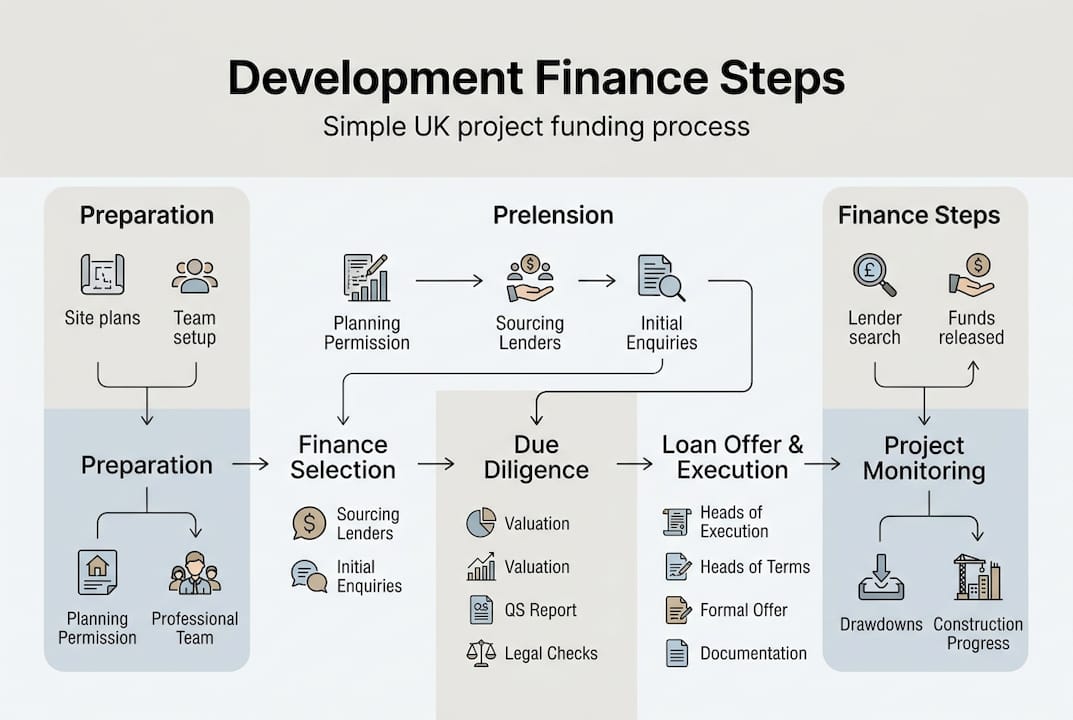
Begin by identifying suitable lenders whose criteria match your project characteristics. Senior lenders provide the bulk of funding at lower rates but impose stricter covenants. Mezzanine providers fill gaps with higher-cost capital offering greater flexibility. For complex projects, layering senior debt with mezzanine or JV equity optimises your capital stack, balancing cost against accessibility.
Securing development finance: the execution sequence
- Research and shortlist lenders whose risk appetite, loan sizes, and geographic focus match your project
- Submit initial enquiries with executive summaries highlighting key metrics and your experience
- Provide detailed documentation packs including plans, budgets, valuations, and financial statements when lenders express interest
- Review indicative terms sheets comparing rates, fees, LTV ratios, and covenant requirements across offers
- Negotiate final terms focusing on total cost, flexibility for variations, and drawdown conditions
- Instruct solicitors to review legal documentation and satisfy conditions precedent
- Complete lender requirements including insurances, guarantees, and security registrations
- Achieve financial close and arrange initial drawdown to commence construction
Understanding how to structure development finance and exploring real estate funding sources helps you evaluate different capital combinations. Current interest rates of 6.5-12% per annum are often rolled up with arrangement and exit fees, impacting your total borrowing cost significantly.
Senior debt versus mezzanine finance comparison
| Feature | Senior debt | Mezzanine finance |
|---|---|---|
| Typical cost | 6.5-9% p.a. | 10-15% p.a. |
| Security position | First charge on property | Second charge or unsecured |
| Loan-to-value | 60-70% LTGDV | Additional 10-20% LTGDV |
| Covenant intensity | Strict monitoring and reporting | More flexible terms |
| Approval speed | 4-8 weeks | 2-4 weeks |
| Risk tolerance | Conservative, proven projects | Higher risk appetite |
Finance brokers add substantial value throughout this process. They understand lender appetites, structure proposals to maximise approval chances, and negotiate terms you might not achieve independently. Their relationships often accelerate decisions and unlock funding sources unavailable through direct approaches.
Pro Tip: Maintain transparent, proactive communication with lenders throughout your project. Regular updates on progress, early notification of potential issues, and responsive handling of queries build trust that facilitates smooth drawdowns and reduces friction if you need variations later.
Common pitfalls include underestimating total fees, neglecting contingency funding for unforeseen costs, and failing to factor in the time required for legal processes. Build buffer time and budget into your plans to accommodate these realities.
Monitoring, troubleshooting, and ensuring project finance success
Securing finance is only the beginning. Effective ongoing management protects your funding, maintains lender confidence, and ensures you can navigate challenges without jeopardising project completion. Proactive monitoring and swift problem resolution separate successful developments from troubled projects.
Track key indicators continuously throughout your build. Budget variances signal potential overruns requiring early intervention. Project timeline slippage impacts your finance costs and may breach lender covenants. Covenant compliance, particularly interest cover and loan-to-value ratios, must be monitored formally at reporting dates and informally between them.
Cost inflation remains a persistent risk in 2026. Material price increases, labour shortages, and unforeseen ground conditions can rapidly consume contingency allowances. Planning delays, whether from local authority backlogs or condition discharge challenges, extend your programme and increase finance costs. VAT liquidity gaps create cash flow pressure as you must pay suppliers before reclaiming from HMRC.
Mid-project overruns often require mezzanine or top-up facilities to bridge funding gaps. Some developers use bridging loans to cover temporary shortfalls whilst awaiting sales completions or refinancing. Understanding how to arrange bridging finance provides options when you need rapid additional capital.
“Maintaining robust financial controls and transparent lender relationships proves essential when projects encounter challenges. Developers who communicate proactively and present solutions alongside problems secure far better support than those who only report issues after they become critical.”
Specialist lenders and debt funds offer more flexibility than traditional banks during challenging market conditions. Their understanding of development realities and appetite for pragmatic solutions makes them valuable partners when you need to adjust plans or secure additional funding.
Troubleshooting strategies for common development finance challenges
- Establish monthly cost tracking against budget with variance analysis to identify problems early
- Build contingency of 10-15% into initial budgets and protect it rigorously for genuine emergencies
- Maintain open dialogue with lenders, providing regular updates even when everything proceeds smoothly
- Arrange mezzanine or top-up facilities before you exhaust existing funding to avoid desperate negotiations
- Review property finance trends regularly to understand market conditions affecting your refinancing options
- Document all variations and their cost impacts immediately to maintain accurate financial positions
- Engage quantity surveyors to certify costs and validate claims when disputes arise with contractors
- Consider accelerated sales or pre-sales to inject equity and reduce debt exposure if markets soften
Successful project finance management requires discipline, transparency, and decisive action when issues emerge. Developers who treat lender relationships as partnerships rather than transactions consistently achieve better outcomes when they need support or flexibility.
How James William & Co Capital supports your development finance journey
Navigating development finance complexity demands specialist expertise and extensive lender relationships. James William & Co Capital structures sophisticated funding solutions for UK property developers and high-net-worth investors pursuing large-scale projects.
Our specialist property finance approach combines senior debt, mezzanine facilities, and joint venture equity into optimised capital stacks tailored to your specific project requirements. We work with family offices, private credit funds, and specialist lenders to deliver rapid solutions for complex transactions.
Our capital concierge model provides a single point of contact for end-to-end structuring, negotiation, and execution. Whether you are undertaking ground-up developments, large acquisitions, or complex refinances, our team arranges the funding you need at terms that work. Explore our property finance services and review case studies demonstrating how we have successfully financed challenging projects under pressure.
Frequently asked questions
What is development finance and how does it differ from traditional loans?
Development finance provides short-to-medium-term funding specifically designed for property construction and renovation projects. Unlike traditional mortgages that release funds in a single advance, development finance draws down in stages aligned with project milestones, paying only for completed work. This structure manages lender risk whilst providing you with capital as you need it throughout the build.
How much equity should I expect to contribute to a development project?
Developers typically contribute 10-30% equity of total project costs, with first-time developers often needing to provide higher percentages due to lender caution about their track record. Your equity reduces lender risk and improves the terms you can negotiate. Experienced developers with strong projects may access higher leverage, whilst complex or higher-risk schemes require greater equity buffers.
What are the typical costs and fees associated with development finance?
Development finance costs in 2026 usually total 12.7-15% of your facility amount, comprising interest rates of 6.5-12% per annum plus arrangement fees (1.5-2%), exit fees (1-2%), and monitoring costs for quantity surveyor site visits. Many developers roll these costs into the loan rather than paying monthly, preserving cash flow during construction but increasing the total amount you must repay from sales proceeds.
How can I manage cost overruns or delays during my development project?
Mid-project cost overruns require swift action to secure additional capital before existing funds are exhausted. Mezzanine loans or top-up facilities can bridge funding gaps, whilst bridging finance provides temporary solutions if you are awaiting sales completions. Maintaining strong lender relationships and communicating challenges early dramatically improves your ability to negotiate variations or additional funding when you need flexibility to complete your project successfully.
Why should I use a specialist broker rather than approaching lenders directly?
Specialist brokers understand lender appetites, structure proposals to maximise approval chances, and access funding sources unavailable through direct approaches. Their relationships accelerate decisions and often secure better terms than you could negotiate independently. Brokers also handle multiple lender discussions simultaneously, saving you time whilst increasing your chances of finding optimal funding for your specific project requirements and risk profile.
Recommended
Related Topics
Speak to a specialist
Discuss your finance with James directly
Whole-of-market specialist finance — bridging, development, commercial and residential. No call centres, no obligation. James reviews every enquiry personally.
New to specialist finance? How unbiased broker advice works · Deals we have completed
Explore Related Finance