
Published · Updated
why structured property financeWhy Structured Property Finance Matters for UK Developers
By James Dawes, CeMAP, Founder, James William & Co Capital

Securing reliable funding for ambitious developments in the United Kingdom often feels like solving a complex puzzle—traditional loans rarely suffice for intricate or large-scale projects. High-net-worth developers and institutional investors face mounting pressure to manage risk and unlock flexible capital solutions. By embracing structured property finance, you gain access to tailored funding architectures, special purpose vehicles and innovative capital stacks that help realise even the most challenging acquisitions and transformations.
Table of Contents
- Defining Structured Property Finance In The UK
- Key Structures And Finance Instruments Explained
- Lender Types And Typical Funding Stacks
- Benefits For Complex Development And Acquisition Needs
- Risk, Cost, And Regulatory Considerations
Key Takeaways
| Point | Details |
|---|---|
| Structured Property Finance Offers Flexibility | Developers can access customised funding solutions that traditional financing models do not provide, enhancing project feasibility. |
| Diverse Funding Instruments Utilised | A combination of senior debt, mezzanine finance, equity investment, and asset-backed securities optimise risk distribution and financial efficiency. |
| Engaging Specialist Advisors is Crucial | Working with financial advisors who understand structured finance ensures tailored and effective funding strategies for complex projects. |
| Risk and Compliance Are Critical | Developers must navigate complex regulatory frameworks and ensure rigorous risk management to maintain project viability and funding stability. |
Defining Structured Property Finance in the UK
Structured property finance represents a sophisticated financial mechanism designed to address complex real estate development challenges in the United Kingdom. Unlike traditional lending models, this approach enables property developers to access nuanced funding strategies that can dramatically transform project feasibility and risk management. Advanced financial techniques have revolutionised how large-scale property developments secure capital.
At its core, structured property finance involves creating specialised financial architectures tailored to specific development requirements. These architectures typically involve:
- Creating Special Purpose Vehicles (SPVs) to isolate financial risks
- Developing complex debt and equity tranching strategies
- Designing bespoke investment vehicles with precise risk-return profiles
- Enabling multi-layered funding approaches beyond conventional bank loans
The primary objective of structured property finance is to provide developers with unprecedented flexibility in managing investment complexity. By disaggregating financial risks and creating multiple investment entry points, developers can access funding sources previously unavailable through standard banking channels. This approach allows institutional investors, private equity firms, and high-net-worth individuals to participate in property development with carefully calibrated risk exposure.
Property developers benefit from structured finance by gaining access to more creative funding solutions that traditional lenders cannot provide. These solutions might include mezzanine debt, bridging finance, joint venture equity arrangements, and complex refinancing strategies designed to unlock capital at critical development stages.
Pro tip: Always engage specialist financial advisors who understand the intricacies of structured property finance to design bespoke funding solutions for your specific development requirements.
Key Structures and Finance Instruments Explained
Structured property finance in the United Kingdom leverages an intricate array of financial instruments designed to provide developers with unprecedented funding flexibility. Sophisticated securitisation techniques enable the creation of complex capital structures that can be precisely tailored to individual project requirements.
The primary finance instruments utilised in structured property development typically include:
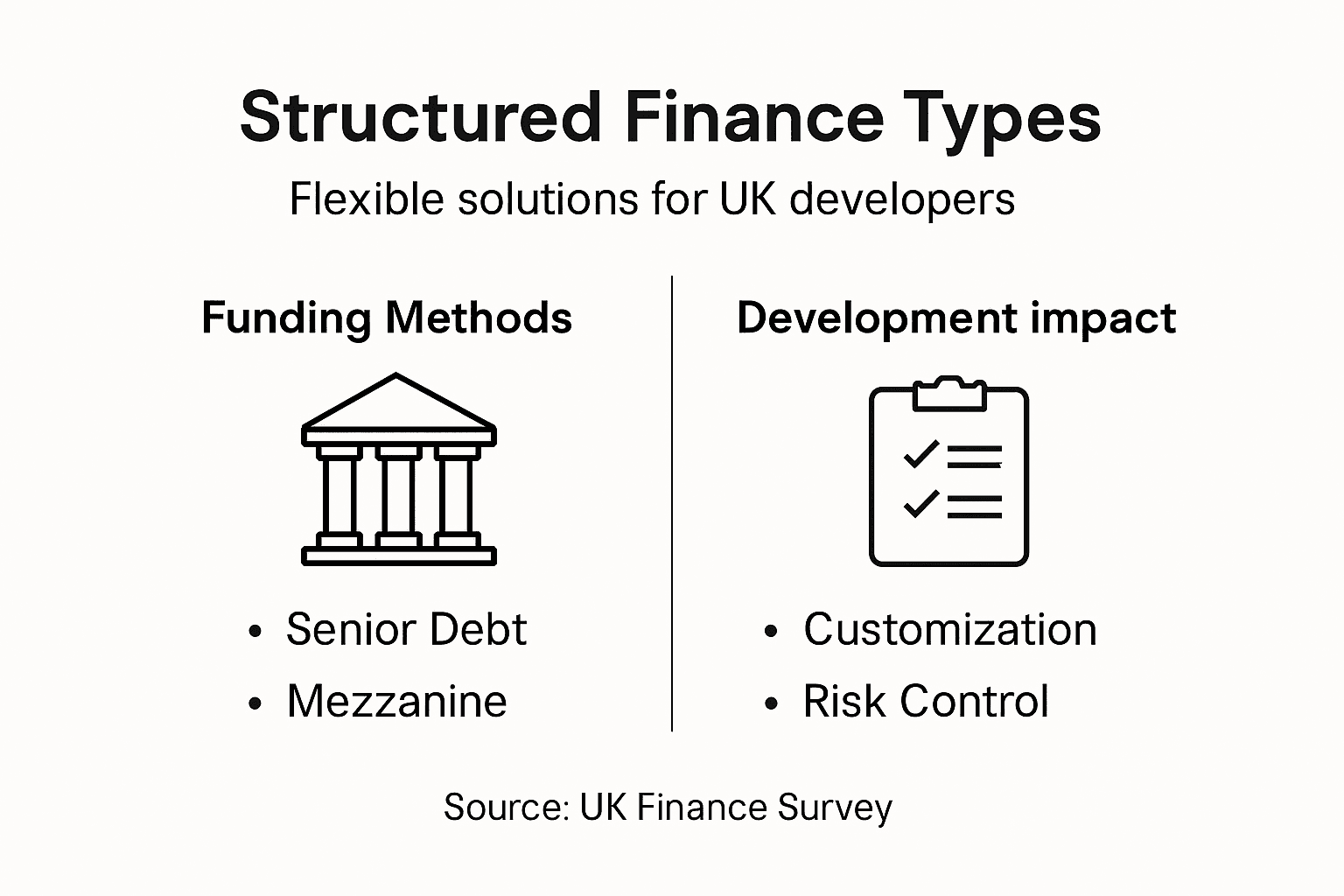
- Senior Debt: Traditional bank loans representing the primary and lowest-risk funding layer
- Mezzanine Finance: Subordinated debt providing a flexible intermediate funding option
- Equity Investment: Risk capital that supports project development and provides additional financial cushioning
- Asset-Backed Securities (ABS): Investment instruments secured against specific property assets
These financial instruments are strategically combined to create multi-layered capital stacks that optimise risk distribution and investment attractiveness. By engineering these sophisticated funding structures, developers can access capital more efficiently while offering investors carefully calibrated risk-return profiles.
Moreover, capital structuring allows for unprecedented customisation. Developers can now construct funding models that precisely match project timelines, risk appetites, and specific development characteristics. Bespoke capital structures enable more complex and ambitious real estate projects that would previously have been financially unfeasible.
To illustrate how various finance instruments contribute to structured property development, see the table below:
| Finance Instrument | Primary Role | Typical Users | Strategic Impact |
|---|---|---|---|
| Senior Debt | Foundation of capital stack | Banks, pension funds | Lowers overall funding cost |
| Mezzanine Finance | Bridging finance gap | Specialist lenders, funds | Enhances project leverage |
| Equity Investment | Risk-bearing capital | Private equity, individuals | Enables higher project returns |
| Asset-Backed Securities | Securitises property assets | Investment institutions | Increases investment liquidity |
Pro tip: Engage specialised financial advisors who can architect nuanced capital structures matching your specific development’s unique financial dynamics and risk profile.
Lender Types and Typical Funding Stacks
The landscape of property finance in the United Kingdom encompasses a diverse ecosystem of lenders, each playing a critical role in constructing sophisticated funding structures. These financial partners collaborate to create comprehensive capital solutions that address the complex needs of modern property development projects.
The primary lender categories in structured property finance include:
- Senior Lenders: Traditional banks providing first-charge debt with lowest risk profile
- Mezzanine Lenders: Specialised financial institutions offering subordinated debt
- Equity Investors: Private equity firms, family offices, and high-net-worth individuals providing risk capital
- Alternative Lenders: Specialist credit funds and private debt providers offering flexible funding solutions
Typical funding stacks are strategically constructed with multiple layers, each representing different risk and return characteristics. The hierarchical structure typically follows a precise order: senior debt forms the foundation, mezzanine finance provides the intermediate layer, and equity capital sits at the top, creating a carefully balanced financial pyramid.
Each lender type brings unique capabilities to the funding stack. Senior lenders provide stable, low-cost capital with stringent underwriting criteria, while mezzanine lenders offer more flexible terms that bridge the gap between senior debt and pure equity investment. Equity investors ultimately provide the risk absorption and potential upside that enables more ambitious and innovative property development strategies.
Pro tip: Develop comprehensive relationships with multiple lender types to ensure maximum funding flexibility and access to tailored capital solutions for your property development projects.
Benefits for Complex Development and Acquisition Needs
Structured property finance emerges as a transformative solution for developers navigating intricate acquisition and development challenges. By offering unprecedented financial flexibility, this approach enables property professionals to overcome limitations inherent in traditional funding models, particularly for projects with complex risk profiles and unique capital requirements.
The key benefits of structured property finance for sophisticated development projects include:
- Customised Funding Solutions: Precisely tailored capital structures matching specific project characteristics
- Risk Mitigation: Advanced mechanisms for distributing and managing financial exposure
- Enhanced Acquisition Capabilities: Access to larger and more complex funding pools
- Flexible Cash Flow Management: Dynamic financial arrangements adapting to project timelines
- Strategic Capital Deployment: Ability to leverage multiple funding sources simultaneously
Complex developments often require nuanced financial engineering that standard lending cannot accommodate. Structured finance provides developers with the strategic toolkit to deconstruct and reassemble financial packages, enabling ambitious projects that would otherwise remain financially unfeasible. By creating multi-layered capital stacks, developers can attract diverse investor types with varying risk appetites and return expectations.

Moreover, structured finance strategies empower developers to unlock value in challenging scenarios. Whether managing phased developments, mitigating geographical risks, or navigating uncertain market conditions, these sophisticated financial approaches provide a robust framework for strategic project execution.
Pro tip: Engage financial advisors with deep expertise in structured property finance to design bespoke capital solutions that align precisely with your project’s unique architectural and economic landscape.
Risk, Cost, and Regulatory Considerations
Structured property finance in the United Kingdom operates within a sophisticated regulatory landscape, with comprehensive oversight mechanisms designed to protect investor interests and maintain market integrity. The Financial Conduct Authority (FCA) and Prudential Regulation Authority (PRA) play pivotal roles in monitoring and regulating these complex financial structures.
Key risk considerations for structured property finance encompass multiple dimensions:
- Regulatory Compliance: Navigating intricate FCA and PRA guidelines
- Counterparty Risk: Managing potential defaults across multiple funding layers
- Liquidity Challenges: Ensuring financial flexibility during project phases
- Complexity Premium: Higher transaction costs associated with sophisticated structures
- Market Volatility: Potential impact of economic fluctuations on funding stability
The cost implications of structured property finance extend beyond traditional financing models. Developers must carefully evaluate the additional expenses associated with complex financial engineering, including legal fees, structuring costs, and potential premium rates charged by specialised lenders. These costs are balanced against the strategic advantages of accessing more flexible and tailored funding solutions.
Regulatory frameworks demand rigorous due diligence and transparent reporting. Developers must demonstrate comprehensive risk management strategies, maintain robust financial documentation, and ensure compliance with evolving regulatory requirements. The additional administrative burden is offset by the potential to unlock more sophisticated and adaptable funding mechanisms.
The following table summarises key risks and cost factors in UK structured property finance:
| Risk/Cost Aspect | Description | Developer Impact |
|---|---|---|
| Regulatory Complexity | Detailed FCA and PRA compliance required | Ensures rigorous project oversight |
| Counterparty Risk | Default risk across funding layers | Necessitates robust due diligence |
| Liquidity Management | Availability of funds during development | May require contingency planning |
| Transaction Expenses | Higher costs for structuring and legal work | Affects overall project viability |
| Market Sensitivity | Vulnerability to economic changes | Can influence funding stability |
Pro tip: Invest in comprehensive legal and financial advisory support to navigate the complex regulatory landscape and minimise potential compliance risks in structured property finance.
Unlock Tailored Structured Property Finance Solutions for UK Developers
Navigating complex funding challenges like multi-layered capital stacks and bespoke covenant packages can be daunting for property developers in the United Kingdom. If you are facing difficulties managing mezzanine debt, bridging finance, or intricate refinancing strategies, understanding structured property finance is only the first step. Developers and investors must access flexible, well-structured capital solutions that reduce risk while optimising returns.
James William & Co Capital specialises in acting as a debt structuring partner for demanding projects involving large-scale acquisitions and ground-up developments. We collaborate with family offices, private credit funds and specialist lenders to provide rapid, bespoke funding arrangements including commercial mortgages, asset finance and joint venture equity. Our “capital concierge” service ensures a single point of contact for end-to-end negotiation and execution tailored to your exact needs.
Discover how our expert advisory and funding solutions can transform your property development ambitions into reality. Visit James William & Co Capital now for practical guidance on structured finance advisory services and securing sophisticated multi-layered debt and equity arrangements. Contact us today to unlock flexible capital strategies that match your project’s complexity and scale.
Frequently Asked Questions
What is structured property finance?
Structured property finance is a sophisticated financial mechanism that provides tailored funding solutions for complex real estate developments, enabling developers to access nuanced capital strategies beyond traditional lending models.
How do structured finance instruments benefit property developers?
These instruments, such as senior debt, mezzanine finance, and equity investment, offer developers flexible funding options, allowing them to optimise risk distribution, enhance acquisition capabilities, and manage cash flow effectively throughout the project lifecycle.
What types of lenders participate in structured property finance?
The primary lenders involved include senior lenders (traditional banks), mezzanine lenders (specialised financial institutions), equity investors (private equity firms and high-net-worth individuals), and alternative lenders (specialist credit funds) who provide various funding layers for development projects.
What are the key risks associated with structured property finance?
Key risks include regulatory compliance challenges, counterparty risk of defaults across funding layers, potential liquidity issues, and higher transaction costs due to the complexity of the financial structures. Developers should engage specialised advisors to mitigate these risks.
Recommended
Related Topics
Speak to a specialist
Discuss your finance with James directly
Whole-of-market specialist finance — bridging, development, commercial and residential. No call centres, no obligation. James reviews every enquiry personally.
New to specialist finance? How unbiased broker advice works · Deals we have completed
Explore Related Finance