
Published · Updated
what is structured property financeStructured Property Finance: Maximising UK Investor Returns
By James Dawes, CeMAP, Founder, James William & Co Capital

Securing capital for UK property deals rarely follows a simple script, especially when rapid execution or unconventional assets are involved. For high-net-worth investors, traditional bank loans can prove too rigid, leaving unique opportunities just out of reach. Structured property finance changes the game, offering layered funding, risk control, and custom solutions that standard lending cannot match. This approach empowers you to act decisively on time-sensitive acquisitions, while dispelling myths around risk and complexity holding investors back.
Table of Contents
- Structured Property Finance: Core Definition And Myths
- Types Of Structured Finance For UK Property Deals
- How Layered Funding And Covenants Work
- Legal And Regulatory Requirements In 2026
- Risks, Costs And Common Structuring Mistakes
- Comparing Structured Finance To Other Funding Options
Key Takeaways
| Point | Details |
|---|---|
| Structured Finance Enhances Capital Access | By pooling financial assets and layering debt and equity, investors can access larger funding pools for property deals. |
| Risk Distribution is Key | Structured finance helps manage risk by distributing it among multiple investors rather than concentrating it with a single lender. |
| Regulatory Compliance is Crucial | Understanding FCA and PRA regulations is essential for structured finance deals to avoid costly delays and ensure transparency. |
| Consider Total Costs and Flexibility | When evaluating funding options, focus on the overall costs and flexibility of covenants rather than just interest rates. |
Structured property finance: core definition and myths
Structured property finance sits at the intersection of traditional lending and sophisticated capital markets. At its core, it involves pooling various financial assets, such as mortgages and development loans, then issuing securities backed by those assets. This mechanism, including securitisation of mortgages and loans, transforms the way capital flows through property markets. Rather than a bank holding a single mortgage until repayment, structured finance creates layers of debt, equity, and risk distribution across multiple investors. For high-net-worth property investors, this translates to access to significantly larger funding pools than conventional bank lending alone could provide.
The real appeal of structured finance becomes clear when you face a time-sensitive acquisition or complex development requiring capital that standard lenders won’t touch. Where a traditional mortgage broker might offer a straightforward £2 million loan against a commercial property purchase, a structured approach could unlock £5 million or more by layering together senior debt, mezzanine finance, and equity components. This tiered structure allows lenders with different risk appetites to participate. A conservative family office might provide the secure senior layer, whilst a specialist credit fund takes the riskier mezzanine tranche. Everyone gets compensated according to their risk tolerance, and you get rapid access to precisely the capital structure your deal requires.
Misconceptions about structured finance run deep, and they often hold investors back from opportunities. The most damaging myth suggests that structured finance is inherently risky or overly complex, creating unnecessary barriers to entry. In reality, this approach plays a crucial role in managing risk by dispersing it across multiple parties rather than concentrating it with a single lender. Another common misconception assumes structured solutions are only for mega transactions or institutional players. High-net-worth individuals regularly use tailored structures for single properties or portfolios worth £5 million to £50 million. The complexity isn’t about sophistication for its own sake; it’s about matching your capital structure to your specific deal circumstances. A £3 million residential development in London requires a fundamentally different financing approach than a £10 million mixed-use acquisition in Manchester, yet both benefit from structured thinking.
Think of structured finance as custom tailoring rather than off-the-shelf suiting. You wouldn’t buy a suit that almost fits and hope for the best. Structured finance demands the same precision. Rather than forcing your deal into a conventional mortgage template, you design a capital stack that reflects your cash flow timing, exit strategy, and risk profile. This precision reduces friction, accelerates closings, and often results in more favourable terms because lenders understand exactly what they’re funding and why.
Pro tip: _When evaluating a structured finance solution, focus on the time to completion and the flexibility of covenants rather than simply comparing interest rates across options; a deal that closes 3 weeks faster can unlock significant value when competing for off-market acquisitions.
Types of structured finance for UK property deals
UK property finance comes in several distinct flavours, each designed to address different deal structures and investor objectives. Senior debt forms the foundation of most capital stacks, typically representing 60-75% of the total funding and commanding the lowest interest rates because lenders are first in the queue for repayment. Above this sits mezzanine financing, a hybrid instrument that behaves like debt but carries equity-like returns, usually ranging from 10-25% of the deal value. Mezzanine lenders accept higher risk in exchange for returns between 12-18% annually, stepping in after senior lenders but before equity holders. Finally, equity capital comprises the remaining 10-20%, provided by the deal sponsors themselves or co-investors willing to absorb the most risk in exchange for the largest returns. This three-tier structure forms the backbone of how sophisticated investors optimise their capital deployment.
Beyond this traditional stacking, more specialised instruments address specific market conditions. Collateralised debt obligations and asset-backed securities pool together multiple mortgages or development loans, then issue tranches to different investor classes. A pension fund might purchase the safest tranche offering 4% returns, whilst a hedge fund takes the riskier bottom layer yielding 14%. For developers juggling multiple projects simultaneously, a portfolio refinance structure lets you consolidate several properties under one financing arrangement, reducing overall costs and simplifying cash management. Development finance differs fundamentally from acquisition funding. When constructing a new residential scheme, you need staged drawdowns aligned to construction milestones, retention holdbacks, and contingency buffers. Acquisition deals, conversely, demand rapid execution and often involve bridge finance to secure assets before conventional mortgages complete. Each scenario requires a bespoke capital structure matched to your specific cash flow timeline and exit strategy.
The real sophistication emerges when combining these instruments strategically. Picture this scenario: you’re acquiring a £12 million mixed-use property with plans to redevelop the upper storeys. A conventional bank might offer £7 million senior debt against the existing value. You layer on £3 million of mezzanine finance from a specialist credit fund, then inject £2 million of your own equity. Now you control the deal with 17% of your own capital rather than 33%, amplifying your return on equity significantly. Alternatively, if you’re refinancing a stabilised portfolio generating steady rental income, a longer-term securitisation structure might lock in cheaper rates than traditional mortgages, potentially saving 1-2% annually across a £20 million portfolio.
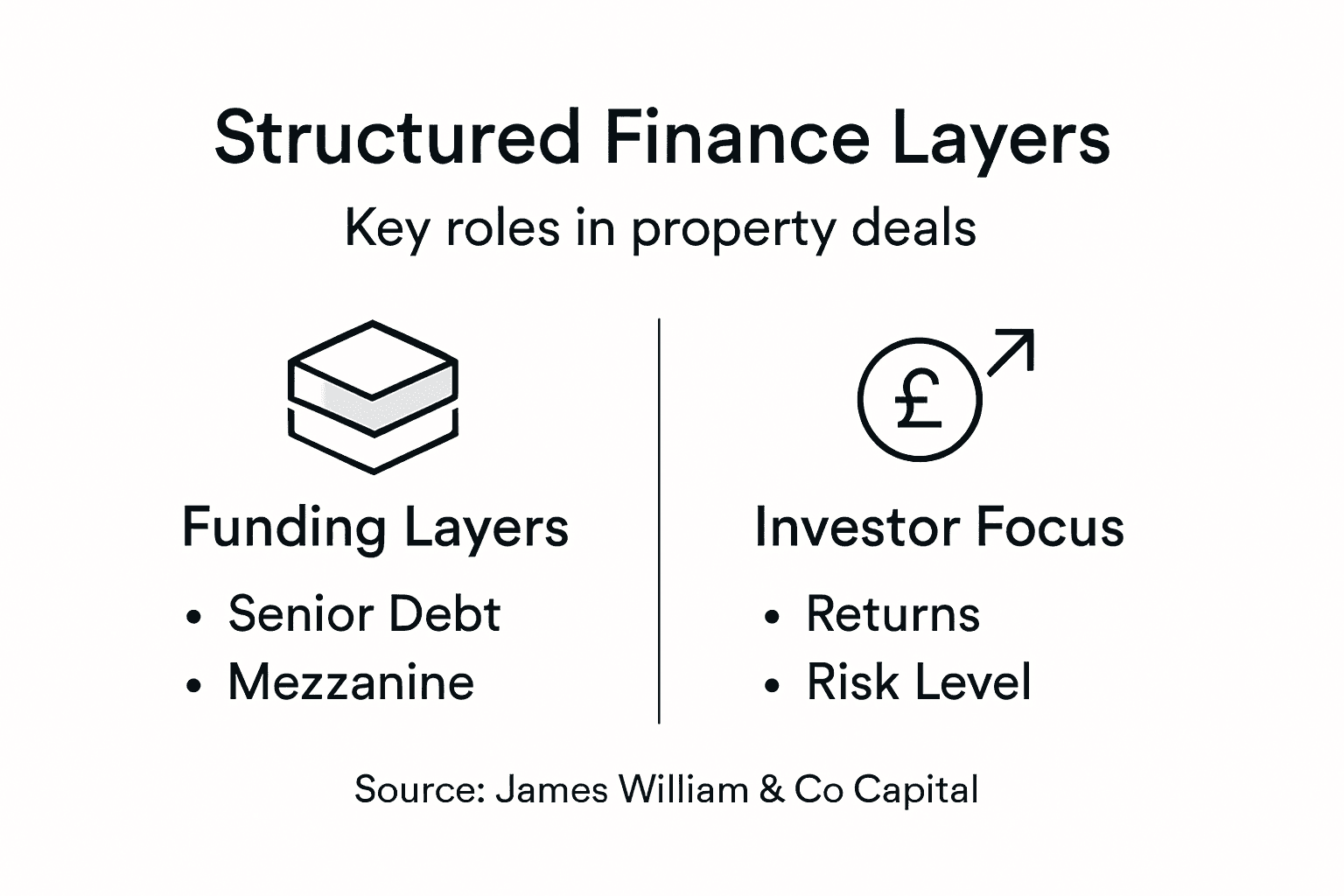
Here’s how the main layers of structured property finance differ in the UK market:
| Layer | Typical Share of Funding | Risk Level | Typical Return Expectation |
|---|---|---|---|
| Senior Debt | 60-75% | Lowest | 4-6% per annum |
| Mezzanine Finance | 10-25% | Moderate | 12-18% per annum |
| Equity Capital | 10-20% | Highest | 18-25%+ per annum |
Pro tip: _When structuring a multi-asset deal, prioritise having your mezzanine and equity committed before approaching senior lenders; showing a completed capital stack makes underwriting faster and often improves your senior debt pricing by 25-50 basis points.
How layered funding and covenants work
Layered funding operates like a hierarchy of claims on your deal’s cash flow and assets. When you structure a property acquisition or development, money doesn’t arrive as one lump sum with identical rights attached. Instead, senior lenders sit at the top of the repayment queue, receiving their interest and principal first regardless of how the deal performs. Mezzanine investors come next, only receiving distributions after senior lenders are satisfied. Equity holders occupy the bottom rung, waiting until both debt layers are fully paid before taking anything home. This ordering matters enormously because it affects pricing. A senior lender accepting 4.5% interest sleeps soundly knowing they’re protected by layers of equity and mezzanine debt beneath them. A mezzanine investor charging 15% is accepting the risk that if things go sideways, the senior lender gets paid first and they might recover only partial returns. The waterfall structure is legally documented, creating absolute clarity about cash flow distribution from day one.

Covenants enforce agreed financial and operational benchmarks, protecting every layer of your capital stack. Think of covenants as the guardrails keeping your deal on track. A typical senior debt covenant might require you maintain a minimum 1.25 times loan-to-value ratio, meaning the property value stays at least 25% higher than the outstanding loan. Breach that covenant, and the lender can demand immediate repayment. Mezzanine covenants often focus on operational metrics: rental income must reach budgeted levels by month 18, or occupancy cannot drop below 85%. These aren’t arbitrary restrictions; they exist because the mezzanine investor’s return depends on the deal performing according to plan. Equity covenants might limit how much additional debt you can layer on, protecting their ultimate return. Covenant packages vary dramatically based on lender sophistication and deal risk. A conservative family office funding a prime central London office building might impose five covenants. A development lender backing a speculative residential scheme in a secondary location might impose fifteen.
The interplay between layers and covenants creates real tension that you must navigate carefully. Tighten covenants to appease conservative senior lenders, and you might lose flexibility when market conditions shift mid-development. Loosen them to give yourself breathing room, and mezzanine investors demand higher returns to compensate for increased risk. Your job involves finding the equilibrium. A well-structured deal has covenants that are genuinely achievable under your business plan but still protect lenders if circumstances deteriorate. Consider a £8 million acquisition with £6 million senior debt and £2 million mezzanine. Your senior lender insists on maintaining 1.25 LTV. Your mezzanine investor wants rental income targets. Rather than fighting these terms, you model them into your underwriting. If hitting 1.25 LTV requires achieving 96% occupancy, that becomes your target, not an impossible imposition. Covenants become management tools that align all parties toward success.
Pro tip: _Negotiate covenant flexibility built into your loan documents from day one, such as temporary covenant holiday periods during pre-letting phases or annual rather than quarterly testing; this costs senior lenders almost nothing but gives you invaluable breathing room when unexpected delays occur.
Legal and regulatory requirements in 2026
Structured property finance in the UK operates within a tightly regulated framework designed to protect investors, lenders, and financial stability. The Financial Conduct Authority (FCA) and Prudential Regulation Authority (PRA) govern this landscape, and understanding their requirements is non-negotiable. As of 2026, FCA and PRA regulatory frameworks shape how deals are structured, disclosed, and executed. For high-net-worth investors, this translates to specific compliance obligations that affect deal timelines and costs. Consumer credit regulations apply to certain mortgage securitisations, requiring lenders to disclose terms clearly and fairly. When securitising development loans or bridging facilities, you’re subject to different rulebooks than a straightforward buy-to-let mortgage. These distinctions matter because getting compliance wrong can delay closings by weeks or trigger costly remediation.
Transparency in securitisation transactions has become a cornerstone of modern regulation. If you’re pooling mortgages or development loans into securities sold to institutional investors, you must provide detailed information about underlying assets, borrower credit quality, loan-to-value ratios, and stress test results. The FCA requires this data standardised across all offerings, preventing investors from comparing apples to oranges. The Consumer Duty, introduced in recent years, mandates that firms treat customers fairly and avoid causing them detriment. This applies even to sophisticated high-net-worth investors. A lender can no longer hide unfavourable terms in appendices; they must actively ensure you understand what you’re signing. For structured deals involving multiple layers, this means each party receives clear documentation explaining their position in the waterfall, their covenant obligations, and their exit scenarios. Breach of Consumer Duty obligations can result in FCA enforcement action, fines, and reputational damage that far exceeds the cost of compliance upfront.
Due diligence requirements have intensified significantly. Before investors commit capital to a structured deal, they conduct rigorous assessments of the underlying property, development team track record, market conditions, and exit feasibility. The regulatory framework supports and encourages this scrutiny. Lenders must verify that borrowers have genuine capacity to service debt, possess relevant experience, and maintain adequate financial reserves. For securitised transactions, credit rating agencies perform independent assessments, and their methodology is now standardised across the market. What does this mean practically? If you’re raising a £15 million mezzanine tranche for a mixed-use development, expect investors to demand detailed architect reports, planning certainty letters, pre-letting evidence, and historical performance data on comparable projects. These requirements slow deals slightly but ultimately strengthen outcomes by filtering out marginal opportunities and ensuring realistic valuations.
One critical development affecting 2026 structures involves anti-money laundering (AML) and sanctions compliance. All parties involved in structured finance transactions must verify beneficial ownership, conduct source-of-funds checks, and maintain audit trails. This applies whether you’re investing £500,000 or £50 million. Failure to comply exposes lenders and advisers to regulatory sanctions and reputational risk. For international investors, HMRC scrutiny has intensified around non-resident capital gains and inheritance tax planning through property structures. Working with advisers familiar with current FCA guidance and PRA expectations prevents costly mistakes.
Pro tip: _Engage specialist regulatory counsel at the deal structuring stage, not during final documentation; early involvement often identifies compliance paths that reduce both regulatory risk and total deal costs by 1-2% whilst accelerating lender approvals.
Risks, costs and common structuring mistakes
Structured property finance introduces genuine risks that demand respect. Market volatility can devastate deals built on optimistic assumptions. A development scheme pencilled in at 8% returns based on rental growth projections suddenly looks unattractive when the market softens and comparable properties sit vacant for months. This isn’t theoretical. In 2022, several mezzanine investors holding UK development tranche watched property values decline 15-20%, wiping out their projected returns entirely. Funding liquidity challenges present another danger. If your mezzanine finance provider faces unexpected capital calls or regulatory pressure, they might demand early repayment even if your deal hasn’t stabilised. Suddenly you’re scrambling to refinance on worse terms or inject additional equity you hadn’t budgeted. Operational risks specific to property development compound these issues. Construction delays, planning challenges, skilled labour shortages, or material cost inflation can all push timelines and budgets beyond projections. When cash flow deteriorates, junior tranches suffer first. Equity investors sometimes discover their returns have halved because a development ran 18 months behind schedule.
Costs in structured deals extend well beyond headline interest rates. Arrangement fees, interest premiums, and administrative expenses add 2-4% to your total capital cost depending on deal complexity. A £10 million structure might incur £200,000 in arranger fees, £150,000 in legal documentation, £80,000 in credit rating agency costs, and £60,000 in ongoing administration. These aren’t padding; they represent genuine work. But they also mean your internal rate of return assumptions must account for real friction costs upfront. Interest premiums reflect lender risk appetite. Senior debt at 5.5% seems reasonable until you layer on 15% mezzanine and 20% equity hurdle rates. Your development project must generate sufficient profit to service all three layers, a threshold many schemes fail to meet. Administrative expenses cover loan servicing, covenant monitoring, and investor reporting. Ongoing quarterly compliance costs typically run 0.5-1% annually of outstanding balances.
Common structuring mistakes sabotage even well-intentioned deals. The most dangerous error involves failing to properly assess risk layers. An adviser might propose a capital stack with 70% senior debt, 20% mezzanine, and 10% equity without stress-testing what happens if rental income misses projections by 20% or construction costs overrun by 15%. Suddenly the mezzanine layer faces severe pressure, and junior investors realise their returns vanished. Another mistake centres on inadequate exit planning. You structure a deal assuming you’ll refinance within 24 months, but market conditions prevent refinancing. Now you’re stuck with expensive bridge financing extending indefinitely. Successful investors build multiple exit routes into deals from inception. A third error involves neglecting regulatory compliance triggers. You structure a transaction casually, then discover mid-deal that covenant breaches or reporting requirements weren’t properly documented. This creates legal ambiguity when cash flow deteriorates and parties argue over their rights. Finally, many investors underestimate complexity costs. A seemingly simple £5 million acquisition becomes a £25,000 legal bill due to multiple lenders, cross-default provisions, and subordination agreements requiring specialist drafting.
Pro tip: _Build a stress test into your deal model examining what happens if rental income falls 15%, construction extends 12 months, or interest rates rise 2%; if the deal still generates acceptable returns under these scenarios, your risk layers are genuinely protected rather than hoping for perfection.
Comparing structured finance to other funding options
When evaluating how to fund a property deal, you essentially face three paths: conventional bank lending, pure equity financing, or structured finance. Each serves different situations, and understanding when structured finance outperforms alternatives is crucial for maximising returns. A traditional bank mortgage offers simplicity and predictability. You approach Barclays or HSBC with your property, they assess loan-to-value, check your credit score, and within 4-6 weeks you have a term sheet. Interest rates sit around 4-6% for blue-chip borrowers. The process is straightforward, costs are transparent, and documentation is standardised across the market. But here’s where this approach breaks down. Banks lend against existing property value, not future potential. A development site worth £5 million today that could generate £15 million in completed value? Most banks won’t touch it because their security is the current land value, not the developer’s vision. They also demand covenant packages designed for conservative lending, not growth scenarios. You’ll face restrictions on additional borrowing, limitations on refinancing optionality, and strict cash management requirements that prevent you from optimising your capital structure.
Pure equity financing solves the risk problem but creates different challenges. Bring in partners or institutional equity providers, and they’ll fund your deal without debt burden or restrictive covenants. You retain operational flexibility and avoid interest expense. The problem is dilution. If your development generates £5 million profit and you’ve given away 40% equity to raise capital, you’ve surrendered £2 million of returns. Equity investors demand 18-25% annualised returns because they’re accepting residual risk. Over a five-year hold, that compounds into a significant wealth transfer from your pocket to theirs. Structured finance offers greater flexibility and customisation by layering different capital sources with varying risk appetites and return expectations. Rather than choosing between restrictive debt and dilutive equity, you construct a capital stack matching your deal’s actual economics.
Consider a practical example. You’re acquiring a £20 million office building requiring a £4 million capital injection to refurbish and reposition. A traditional bank might lend £12 million against current value, demanding you inject £8 million equity. You control 100% but have £8 million locked into this single deal. Alternatively, a pure equity partner provides all £8 million, you control 60%, and they control 40%. Structured finance splits the difference. You layer £12 million senior debt at 5.25%, £5 million mezzanine at 14%, and inject only £3 million equity yourself. Now you control the deal with 15% capital deployed rather than 40%, your return on equity trebles, and you retain operational control. The mezzanine investor accepts higher risk in exchange for enhanced returns. The senior lender sleeps soundly with two cushions of capital beneath them. Everyone gets compensated appropriately for their risk tolerance.
The trade-off involves cost and complexity. Structured deals typically cost 200-400 basis points more in fees and arrangement costs than conventional lending. Documentation is thicker, timelines longer, and underwriting more rigorous. You’ll need specialist advisers, legal counsel experienced in subordination, and investors comfortable with customised structures. For small deals under £3 million, this overhead often isn’t justified. But for developments, acquisitions, or refinances exceeding £5 million with non-standard requirements, structured finance consistently outperforms traditional alternatives by preserving capital control whilst achieving faster execution than waiting for equity commitments.
The table below compares key factors between major property funding options:
| Factor | Bank Loan | Pure Equity | Structured Finance |
|---|---|---|---|
| Flexibility | Low | High | Customisable |
| Speed to Close | 4-6 weeks | Varies, often slow | Potentially faster |
| Capital Control | High, but restrictive | Potentially diluted | Greater retention |
| Complexity | Straightforward | Simple | Higher, but tailored |
| Typical Cost | 4-6% interest | 18-25% annualised return | 6-10% blended, plus fees |
Pro tip: _Model your deal three ways: conventional bank financing, pure equity with majority investor, and layered structured finance; then compare your net returns after fees and dilution to identify which path maximises your wealth creation rather than simply accepting the first offer that closes fastest.
Unlock the Full Potential of Structured Property Finance with Expert Support
Navigating the complexities of structured property finance requires precision, flexibility and deep market knowledge. If you face challenges like layering mezzanine debt, managing covenant negotiations or accelerating closing timelines, you are not alone. Many UK property investors and developers struggle to tailor capital stacks that optimise returns while controlling risk and complying with evolving regulations. This is where partnering with a specialist mortgage broker and debt structuring expert becomes essential.
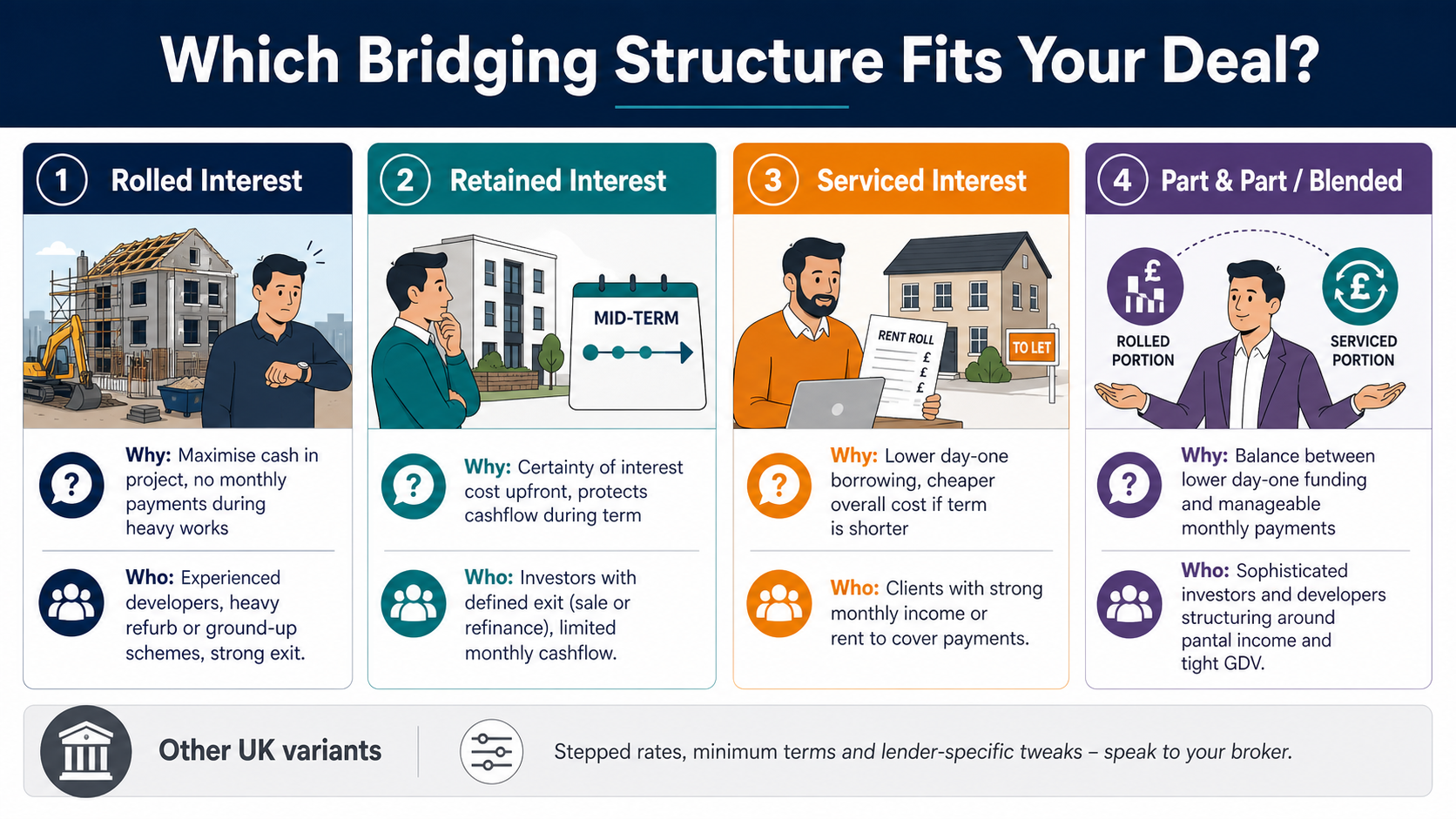
James William & Co Capital excels at delivering rapid, bespoke funding solutions crafted specifically for sophisticated UK property transactions. We work closely with family offices, private credit funds and specialist lenders to create multi-layered capital structures including bridging finance, development loans and mezzanine debt. Our “capital concierge” approach means you have a single point of contact guiding you through every stage from deal structuring to negotiation and execution. Avoid costly mistakes and seize time-sensitive opportunities with confidence by visiting James William & Co Capital today. Explore how our expertise in structured finance advisory can transform your next large-scale acquisition or development project. Take the next step to maximise your investment returns with a trusted partner who understands the nuances of UK property finance.
Frequently Asked Questions
What is structured property finance and how does it work?
Structured property finance involves pooling various financial assets, like mortgages and loans, and issuing securities backed by those assets. This approach allows property investors to access larger funding pools through a tiered capital structure that includes senior debt, mezzanine finance, and equity components.
How does the risk profile differ across the layers of structured finance?
In structured finance, senior debt is the least risky and typically covers 60-75% of funding at lower interest rates, while mezzanine finance carries moderate risk with higher returns of 12-18%. Equity capital, being the riskiest layer, often demands 18-25%+ returns as it is reliant on the success of the project after the debts are paid.
What are the common misconceptions about structured property finance?
Many believe that structured finance is overly complex or only suitable for large players. In reality, it offers tailored solutions for high-net-worth individuals and can effectively manage risk by spreading it across multiple parties. It can apply to properties or portfolios valued between £5 million to £50 million.
How can I optimise my returns through structured property finance?
To maximise returns, it’s essential to design a capital stack that aligns with your specific deal circumstances, focusing on cash flow timing and risk profile. Additionally, prioritising speed of completion and flexibility in covenants can lead to better deal outcomes, compared to simply comparing interest rates.
Recommended
- James William & Co Capital | Specialist Property Finance
- James William & Co Capital | Specialist Property Finance
- James William & Co Capital | Specialist Property Finance
- James William & Co Capital | Specialist Property Finance
- Financing Options for Investors: Building Wealth in Real Estate | Bold Street AI
Related Topics
Speak to a specialist
Discuss your finance with James directly
Whole-of-market specialist finance — bridging, development, commercial and residential. No call centres, no obligation. James reviews every enquiry personally.
New to specialist finance? How unbiased broker advice works · Deals we have completed
Explore Related Finance