
Published · Updated
role of credit fundsThe role of credit funds in property finance: 2026 guide
By James Dawes, CeMAP, Founder, James William & Co Capital

TL;DR:
- Credit funds have become essential in UK property finance by filling gaps left by retreating banks and offering flexible, bespoke lending solutions. They hold high equity levels, negotiate tailored covenants, and are less risky than banks due to their stability and structured maturity profiles. The sector is rapidly growing, driven by institutional demand, higher yields, and ongoing property market needs, making understanding them crucial for investors and developers.
Credit funds have quietly become one of the most consequential forces in UK property finance, yet they are still widely misunderstood. Many investors dismiss them as niche, illiquid, or unnecessarily complex. That misreading is costly. The role of credit funds now spans everything from ground-up development finance to large-scale commercial acquisitions, filling gaps that high-street banks increasingly refuse to touch. If you work in property investment, development, or asset management, understanding how credit funds operate and where they genuinely add value is no longer optional. It is a practical necessity.
Table of Contents
- Key takeaways
- The role of credit funds: structure and mechanics
- Credit funds in property financing and investment
- Credit funds vs traditional lending
- Market trends and the outlook for 2026 and beyond
- Integrating credit funds into your investment approach
- My perspective on credit funds and the real estate market
- Work with specialists who know credit fund structures
- FAQ
Key takeaways
| Point | Details |
|---|---|
| Credit funds fill bank gaps | Private credit lenders step in where traditional banks have retreated, offering speed and structuring flexibility. |
| Bespoke covenants protect all parties | Credit funds negotiate tailored loan terms that respond to borrower realities, unlike rigid bank templates. |
| Equity capitalisation drives stability | Credit funds hold 65 to 80% equity capitalisation, making them significantly more resilient than banks. |
| Liquidity terms are deliberate design | Redemption limits in credit funds align investor timelines with the illiquid nature of underlying assets. |
| Market growth signals strategic importance | Private credit is projected to exceed $3 trillion by 2028, reflecting deepening institutional confidence. |
The role of credit funds: structure and mechanics
Credit funds are pooled investment vehicles that deploy capital into debt instruments rather than equity. They lend directly to borrowers, purchase loans, or invest in asset-backed securities, generating returns through interest income, origination fees, and occasionally equity kickers. The spectrum is wide.
Types of credit fund strategies:
- Direct lending funds originate senior secured loans to mid-market businesses and property developers
- Asset-backed finance funds focus on loans secured against physical collateral, including real estate, infrastructure, and receivables
- Mezzanine and subordinated debt funds take on higher risk in exchange for enhanced yields, sitting between senior debt and equity in the capital stack
- Opportunistic credit funds target distressed or special situations, such as Blackstone’s recently closed $10 billion fund in 2026
The operational mechanics differ significantly from a bank. Rather than taking deposits and recycling them into loans, credit funds raise committed capital from institutional investors, family offices, and increasingly from high-net-worth individuals via feeder structures. That capital is then deployed over an investment period, with returns distributed to investors as loans are repaid.
Where fund structures diverge is in their liquidity design. Evergreen funds allow rolling subscriptions and periodic redemptions, making them attractive for investors who want ongoing access. Interval funds, by contrast, offer quarterly redemption caps, deliberately aligning liquidity with asset profiles. Slow pay funds take this further, distributing redemptions as underlying assets mature or are sold. These are not weaknesses. They are deliberate mechanisms to prevent the kind of maturity mismatch that has destabilised banks.

One of the most operationally significant features of credit funds is covenant flexibility. Unlike standardised bank loan agreements, bespoke negotiated covenants allow credit fund managers to tailor tests to a borrower’s seasonal revenue cycles, development programme milestones, or asset disposal timelines. A residential developer with a phased sales programme, for example, is far better served by a covenant tested against unit completions than against quarterly EBITDA.
Pro Tip: When evaluating a credit fund’s suitability for a property transaction, ask the fund manager specifically about their covenant testing approach. A manager who cannot explain how covenants flex for development-stage assets is probably not the right fit for complex property deals.
Credit funds in property financing and investment
The importance of credit funds to UK property finance has grown precisely because traditional bank appetite has narrowed. Basel III and IV capital requirements have made it expensive for banks to hold certain categories of real estate exposure. Ground-up residential developments, mixed-use schemes, and secondary commercial assets have been progressively underserved. Credit funds stepped into that space, and they have not stepped back.
For a property developer seeking finance for a 50-unit residential scheme in the Midlands, the difference between bank and credit fund terms can be dramatic. A high-street lender might offer 60% loan-to-cost with a rigid interest coverage covenant, a 12-month draw schedule, and limited tolerance for programme delays. A credit fund operating in the same space might offer 75 to 80% loan-to-cost, interest rolled or capitalised during construction, stage drawdowns aligned with actual build progress, and covenant tests structured around practical completion rather than quarterly financials. Speed matters too. Decisions that take a bank committee six weeks can often be reached by a credit fund credit team in ten days.
For investors, the functions of credit funds extend beyond financing. Consider how they improve portfolio construction:
- Yield enhancement — asset-backed credit strategies typically target a 200 to 250 basis point premium over comparable public securitised products, with lower volatility because the collateral is tangible and specific
- Floating rate exposure — most private credit loans price at a margin over SONIA or SOFR, meaning as base rates move, income adjusts. That is structural protection that fixed-coupon bonds simply cannot replicate
- Low correlation with public markets — private credit valuations do not move in lockstep with listed bond markets, which matters when you are constructing a genuinely diversified portfolio
- Inflation linkage — real estate-backed debt benefits from rising asset values, giving you some insulation against inflationary environments that erode fixed-rate bond returns
Pro Tip: For real estate professionals new to credit fund investment, consider starting with a senior secured direct lending fund rather than a mezzanine or opportunistic vehicle. Senior positions mean you are first in line for repayment, which simplifies risk analysis and typically offers cleaner underwriting.
You can explore how asset-backed lending strategies apply specifically to UK property contexts for a deeper view of how these instruments sit within the broader capital stack.
Credit funds vs traditional lending
Understanding the risk and return profile of credit funds relative to banks and public bond markets is what separates informed allocation decisions from guesswork.
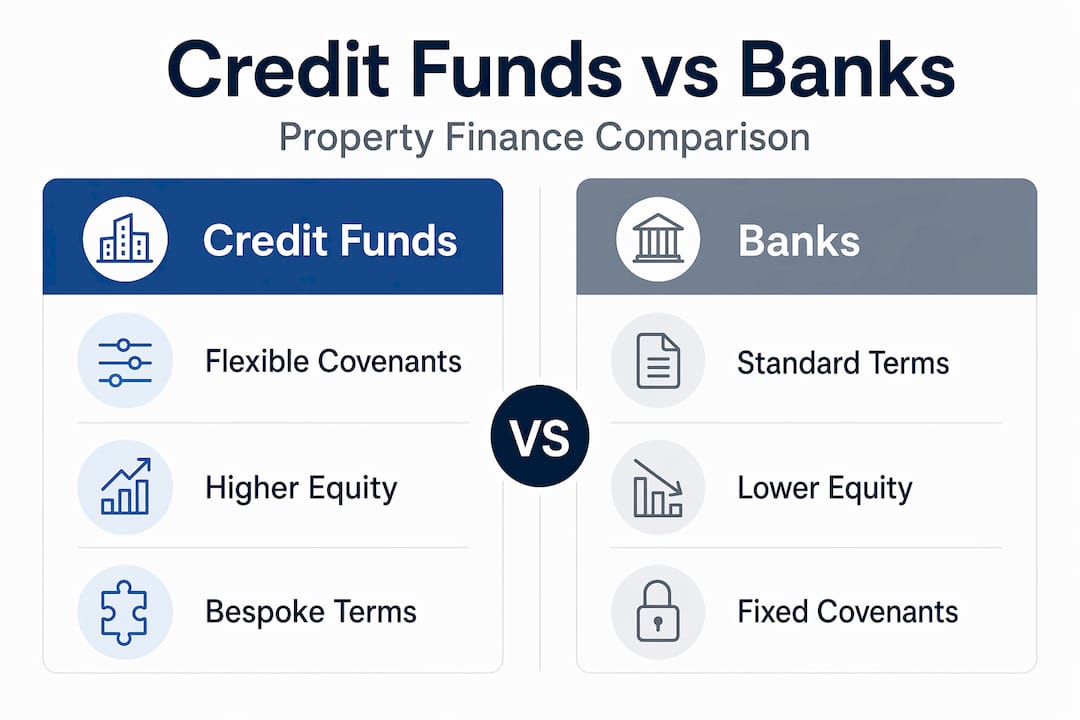
| Feature | Credit funds | High-street banks | Public bond markets |
|---|---|---|---|
| Equity capitalisation | 65 to 80% | Approximately 10% | N/A |
| Covenant flexibility | High, bespoke | Low, standardised | Very low |
| Loan customisation | Extensive | Limited | None |
| Speed to decision | Days to weeks | Weeks to months | Market-dependent |
| Liquidity for investors | Limited, structured | N/A | High |
| Yield premium | 200 to 250 bps over public credit | Below market for complex deals | Benchmark-linked |
| Refinancing risk | Lower (amortising ABF structures) | Higher (bullet repayments) | Moderate |
The stability comparison is striking. Credit funds hold far greater equity reserves than traditional banks, which reduces both systemic risk and loss absorption vulnerability. Where a bank operates on thin equity cushions amplified by depositor funding, a credit fund’s capital base is almost entirely committed long-term investor equity.
The risk considerations worth understanding are different in character, not necessarily greater:
- Valuation opacity — private credit assets are marked to model, not to market, which can delay recognition of impairment
- Underwriting quality variance — in a competitive market, not all managers maintain the same discipline; covenant-lite deals have increased
- Concentration risk — a smaller fund with heavy exposure to one sector or geography carries different risk than a diversified institutional vehicle
- Redemption misalignment — investors who misunderstand liquidity terms can face friction at redemption if they have not planned for asset-level timelines
Private credit funds also avoid the maturity transformation risk that makes banks fragile. Because loans mature before the fund ends, cash flows arrive before obligations do. There is no fractional reserve dynamic and no run risk.
Market trends and the outlook for 2026 and beyond
The private credit market has grown from $500 billion to $1.3 trillion over five years, with projections suggesting it will exceed $3 trillion by 2028. That is not speculative growth. It reflects a structural shift in how credit is originated and held.
Institutional investors, including pension funds, sovereign wealth funds, and insurance companies, have been systematically increasing their credit fund allocations over the past decade. Retail access is expanding too, through Business Development Companies in the US and via LTAF (Long-Term Asset Fund) structures in the UK. This democratisation of access is reshaping who benefits from private credit returns.
The driving forces behind this growth are clear:
- Bank retrenchment from complex or capital-intensive lending categories continues to create space for non-bank lenders
- Higher base rates have increased absolute yields across the credit spectrum, making the asset class more attractive in absolute terms
- Property developers and mid-market businesses are actively seeking alternatives to slow, covenant-heavy bank facilities
- Disciplined underwriting and valuation are becoming differentiators as more capital crowds into the space
The challenge emerging in 2026 is competitive pressure on returns. As more capital chases the same borrowers, spreads tighten and covenants weaken. Sophisticated investors are responding by prioritising managers with genuine origination capability, not those simply buying into club deals or following the same flow. For UK property specifically, the opportunity remains acute because planning complexity, development risk, and asset specificity create barriers that generalist credit funds cannot easily clear.
Integrating credit funds into your investment approach
Knowing the theory of credit funds is one thing. Structuring your exposure effectively is where the real work lies.
-
Define your liquidity horizon first. Credit fund allocations should only be made with capital you genuinely do not need for three to seven years. Matching your liquidity horizon to the fund’s redemption structure prevents forced decisions at the wrong moment.
-
Assess manager pedigree, not just fund size. A £500 million fund with a specialist team of former property lenders will typically outperform a £2 billion fund that treats real estate as one box among many. Ask about their default history, workout experience, and how they have handled underperforming positions.
-
Understand where in the capital stack you are sitting. Senior secured, mezzanine, and subordinated positions carry fundamentally different risk profiles. Your allocation should reflect your loss tolerance and income requirements, not just the headline yield.
-
Combine structures to manage cash drag. Managing cash drag in private credit is a real challenge. Sophisticated allocators combine traditional drawdown funds with evergreen vehicles, maintaining capital productivity while managing the timing of deployments.
-
Align credit fund selection with your specific property strategy. A developer active in the residential build-to-sell market needs a fund that understands phased sales risk. A commercial investor acquiring secondary offices needs a lender comfortable with lease-up timelines and asset management plans.
Pro Tip: Request a fund manager’s most recent vintage performance data alongside their projected returns. A consistent track record across market cycles tells you far more than a compelling pitch deck from a single strong year.
Current UK property finance trends show growing demand for exactly this kind of structured, flexible credit access across all development types.
My perspective on credit funds and the real estate market
I have structured and sourced credit fund financing across a range of UK property transactions, from single-asset acquisitions to multi-tranche development finance. What I have found, consistently, is that the investors who underestimate credit funds are usually the ones who once had a bad experience with an ill-suited product. They picked a fund with the wrong liquidity terms, or a lender with no real understanding of their asset type, and drew the wrong conclusions.
The deeper truth is that credit funds, when properly matched to the transaction and borrower profile, are not a compromise. They are often the superior structural choice. The 2008 financial crisis exposed how fragile bank-led credit cycles are. Private credit, with its high equity capitalisation and bespoke structuring, absorbed the 2020 and 2022 market shocks without the contagion that bank-based credit would have propagated.
What I tell clients at Jwcapital is this: do not assess a credit fund by its headline rate alone. Look at who sits behind it, what sectors they genuinely understand, how they have handled troubled positions in the past, and whether their covenant approach reflects operational reality or generic legal templates. The difference between a fund that works with you through a development delay and one that enforces a technical breach is not just financial. It can determine whether a project survives.
— James
Work with specialists who know credit fund structures

At Jwcapital, we work directly with a network of private credit funds, family offices, and specialist lenders across the UK market. For developers, investors, and asset managers who need more than a standard mortgage broker, our approach is to structure the entire capital stack. That includes senior debt, mezzanine layers, and equity-linked instruments, sourced from lenders who genuinely understand complex property assets. Whether you are financing a ground-up residential scheme, refinancing a commercial portfolio, or structuring a joint venture, our specialist property finance team provides a single point of contact from initial structuring through to execution. View our completed case studies to see how we have deployed credit fund solutions across real transactions.
FAQ
What is the main role of credit funds in property finance?
Credit funds provide flexible, bespoke debt financing to property developers and investors, filling gaps left by traditional banks. They offer faster decision-making, higher loan-to-cost ratios, and tailored covenant structures suited to development and investment timelines.
How do credit funds differ from high-street bank lending?
Credit funds hold significantly higher equity capitalisation (65 to 80%) compared to banks and offer negotiated loan covenants rather than standardised templates. They also avoid the maturity transformation risk inherent in bank lending because fund life exceeds loan duration.
Are credit funds suitable for individual investors?
Yes, increasingly so. Long-Term Asset Fund (LTAF) structures in the UK and interval funds globally are opening private credit to high-net-worth and sophisticated individual investors. However, investors must be comfortable with limited liquidity and multi-year investment horizons.
What return premium do credit funds typically offer?
Asset-backed credit strategies in private credit typically target 200 to 250 basis points above comparable public securitised products, with lower volatility due to tangible collateral backing the loans.
How large is the private credit market in 2026?
The private credit market has grown from $500 billion to $1.3 trillion over the past five years and is forecast to exceed $3 trillion by 2028, reflecting deepening institutional demand and the structural retreat of traditional bank lenders from complex credit markets.
Recommended
Related Topics
Speak to a specialist
Discuss your finance with James directly
Whole-of-market specialist finance — bridging, development, commercial and residential. No call centres, no obligation. James reviews every enquiry personally.
New to specialist finance? How unbiased broker advice works · Deals we have completed
Explore Related Finance