
Published · Updated
role of loan agreementsThe role of loan agreements in property finance
By James Dawes, CeMAP, Founder, James William & Co Capital

TL;DR:
- Loan agreements in UK property finance establish the legal relationship, obligations, and protections for developers and investors. They include key components such as repayment schedules, covenants, security arrangements, and draw processes, which influence project risk and cash flow management. Understanding and negotiating default, prepayment, and covenant terms is essential to protect operational flexibility and optimize exit strategies.
Loan agreements are legally binding contracts that define the precise terms, obligations, and protections governing every real estate financing transaction. In UK property finance, the role of loan agreements extends far beyond paperwork: they establish the creditor-debtor relationship, allocate risk between parties, and set the operational rules for everything from draw schedules to covenant compliance. For developers and investors working with bridging finance, development loans, or commercial mortgages, understanding what these documents actually require is the difference between a project that runs smoothly and one that stalls at the worst possible moment.

What key components make up loan agreements for property investors?
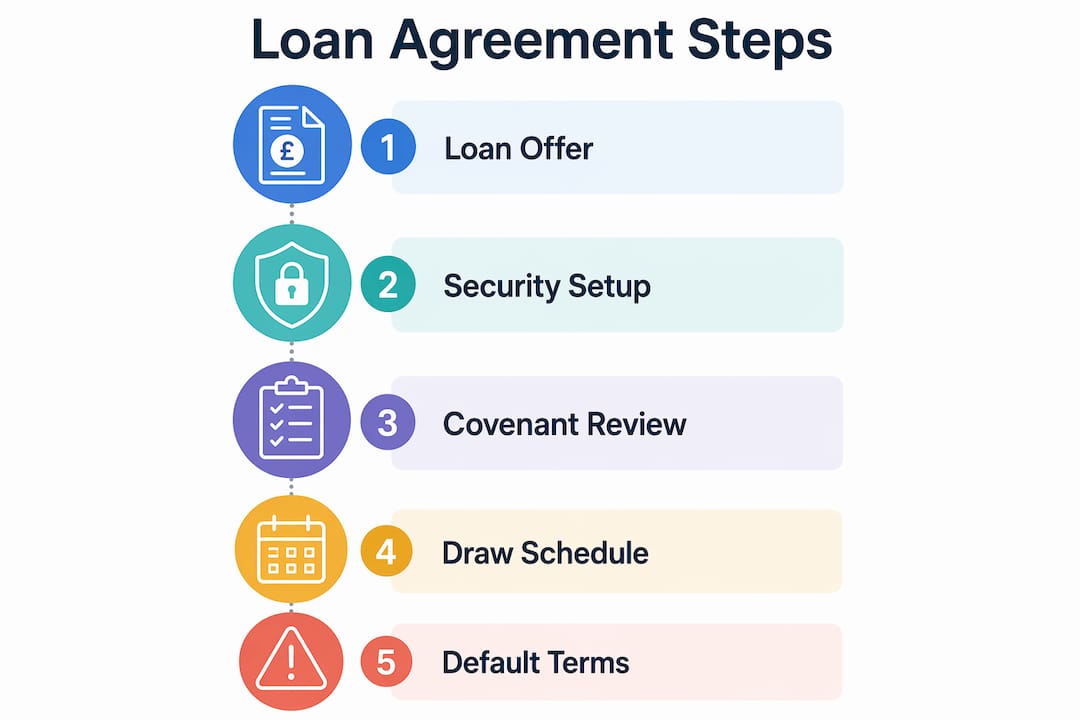
Loan agreements typically consist of multiple documents, where the credit agreement defines the creditor-debtor relationship and the promissory note evidences the actual loan amount and obligation. This distinction matters in practice. The credit agreement sets the rules of engagement: repayment schedule, interest rate, maturity date, prepayment provisions, and the full suite of covenants. The promissory note is the borrower’s formal promise to repay. Treating them as one document is a common oversight that creates confusion when disputes arise.
For real estate investors, the standard loan agreement terms you will encounter include:
- Repayment schedule: Whether interest-only during construction, then capital repayment on term, or a bullet repayment at maturity.
- Interest rate: Fixed, variable, or a margin over SONIA (the Sterling Overnight Index Average, which replaced LIBOR in UK lending).
- Loan covenants: Affirmative covenants (what you must do), negative covenants (what you cannot do), and financial covenants (metrics you must maintain).
- Events of default: Defined triggers that give the lender enforcement rights.
- Security package: Mortgages, charges, assignments of rental income, and personal or corporate guarantees.
Security agreements often extend beyond the mortgaged property to include assignments of revenues and recourse to guarantors, which shifts the negotiation dynamic considerably. A developer who signs a personal guarantee without fully understanding its scope has effectively put personal assets on the line for a commercial venture.
For ground-up developments, loan agreements also contain specific construction provisions: draw conditions, cost monitoring requirements, and practical completion milestones. These clauses are as commercially significant as the interest rate itself.
Pro Tip: Before signing any facility letter, map every covenant against your current financial position and projected figures for the loan term. A covenant you cannot meet in month eight is a problem you should identify in month one.
How do loan covenants impact risk management in real estate financing?
Loan covenants act as enforced promises that protect lenders by monitoring financial and operational compliance, functioning as an early warning system against default risk. For the borrower, they are the ongoing obligations that determine whether the facility remains in good standing throughout its life.
In property finance, the covenants most frequently tested include:
- Debt Service Coverage Ratio (DSCR): The ratio of net operating income to debt service payments. A lender may require a minimum DSCR of 1.25x on an income-producing asset.
- Loan-to-Value (LTV) maintenance: If the property value falls, a breach may trigger a margin call or partial repayment obligation.
- Reporting covenants: Quarterly management accounts, annual audited financials, and rent roll updates submitted within defined timeframes.
- Maintenance and insurance obligations: Keeping the asset in good repair and maintaining adequate cover.
Covenants are not bureaucratic hurdles. They are the lender’s real-time view into the health of your project. Treat covenant compliance as an operational discipline, not an administrative afterthought.
The consequences of a covenant breach range from a formal waiver request to full acceleration of the loan. Most lenders will engage commercially on a first breach if the borrower communicates early and presents a credible remediation plan. Silence is far more damaging than a difficult conversation. When negotiating loan agreement clauses at the outset, experienced developers push for cure periods, equity cure rights (the ability to inject capital to remedy a financial covenant breach), and clearly defined testing dates. These provisions can be the difference between a manageable situation and a forced sale. You can read more about managing covenant risk in the context of UK development funding.
What are draw schedules and how do they affect development cash flow?
Construction loan draws release funds periodically based on verified construction progress against a Schedule of Values (SOV), directly affecting cash flow and project scheduling. The SOV is the master budget document that allocates the total loan across individual cost line items: groundworks, superstructure, mechanical and electrical, fit-out, and so on. Each draw request must demonstrate that the claimed percentage of each line item has been completed and verified.
A typical development loan involves four to six draw cycles over the construction period. Each cycle follows a structured process:
- The contractor submits a pay application referencing the SOV.
- The borrower compiles supporting documentation including lien waivers and invoices.
- The lender’s monitoring surveyor or quantity surveyor inspects the site and certifies progress.
- The lender processes the draw and releases funds.
This administrative cycle typically takes 30 to 45 days from work performed to funds received, which creates a structural cash flow gap that many developers underestimate at the planning stage. A contractor who completes a significant phase in week one of a given month may not receive payment until week four or five of the following month. That gap must be funded from working capital or a pre-agreed liquidity facility.
| Draw stage | Typical documentation required | Approximate processing time |
|---|---|---|
| Initial draw | Executed contracts, insurance certificates, planning consent | 10 to 14 days |
| Progress draws | Pay application, lien waivers, QS inspection report | 30 to 45 days |
| Final draw | Practical completion certificate, final account, snagging sign-off | 14 to 21 days |
Pro Tip: Build a draw calendar at the start of every project. Work backwards from your contractor payment dates and submit draw requests at least six weeks in advance of when you need the funds. Administrative latency is predictable. Cash flow crises caused by it are not.
For a detailed breakdown of draw administration in commercial development loans, the mechanics are broadly consistent across markets, though UK lenders typically require a monitoring surveyor rather than a title company inspection.
How do default events and lender remedies shape borrower risk?
Loan agreements dedicate significant documentation to events of default and lender remedies, and for good reason. These provisions define what happens when things go wrong, and in property finance, the consequences are severe.
Common events of default in UK real estate loan agreements include:
- Payment default: Failure to pay interest or principal on the due date.
- Covenant breach: Failure to maintain a required financial ratio or comply with an operational obligation.
- Misrepresentation: A warranty or representation in the loan agreement proving materially false.
- Insolvency events: Administration, liquidation, or appointment of a receiver.
- Cross-default: Default under another facility triggering default under this one.
Acceleration clauses permit lenders to demand immediate repayment of the full loan balance upon default, typically following a formal notice and a defined cure period. For a development loan with 18 months remaining, acceleration is an existential threat to the project. Lenders also hold the right to appoint a Law of Property Act (LPA) receiver, who takes control of the asset and manages or sells it to recover the debt.
The negotiation of default provisions at the outset is therefore not a theoretical exercise. Borrowers should push for notice periods of at least 10 to 15 business days, clearly defined cure windows for remediable breaches, and carve-outs for technical breaches that cause no material harm. Understanding the full scope of lender remedies before signing is a core benefit of loan contracts that protects both parties.
What do prepayment terms mean for your exit strategy?
Prepayment penalties such as yield maintenance and defeasance are common in CMBS real estate loans, with lockout periods of 24 to 36 months followed by penalty windows that can make early exit prohibitively expensive. These provisions exist because lenders securitise loans and sell them to bond investors who rely on predictable cash flows. Early repayment disrupts that model, so the borrower compensates the lender for the lost income.
| Prepayment mechanism | How it works | Typical cost implication |
|---|---|---|
| Yield maintenance | Borrower pays the present value of remaining interest payments, discounted at a treasury rate | High cost if rates have fallen since origination |
| Defeasance | Borrower substitutes the loan collateral with a portfolio of government securities that replicates the cash flow | Complex and costly, but can be net positive in specific rate environments |
| Step-down penalty | Penalty reduces over time, e.g. 5%, 4%, 3%, 2%, 1% | Predictable and easier to model at underwriting |
The 2026 defeasance cycle has created a specific window where certain borrowers can prepay CMBS loans at a net gain under current treasury yield conditions. This is a rare occurrence and requires specialist advice to execute correctly. For UK developers using senior debt from private credit funds rather than CMBS, step-down penalties are more common and generally more straightforward to model into exit projections.
Pro Tip: Map your prepayment provisions against your business plan exit date at the point of underwriting, not six months before you want to sell. A 12-month penalty window you did not account for can eliminate the profit margin on a well-executed project.
Key takeaways
Loan agreements are the legal and operational backbone of every property finance transaction, and understanding their terms in full before drawdown is the single most effective way to protect your investment.
| Point | Details |
|---|---|
| Understand the document structure | Credit agreements and promissory notes serve distinct legal functions; treat them separately during review. |
| Monitor covenants operationally | DSCR, LTV, and reporting obligations require active tracking throughout the loan term, not just at origination. |
| Plan for draw latency | A 30 to 45 day administrative cycle between work completed and funds received must be built into every development cash flow. |
| Negotiate default provisions | Cure periods, equity cure rights, and carve-outs for technical breaches materially reduce borrower risk. |
| Align exit with prepayment terms | Yield maintenance and defeasance clauses can make early repayment costly; model these costs before committing to a business plan timeline. |
What I have learned from structuring complex loan agreements
The most consistent mistake I see from experienced developers is treating loan documentation as a formality to get through rather than a set of operational instructions to live by. The credit agreement tells you exactly how your lender will behave under pressure. Most borrowers read it once, sign it, and file it. That is a significant error.
Covenant packages in particular deserve far more attention than they typically receive. I have seen developers breach a reporting covenant simply because they missed a quarterly accounts submission deadline, triggering a technical default that gave the lender leverage at exactly the wrong moment in the project cycle. The breach was entirely avoidable. The consequences were not trivial.
On draw mechanics, the 30 to 45 day administrative cycle is not a lender failing. It is a structural feature of how construction lending works, and the developers who manage it best are the ones who treat draw administration as a project management discipline. They appoint a dedicated person to manage documentation, they submit early, and they maintain a liquidity buffer to cover the gap. The ones who struggle treat it as the lender’s problem.
My strongest advice on prepayment terms: never assume you will hold a loan to maturity. Markets move, opportunities arise, and the ability to refinance or sell at the right moment is a genuine competitive advantage. A loan agreement that locks you in for three years with a punitive exit cost is not just a financial constraint. It is a strategic one. Negotiate prepayment flexibility at the outset, when you have the most leverage, not when you are trying to exit under time pressure.
The UK property finance market in 2026 is pricing covenant packages more tightly than in previous cycles, which makes early negotiation even more important for developers seeking to protect their operational flexibility.
— James
How James William & Co structures loan agreements for UK developers

At James William & Co, we work with UK property developers, investors, and high-net-worth clients to structure and negotiate loan agreements that reflect the commercial reality of their projects, not just the lender’s standard terms. From development finance and commercial mortgages to mezzanine debt and JV equity, our capital concierge approach means you have a single point of contact for the full debt stack. We review covenant packages, negotiate default provisions, and model prepayment costs before you commit to any facility. If you are working on a large-scale acquisition, ground-up development, or complex refinance in London or across the UK, speak to our team about bespoke property finance solutions tailored to your specific transaction.
FAQ
What is the role of loan agreements in property finance?
Loan agreements define the legal terms, obligations, and protections that govern a real estate financing transaction. They establish the creditor-debtor relationship, set repayment and covenant obligations, and specify lender remedies in the event of default.
What are the most important loan agreement clauses for developers?
The most commercially significant clauses for developers are loan covenants (particularly DSCR and LTV tests), draw conditions for construction funding, events of default with associated cure periods, and prepayment provisions including yield maintenance or step-down penalties.
How do loan covenants work in practice?
Covenants are ongoing obligations that the borrower must meet throughout the loan term. Financial covenants such as DSCR are tested at defined intervals, while reporting covenants require regular submission of accounts and rent rolls. A breach can trigger a default event and lender remedies including acceleration.
What is the difference between yield maintenance and defeasance?
Yield maintenance requires the borrower to pay the present value of remaining interest payments upon early repayment, compensating the lender for lost income. Defeasance substitutes the loan collateral with government securities that replicate the original cash flow. Both are common in CMBS loans and can be costly in certain rate environments.
How long does a construction loan draw typically take to process?
A construction loan draw typically takes 30 to 45 days from the date work is completed to the date funds are received, covering contractor pay applications, lien waivers, and monitoring surveyor inspections. Developers should build this administrative lead time into their project cash flow from the outset.
Recommended
Related Topics
Speak to a specialist
Discuss your finance with James directly
Whole-of-market specialist finance — bridging, development, commercial and residential. No call centres, no obligation. James reviews every enquiry personally.
New to specialist finance? How unbiased broker advice works · Deals we have completed
Explore Related Finance