
Published · Updated
role of property valuationThe role of property valuation in investment decisions
By James Dawes, CeMAP, Founder, James William & Co Capital

TL;DR:
- Property valuation is a systematic and regulation-compliant process that determines a property’s market value for financial decision-making purposes. It underpins all UK real estate financing, governance, and legal transactions, requiring independent, professionally produced valuations like RICS Red Book reports for credibility and legal weight. Regular, current valuations enable strategic asset management, mitigate risks, and ensure compliance with regulatory and lender requirements.
Property valuation is the systematic, evidence-based process of determining a property’s market value through professionally regulated methods recognised by lenders, courts, and HMRC. For UK property investors and real estate professionals, it sits at the centre of every significant financial decision: from securing a commercial mortgage to structuring a complex multi-asset portfolio. Accurate appraisal, conducted under RICS Red Book standards, removes guesswork from capital allocation and replaces it with defensible, auditable evidence. Without it, loan-to-value ratios are arbitrary, acquisition pricing is speculative, and governance risk compounds quietly until it becomes a material problem.
What is the role of property valuation in real estate finance?
Property valuation is the foundation upon which every credible financing decision in UK real estate is built. Independent appraisals establish loan-to-value ratios necessary to secure mortgage and specialist lending products, directly affecting credit limits and borrowing costs. That single fact explains why lenders, from high-street banks to private credit funds, will not advance capital without a formal valuation in place.

The importance of property appraisal extends well beyond the initial transaction. Corporate boards rely on independent valuations ahead of financing and tax events to preserve capital value and reduce audit risk. This means valuation is not a one-off compliance exercise. It is a recurring governance instrument that gives institutional investors the empirical clarity to make confident decisions about capital deployment, disposal, and refinancing.
The property valuation significance for UK investors is also regulatory. RICS Red Book standards govern how chartered surveyors produce formal opinions of value, and those opinions carry weight that no automated estimate or broker opinion can replicate. Understanding the difference between a formal appraisal and an informal estimate is not a technical nicety. It is the difference between a defensible position and an exposed one.
What are the main property valuation methods and how do they apply?
Three core methodologies underpin how property valuation works in professional practice, and each serves a distinct purpose depending on asset type, market conditions, and the purpose of the valuation.
The market (sales comparison) approach analyses recent transactions of comparable properties to derive a market value. It is the most widely used method for residential and standard commercial assets where sufficient comparable evidence exists. Valuers adjust for differences in size, condition, location, and tenure to produce a calibrated opinion rather than a simple average.
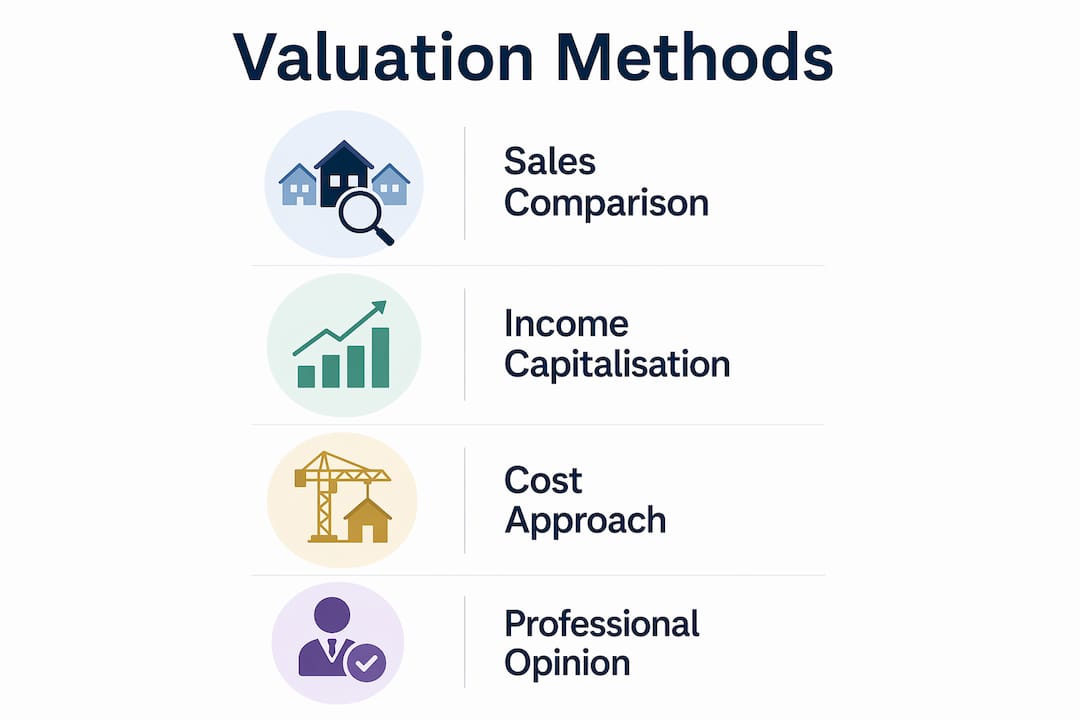
The income capitalisation approach converts a property’s income stream into a capital value by applying a yield or capitalisation rate. This method is standard for investment-grade assets: offices, retail units, industrial sheds, and build-to-rent schemes. A property generating £500,000 per annum net, capitalised at a 5% yield, produces a valuation of £10 million. The yield applied reflects market sentiment, lease quality, and covenant strength.
The cost approach values a property by calculating the cost of replacing or reproducing it, less depreciation, plus the land value. It is most relevant for specialist assets such as owner-occupied industrial facilities, schools, or properties with limited comparable transaction evidence. New-build developments also frequently use this method during the appraisal stage.
Critically, valuation models support but do not replace professional opinion. A skilled valuer reconciles the outputs of multiple methods, weighing the reliability of each given the available evidence, before arriving at a final figure. The number is a conclusion, not a calculation.
| Method | Best used for | Key input |
|---|---|---|
| Sales comparison | Residential and standard commercial | Recent comparable transactions |
| Income capitalisation | Investment properties with rental income | Net income and market yield |
| Cost approach | Specialist or owner-occupied assets | Replacement cost and depreciation |
Pro Tip: When commissioning a valuation for a complex or mixed-use asset, ask the valuer to explain which method they weighted most heavily and why. The reasoning reveals far more about reliability than the headline figure alone.
Why is professional regulation and independence vital in property valuation?
The integrity of any valuation rests on the independence of the person producing it. Regulations like Dodd-Frank create a firewall ensuring appraiser independence, strengthening trust in valuations and preventing the kind of inflated appraisals that contributed to the 2008 financial crisis. In the UK, RICS Red Book standards serve a comparable function, setting out mandatory requirements for objectivity, competence, and disclosure of conflicts of interest.
Federal regulations mandate that federally related transactions use appraisals performed by state-certified or licensed appraisers following USPAP. In the UK context, the equivalent requirement is that lenders and HMRC accept only RICS-compliant valuations for formal purposes. This is not bureaucratic formality. It is the mechanism by which valuations become legally defensible.
The distinction between valuation types matters enormously in practice:
- RICS Red Book valuations carry legal weight recognised by courts, lenders, and HMRC, and are produced by chartered surveyors with professional indemnity insurance.
- Automated valuation models (AVMs) such as those used by online portals supplement but do not replace appraiser judgment for standard purchase transactions, and carry no professional accountability.
- Broker price opinions are informal estimates produced without the regulatory framework or indemnity cover of a formal appraisal.
- Desktop valuations sit between AVMs and full inspections, often used for lower-risk refinancing but not accepted for all lending purposes.
Professional indemnity and accountability differentiate certified chartered surveyor valuations from informal estimates or broker opinions. That accountability is not abstract. If a valuation is later challenged in court or by HMRC, the valuer’s professional standing and insurance are on the line. That exposure is precisely what makes the opinion credible.
As the Appraisal Institute has noted, appraisers serve as a stabilising force in the economy by providing credible valuations that prevent market distortion and speculation. This framing of appraisal as economic infrastructure, rather than a transactional service, reflects how seriously regulators and institutional capital treat the function.
How does valuation influence financing and portfolio risk management?
The practical impact of property valuation on financing terms is direct and quantifiable. Lenders use the valuation to set the loan-to-value ratio, which in turn determines the maximum loan amount, the interest rate applied, and the covenant package attached to the facility. A valuation that comes in below the agreed purchase price does not just complicate the deal. It can collapse it entirely or force a renegotiation of terms.
For institutional investors and property companies with significant real estate holdings, annual or biennial independent valuations are recommended to mitigate governance risks and improve capital allocation. This frequency reflects the pace at which market conditions, occupancy rates, and planning environments can shift the underlying value of a portfolio. Relying on a three-year-old valuation to support a refinancing or acquisition decision is a governance failure waiting to be exposed.
Valuations also inform buy and sell decisions at the asset level. When a fund manager is considering disposing of an underperforming asset, a current independent valuation provides the benchmark against which offers are assessed. Without it, the negotiating position is weakened and the risk of accepting an undervalue increases materially.
For real estate debt and loan approvals, the valuation is the single most important document in the credit file. Specialist lenders, including those offering bridging finance, development finance, and mezzanine debt, all structure their facilities around the valuation. The quality of that valuation, and the credibility of the valuer who produced it, directly affects the terms available.
Pro Tip: For portfolio refinancing, commission valuations across all assets simultaneously rather than staggering them. Lenders and auditors respond more favourably to a cohesive, contemporaneous dataset than to a patchwork of reports from different dates and valuers.
Valuations must be audit-ready, independently verified, and compliant with RICS or local regulations to serve as reliable governance tools for institutional portfolios. That standard is not optional for any investor seeking to raise institutional capital or access regulated lending markets.
When is a formal property valuation legally or financially required?
Certain transactions and events make a formal, RICS-compliant valuation not just advisable but legally or financially obligatory. Knowing when you need one protects you from regulatory exposure and strengthens your position in negotiations.
- Mortgage and refinancing applications. All UK mortgage lenders require a formal valuation before advancing funds. For commercial and specialist lending, the valuation must typically be conducted by a lender-approved panel valuer.
- Inheritance tax and probate. HMRC requires a professional valuation of all property assets in an estate at the date of death. An informal estimate or AVM output will not satisfy this requirement and may trigger an HMRC inquiry.
- Divorce settlements and legal disputes. Courts require independent, RICS-compliant valuations to determine the fair division of property assets. A Red Book valuation carries legal weight that no other form of estimate can provide in this context.
- Corporate financial reporting and IFRS compliance. Companies holding investment property under IFRS must report assets at fair value, requiring regular independent valuations to satisfy auditors and shareholders.
- Transfers between connected parties. Property transferred between family members, directors, or associated companies must be valued at market value for tax purposes. HMRC scrutinises these transactions closely.
- Specialist lending products. Bridging loans, development finance, and mezzanine facilities all require formal valuations as part of the credit assessment. The benefits of property valuation in this context include faster credit decisions and stronger negotiating leverage with lenders.
In each of these scenarios, relying on an informal estimate exposes you to challenge from HMRC, lenders, or opposing legal counsel. The cost of a formal RICS appraisal is negligible relative to the financial and legal risk of proceeding without one.
Key takeaways
Accurate, independent property valuation is the single most important document in any UK real estate financing, governance, or legal process, and no informal estimate or automated model can substitute for it.
| Point | Details |
|---|---|
| Valuation underpins all lending | Lenders use formal appraisals to set LTV ratios, loan limits, and covenant terms. |
| Three core methods apply | Sales comparison, income capitalisation, and cost approach each suit different asset types. |
| RICS compliance is non-negotiable | Only Red Book valuations are accepted by HMRC, courts, and regulated lenders. |
| Governance requires regular revaluation | Institutional portfolios should be independently valued annually or biennially. |
| Formal valuations are legally required | Probate, divorce, IFRS reporting, and specialist lending all mandate certified appraisals. |
Valuation is strategy, not just compliance
Most investors I speak with treat property valuation as a box to tick before a lender will release funds. That framing is understandable, but it leaves significant value on the table. The investors who use valuation most effectively treat it as a strategic instrument: commissioning appraisals proactively before refinancing windows open, using them to benchmark acquisition offers, and building a contemporaneous valuation record that strengthens their position with every lender, auditor, and counterparty they encounter.
The misconception I see most often is that a valuation from two years ago is still “good enough.” Markets move. Planning consents change. Lease events occur. An outdated valuation does not just carry governance risk. It actively misrepresents the asset, and sophisticated lenders and institutional partners will notice.
Selecting the right valuer matters as much as commissioning the valuation itself. For complex assets, including mixed-use schemes, ground-up developments, and portfolios with offshore structures, you need a valuer with demonstrable experience in that specific asset class. A generalist residential surveyor producing a Red Book report on a 200-unit build-to-rent scheme is not the same as a specialist with comparable transaction evidence and sector knowledge. The report may look identical. The credibility with lenders will not be.
The real estate funding landscape in 2026 rewards investors who arrive at the table with clean, current, credible valuations. Those who do not are negotiating from a weaker position before the conversation has even begun.
— James
How James William & Co can support your next transaction

At James William & Co, we work with UK property developers, institutional investors, and high-net-worth clients who understand that the quality of their valuation directly affects the terms of their finance. Whether you are structuring a bridging facility, a development loan, or a complex refinance across a multi-asset portfolio, the valuation is the document that sets the parameters for everything that follows. Our specialist property finance in London and across the UK is structured around that reality. We work with lenders who take valuation quality seriously, and we help clients commission the right appraisals from the right valuers before they approach the market. If you are preparing for a significant transaction and want to understand how valuation will affect your financing options, speak with our team at James William & Co Capital.
FAQ
What is the role of property valuation in securing a mortgage?
A formal property valuation establishes the loan-to-value ratio that determines how much a lender will advance and on what terms. Without a lender-approved appraisal, no regulated mortgage or specialist finance product can be issued in the UK.
How does a RICS Red Book valuation differ from an AVM?
A RICS Red Book valuation is produced by a chartered surveyor with professional indemnity insurance and carries legal weight with HMRC, courts, and lenders. Automated valuation models are statistical tools that supplement but cannot replace professional judgment or provide legal accountability.
How often should investment property be revalued?
Boards and institutional investors with significant real estate holdings should commission independent valuations annually or biennially to support governance, capital allocation, and audit requirements.
Is a formal valuation required for inheritance tax purposes?
Yes. HMRC requires a professional valuation of all property in an estate at the date of death. Only a formal RICS-compliant appraisal satisfies this requirement and provides the USPAP-level credibility that regulators and courts accept.
What are the risks of using an informal valuation for a property transaction?
Informal estimates carry no professional indemnity, no regulatory standing, and no legal defensibility. In the context of HMRC inquiries, court proceedings, or lender credit assessments, they expose you to challenge, delay, and potential financial penalty.
Recommended
Related Topics
Speak to a specialist
Discuss your finance with James directly
Whole-of-market specialist finance — bridging, development, commercial and residential. No call centres, no obligation. James reviews every enquiry personally.
New to specialist finance? How unbiased broker advice works · Deals we have completed
Explore Related Finance