
Published · Updated
role of spvs in propertyThe role of SPVs in property investment: a 2026 guide
By James Dawes, CeMAP, Founder, James William & Co Capital

TL;DR:
- Using an SPV in property offers legal separation, tax benefits, and lender preference, especially for larger portfolios. However, higher upfront costs, transfer penalties, and increased compliance make it less suitable for small or low-value portfolios. Careful modeling and professional advice are essential before establishing or transferring properties into an SPV.
A Special Purpose Vehicle (SPV) in property is a separate limited company created solely to own and manage real estate assets, providing distinct legal, financial, and operational advantages over personal ownership. The role of SPVs in property has grown significantly among UK investors, particularly since Section 24 tax changes removed full mortgage interest relief for individual landlords. For higher-rate taxpayers, portfolio builders, and joint venture partners, the SPV structure is now the default starting point for serious property investment. This guide explains how SPVs work, where they add genuine value, and where they fall short.
What are the key benefits of using SPVs in property investment?
The primary benefit of a property investment SPV is legal separation. The company holds the asset, so your personal finances sit outside the liability boundary. If a tenant dispute escalates or a development goes wrong, creditors pursue the SPV, not you personally.

The tax case for SPVs is equally compelling. Full mortgage interest deductibility is available to SPVs, bypassing the Section 24 restrictions that cap relief for individual landlords at the basic rate. For a higher-rate taxpayer with a leveraged portfolio, this difference alone can shift a property from loss-making to profitable. Profits retained within the SPV are subject to corporation tax rather than income tax, which at current rates is materially lower.
Lenders also respond well to the structure. SPVs represent a clean legal entity with no unrelated liabilities, which simplifies risk assessment and speeds up credit decisions. Specialist lenders and private credit funds, the kind James William & Co works with regularly, actively prefer SPV borrowers because enforcement is straightforward and accounts are transparent.
For co-investments, the governance benefits are underrated. Voting rights and management terms can be codified in the SPV’s articles and a shareholders’ agreement, removing ambiguity before it becomes a dispute.
- Liability isolation: personal assets are protected from SPV-level creditors
- Full mortgage interest relief: corporation tax treatment bypasses Section 24 restrictions
- Lender preference: clean entity structure speeds up credit decisions
- Governance clarity: shareholder agreements codify rights in multi-investor deals
- Tax efficiency on retained profits: corporation tax rates apply rather than income tax
Pro Tip: If you plan to retain profits for reinvestment rather than draw income immediately, the SPV structure almost always wins on tax. If you need income now, model the dividend tax cost before committing.
How do SPVs differ from direct property ownership?
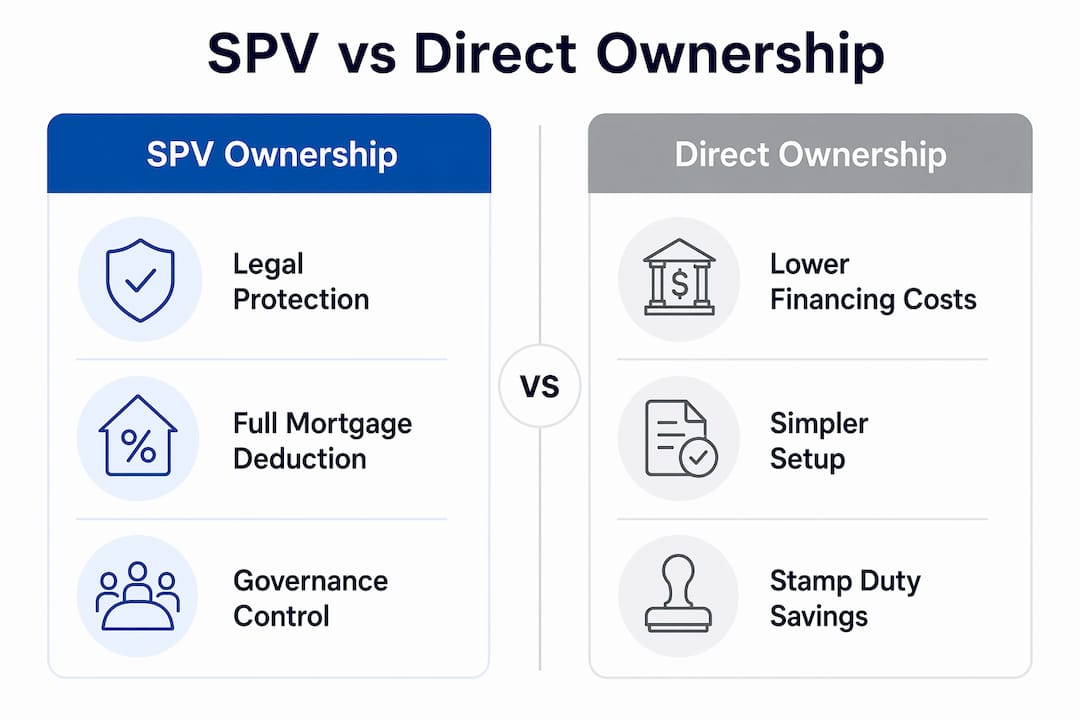
The most immediate difference is Stamp Duty Land Tax (SDLT). Residential properties over £500,000 bought through an SPV attract a flat 17% SDLT rate. That is a significant upfront cost that direct ownership does not carry at the same level, and it must be factored into any acquisition model from day one.
Mortgage financing also differs materially. SPV mortgage rates tend to run 0.5–1% higher than equivalent personal buy-to-let products, and deposits typically sit at 25–30%. Lenders also apply more stringent affordability testing, with Interest Cover Ratios of 125%–145% commonly required. That higher bar means some deals that work on a personal mortgage do not stack up inside an SPV without additional equity.
Capital Gains Tax treatment diverges too. Selling shares in an SPV rather than the underlying property can be tax-efficient in some scenarios, but it also means the buyer inherits the company’s full history, which can complicate negotiations. Valuers must also treat SPV-held property as a company sale rather than an asset sale under RICS Red Book Global Standards, which affects reported market value.
| Factor | SPV ownership | Direct personal ownership |
|---|---|---|
| Mortgage interest relief | Full deductibility | Restricted to basic rate (Section 24) |
| SDLT on purchase | 17% flat rate above £500k | Standard residential rates apply |
| Mortgage rates | Typically 0.5–1% higher | Lower personal buy-to-let rates |
| Liability exposure | Limited to SPV assets | Personal assets at risk |
| Administration | Annual accounts, CT600, Companies House filings | Self-assessment only |
| Profit extraction | Subject to dividend tax | Income taxed at personal rate |
Direct ownership remains preferable for basic-rate taxpayers with small portfolios, short-term holds, or where the SDLT premium cannot be recovered through tax savings within a reasonable timeframe.
Pro Tip: Run a break-even analysis before you commit. Model the SDLT premium, higher mortgage rate, and annual compliance costs against the corporation tax saving and Section 24 relief. For most higher-rate taxpayers with three or more properties, the SPV wins within three to five years.
What are the practical steps to setting up a property SPV?
Setting up an SPV is straightforward in mechanical terms. The complexity lies in getting the structure right before you start, not after.
-
Incorporate at Companies House. Incorporation takes a few days and costs between £50 and £500 depending on whether you use a formation agent or solicitor. Use SIC code 68100 for buying and selling own real estate, or 68209 for letting and managing. Correct SIC codes are not optional: lenders check them as part of their initial screening.
-
Register for Corporation Tax. HMRC requires registration within three months of starting business activity. Missing this deadline creates unnecessary compliance risk before the SPV has even made its first acquisition.
-
Draft a shareholders’ agreement. If there is more than one director or shareholder, this document defines voting rights, profit distribution, and exit terms. Skipping it is the most common governance mistake in joint property ventures.
-
Arrange SPV-specific mortgage finance. Not all lenders operate in this space. Specialist lenders, private credit funds, and family offices are the primary sources. James William & Co structures this type of finance regularly and can identify the right lender for the asset class and deal size.
-
Set up a dedicated bank account. The SPV must operate as a genuinely separate entity. Mixing personal and company finances undermines the legal separation that makes the structure worthwhile.
-
Engage a property accountant. Annual accounts, Corporation Tax returns (CT600), and Companies House confirmation statements are mandatory. The cost is typically £1,000–£2,500 per year for a single-asset SPV, which must be included in your deal modelling.
The most common pitfall at setup is transferring personally-owned properties into a newly formed SPV. This triggers Capital Gains Tax and SDLT unless incorporation relief applies and the business is transferred as a going concern with proper documentation. Professional advice at this stage is not optional.
How do SPVs support complex portfolio and joint venture structures?
At portfolio scale, the SPV structure becomes a genuine management tool rather than just a tax wrapper. Each asset or asset class sits in its own entity, so a problem with one property does not contaminate the rest of the portfolio. This is the same logic that institutional investors apply when structuring real estate funds.
- Asset ring-fencing: each SPV holds a discrete asset or development, isolating liabilities across the portfolio
- Joint venture governance: distribution waterfalls and management fees are defined in operating agreements, removing ambiguity in co-investment scenarios
- Holding company integration: a parent company can own multiple SPVs, enabling group-level capital allocation and inter-company loans
- Refinancing clarity: lenders can assess each SPV on its own merits, without the noise of unrelated assets or liabilities
- Succession planning: shares in an SPV can be transferred or gifted more efficiently than direct property ownership in some estate planning scenarios
The holding company model is particularly useful for developers and portfolio investors working with structured property finance. A parent entity borrows at the group level, then allocates capital to individual SPVs as projects require it. This gives lenders a consolidated view while keeping individual assets legally separate.
For joint ventures, the SPV provides governance neutrality. No single investor dominates by default. Voting thresholds, reserved matters, and exit mechanisms are all written into the structure before money is committed. Investors exploring off-market opportunities in Scotland or other regional markets increasingly use this model to co-invest with local partners while maintaining clear legal boundaries.
What challenges and drawbacks should investors be aware of?
The SPV structure is not universally superior. Several factors can make it the wrong choice for a given investor or deal.
- Higher borrowing costs: mortgage rates run 0.5–1% above personal buy-to-let products, and deposits of 25–30% are standard. On a £1 million asset, that rate differential costs £5,000–£10,000 per year in additional interest.
- SDLT exposure: the 17% flat rate on residential properties above £500,000 is a substantial upfront cost that takes years to recover through tax savings alone.
- Transfer penalties: moving existing personally-owned properties into an SPV triggers CGT and SDLT unless very specific relief conditions are met. Many investors discover this too late.
- Profit extraction costs: drawing money from the SPV as salary or dividends adds a layer of personal tax. The corporation tax saving is partially offset by dividend tax when profits are extracted.
- Compliance overhead: annual accounts, CT600 filings, and Companies House obligations cost time and money. For a single low-value property, these costs can exceed the tax benefit.
- Lender restrictions: some high-street lenders do not lend to SPVs at all, narrowing the financing market and increasing reliance on specialist lenders.
Pro Tip: The SPV structure suits higher-rate taxpayers who plan to retain and reinvest profits. If your strategy is to draw income immediately or you hold only one or two lower-value properties, the compliance costs and higher mortgage rates may outweigh the tax advantages. Model it first.
Key takeaways
The SPV structure delivers genuine advantages in UK property investment, but only when the numbers are modelled honestly against the additional costs of borrowing, compliance, and tax on profit extraction.
| Point | Details |
|---|---|
| Legal separation protects you | An SPV limits personal liability to the company’s assets, not your own. |
| Section 24 makes SPVs compelling | Full mortgage interest deductibility is available inside an SPV, unlike personal ownership. |
| SDLT and mortgage costs are real | The 17% flat SDLT rate and higher mortgage rates must be modelled before acquisition. |
| Transfers trigger tax liabilities | Moving personal property into an SPV triggers CGT and SDLT unless relief conditions are met. |
| Governance matters in joint ventures | Shareholders’ agreements and operating agreements prevent disputes before they start. |
Why I think most investors underestimate the governance side of SPVs
The tax argument for SPVs gets all the attention, and rightly so. But in my experience, the governance function is what separates a well-structured SPV from a problematic one. I have seen joint ventures unravel not because the numbers were wrong, but because nobody agreed in writing on what happens when one partner wants to sell and the other does not.
The SPV forces that conversation early. When you are drafting the shareholders’ agreement, you have to decide on voting thresholds, reserved matters, and exit mechanisms. That process surfaces disagreements before money is committed, which is exactly when you want to find them.
On the financing side, I have noticed lenders becoming more comfortable with SPV borrowers over the past few years, particularly at the specialist end of the market. Family offices and private credit funds now treat the SPV as the expected vehicle for professional investors. That shift has improved pricing and availability, though the gap with personal buy-to-let rates has not closed entirely.
The area where I see the most avoidable mistakes is property transfers. Investors incorporate an SPV, then try to move existing personally-owned properties into it without proper advice. The CGT and SDLT consequences can be severe. The SPV works best when it is the starting point for new acquisitions, not a retrospective fix for an existing portfolio.
The regulatory environment is also moving. Tax treatment of SPVs, SDLT rates, and corporation tax policy all shift with each Budget. Any model you build today needs to be stress-tested against plausible changes to those inputs. That is not a reason to avoid the structure. It is a reason to keep your modelling current and your advisers close.
— James
How James William & Co structures SPV finance for property investors
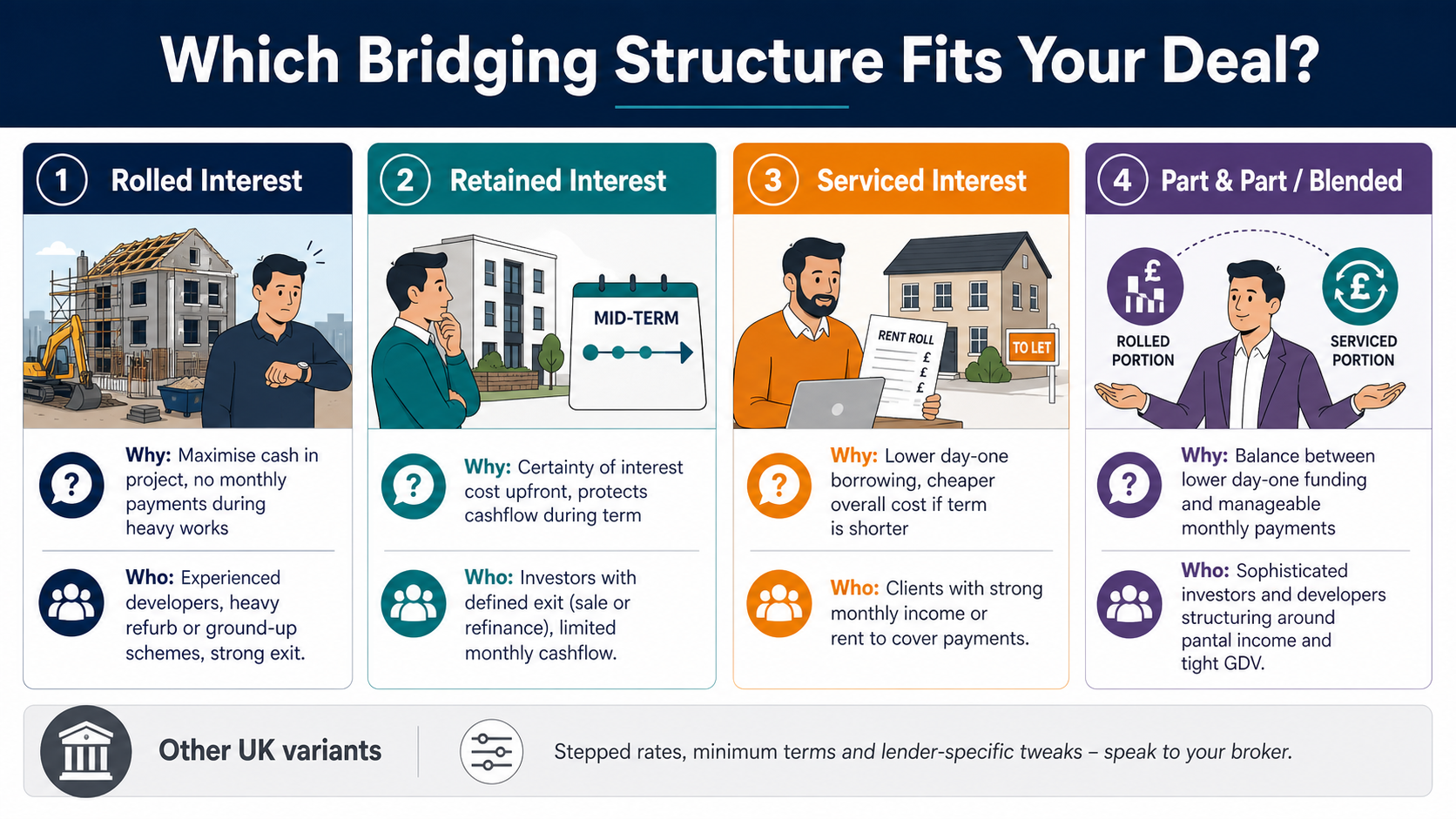
James William & Co arranges specialist finance for property SPVs across the full capital stack, from senior debt and mezzanine to JV equity and bridging. Whether you are acquiring a first SPV asset, refinancing a portfolio, or structuring a multi-investor joint venture, the team works directly with specialist lenders, private credit funds, and family offices to find the right solution. For investors tracking UK property finance trends or building out a complex portfolio structure, James William & Co provides a single point of contact for end-to-end structuring and execution. Contact the team at James William & Co Capital to discuss your SPV financing requirements.
FAQ
What is an SPV in property investment?
An SPV (Special Purpose Vehicle) in property is a separate limited company created solely to hold and manage real estate assets. It provides legal separation between the investor’s personal finances and the property, along with corporation tax treatment on profits.
Can I transfer my existing properties into an SPV?
Transferring personally-owned properties into an SPV triggers CGT and SDLT unless incorporation relief applies and the business is transferred as a going concern. Professional advice and detailed documentation are required before any transfer.
What SIC codes should a property SPV use?
Property SPVs should register with SIC code 68100 for buying and selling own real estate, or 68209 for letting and managing. These codes are checked by lenders during initial screening and must be correct for lender acceptance.
Are SPV mortgage rates higher than personal buy-to-let rates?
Yes. SPV mortgage rates are typically 0.5–1% higher than personal buy-to-let products, with deposits of 25–30% and Interest Cover Ratio requirements of 125%–145%. This additional cost must be included in any acquisition model.
Is an SPV right for a small property portfolio?
An SPV is most beneficial for higher-rate taxpayers who plan to retain profits for reinvestment. For investors with one or two lower-value properties who need immediate income, the compliance costs and higher mortgage rates may outweigh the tax advantages. A break-even analysis is the correct starting point.
Recommended
Related Topics
Speak to a specialist
Discuss your finance with James directly
Whole-of-market specialist finance — bridging, development, commercial and residential. No call centres, no obligation. James reviews every enquiry personally.
New to specialist finance? How unbiased broker advice works · Deals we have completed
Explore Related Finance