
Published · Updated
types of commercial mortgagesTypes of commercial mortgages: choosing the right funding
By James Dawes, CeMAP, Founder, James William & Co Capital

Selecting the right commercial mortgage in 2026 requires navigating complex lending criteria, from loan-to-value ratios and interest coverage requirements to property type risk assessments. Property developers and institutional investors face stricter lender scrutiny, particularly for office and retail assets, whilst industrial and mixed-use properties attract more favourable terms. This article examines the key evaluation criteria for commercial mortgages, explores the main funding types available, compares their features and trade-offs, and provides practical guidance for matching mortgage solutions to your project requirements and risk profile.
Table of Contents
- Key takeaways
- How to evaluate commercial mortgage options
- Key types of commercial mortgages available
- Comparing commercial mortgage types: key features and considerations
- Choosing the right commercial mortgage for your project
- Specialist commercial mortgage solutions from James William & Co Capital
- What are the key questions about commercial mortgage types?
Key Takeaways
| Point | Details |
|---|---|
| LTV and equity | Loan to value and available equity shape leverage and pricing, with higher LTVs possible for strong propositions but accompanied by stricter terms. |
| ICR and income | Interest coverage ratio assesses rent income against debt service, with typical targets of 130 to 150 percent and tighter terms for weaker metrics. |
| Property sector risk | Industrial and mixed use assets often attract more favourable terms, while offices and secondary retail face heightened scrutiny. |
| Market conditions 2026 | Market conditions in 2026 favour stability over expansion and prioritise borrower financial strength, property fundamentals and sustainable business models. |
| Lender criteria insights | Understanding lender selection criteria and cashflow projections helps optimise funding strategies and strengthen proposals. |
How to evaluate commercial mortgage options
Successful commercial mortgage selection begins with understanding the metrics lenders prioritise when assessing applications. Loan-to-value ratios determine your available leverage, with prime deals typically allowing 60-75% LTV and select borrowers accessing up to 95% for strong propositions. Higher LTV means less equity required but increased lender risk, which translates to stricter terms and higher rates.
Interest coverage ratio measures your property income against loan servicing costs. Most lenders expect 130-150% ICR, meaning rental income must exceed debt payments by at least 30-50%. This buffer protects lenders during void periods or market downturns. Borrowers with weaker ICR face limited options or higher pricing to compensate for elevated risk.
Property type significantly influences lender appetite in 2026. Industrial units, logistics warehouses, and mixed-use developments attract competitive terms due to strong tenant demand and stable income profiles. Conversely, traditional offices and secondary retail face heightened scrutiny as lenders remain cautious about these sectors amid changing work patterns and consumer behaviour. Location quality, tenant covenant strength, and lease length also factor heavily into underwriting decisions.
Market conditions in 2026 favour stability over expansion. Lenders maintain selective criteria, prioritising borrower financial strength, property fundamentals, and sustainable business models. Understanding property finance trends helps developers anticipate lender requirements and structure applications accordingly.
Key evaluation criteria:
- Loan-to-value ratio and available equity
- Interest coverage ratio and rental income stability
- Property sector risk profile and market demand
- Borrower credit history and financial capacity
- Location quality and tenant covenant strength
Pro tip: Prepare detailed cashflow projections showing ICR under various scenarios, including void periods and rent reductions, to demonstrate robust debt servicing capacity to lenders.
Assessing your project against these criteria early identifies which mortgage types suit your requirements and where you may need to strengthen your proposition. Developers with strong fundamentals across these metrics access the widest range of funding sources and most competitive terms.
Key types of commercial mortgages available
UK property investors and developers can access several distinct commercial mortgage categories, each designed for specific project types and risk profiles. Standard commercial mortgages provide long-term financing for income-producing properties, typically offering fixed or variable rates over 15-25 year terms. These suit established assets with proven rental income and stable tenant profiles, delivering predictable debt servicing costs for buy-to-let investors and portfolio landlords.
Development finance addresses the unique requirements of ground-up construction and major refurbishment projects. Lenders advance funds in stages as construction progresses, with borrowers paying interest only on drawn amounts. This short-term facility typically runs 12-24 months, carrying higher rates than standard mortgages to reflect construction risk and the illiquid nature of incomplete developments. Development finance works for projects with clear exit strategies, whether through refinancing onto long-term debt or outright sale.

Bridging loans deliver rapid, short-term funding for time-sensitive acquisitions or gap financing between property transactions. These 1-18 month facilities enable developers to secure opportunities quickly, often completing within days rather than weeks. Higher costs reflect the speed and flexibility, making bridging suitable for auction purchases, chain breaks, or temporary funding whilst arranging longer-term finance.
Mezzanine finance sits between senior debt and equity in the capital stack, providing subordinated loans that increase overall leverage. This expensive but flexible option suits complex deals requiring higher LTV than senior lenders permit, or projects needing growth capital without diluting equity ownership. Mezzanine typically carries higher rates and may include equity participation or profit share arrangements.
Specialist mortgage products target specific sectors or borrower profiles. Mixed-use property finance accommodates the complexity of residential and commercial elements within single schemes. Industrial and logistics mortgages reflect strong lender appetite for these sectors in current market conditions. Portfolio finance consolidates multiple properties under unified facilities, simplifying administration for landlords with diverse holdings.
Main commercial mortgage categories:
- Standard commercial mortgages for stabilised, income-producing assets
- Development finance for construction and major refurbishment projects
- Bridging loans for short-term, time-sensitive funding requirements
- Mezzanine finance for enhanced leverage in complex capital structures
- Specialist products for mixed-use, industrial, logistics, and portfolio properties
Understanding these categories helps developers identify which property finance types align with their project stage, timeline, and funding requirements. Many sophisticated investors use multiple products simultaneously, layering senior debt, mezzanine finance, and equity to optimise capital efficiency whilst managing risk exposure.
The choice between mortgage types depends on project characteristics, borrower circumstances, and market timing. Selecting the wrong product increases costs, creates unnecessary constraints, or results in declined applications. Conversely, matching mortgage type precisely to project requirements unlocks competitive terms and smooth execution.
Comparing commercial mortgage types: key features and considerations
Commercial mortgage types present distinct trade-offs in cost, flexibility, and suitability for different project profiles. Understanding these differences enables informed selection aligned with your funding objectives and risk tolerance.
| Mortgage type | Typical rates | LTV range | Term length | Best suited for |
|---|---|---|---|---|
| Standard commercial | 5.25-6.50% | 60-75% | 15-25 years | Stabilised income properties with proven tenant demand |
| Development finance | 6.50-9.00% | 60-80% | 12-24 months | Ground-up construction and major refurbishment projects |
| Bridging loans | 0.75-1.50% monthly | 65-75% | 1-18 months | Time-sensitive acquisitions and gap funding |
| Mezzanine finance | 10.00-15.00% | 80-95% combined | 2-5 years | Complex deals requiring enhanced leverage |
| Specialist products | 5.50-7.75% | 65-80% | 10-25 years | Mixed-use, industrial, logistics, and portfolio properties |
Interest rates across commercial mortgages generally range between 5.25% and 7.75% for standard products, with development finance and bridging commanding premiums for increased risk and shorter durations. Mezzanine finance carries substantially higher rates due to subordinated position and elevated default risk. Borrower strength, property quality, and LTV significantly influence final pricing within these ranges.
Loan-to-value limits vary by product and risk profile. Standard mortgages typically cap at 75% LTV for prime borrowers, whilst select propositions reach 95% through layered debt structures combining senior and mezzanine facilities. Development finance often permits 70-80% of gross development value, with the remaining equity required from borrowers. Bridging loans generally stay within 65-75% LTV given their short-term nature and quick completion requirements.
Term length directly impacts monthly payments and overall flexibility. Standard commercial mortgages amortise over 15-25 years, providing predictable long-term financing for stable assets. Development finance and bridging loans run 12-24 months and 1-18 months respectively, requiring clear exit strategies through refinancing or sale. Mezzanine finance typically extends 2-5 years, bridging the gap between short-term construction loans and permanent financing.
Key comparison factors:
- Rate competitiveness versus flexibility trade-offs
- LTV limits and equity requirements for different products
- Term length alignment with project timeline and exit strategy
- Prepayment flexibility and early redemption penalties
- Lender criteria strictness and approval probability
Pro tip: Calculate total cost of capital across the full project lifecycle, including arrangement fees, valuation costs, and potential refinancing expenses, rather than focusing solely on headline interest rates.
Flexibility varies considerably between products. Bridging loans and development finance offer greater adaptability for changing circumstances but cost more. Standard mortgages provide stability and lower rates but impose stricter covenants and limited prepayment options. Optimising your funding structure requires balancing these competing priorities based on project-specific requirements.
Borrower suitability depends on financial capacity, experience, and project complexity. First-time developers may struggle to access development finance without track records, whilst experienced operators with strong balance sheets negotiate preferential terms across all products. Property type and market positioning also influence which mortgage types lenders will consider for specific assets.
Choosing the right commercial mortgage for your project
Matching mortgage type to project characteristics, market conditions, and borrower capacity optimises funding outcomes and minimises execution risk. A systematic evaluation process helps developers navigate the selection decision effectively.
-
Assess your asset class and market position. Industrial, logistics, and quality mixed-use properties access the widest lender appetite in 2026, whilst offices and secondary retail face stricter scrutiny. Location quality, tenant strength, and income stability significantly influence which mortgage products lenders will consider. Properties in strong locations with long leases to creditworthy tenants unlock competitive standard mortgage terms, whilst secondary assets may require specialist or bridging finance.
-
Evaluate your financial capacity against lender criteria. Calculate your achievable ICR based on realistic rental income projections, ensuring you meet the typical 130-150% requirement with comfortable headroom. Assess available equity against target LTV ratios, identifying whether you need senior debt only or layered structures incorporating mezzanine finance. Strong personal or corporate balance sheets improve terms and expand options.
-
Consider project timeline and funding duration. Development projects require short-term construction finance with clear exit routes to permanent debt or sale. Acquisitions of stabilised assets suit long-term standard mortgages providing certainty and lower rates. Time-sensitive opportunities may necessitate bridging loans despite higher costs, particularly where delays risk losing the deal.
-
Factor market conditions and lender selectivity. The cautious 2026 lending environment rewards borrowers who understand current lender priorities and structure applications accordingly. Emphasising property fundamentals, sustainable income, and robust financial capacity increases approval probability. Avoid overleveraging or targeting out-of-favour sectors without compelling mitigating factors.
-
Engage professional advice early. Specialist brokers access wider lender panels, understand current appetite, and structure applications to maximise success rates. Their market knowledge helps developers avoid wasted time on inappropriate lender approaches and identifies creative solutions for complex scenarios. Professional guidance on development funding proves particularly valuable for first-time borrowers or unusual propositions.
“The difference between successful and failed funding applications often lies not in the underlying project quality but in how effectively borrowers match their requirements to appropriate lender criteria and mortgage products.”
Anticipating potential challenges allows proactive mitigation. Projects with marginal ICR benefit from interest reserve facilities or income guarantees. Higher-risk sectors may require larger equity contributions or blended structures combining different debt types. Understanding lender concerns enables developers to address them upfront rather than facing declined applications.
Timing considerations matter significantly. Securing funding commitments before exchanging contracts on acquisitions prevents deal collapse due to financing failure. Starting development finance discussions during planning stages allows adequate time for due diligence and documentation. Refinancing existing facilities well before maturity avoids distressed situations where lenders hold disproportionate negotiating power.
The optimal commercial mortgage balances cost, risk, and flexibility for your specific circumstances. Developers with strong fundamentals and straightforward propositions prioritise low-cost standard mortgages. Complex projects or challenging scenarios may justify higher-cost specialist products offering greater flexibility and enhanced leverage. Understanding these trade-offs enables informed decisions aligned with your investment strategy and risk tolerance.
Specialist commercial mortgage solutions from James William & Co Capital
Navigating the commercial mortgage landscape in 2026 requires expertise, market access, and sophisticated structuring capabilities. James William & Co Capital delivers tailored specialist property finance solutions for UK developers, investors, and high-net-worth individuals pursuing complex real estate transactions. Our capital concierge approach provides single-point-of-contact service for end-to-end structuring, negotiation, and execution across the full spectrum of commercial mortgages, development finance, and mezzanine debt.
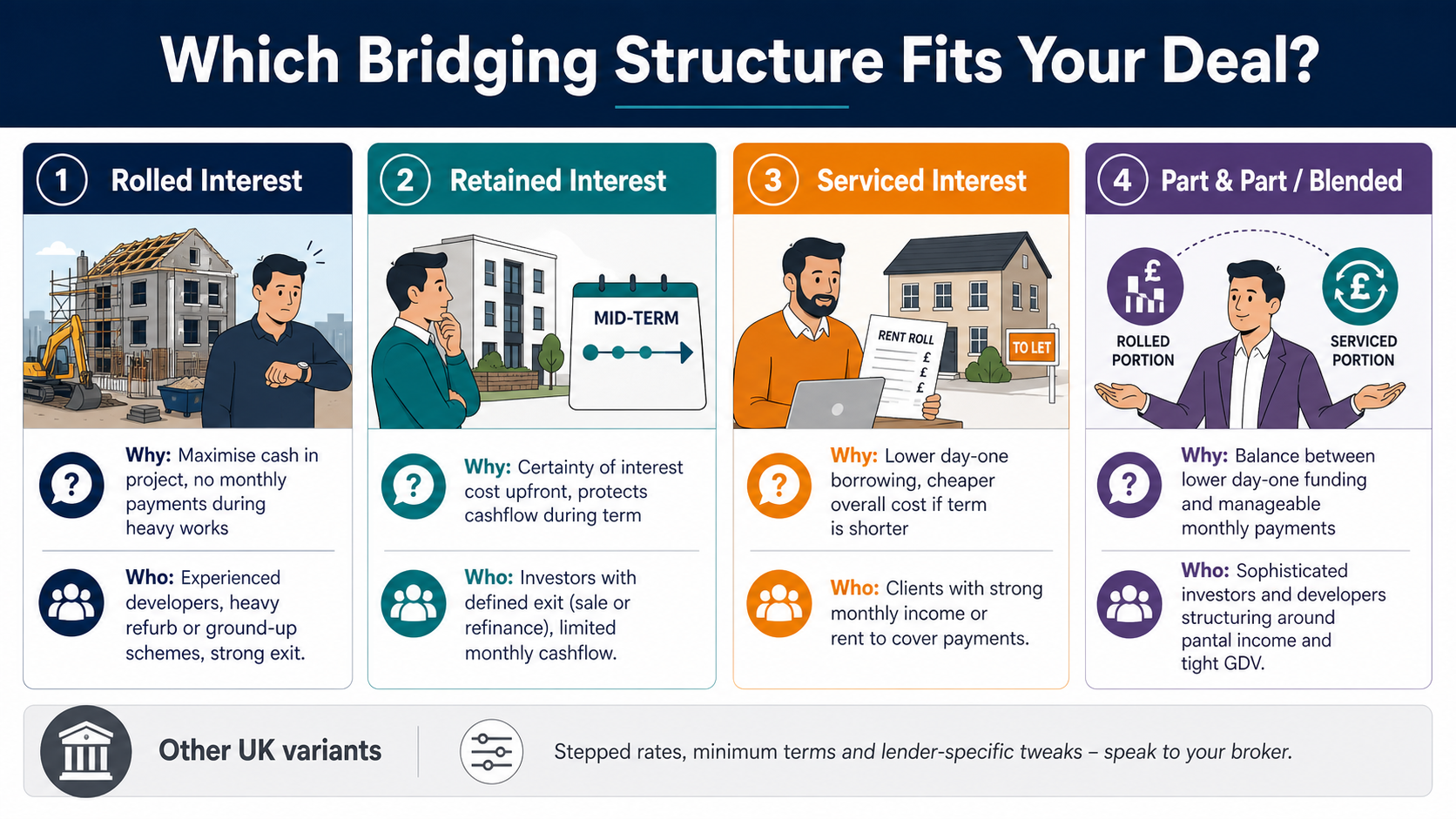
Working with an extensive network of family offices, private credit funds, and specialist lenders, we arrange sophisticated funding for large-scale acquisitions, ground-up developments, and complex refinances. Our experience structuring multi-layered debt stacks, offshore vehicles, and bespoke covenant packages enables us to deliver rapid, tailored solutions under pressure. Explore our comprehensive property finance services and wealth planning solutions to support your investment strategy and optimise funding outcomes.
What are the key questions about commercial mortgage types?
What is the difference between standard commercial mortgages and development finance?
Standard commercial mortgages provide long-term financing for income-producing properties with established tenants, typically offering 15-25 year terms at lower rates. Development finance delivers short-term funding for construction projects, advancing funds in stages as building progresses over 12-24 months at higher rates reflecting construction risk.
How do loan-to-value ratios affect commercial mortgage availability in 2026?
LTV ratios determine leverage and directly influence lender appetite, with prime borrowers accessing 60-75% LTV on standard mortgages and select propositions reaching 95% through layered structures. Higher LTV requires stronger borrower credentials, superior property fundamentals, and often involves mezzanine finance to supplement senior debt.
Why do lenders favour industrial and mixed-use properties over offices?
Industrial and logistics assets benefit from strong e-commerce driven demand and stable tenant profiles, whilst mixed-use properties diversify income streams across residential and commercial elements. Office properties face uncertainty from hybrid working patterns, making lenders more cautious about long-term income stability and capital values in this sector.
What interest coverage ratio do commercial mortgage lenders typically require?
Most commercial mortgage lenders expect 130-150% ICR, meaning property income must exceed debt servicing costs by at least 30-50%. This buffer protects lenders during void periods or rent reductions, with stronger ICR enabling access to more competitive terms and higher LTV ratios.
When should developers consider mezzanine finance for commercial projects?
Mezzanine finance suits situations requiring leverage beyond senior lender LTV limits, complex capital structures, or growth capital without equity dilution. Despite higher costs of 10-15% annually, mezzanine debt enables developers to pursue larger projects or preserve equity ownership whilst achieving target returns on invested capital.
How can specialist brokers improve commercial mortgage outcomes?
Specialist brokers access wider lender panels beyond high-street banks, understand current market appetite across different sectors, and structure applications to match lender criteria effectively. Their expertise proves particularly valuable for complex scenarios, first-time borrowers, or projects requiring creative funding solutions combining multiple debt types.
Recommended
Related Topics
Speak to a specialist
Discuss your finance with James directly
Whole-of-market specialist finance — bridging, development, commercial and residential. No call centres, no obligation. James reviews every enquiry personally.
New to specialist finance? How unbiased broker advice works · Deals we have completed
Explore Related Finance