
Published · Updated
trends in uk property finance 2026Trends in UK Property Finance 2026: What Investors Must Know
By James Dawes, CeMAP, Founder, James William & Co Capital

The rules of property finance in the United Kingdom are shifting fast as 2026 approaches. High-net-worth developers and institutional investors face a market where advanced lending models and private credit funds are replacing the old order. With UK Finance predicting gross mortgage lending to hit £300 billion and fresh regulatory twists changing investment strategies, understanding how these changes shape risk, financing structures, and opportunity is vital for those aiming to secure their position in the next cycle of British property.
Table of Contents
- Defining UK Property Finance in 2026
- Emerging Loan Structures and Facilities
- The Rise of Private Credit and Alternative Lenders
- Regulatory Shifts Impacting Large Transactions
- Risk Management and Funding Costs in 2026
Key Takeaways
| Point | Details |
|---|---|
| Evolving Property Finance Landscape | The UK property finance market is shifting towards sophisticated, multi-layered financial instruments, influenced by macroeconomic factors and changing investor expectations. |
| Emerging Loan Structures | Loan structures are becoming more tailored, with diverse facilities and flexible financing models that cater to complex investor needs. |
| Rise of Private Credit | Private credit markets are expanding as viable alternatives to traditional banks, offering faster and more flexible financing options amidst increased regulatory scrutiny. |
| Regulatory Transformations | New legislative frameworks are reshaping property transactions, necessitating that investors adopt a holistic approach to navigate evolving tenant protections and investment strategies. |
Defining UK Property Finance in 2026
The UK property finance landscape in 2026 represents a complex, nuanced ecosystem shaped by macroeconomic shifts and strategic market adaptations. Property financing has evolved from traditional lending models to become a sophisticated, multi-layered financial instrument responding dynamically to economic pressures and investor expectations.
According to recent UK Finance projections, mortgage lending will experience modest growth of approximately 4%, reaching £300 billion in gross lending. This projection reflects a cautious yet resilient market environment characterised by structural changes in buyer behaviour, lending practices, and investment strategies. Key dynamics include declining inflation rates, emerging refinancing opportunities, and increasingly complex mortgage product structures designed to address affordability challenges.
Investors can expect a property finance landscape defined by three primary characteristics: heightened regulatory scrutiny, technological integration, and flexible financing models. The market is transitioning towards more granular risk assessment frameworks, with lenders leveraging advanced data analytics to create bespoke financing solutions. Evolving buyer behaviour will significantly influence lending patterns, particularly in sectors like buy-to-let and residential development, where taxation and regulatory environments continue to reshape investment strategies.
Pro tip: Sophisticated property investors should develop robust, diversified financing strategies that incorporate multiple lending sources and anticipate potential regulatory shifts in the UK property market.
Emerging Loan Structures and Facilities
The property finance sector in 2026 is experiencing a fundamental transformation, with loan structures becoming increasingly sophisticated and tailored to meet complex investor requirements. Development finance has evolved beyond traditional lending models, offering unprecedented flexibility and nuanced risk management strategies designed to address the dynamic challenges of contemporary property investment.

Property development finance providers are now offering an expansive range of loan facilities that cater to diverse investment scenarios. These sophisticated structures include short-term loans spanning 12-36 months, with loan-to-value ratios ranging from 50% to 85% and financing amounts capable of supporting projects from several million to over £100 million. Such versatility enables developers to access precisely calibrated financial solutions for new builds, conversions, refurbishments, and mixed-use developments.
The emergent loan landscape is characterised by specialisation and strategic differentiation. Some lenders now concentrate exclusively on niche segments such as bridging finance, VAT loans, residential developments, or commercial property projects. This segmentation allows for more precise risk assessment, with financial products increasingly leveraging advanced data analytics and machine learning algorithms to create bespoke financing packages that align precisely with individual project parameters and investor risk profiles.
Moreover, the 2026 property finance market demonstrates a marked shift towards more transparent, collaborative lending models. Investors can expect more integrated financial solutions that combine multiple funding streams, including traditional bank lending, specialist property finance providers, private equity, and innovative crowdfunding platforms. These hybrid approaches provide greater financial resilience and flexibility, enabling developers to construct more complex, multi-layered investment strategies.
Pro tip: Savvy property investors should cultivate relationships with multiple finance providers and develop a comprehensive understanding of emerging loan structures to optimise their investment potential.
The Rise of Private Credit and Alternative Lenders
The United Kingdom’s property finance ecosystem is experiencing a profound transformation, with private credit markets emerging as a critical alternative to traditional banking institutions. This structural shift represents more than a temporary market adjustment; it signals a fundamental recalibration of how property investments are financed and structured in the contemporary economic landscape.
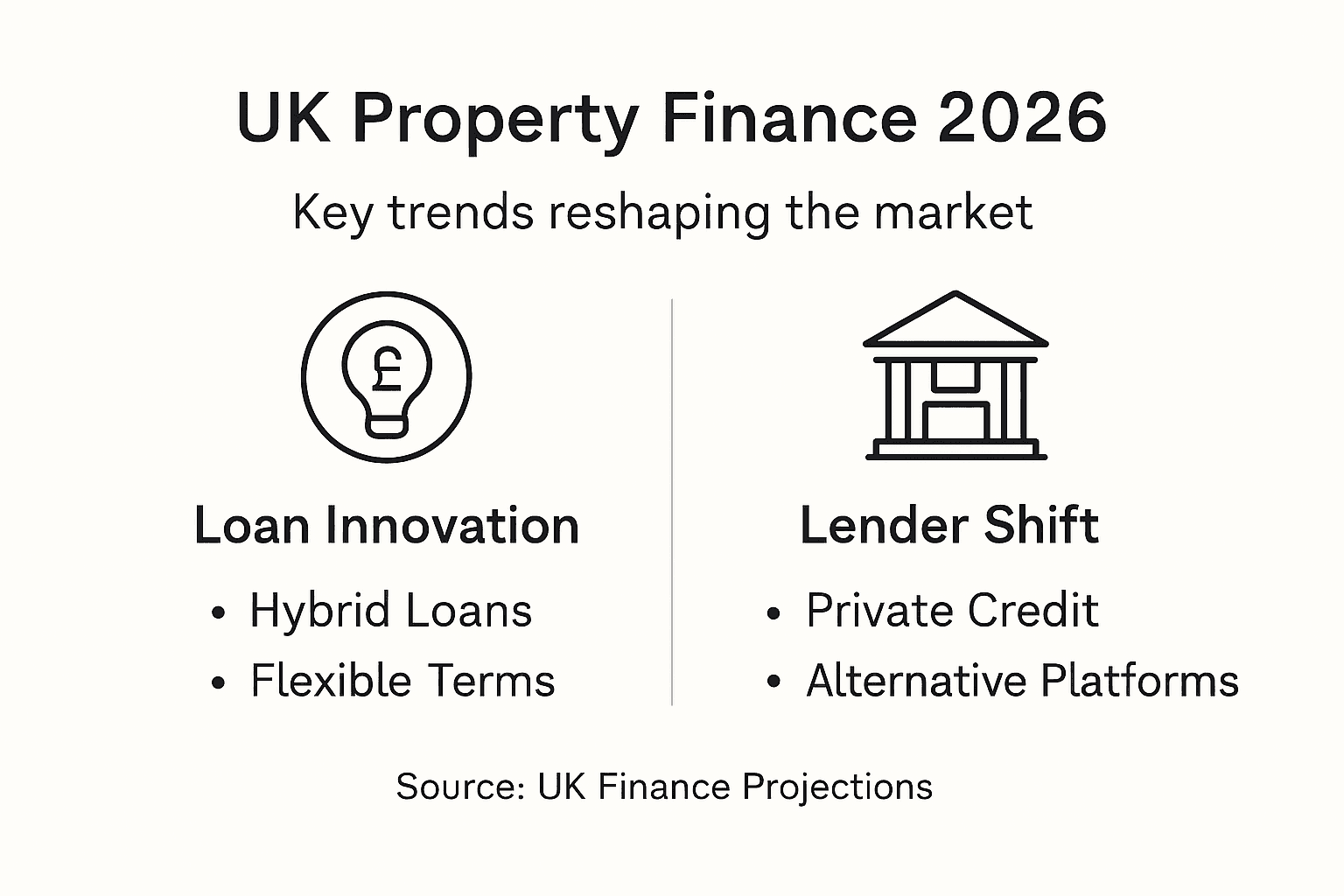
Private credit markets are expanding rapidly, driven by traditional lenders’ retreat from complex property financing scenarios. Banks and insurance companies have progressively scaled back their lending activities due to increasingly stringent regulatory constraints and higher interest rate environments. This withdrawal has created a substantial financing gap that private credit funds are strategically positioning themselves to fill, particularly in refinancing maturing loan portfolios.
The evolving private credit landscape demonstrates remarkable adaptability and sophistication. Alternative lending platforms offer unprecedented flexibility compared to conventional banking models, with faster decision-making processes and a more nuanced approach to complex lending requirements. These alternative lenders are distinguished by their willingness to engage with mid-market transactions, provide tailored financing solutions, and demonstrate greater appetite for intricate investment structures that traditional banks might typically eschew.
However, the expansion of private credit is not without potential risks. While these alternative lenders offer more flexible terms and faster execution, some funds may be tempted to assume higher risk profiles to secure investment mandates. Sophisticated investors must conduct rigorous due diligence, carefully assessing each private credit opportunity’s underlying risk-return characteristics and understanding the specific terms and structural nuances of proposed financing arrangements.
Here is a comparison of traditional bank lending versus private credit in the 2026 UK property finance market:
| Feature | Traditional Bank Lending | Private Credit & Alternative Lenders |
|---|---|---|
| Decision Speed | Weeks to months | Days to weeks |
| Risk Appetite | Low to moderate | Moderate to high |
| Transaction Complexity | Prefer standard deals | Handle bespoke, complex structures |
| Regulatory Scrutiny | Highly regulated | Less regulated, more flexible |
| Funding Flexibility | Fixed structures | Customised terms, hybrid options |
| Typical Project Size | Large and standardised | Mid-market and niche segments |
| Typical Borrowers | Established developments | Diverse, including non-traditional |
Pro tip: Prudent investors should develop comprehensive risk assessment frameworks and maintain multiple lending relationships to navigate the increasingly complex private credit landscape.
Regulatory Shifts Impacting Large Transactions
The United Kingdom’s property investment landscape is undergoing significant regulatory transformation, with legislative frameworks evolving to balance growth ambitions and market stability. These nuanced changes represent a sophisticated approach to governance that will fundamentally reshape how large property transactions are conceptualised, structured, and executed in 2026.
Financial services regulation in 2026 is characterised by the government’s innovative “regulate for growth” strategy. This approach applies strategic pressure on regulatory bodies to streamline capital markets oversight while maintaining robust consumer protection mechanisms. The introduction of new legislative instruments such as the Public Offers and Admissions to Trading Regulations 2024 demonstrates a measured approach to modernising financial governance, introducing more flexible frameworks for public offers and debt securities transactions.
Legal developments reshaping real estate will have profound implications for property investors. The implementation of the Renters’ Rights Act from May 2026 introduces extended tenancy protections, while pending reforms like the Freehold and Leasehold Reform Act will significantly enhance tenant enfranchisement rights and impose more stringent regulations on service charges. These legislative shifts will materially impact investment strategies, development approaches, and portfolio management techniques for large-scale property investors.
Investors must recognise that these regulatory changes represent more than administrative modifications; they signify a fundamental reimagining of the relationship between property rights, tenant protections, and investment frameworks. The emerging regulatory landscape demands a more holistic, nuanced approach to property investment that balances financial objectives with broader social and economic considerations.
Pro tip: Sophisticated investors should proactively engage legal and regulatory specialists to develop adaptive investment strategies that anticipate and leverage emerging regulatory frameworks.
Risk Management and Funding Costs in 2026
The property investment landscape in 2026 demands an unprecedented level of sophisticated risk management strategies, requiring investors to develop multifaceted approaches that balance financial resilience with strategic adaptability. The complex interplay between economic volatility, regulatory shifts, and market dynamics necessitates a comprehensive and nuanced approach to financial risk assessment.
Post-budget market analyses underscore the critical importance of adaptive risk management techniques in navigating the increasingly selective lending environment. Investors must now contend with rising funding costs, intricate regulatory changes, and fluctuating rental demand, which collectively create a challenging investment ecosystem that demands sophisticated risk mitigation strategies.
Financial risk management education has evolved to equip professionals with advanced tools for identifying, evaluating, and managing complex financial risks. Contemporary risk management approaches incorporate sophisticated data analytics, predictive modelling, and comprehensive compliance frameworks. These strategies go beyond traditional risk assessment, integrating dynamic variables such as macroeconomic trends, regulatory shifts, and technological disruptions to create more robust and responsive financial risk models.
Successful property investors in 2026 will distinguish themselves through their ability to develop holistic risk management frameworks that transcend conventional financial metrics. This approach requires a multidisciplinary perspective that combines financial acumen, regulatory insight, technological understanding, and strategic foresight. The most effective risk management strategies will be those that can anticipate potential challenges, create flexible response mechanisms, and maintain financial resilience across diverse market conditions.
The table below summarises the core risk management advancements in UK property finance by 2026:
| Area of Risk Management | 2026 Practice | Business Impact |
|---|---|---|
| Data Analytics | Predictive modelling adopted | Proactive identification of risk |
| Regulatory Integration | Compliance embedded tools | Enhanced legal risk mitigation |
| Funding Cost Analysis | Real-time scenario planning | Better cash flow management |
| Investor Education | Continuous professional learning | Informed, adaptive decision-making |
| Stress Testing | Multidisciplinary frameworks | Stronger financial resilience |
Pro tip: Develop a comprehensive risk management framework that integrates predictive analytics, scenario planning, and continuous learning to navigate the complex property investment landscape.
Navigate the Complex UK Property Finance Market with Expert Guidance
The 2026 UK Property Finance landscape demands sophisticated strategies to manage rising funding costs, evolving regulatory pressures and the growing role of private credit. If you find yourself challenged by intricate loan structures or needing bespoke solutions for large-scale acquisitions and complex refinances, you are not alone. Building relationships with expert brokers who understand multilayered debt stacks and nuanced covenant packages is critical for success.
James William & Co Capital specialises in structuring tailored funding for property developers, institutional investors and high-net-worth clients. With a robust network of family offices, private credit funds and specialist lenders, our capital concierge approach ensures seamless execution of bridging finance, mezzanine debt and commercial mortgages at speed and with precision.

Empower your property investment journey with bespoke financial solutions aligned to the latest market trends. Visit James William & Co Capital now to arrange a personalised consultation and secure your competitive advantage in today’s dynamic UK property finance environment.
Frequently Asked Questions
What are the key trends in UK property finance for 2026?
The key trends in UK property finance for 2026 include heightened regulatory scrutiny, technological integration, and the emergence of flexible financing models. These changes aim to respond to shifting buyer behaviours and economic conditions.
How is private credit changing property finance in 2026?
Private credit is rapidly expanding as a viable alternative to traditional bank lending, providing more flexible terms and tailored financing solutions for complex property transactions that banks may avoid.
What impact do regulatory shifts have on large property transactions in 2026?
Regulatory shifts in 2026 are reshaping investment strategies and portfolio management, with significant changes like the Renters’ Rights Act and the Freehold and Leasehold Reform Act aimed at enhancing tenant protections and influencing how large transactions are structured.
How can investors manage risks in the evolving property finance landscape?
Investors can manage risks by developing sophisticated risk management frameworks that incorporate data analytics, predictive modelling, and continuous learning to adapt to the complexities of the market in 2026.
Recommended
Related Topics
Speak to a specialist
Discuss your finance with James directly
Whole-of-market specialist finance — bridging, development, commercial and residential. No call centres, no obligation. James reviews every enquiry personally.
New to specialist finance? How unbiased broker advice works · Deals we have completed
Explore Related Finance