
Published · Updated
financing trends in 2026UK property financing trends in 2026
By James Dawes, CeMAP, Founder, James William & Co Capital

Mortgage rates may be easing from their recent peaks, but they remain nearly triple the lows seen in the early 2010s, fundamentally reshaping how high-net-worth investors and developers approach UK property deals. In 2026, understanding these financing shifts is no longer optional. Regional divergence, specialist lender growth, new tax regimes and evolving borrowing costs demand strategic capital structuring to maintain deal viability and profitability in a transformed market.
Table of Contents
- The 2026 UK Property Financing Landscape
- Easing Interest Rates: Impact On Property Financing
- Regional UK Market Divergence And Its Implications For Financing
- The Rise Of Specialist Lending And Bridging Finance
- Regulatory And Taxation Changes Affecting Financing Choices
- Find Expert Specialist Property Finance Solutions With Us
Key takeaways
| Point | Details |
|---|---|
| Interest rates easing but elevated | Mortgage rates stabilise at 3.75% to 4.75%, significantly higher than historical lows, requiring optimised loan structures. |
| Regional market divergence accelerates | Northern England and Scotland forecast 4% to 4.5% price growth, outperforming London and the South East. |
| Specialist lenders become mainstream | Bridging finance and bespoke underwriting transition from niche to essential tools for complex property deals. |
| New taxation increases complexity | Mansion tax surcharges and property income levies introduced from 2025 onwards reshape financing strategies. |
| Technology speeds decision making | Digital platforms and data analytics accelerate underwriting and capital deployment for high-value transactions. |
The 2026 UK property financing landscape
The UK property market is navigating a pivotal moment. The Bank of England base rate is projected to ease to around 3.25% by year end, signalling relief after sustained monetary tightening. Mortgage rates are stabilising between 3.75% and 4.75%, a marked improvement from peak levels but still substantially higher than the sub-2% environment that fuelled deal activity earlier last decade.
Transaction volumes tell a cautiously optimistic story. UK property transaction volumes are predicted to rise modestly to 1.18 million in 2026, reflecting improved financing conditions and buyer confidence. This uptick signals that investors and developers are adapting to the new normal rather than waiting for a return to ultra-low rates.
For sophisticated investors, these dynamics create both challenges and opportunities:
- Borrowing costs remain elevated, compressing margins on leveraged acquisitions and development projects.
- Deal feasibility now hinges on creative financing structures rather than cheap debt alone.
- Regional variations in growth and demand require localised due diligence and capital allocation.
- Access to flexible funding sources becomes a competitive advantage in a rate-sensitive environment.
Understanding how UK property finance trends 2026 intersect with macroeconomic shifts is essential. The era of one-size-fits-all debt strategies has ended. Investors must now layer mezzanine finance, bridging loans and bespoke senior debt to optimise cost, speed and risk exposure across diverse asset classes and geographies.
Easing interest rates: impact on property financing
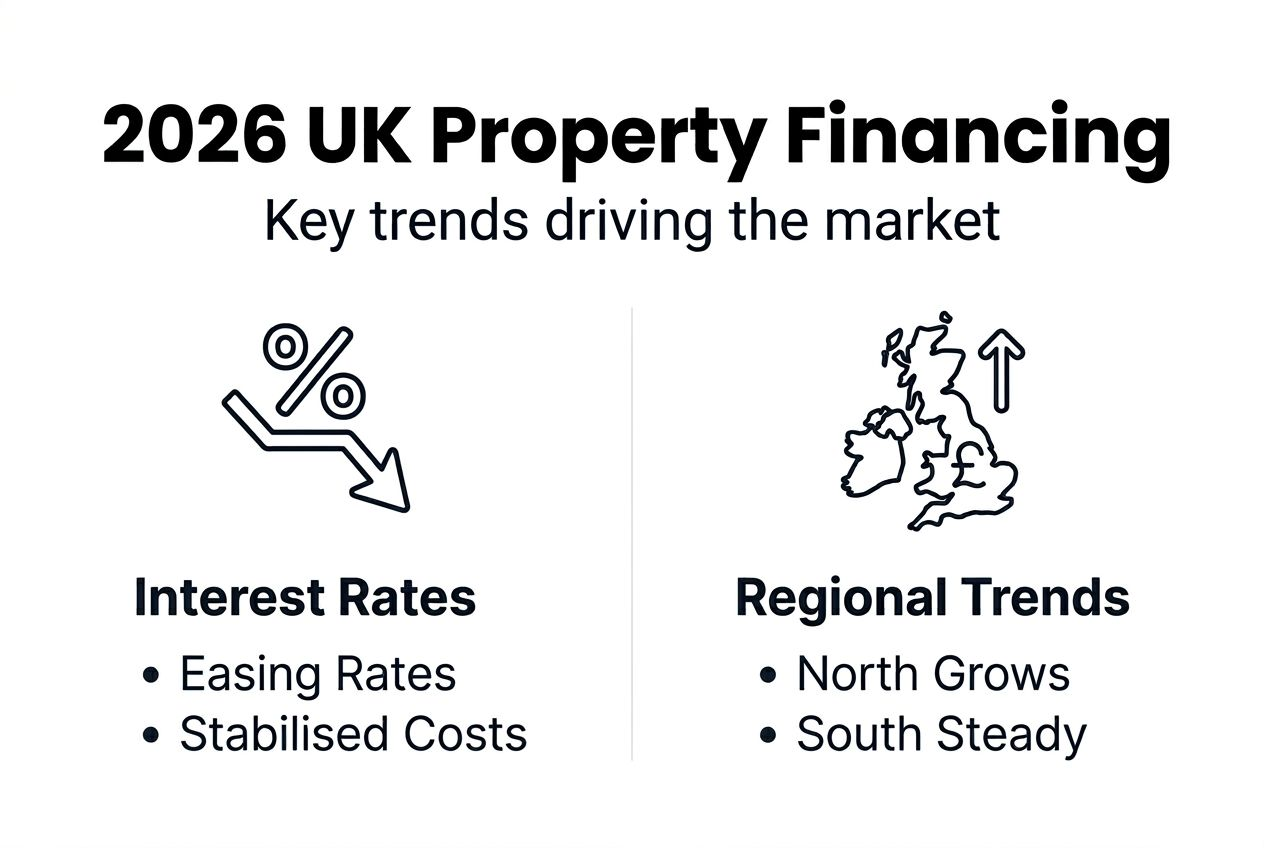
Whilst the direction of travel is favourable, the absolute level of mortgage rates stabilising at 3.75% to 4.75% represents a structural shift in financing economics. To put this in perspective, rates in the early 2010s frequently sat below 2%, enabling developers and investors to leverage heavily with minimal debt service burden. Today’s environment demands a fundamentally different calculus.
Higher borrowing costs directly impact monthly financing expenses, reducing cash flow available for capital improvements, operational expenses or distribution to equity partners. A £5 million development loan at 4.5% costs approximately £225,000 annually in interest alone, compared to roughly £100,000 at 2%. This differential can determine whether a marginal deal proceeds or stalls.
| Rate environment | Typical mortgage rate | Annual interest on £5m | Impact on deal viability |
|---|---|---|---|
| Early 2010s | 1.5% to 2.5% | £75k to £125k | High leverage sustainable |
| 2026 stabilised | 3.75% to 4.75% | £187k to £237k | Requires tighter margins |
| Recent peak | 5.5% to 6.5% | £275k to £325k | Many deals uneconomic |
Optimising loan structures becomes critical. Senior debt might cover 60% to 70% of project costs at lower rates, whilst mezzanine finance fills the gap at higher pricing but with flexible repayment terms. This layered approach balances cost efficiency with execution speed, particularly valuable when acquiring off-market opportunities or competing against cash buyers.
Pro Tip: Engage multiple lenders early to map out blended financing costs across senior, mezzanine and bridging layers, then model sensitivity to rate movements and project delays to stress-test deal viability.
Regional UK market divergence and its implications for financing
The 2026 property landscape is defined by widening regional performance gaps. Northern UK regions including North West, Yorkshire, Scotland and Wales are forecast to outperform London and South East with 4% to 4.5% price growth in 2026. This marks a reversal of decades of capital concentration in the South East and signals a structural rebalancing driven by affordability, regeneration investment and shifting work patterns.

Buyer migration is reshaping demand. Professionals and families priced out of southern markets are moving north, attracted by lower entry costs and improving infrastructure. Cities like Manchester, Leeds, Birmingham and Glasgow benefit from major regeneration projects that enhance amenity and connectivity, making them viable alternatives to London for both occupiers and investors.
However, rental demand has softened regionally in early 2026, leading investors to focus on asset quality and location rather than volume. Not all northern markets perform equally. Financing strategies must differentiate between proven growth corridors and speculative plays.
| Region | Forecast price growth | Financing considerations | Lender appetite |
|---|---|---|---|
| London & South East | 1% to 2% | Premium pricing, tax exposure, slower liquidity | High for prime, cautious for secondary |
| North West & Yorkshire | 4% to 4.5% | Value-add opportunities, regeneration proximity critical | Growing, selective on asset quality |
| Scotland & Wales | 4% to 4.5% | Strong fundamentals, local lender relationships valuable | Moderate, improving with track record |
| Midlands | 3% to 3.5% | Mixed performance, city-centre focus preferred | Stable, dependent on micro-location |
For property finance for UK developers, understanding regional nuances is non-negotiable. Lenders price risk differently by geography, and senior debt availability varies. Northern projects may require higher equity contributions or mezzanine layers to compensate for perceived risk, even when growth prospects exceed southern markets.
The rise of specialist lending and bridging finance
The complexity of 2026’s financing environment has accelerated the shift towards specialist lenders and alternative funding structures. High street banks remain important for vanilla transactions, but specialist lenders offer rapid underwriting and bridging loans have become mainstream financing solutions for complex UK property deals. This transition reflects investor demand for speed, flexibility and bespoke covenant packages that traditional institutions struggle to provide.
Specialist lenders differentiate through several mechanisms:
- Rapid decision-making, often delivering terms within 48 to 72 hours versus weeks for high street banks.
- Willingness to underwrite complex collateral including development sites with planning risks or mixed-use assets.
- Flexible covenant structures that accommodate cash flow lumpiness in value-add or repositioning projects.
- Expertise in niche sectors such as co-living, purpose-built student accommodation or industrial conversions.
Bridging finance has evolved from a last-resort stopgap to a strategic tool. Investors use it to secure off-market acquisitions before permanent financing closes, or to fund refurbishment ahead of refinancing at improved valuations. Rates typically range from 0.5% to 1.5% monthly, making speed and exit certainty paramount.
Consider a Birmingham-based specialist lender that closed a £3.2 million bridge for a multi-unit residential conversion in under five days. The borrower leveraged this speed to outcompete cash buyers, then refinanced into term debt once planning consent and value uplift materialised. This approach, once rare, is now standard practice among sophisticated operators.
Pro Tip: Engage arranging bridging finance specialists early in your acquisition process to pre-approve credit lines, enabling you to act decisively when opportunities arise without financing contingencies.
Regulatory and taxation changes affecting financing choices
The 2026 financing landscape is further complicated by regulatory and tax developments that reshape deal economics. The 2025 Autumn Budget introduced a surcharge on properties over £2 million and new taxes on property income from 2027, complicating financing decisions for high-net-worth investors. These measures specifically target the premium London and South East markets where international capital has historically concentrated.
The mansion tax surcharge adds a material acquisition cost for properties exceeding £2 million, reducing net yields and extending payback periods. The additional 2% property income tax starting 2027 further compresses returns on buy-to-let and commercial portfolios. Together, these changes may suppress demand in affected segments, creating both risks and opportunities for strategic buyers.
Financing structures must adapt to this new reality:
- Incorporate tax-efficient holding structures, such as offshore vehicles or corporate wrappers, to mitigate income tax exposure where legally permissible.
- Model sensitivity to future tax rate changes when sizing debt, ensuring cash flow adequacy under multiple scenarios.
- Prioritise capital growth over income generation in affected segments, structuring exits to realise gains efficiently.
- Explore alternative asset classes less exposed to new taxes, such as purpose-built student accommodation or industrial logistics.
- Engage tax and legal advisors early in the structuring process to identify compliant optimisation strategies.
These regulatory shifts also influence lender appetite. Institutions view tax-affected assets as higher risk, potentially tightening loan-to-value ratios or increasing pricing. Demonstrating sophisticated tax planning and robust cash flow forecasting becomes essential to securing competitive terms.
Optimising real estate funding in 2026 requires integrating tax strategy with capital structure from the outset, rather than treating them as separate workstreams.
Find expert specialist property finance solutions with us
Navigating the 2026 UK property financing landscape demands expertise, agility and access to the right capital partners. Whether you’re structuring a multi-layered debt stack for a ground-up development, arranging bridging finance for a time-sensitive acquisition or refinancing a complex portfolio under new tax regimes, having a specialist partner makes the difference between executing and losing opportunities.

James William & Co Capital delivers bespoke specialist property finance solutions tailored to the realities of 2026’s market. Our capital concierge approach gives you a single point of contact for end-to-end structuring, negotiation and execution, leveraging relationships with family offices, private credit funds and specialist lenders to secure rapid, flexible funding. Explore our comprehensive property finance services and review proven results through detailed case studies demonstrating our ability to execute under pressure.
Frequently asked questions
How are interest rates expected to affect UK property financing in 2026?
Rates are easing towards 3.75% to 4.75%, down from recent peaks but still nearly triple early 2010s lows. This requires sophisticated loan structuring, layering senior debt with mezzanine or bridging finance to balance cost and flexibility whilst maintaining deal viability.
What financing options are growing in popularity among high-net-worth property investors?
Specialist lenders and bridging finance have transitioned from niche to mainstream. Their speed, flexibility and willingness to underwrite complex collateral make them essential for competitive acquisitions and value-add projects in 2026’s dynamic market.
How do regional property market differences influence financing choices?
Northern England and Scotland’s stronger 4% to 4.5% growth prospects attract capital but require localised lender relationships and flexible funding. Lenders price risk differently by region, affecting loan-to-value ratios and terms even when fundamentals are robust.
What regulatory changes should investors consider when planning financing in 2026?
New surcharges on properties exceeding £2 million and additional taxes on property income from 2027 onwards add complexity. Tax-aware capital structures, offshore vehicles where appropriate and sensitivity modelling are now critical components of financing strategy for high-value assets.
Recommended
Related Topics
Speak to a specialist
Discuss your finance with James directly
Whole-of-market specialist finance — bridging, development, commercial and residential. No call centres, no obligation. James reviews every enquiry personally.
New to specialist finance? How unbiased broker advice works · Deals we have completed
Explore Related Finance