
Published · Updated
what is a funding partnerWhat is a funding partner: guide for UK property developers 2026
By James Dawes, CeMAP, Founder, James William & Co Capital

What is a funding partner: guide for UK property developers 2026
Many property professionals mistakenly believe funding partners are simply alternative lenders offering capital on flexible terms. In reality, they are strategic collaborators who provide both capital and expertise to enable large-scale developments that traditional finance cannot support. This guide explains their role, legal structures, benefits, risks, and practical steps to engage them effectively in 2026.
Table of Contents
- Introduction To Funding Partners In UK Property Development
- Legal And Financial Structures Of Funding Partnerships
- Benefits And Risks For Developers And Funding Partners
Key takeaways
| Point | Details |
|---|---|
| Funding partners differ from lenders | They provide capital plus strategic collaboration, not just fixed debt repayment. |
| Bespoke governance preserves control | Over 60% of agreements feature tailored governance allowing developers to retain operational control. |
| Legal structures vary widely | Common frameworks include JV SPVs, LLPs, and contractual joint ventures with profit-sharing and exit terms. |
| Partnerships enable higher leverage | Funding can reach 100% of build costs, exceeding traditional loan-to-value ratios. |
| Practical steps ensure success | Clear legal agreements, transparent negotiation, and broker support optimise partnership outcomes. |
Introduction to funding partners in UK property development
Understanding what a funding partner is begins with recognising how they differ fundamentally from traditional lenders or passive investors. A funding partner actively participates in your development project by contributing capital, land, or operational expertise whilst sharing both risks and rewards through structured agreements.
Unlike banks that provide loans with fixed repayment schedules and security over assets, funding partners typically take equity stakes and engage in project decision-making. They are not silent investors either. Their involvement extends to governance, strategic planning, and sometimes day-to-day operational support, making them integral to project delivery.
This collaborative model is particularly valuable for large-scale UK property developments requiring sophisticated financing beyond the reach of conventional mortgages or development loans. Funding partnerships can unlock finance facilities up to 100% of build costs, far exceeding typical loan-to-value ratios offered by traditional lenders.
Common contributions from funding partners include:
- Equity capital to bridge funding gaps and reduce personal leverage
- Land or site assembly expertise to accelerate project commencement
- Specialist operational knowledge in planning, construction, or sales
- Access to extended lender networks and private credit sources
- Strategic guidance on phasing, design, and market positioning
For developers pursuing ground-up developments, complex refinances, or multi-phase schemes, funding partners provide the financial firepower and collaborative framework essential to execute at scale. Their role becomes critical when property development funding tips suggest traditional routes cannot meet project demands or timelines.
Legal and financial structures of funding partnerships
The effectiveness of any funding partnership hinges on choosing the right legal and financial structure. In the UK, three primary frameworks dominate: Joint Venture Special Purpose Vehicles (JV SPVs), Limited Liability Partnerships (LLPs), and contractual joint ventures. Each offers distinct advantages depending on project complexity, tax considerations, and lender preferences.

Common structures include JV SPVs, LLPs, and contractual joint ventures with documented governance and profit-sharing. JV SPVs are separate legal entities formed specifically for a development project, isolating risk and providing clarity on ownership and control. LLPs blend partnership flexibility with limited liability protection, making them attractive for longer-term collaborations. Contractual joint ventures rely on detailed agreements without creating a separate legal entity, offering simplicity but requiring meticulous drafting.
Key structural elements that must be defined include:
- Profit-sharing ratios reflecting capital contributions and risk exposure
- Governance rights determining who controls operational decisions
- Exit strategies outlining buyout terms, sale triggers, and dispute resolution
- Funding tranches specifying when and how capital is released
- Reporting obligations ensuring transparency and accountability
Lenders scrutinise these structures carefully. They prefer arrangements with clear documentation, ring-fenced assets, and enforceable security. Multi-layered debt and equity stacks are common, with senior lenders providing bridging or development finance secured against the project, mezzanine lenders filling gaps at higher rates, and equity partners taking residual profits after debt service.
| Structure Type | Liability | Tax Treatment | Best For |
|---|---|---|---|
| JV SPV | Limited to entity | Corporation tax on profits | Single-project ventures |
| LLP | Limited for partners | Pass-through to partners | Multi-project collaborations |
| Contractual JV | Varies by agreement | Depends on structure | Simple or short-term projects |
Pro Tip: Always align your funding structure with the expectations of your senior lender before finalising agreements. Misalignment can delay drawdowns or trigger covenant breaches.
Exploring diverse funding sources UK developers can access requires understanding these structural nuances. The right framework balances flexibility, tax efficiency, and lender comfort whilst preserving developer control where possible.
Benefits and risks for developers and funding partners
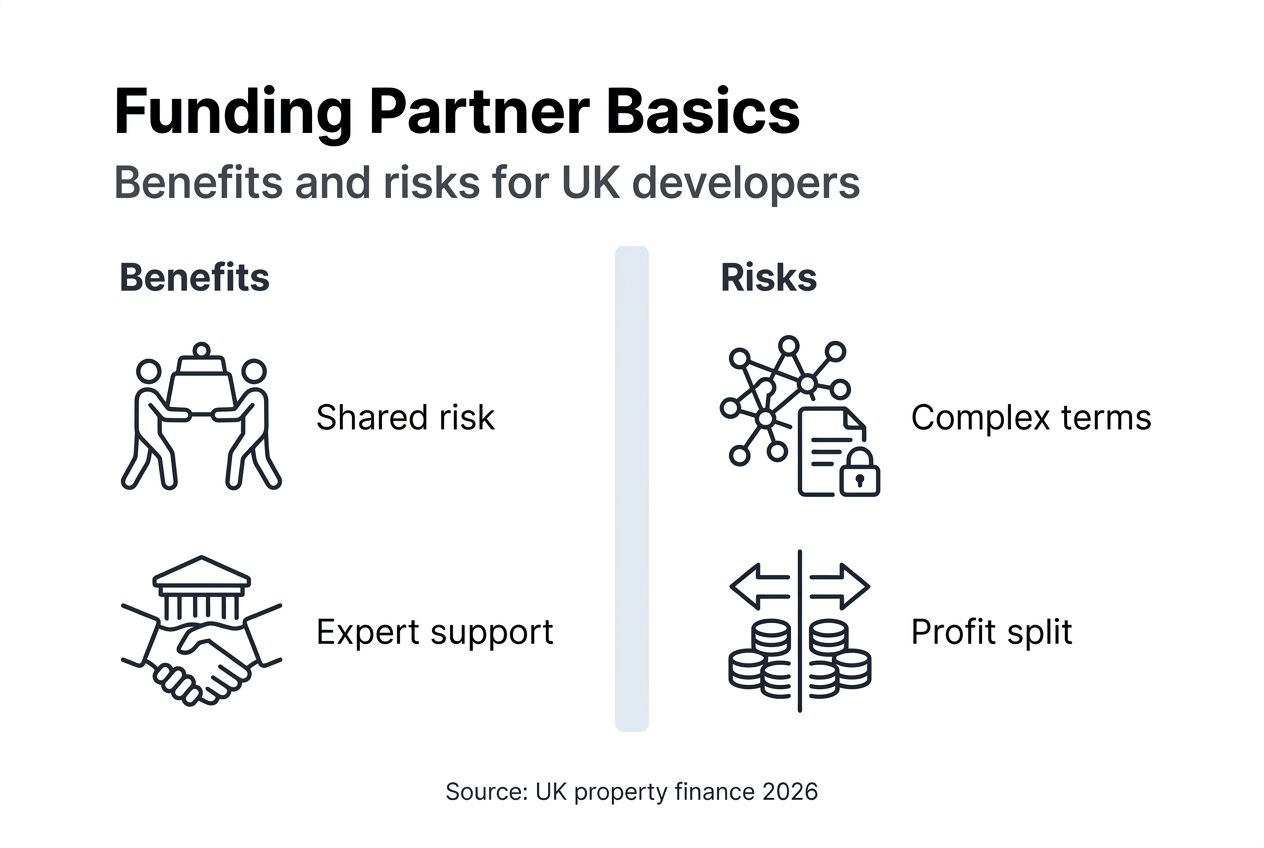
Funding partnerships deliver compelling advantages when structured correctly. For developers, the primary benefit is access to capital that would otherwise be unavailable or prohibitively expensive. This enables projects to proceed without over-leveraging personal guarantees or exhausting equity reserves.
Shared risk is another critical advantage. When a funding partner commits significant capital and expertise, they absorb a portion of downside exposure, making projects more resilient to market volatility or construction delays. Nearly two-thirds of agreements have bespoke governance arrangements preserving developer control, allowing operational autonomy whilst benefiting from partner capital and networks.
Funding partners gain exposure to high-return property developments without managing day-to-day operations. They leverage developer expertise whilst diversifying their investment portfolios. For family offices and private credit funds, these partnerships offer attractive risk-adjusted returns compared to passive property holdings.
However, risks exist for both parties:
- Dilution of developer equity and profit share
- Governance conflicts arising from divergent priorities or risk appetites
- Complexity in decision-making that can slow project execution
- Exit disagreements if market conditions or valuations shift unexpectedly
- Legal disputes if agreements lack clarity or enforcement mechanisms
Pro Tip: Conduct thorough due diligence on potential partners, reviewing their track record, financial stability, and dispute history before committing. Chemistry and aligned values matter as much as capital.
Recommended
Related Topics
Speak to a specialist
Discuss your finance with James directly
Whole-of-market specialist finance — bridging, development, commercial and residential. No call centres, no obligation. James reviews every enquiry personally.
New to specialist finance? How unbiased broker advice works · Deals we have completed
Explore Related Finance