
Published · Updated
what is asset-backed lendingWhat is asset-backed lending? A guide for investors
By James Dawes, CeMAP, Founder, James William & Co Capital
TL;DR:
- Asset-backed lending provides credit secured by tangible assets like receivables, inventory, or property, with loan amounts based on asset value rather than earnings. It offers flexible, collateral-driven financing suitable for asset-heavy businesses and property investors, but requires rigorous reporting and operational transparency. Understanding and managing collateral quality, reporting obligations, and asset concentration are crucial for success in this form of financing.
Asset-backed lending is defined as a form of secured financing where the loan amount is determined primarily by the appraised value of a borrower’s tangible assets rather than their cash flow projections or earnings history. In practice, this means a property investor or business can access credit against collateral such as accounts receivable, inventory, equipment, or real estate, with the lender’s exposure anchored to what those assets are worth in a liquidation scenario. The industry also uses the term asset-based financing interchangeably, though there is a technical distinction worth noting: asset-based lending typically refers to revolving credit secured by operating assets, while asset-backed lending in its strictest sense involves pools of assets isolated within special-purpose vehicles. For most investors exploring UK financing options, the two terms describe the same fundamental principle: your assets do the talking, not your profit and loss account.
How does asset-backed lending work in practice?
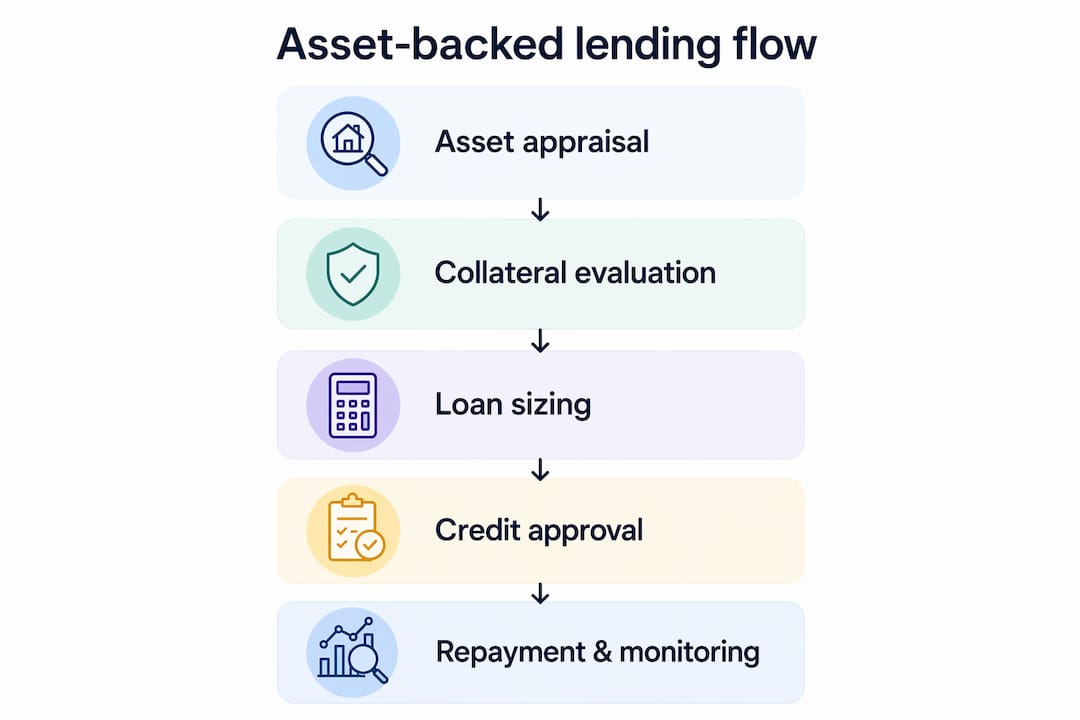
The process begins with asset appraisal. A lender assesses the quality, liquidity, and realisable value of the collateral you are pledging, then applies an advance rate to determine how much credit you can access. Advance rates vary by asset class: accounts receivable typically attract 80 to 90%, while finished goods inventory sits closer to 50 to 65%. These percentages reflect how quickly and reliably each asset type can be converted to cash if the borrower defaults.

Once the facility is established, the available credit line fluctuates in direct proportion to the value of the underlying collateral. This is governed by a borrowing base certificate, a document the borrower submits to the lender on a regular basis to confirm the current value and composition of pledged assets. Weekly reporting is standard in most facilities, though some lenders require daily submissions for higher-risk portfolios. This means your credit availability can rise when your receivables grow and contract when they shrink.
The mechanics break down into four stages:
- Asset identification and appraisal. The lender commissions an independent valuation of eligible collateral, often including a field examination where auditors physically verify inventory counts or inspect property.
- Borrowing base calculation. Eligible assets are multiplied by their respective advance rates to produce the maximum available credit.
- Facility drawdown. The borrower draws against the revolving line or term loan as needed, up to the borrowing base limit.
- Ongoing monitoring. The lender receives regular borrowing base certificates and conducts periodic audits to confirm collateral quality has not deteriorated.
Pro Tip: Before entering an asset-backed facility, map your asset base carefully. Lenders will exclude ineligible receivables such as those over 90 days old or owed by related parties, so your actual borrowing base is often lower than your gross asset value suggests.
Asset-backed facilities can be structured as revolving credit lines, where you draw and repay repeatedly as your collateral fluctuates, or as term loans secured against a fixed asset pool. For UK property investors, the revolving structure is common in development finance contexts, while term loans are more typical for commercial real estate acquisitions. Understanding which structure suits your project is the first conversation to have with a specialist like James William & Co.
What assets can be used as collateral, and what are the advance rates?
The range of eligible collateral is broader than many investors realise. Lenders assess each asset category on two criteria: how reliably it can be valued, and how quickly it can be liquidated at or near that value if required.
The four principal collateral categories are:
- Accounts receivable. The most liquid and therefore the most favourably treated. Advance rates of 80 to 90% are standard because receivables convert to cash within a predictable timeframe. Lenders monitor ageing reports closely, excluding any invoices beyond agreed thresholds.
- Finished goods inventory. More variable in value and harder to liquidate quickly, hence advance rates of 50 to 65%. Lenders focus on whether goods are saleable in their current state and whether there is an active market for them.
- Plant and equipment. Advance rates typically range from 50 to 80% of orderly liquidation value, assessed by specialist machinery appraisers. Depreciation schedules and market demand for second-hand equipment both influence the outcome.
- Real estate and property. Advance rates vary considerably depending on asset type, location, and planning status. For UK real estate debt transactions, lenders typically lend 60 to 75% of open market value, though development assets attract more conservative treatment.
| Collateral type | Typical advance rate | Key monitoring factor |
|---|---|---|
| Accounts receivable | 80 to 90% | Ageing reports, debtor concentration |
| Finished goods inventory | 50 to 65% | Liquidation value, market demand |
| Plant and equipment | 50 to 80% | Orderly liquidation value, depreciation |
| Commercial real estate | 60 to 75% | Open market value, planning status |
Asset quality matters as much as asset quantity. A borrower with £5 million of receivables concentrated in a single debtor will receive less favourable treatment than one with the same value spread across 50 counterparties. Lenders apply concentration limits precisely because single-debtor exposure amplifies recovery risk.
How does asset-backed lending compare with traditional cash-flow lending?
The fundamental difference lies in what the lender is underwriting. Cash-flow lending sizes loans using EBITDA multiples, typically three to six times earnings before interest, tax, depreciation, and amortisation. Asset-backed lending ignores EBITDA almost entirely and focuses instead on the realisable value of the collateral pool. This distinction has significant practical consequences for borrowers.
During a downturn, a cash-flow borrower whose EBITDA falls sharply may breach financial covenants and face accelerated repayment demands. An asset-backed borrower in the same environment faces a different dynamic: credit availability adjusts in proportion to collateral fluctuations rather than triggering covenant breaches based on earnings ratios. This provides meaningful resilience during periods of EBITDA volatility, which is one reason asset-backed structures are popular with cyclical businesses and property investors managing multiple projects simultaneously.
| Feature | Asset-backed lending | Cash-flow lending |
|---|---|---|
| Loan sizing basis | 50 to 90% of collateral value | 3 to 6x EBITDA |
| Covenant structure | Collateral-based, fewer financial covenants | EBITDA and leverage ratios |
| Flexibility in downturns | Credit adjusts with asset values | Covenant breaches risk acceleration |
| Reporting requirements | Weekly or daily borrowing base certificates | Quarterly financial statements |
| Best suited to | Asset-heavy businesses, property investors | Profitable businesses with stable earnings |
Interest rates on asset-backed facilities are generally lower than unsecured or cash-flow lending because the lender holds a security interest in specific assets. The trade-off is administrative: field examinations and on-site audits are a standard feature, requiring borrowers to maintain detailed records and cooperate with lender oversight. For UK property developers managing complex capital stacks, this overhead is manageable when weighed against the financing flexibility gained.
Pro Tip: If your project involves a mix of asset types, consider how a specialist can structure the collateral pool to maximise your borrowing base. Combining receivables, equipment, and property within a single facility often produces a higher aggregate advance than treating each asset class separately.
What are the main advantages and challenges of asset-backed lending?
Advantages worth understanding
Asset-backed lending offers several structural benefits that make it particularly well-suited to investors and businesses with significant tangible assets.
- Credit scales with your assets. As your receivables or property portfolio grows, your available credit grows with it. This is genuinely useful for developers acquiring multiple sites or businesses in rapid growth phases.
- Lower cost of capital. Because the lender holds a security interest in specific collateral, underwriting focuses on asset quality and contractual cash flows rather than long-term profitability. This leads to higher recovery rates upon default and justifies tighter pricing.
- Access despite earnings volatility. A business with strong assets but inconsistent profits can access credit that would be unavailable through conventional bank lending. This is particularly relevant for seasonal businesses or those in early growth stages.
- Resilience during downturns. The absence of tight EBITDA covenants means asset-backed borrowers are less likely to face technical default during a difficult trading period, provided their collateral values hold.
Challenges to plan for
- Administrative burden. Frequent reporting requirements and on-site audits demand significant internal resource. Borrowers who underestimate this often find the facility more operationally demanding than expected.
- Collateral dependency. If asset values fall, your credit line contracts. A property investor whose portfolio is revalued downward will see immediate reductions in available borrowing capacity.
- Not a permanent solution. Asset-based financing serves as a liquidity stabiliser during periods of seasonal fluctuation rather than as a substitute for stable cash-flow financing. Businesses that rely on it indefinitely without addressing underlying profitability issues are storing up risk.
- Lender oversight. The lender’s right to conduct field examinations and audit collateral means a degree of operational transparency that some borrowers find intrusive.
For UK property developers and investors, the structured finance considerations around asset-backed facilities are best navigated with a specialist who understands both the collateral mechanics and the lender market.
Key takeaways
Asset-backed lending offers investors and businesses a flexible, collateral-driven alternative to cash-flow lending, with credit availability tied directly to the realisable value of pledged assets rather than earnings performance.
| Point | Details |
|---|---|
| Loan sizing is asset-driven | Advance rates of 50 to 90% of collateral value determine your credit limit, not your EBITDA. |
| Reporting is frequent and rigorous | Borrowing base certificates are typically submitted weekly, requiring strong internal record-keeping. |
| Collateral quality is paramount | Lenders assess liquidity and concentration risk, not just headline asset values. |
| Downturns are handled differently | Credit adjusts with collateral rather than triggering covenant breaches based on earnings ratios. |
| It suits specific financing needs | Asset-backed lending works best as a targeted tool for growth or seasonal periods, not as permanent capital. |
Why I think most investors underestimate the operational side
Most of the conversations I have with investors exploring asset-backed financing focus on the headline numbers: advance rates, pricing, and credit availability. Very few start by asking about the reporting obligations, and that is where I see deals go wrong after drawdown.
The administrative commitment in a well-structured asset-backed facility is real. Weekly borrowing base certificates, periodic field examinations, and lender audits are not bureaucratic inconveniences. They are the mechanism by which the lender maintains confidence in the collateral pool, and they require the borrower to have clean, current records at all times. Investors who treat this as an afterthought tend to find their credit line restricted at exactly the moment they need it most.
What I find genuinely compelling about asset-backed structures, particularly in the UK private credit market, is the underwriting logic. The focus on asset quality and recovery value rather than projected profitability makes these facilities more honest about risk than many cash-flow loans. When a lender is pricing based on what they can recover in a default scenario, you get a clearer picture of how they actually view your collateral. That transparency, when you understand how to read it, is useful information for any serious investor.
The UK market has seen growing appetite from family offices and private credit funds for asset-backed structures, particularly where the collateral involves income-producing real estate or receivables from creditworthy counterparties. If you are building a portfolio with meaningful tangible assets, this financing model deserves serious consideration. But go in with your eyes open about what the lender will expect from you operationally.
— James
How James William & Co can structure your asset-backed facility
James William & Co works with UK property investors, developers, and high-net-worth clients who need financing structures built around their asset base rather than their earnings history. Whether you are looking to leverage receivables, commercial property, or a mixed collateral pool, the team arranges facilities through a network of family offices, private credit funds, and specialist lenders who understand asset-backed structures at the level of complexity your transaction requires. If you are ready to explore what your asset base can support, speak to the team at James William & Co for a tailored assessment. For London-based investors, specialist property finance services are available with the same single-point-of-contact approach.
FAQ
What is asset-backed lending in simple terms?
Asset-backed lending is a financing arrangement where the loan amount is determined by the value of specific assets pledged as collateral, such as receivables, inventory, or property, rather than the borrower’s earnings or credit history.
What advance rates apply to different asset types?
Accounts receivable typically attract advance rates of 80 to 90%, finished goods inventory around 50 to 65%, and commercial real estate generally 60 to 75% of open market value, depending on asset quality and lender appetite.
How is asset-backed lending different from a standard mortgage?
A standard mortgage is secured against a single property with a fixed loan-to-value ratio. Asset-backed lending involves a dynamic credit facility where availability fluctuates with the changing value of a broader collateral pool, often including multiple asset types.
Is asset-backed lending suitable for property investors?
Asset-backed lending suits property investors with significant tangible assets who need flexible credit that scales with their portfolio. It is particularly useful during acquisition phases or development periods where earnings are inconsistent but asset values are strong.
What are the main risks of asset-backed lending?
The primary risks are collateral value decline, which directly reduces available credit, and the administrative burden of frequent reporting and lender audits. It is recommended as a targeted financing tool rather than a permanent capital solution.
Recommended
Related Topics
Speak to a specialist
Discuss your finance with James directly
Whole-of-market specialist finance — bridging, development, commercial and residential. No call centres, no obligation. James reviews every enquiry personally.
New to specialist finance? How unbiased broker advice works · Deals we have completed
Explore Related Finance