
Published · Updated
what is balance sheet lendingWhat is balance sheet lending: a UK guide for 2026
By James Dawes, CeMAP, Founder, James William & Co Capital

TL;DR:
- Balance sheet lending involves a lender using its own capital to originate and hold loans on its books for the full term.
- It offers UK property developers and investors faster, more flexible financing with full credit risk retention.
Balance sheet lending is defined as a financing model in which a lender uses its own proprietary capital to originate loans and retains those loans on its own books for the full term. This contrasts sharply with models that sell or securitise debt into the secondary market. For UK property developers, business owners, and investors, understanding this distinction is not academic. It determines how fast you get funded, how much flexibility you have during a project, and what your lender’s real incentive is when things get complicated. Balance sheet lenders use their own capital to originate and hold loans, achieving higher returns through interest spreads while assuming full credit risk. That risk retention is the defining feature of the entire model.
What is balance sheet lending and how does it work?
Balance sheet lending works by deploying a lender’s own capital directly to a borrower, with the loan sitting on the lender’s books from origination to repayment. No third-party investor buys the loan. No securitisation vehicle holds it. The lender earns the interest spread and carries the credit risk throughout.

Underwriting in this model focuses on the borrower’s overall financial strength rather than a single asset’s cash flow. Lenders review 3–5 years of financial statements, liquidity positions, and net worth before approving a facility. This is a materially different lens from asset-level or DSCR underwriting, which evaluates whether a specific property generates enough income to service its own debt.
Loan terms under balance sheet financing typically run from 3 to 7 years, often structured with interest-only payments or short amortisation schedules. The process includes formal due diligence, credit committee review, and covenant negotiation. Due diligence can take 3–9 months for thorough business and financial reviews, including loan committee approvals. That timeline reflects the depth of scrutiny involved, not bureaucratic inefficiency.
Pro Tip: Prepare a consolidated financial pack covering at least three years of audited accounts, a current liquidity summary, and a net worth statement before approaching a balance sheet lender. Incomplete submissions are the single most common cause of delays at credit committee stage.
The process typically follows this sequence:
- Initial borrower financial review and indicative terms
- Full due diligence including business plan, financial statements, and asset appraisal
- Loan committee presentation and approval
- Covenant negotiation and facility documentation
- Drawdown and ongoing compliance monitoring
What are the advantages and challenges of balance sheet lending?
The primary advantage of balance sheet financing is execution certainty. Balance sheet lenders hold loans to maturity, eliminating the risk of secondary market funding pullouts. A borrower mid-construction does not face the scenario where a loan is sold to an investor with different risk appetite or timeline expectations.
Speed and flexibility in draw approvals are equally significant. In construction and bridge lending, balance sheet lenders control draw approvals directly, reducing project stall risk and improving execution speed. When a contractor hits a delay or a planning condition changes, the lender can respond within days rather than weeks because no third-party servicer sits between the decision and the borrower.
Alignment of interests is the structural advantage that separates this model from most alternatives. Balance sheet lenders retain risk and are motivated to manage challenges collaboratively, unlike institutional investors who view assets in isolation. A lender that cannot sell your loan has every reason to help you succeed.
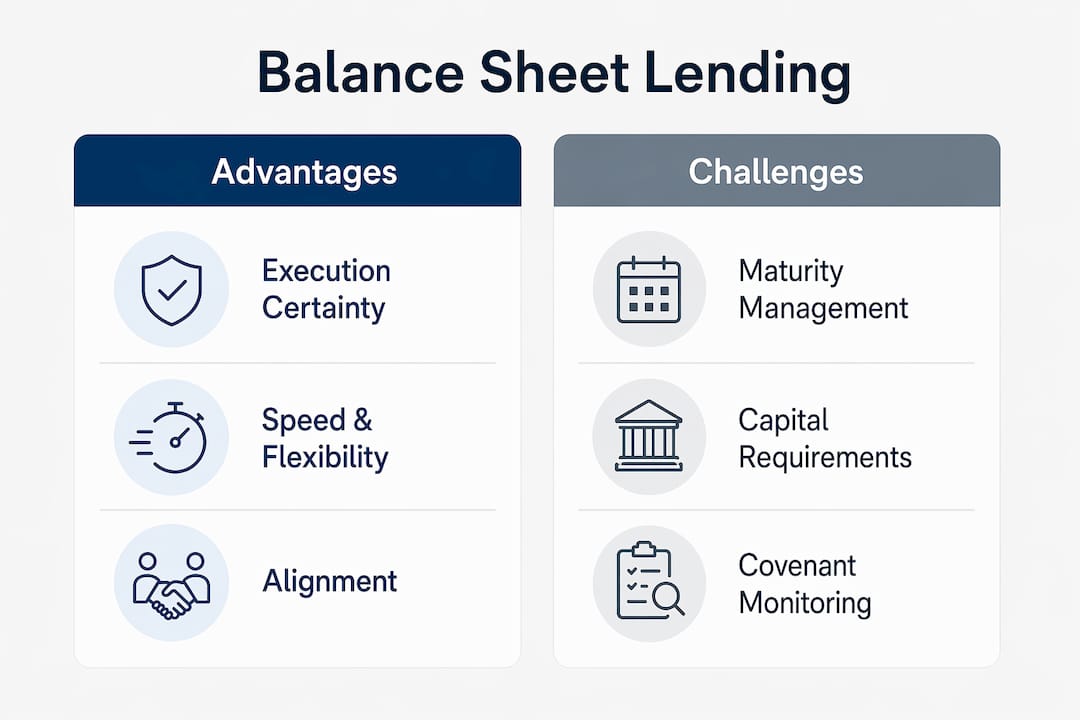
The challenges are real, however. Lenders must manage asset-liability maturity profiles closely, and stringent capital adequacy and liquidity requirements slow rapid growth in balance sheet lending. For borrowers, the ongoing covenant compliance burden is significant.
Pro Tip: Treat covenant compliance as a live reporting obligation, not an annual checkbox. Balance sheet lenders monitor borrower financial health continuously, and proactive communication about covenant headroom builds the trust that unlocks flexibility when you need it most.
| Feature | Balance sheet lending | Asset-level lending |
|---|---|---|
| Underwriting focus | Borrower’s full financial strength | Asset cash flow and DSCR |
| Loan retention | Held to maturity by originating lender | Often sold or securitised |
| Draw approval speed | Direct and fast | Dependent on servicer or investor |
| Borrower relationship | Ongoing, collaborative | Transactional |
| Covenant burden | Higher, ongoing compliance required | Lower, asset-specific covenants |
How does balance sheet lending compare to alternative lending models?
Marketplace lending and peer-to-peer platforms aggregate capital from multiple investors and match it to borrowers. The originating platform typically does not hold the loan. Risk sits with the investor pool, not the platform. This creates a structural misalignment: the platform’s incentive is to originate volume, not to manage loan performance over time.
Asset-based lending evaluates a specific asset’s value or income as the primary security. The lender’s decision rests on the asset, not the borrower’s broader financial position. This suits borrowers with strong assets but weaker trading histories. It is a narrower lens, and it produces narrower flexibility.
The key distinctions for borrowers choosing between models are:
- Ownership and control. Balance sheet lenders own the loan throughout its life. Marketplace lenders do not.
- Risk dynamics. Balance sheet lenders price for the full credit risk they retain. Marketplace platforms price for origination volume.
- Speed and flexibility. Balance sheet lenders make faster bespoke decisions. Marketplace platforms follow standardised credit algorithms.
- Borrower profile. Balance sheet financing suits borrowers with complex financial structures or projects requiring ongoing lender engagement. Asset-based models suit simpler, asset-heavy transactions.
For UK property developers seeking real estate funding options across a multi-site programme, balance sheet financing offers the relationship depth that transactional models cannot replicate.
What are the practical applications in UK real estate and business finance?
Balance sheet lending is the dominant model in UK bridging finance and development finance. A ground-up residential scheme with phased draw requirements needs a lender that can approve each draw quickly and respond to programme changes without escalating to an external investor committee. Balance sheet lenders are built for exactly this scenario.
In commercial property acquisition, balance sheet financing allows underwriting on the sponsor’s full financial strength rather than the property’s current income. This matters when acquiring a vacant building for conversion or a site with planning risk. A DSCR model cannot underwrite a property with no current income. A balance sheet model can, provided the borrower’s financial position supports the exposure.
For operating companies, balance sheet loans evaluate the business as a whole. A manufacturer seeking to refinance its premises and fund a capital expenditure programme can present three years of trading history, its order book, and its net worth. The lender assesses the enterprise, not just the bricks. This approach suits UK property developers and investors who hold multiple assets across different structures.
Bridging finance is perhaps the clearest application. Arranging bridging finance through a balance sheet lender gives borrowers direct access to the decision-maker, controlled draw timings, and the certainty that the facility will not be pulled mid-transaction. Speed and certainty are the two things a bridging borrower values most, and balance sheet lenders deliver both.
The practical applications in UK real estate include:
- Ground-up residential and commercial development with phased draw schedules
- Bridging loans for time-sensitive acquisitions and refinances
- Mezzanine debt layered into complex capital stacks
- Commercial mortgage facilities for owner-occupiers and investors
- Business loans for operating companies evaluated on enterprise financial strength
What are the key risks and considerations for borrowers?
Balance sheet loans typically carry more recourse features and require corporate or personal guarantees. Borrowers expose their entire financial position to lender scrutiny, not just the asset being financed. This is the trade-off for the flexibility and alignment the model provides.
Financial covenants are a defining feature of balance sheet financing. These covenants require maintaining specific financial health thresholds over the loan life, covering liquidity ratios, leverage ratios, and tangible net worth. A breach triggers a lender review and potentially a default event, even if the underlying asset is performing well.
The key borrower considerations are:
- Recourse and guarantees. Personal and corporate guarantees are standard. Understand the full scope of your liability before signing.
- Covenant compliance. Budget for ongoing financial reporting and monitoring. The cost is time and management resource, not just fees.
- Relationship transparency. Balance sheet lenders value open communication. Surprises damage the relationship and reduce flexibility.
- Due diligence depth. Expect a thorough review of your entire financial position, including real estate debt structures and cross-liabilities across your portfolio.
- Strategic planning impact. Covenant constraints can limit your ability to take on additional debt or distribute capital during the loan term. Model this before committing.
While headline pricing on balance sheet loans can appear competitive, the ongoing covenant compliance imposes implicit costs that borrowers should assess carefully before comparing rates in isolation.
Key takeaways
Balance sheet lending delivers execution certainty, lender alignment, and underwriting flexibility that transactional models cannot match, but it demands full financial transparency and ongoing covenant compliance from borrowers.
| Point | Details |
|---|---|
| Core definition | Balance sheet lenders use their own capital and retain loans to maturity, holding full credit risk. |
| Underwriting approach | Lenders assess 3–5 years of borrower financials, not just the asset’s income or value. |
| Execution certainty | Loans held to maturity eliminate secondary market pullout risk for borrowers mid-project. |
| Covenant obligations | Borrowers must maintain liquidity, leverage, and net worth thresholds throughout the loan term. |
| Best-fit applications | Ground-up development, bridging finance, and complex business loans suit this model best. |
Why balance sheet lending is the model serious developers should understand first
My view, after years of structuring property finance for developers and investors across the UK, is that balance sheet lending is misunderstood in one specific way. Most borrowers focus on the rate. The rate is almost never the most important variable.
What matters is who controls the decision when something goes wrong. And something always goes wrong on a development. Planning conditions change. Contractors miss programmes. Markets shift between acquisition and exit. In every one of those scenarios, the question is whether your lender has the authority and the incentive to work with you. A balance sheet lender does, because they own the problem alongside you.
The covenant burden is real, and I would not minimise it. I have seen borrowers caught by liquidity covenants during a period of rapid reinvestment, where the cash was deployed productively but the ratio test was breached on a technicality. The lesson is not to avoid balance sheet lenders. The lesson is to model your covenants before you sign, not after. Know your headroom. Report proactively. Build the relationship before you need it.
The UK private credit market has matured considerably, and family offices and specialist funds now offer balance sheet facilities that compete directly with bank terms on pricing while offering far greater flexibility on structure. For developers working on complex schemes, that combination is worth more than a basis point or two on the margin.
— James
Specialist property finance from James William & Co
James William & Co Capital structures balance sheet financing solutions for UK property developers, investors, and high-net-worth clients who need certainty of execution on complex transactions.
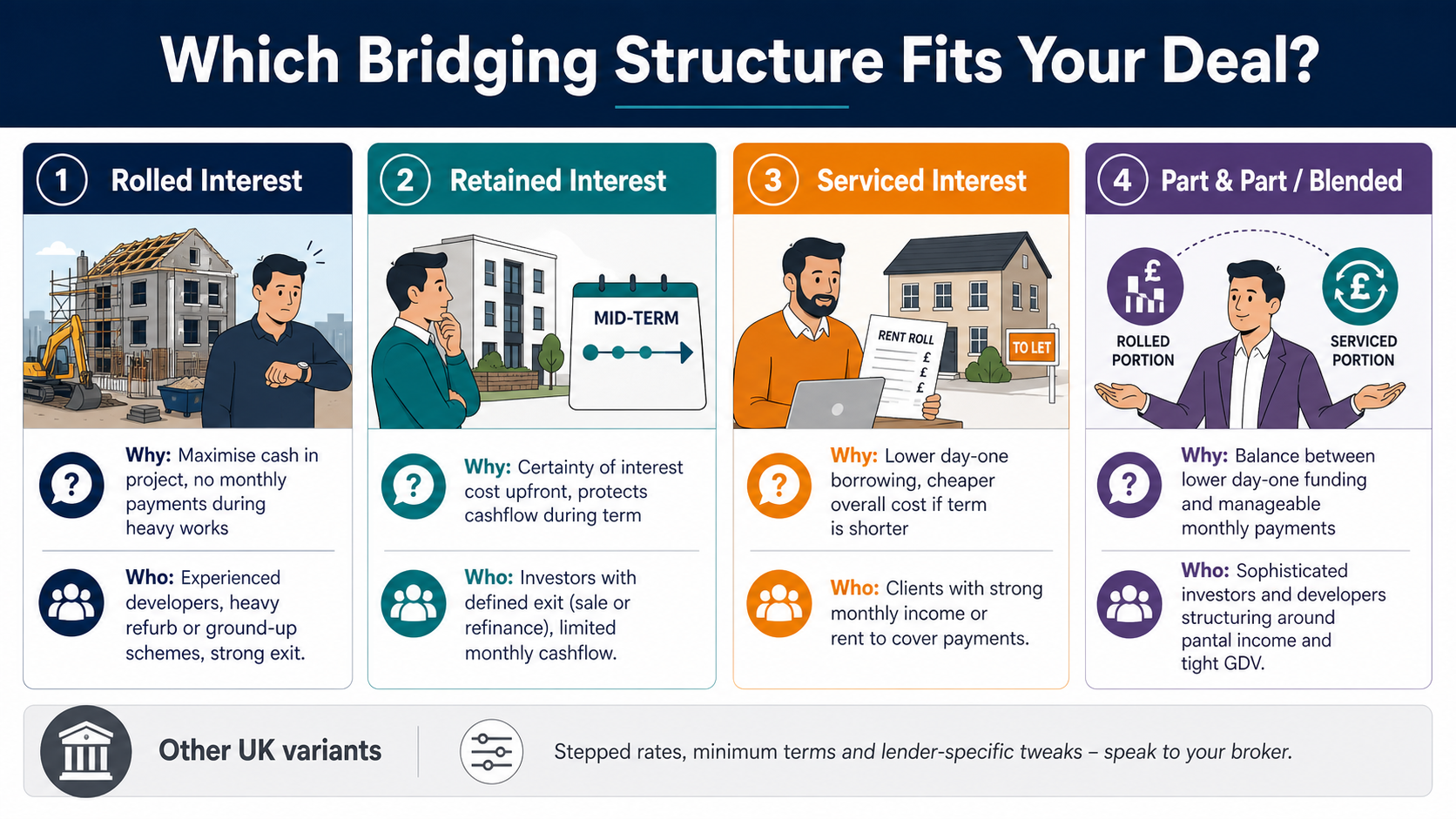
Whether you are funding a ground-up development, arranging a bridging facility, or building a multi-layered debt stack for a large-scale acquisition, James William & Co works with a network of family offices, private credit funds, and specialist lenders to deliver bespoke terms at speed. The firm’s specialist property finance approach gives clients a single point of contact for structuring, negotiation, and execution. If you are evaluating balance sheet financing for your next transaction, speak to James William & Co Capital directly.
FAQ
What is the balance sheet loan definition?
A balance sheet loan is a facility originated and held by a lender using its own capital, retained on the lender’s books for the full loan term rather than sold or securitised.
How does balance sheet lending work for property developers?
The lender underwrites the borrower’s overall financial strength, approves draws directly, and retains the loan to maturity, giving developers faster decisions and greater flexibility during construction.
What are the main advantages of balance sheet lending?
The main advantages are execution certainty, faster draw approvals, and lender alignment, because the lender retains full credit risk and is motivated to support the borrower through project challenges.
What covenants do balance sheet loans typically include?
Balance sheet loans typically include liquidity ratio tests, leverage ratio limits, and tangible net worth thresholds that borrowers must maintain throughout the loan term.
How does balance sheet lending differ from marketplace lending?
Balance sheet lenders hold loans on their own books and retain credit risk, while marketplace lenders match borrowers to third-party investors and do not retain the loan or its risk.
Recommended
Related Topics
Speak to a specialist
Discuss your finance with James directly
Whole-of-market specialist finance — bridging, development, commercial and residential. No call centres, no obligation. James reviews every enquiry personally.
New to specialist finance? How unbiased broker advice works · Deals we have completed
Explore Related Finance