
Published
what is distressed asset financeWhat is distressed asset finance? A UK guide
By James Dawes, CeMAP, Founder, James William & Co Capital
TL;DR:
- Distressed asset finance involves specialized funding to acquire undervalued properties or debt facing financial stress, primarily through bridge loans assessed by after-repair value.
- It is a complex market that requires careful legal structuring, fast execution, and operational management, often involving specialist lenders and out-of-court transactions.
Distressed asset finance is one of the most misunderstood tools in the UK property investor’s arsenal. Most people assume it is the preserve of hedge funds and insolvency practitioners. In reality, understanding distressed assets and how to finance them is increasingly relevant for developers, investors, and financial professionals operating in a market where the ‘Extend and Pretend’ era of commercial real estate has definitively ended. This guide cuts through the complexity and gives you a practical, UK-focused framework for what distressed asset finance actually is, how it works, and where the real opportunities lie in 2026.
Table of Contents
- Key takeaways
- What is distressed asset finance?
- How distressed property finance actually works
- Legal and operational nuances in distressed acquisitions
- Strategic opportunities and risks in distressed investing
- My perspective on distressed finance in 2026
- How Jwcapital structures distressed property finance
- FAQ
Key takeaways
| Point | Details |
|---|---|
| Distressed assets are undervalued | Properties or debt trading significantly below market value due to financial stress, default, or insolvency. |
| Specialist lenders fill the gap | Traditional banks reject a high proportion of distressed loan applications, making specialist finance critical. |
| Legal structure matters more than price | How you acquire a distressed asset determines your legal exposure, often more than the purchase price itself. |
| Bridge finance is the primary tool | Short-term bridge loans assessed on ARV and DSCR are the standard financing vehicle for distressed acquisitions. |
| Speed and preparation are decisive | Distressed deals move fast; investors with documentation ready and specialist advisors in place win the best assets. |
What is distressed asset finance?
Before you can understand the finance, you need to understand the asset. A distressed asset is any property, business, or financial instrument where the owner is under severe financial pressure, typically because of default, insolvency, or an inability to service debt. In real estate, this manifests as properties facing repossession, sites stalled mid-development, or commercial buildings whose income no longer covers the loan.
Distressed debt has a specific definition in financial markets. Debt trading below 70 cents on the dollar is classified as distressed, reflecting the market’s judgement that full repayment is unlikely. Stressed debt sits between 70 and 90 cents. This distinction matters because it determines which investors and lenders are even permitted to participate under their mandates.
Distressed asset finance, then, describes the specialist funding structures used to acquire, refinance, or reposition these assets. It covers a spectrum of activity:
- Distressed asset investing: Buying undervalued properties or debt at a discount with the intention of generating returns through recovery or repositioning.
- Distressed asset lending: Extending credit to borrowers in default or near-default, with the goal of minimising loss and preserving collateral value rather than seeking upside profit.
- Loan-to-own strategies: Acquiring distressed debt at a discount with the explicit intent of converting it into equity through restructuring.
- Receivership and insolvency finance: Funding provided specifically to facilitate the acquisition of assets from administrators or receivers.
The key stakeholders in any distressed transaction include the distressed borrower or seller, the existing lender (often a bank or fund seeking to exit), specialist bridge lenders, legal advisors, insolvency practitioners, and the acquiring investor. Each party has a different objective, and understanding those objectives is what separates sophisticated investors from those who get burned.
How distressed property finance actually works
The mechanics of financing a distressed real estate asset differ substantially from a conventional mortgage or development loan. Banks are largely absent from this market. Traditional banks reject nearly 43% of commercial and investment loan applications as of early 2026, and distressed assets face an even higher rejection rate due to their condition, title complexity, or borrower profile.
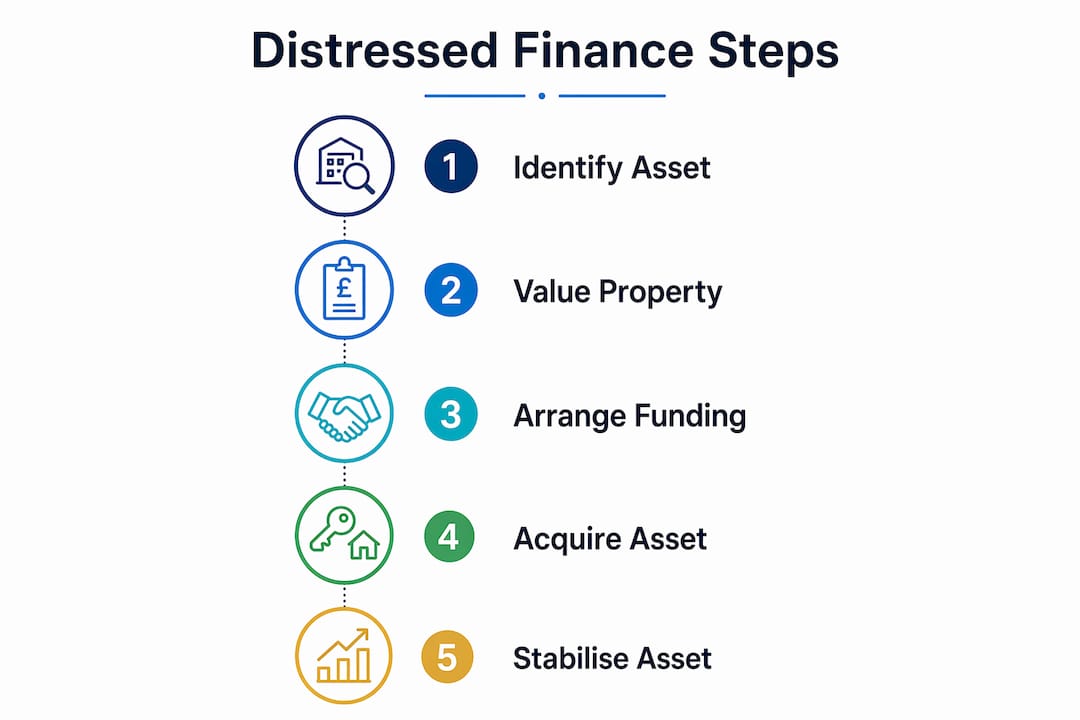
The primary financing vehicle is the bridge loan. Here is how the typical structure works in practice:
- Loan assessment based on ARV. Lenders focus on the After-Repair Value of the property rather than its current distressed condition. Bridge loans for distressed assets typically provide 6 to 36 months of financing, with underwriting centred on a projected Debt Service Coverage Ratio of 1.25x once the asset is stabilised.
- Loan-to-value is conservative. Specialist lenders will typically advance 65% to 75% of the distressed property’s current value, or a higher percentage against ARV, depending on the exit strategy’s credibility.
- Speed of execution is paramount. Distressed sellers and insolvency practitioners are not waiting for a 12-week mortgage process. Specialist lenders can move in days rather than months, which is often the decisive factor in winning the deal.
- Exit strategy is non-negotiable. Bridge loans require a credible exit plan to avoid expensive refinancing or forced sales at the end of the term. Lenders will scrutinise whether you are refinancing onto a commercial mortgage, selling, or refinancing into development finance.
- Documentation preparation is critical. Investors who arrive with a forensic valuation, a clear business plan, and evidence of comparable transactions move through credit committees far faster than those who do not.
Pro Tip: Commission an independent Red Book valuation that addresses both the current as-is value and the projected ARV before approaching any lender. This single step can shorten your credit approval timeline significantly and strengthen your negotiating position on pricing.
The role of specialist lenders, family offices, and private credit funds is central to this market. These are the institutions with mandates to lend against impaired collateral, complex title situations, and assets in receivership. Understanding how to arrange bridge finance for property deals is a prerequisite for anyone serious about distressed acquisitions.
Legal and operational nuances in distressed acquisitions
This is where many investors underestimate the complexity. The legal structure of how you acquire a distressed asset has consequences that can outlast the investment itself. Getting this wrong is expensive.
In the UK and internationally, there are several out-of-court acquisition mechanisms that offer faster routes than formal insolvency proceedings:
- Receivership sales: A receiver appointed by the lender sells the asset to recover the debt. These transactions move quickly and the receiver has a duty to obtain a proper price, but the buyer takes the asset in its current legal and physical state.
- Assignment for the Benefit of Creditors: ABC sales allow near-simultaneous asset transfer and closing with creditor notice, but they lack the full protections of a formal bankruptcy court sale.
- Non-performing loan portfolio sales: Private off-market sales of non-performing loans allow lenders to exit operational liabilities and generate immediate liquidity, and are increasingly common as lenders seek to clean up balance sheets.
The critical risk to understand is successor liability. When a buyer appears to be a continuation of the distressed seller, or when the transaction resembles a merger rather than an arm’s length asset purchase, successor liability risks arise and can expose the buyer to the seller’s historic legal claims, tax liabilities, and employee obligations. Creative structuring through a special purpose vehicle or careful transaction design can mitigate this, but it requires specialist legal input from day one.
Foreclosure is frequently avoided in distressed commercial real estate because it converts a financial asset into an operating liability. The consequences include rapid cap rate decompression, receiver fees, and insurance premiums that can triple overnight. Lenders know this, which is why they are often motivated to sell debt or negotiate rather than enforce.
Operationally, distressed assets frequently carry deferred maintenance, planning complications, environmental issues, or tenant disputes. Turnaround management, whether that means bringing in a specialist asset manager or restructuring leases, is part of the value creation thesis. Investors who treat distressed acquisitions as purely financial transactions without addressing operational realities rarely achieve their projected returns.
Strategic opportunities and risks in distressed investing

The appeal of distressed asset investment is straightforward: you are acquiring something below its intrinsic value, and the gap between purchase price and stabilised value is your return. The execution, however, is where the opportunity either materialises or evaporates.
Here is a comparison of the most common distressed finance strategies and their risk and reward profiles:
| Strategy | Structure | Risk level | Typical return profile |
|---|---|---|---|
| Bridge-to-stabilise | Short-term bridge loan, refurbish, refinance | Medium | 15%–25% equity uplift on stabilisation |
| Loan-to-own | Acquire debt at discount, convert to equity | High | Control of asset at below-market basis |
| Receivership purchase | Buy from receiver at auction or private sale | Medium-high | Discount to market, execution risk |
| NPL portfolio acquisition | Buy non-performing loan book from lender | High | Spread between purchase price and recovery |
| Development rescue finance | Inject capital into stalled scheme | Very high | Development profit if scheme completes |
Distressed debt investing differs fundamentally from conventional property investment because financial statements are unreliable, legal timelines are uncertain, and the information asymmetry between seller and buyer is extreme. Due diligence in this context is not a box-ticking exercise. It is forensic.
The loan-to-own strategy deserves particular attention. Acquiring debt at a discount with intent to convert into equity via restructuring requires deep legal and financial expertise, but it gives the creditor significant leverage over the restructuring process. For investors who understand the mechanics, it is one of the most powerful tools available.
Pro Tip: Before committing to any distressed acquisition, stress-test your exit strategy against a scenario where the market moves 15% against you and your bridge term extends by six months. If the deal still works under those conditions, you have a genuine margin of safety. If it does not, reprice or walk away.
The risks are real. Market timing, liquidity constraints, unexpected legal outcomes, and the sheer complexity of distressed asset management all create execution risk that conventional property investment simply does not carry. The investors who succeed consistently are those who treat legal structure, financing terms, and operational planning with the same rigour as the purchase price itself.
My perspective on distressed finance in 2026
I have worked on enough distressed transactions to know that the investors who lose money almost never lose it because they paid too much. They lose it because they got the legal structure wrong, moved too slowly, or underestimated the operational complexity of the asset they acquired.
The 2026 UK market presents a genuine window. The CRE maturity wall is real, stalled development sites are accumulating, and lenders are increasingly motivated to exit positions they would rather not manage. That creates pricing dislocation that sophisticated investors can exploit.
What I consistently see, though, is investors fixating on the discount and underweighting everything else. The asset is cheap for a reason. Your job is to determine whether that reason is temporary and solvable, or structural and permanent. Getting that judgement right requires legal counsel who understands distressed transactions, a lender who has seen these situations before, and an honest assessment of your own operational capability.
Speed matters enormously in this market. The deals that get done are won by investors who have their financing pre-arranged, their legal team briefed, and their due diligence framework ready before the opportunity surfaces. Preparation is not a nice-to-have. It is the competitive advantage.
— James
How Jwcapital structures distressed property finance
At Jwcapital, we work specifically with property investors and developers who are pursuing distressed acquisitions, receivership purchases, and development rescue situations across the UK. We understand that these transactions do not fit standard lending criteria, and we have built a lender network, including family offices, private credit funds, and specialist bridge lenders, that is designed precisely for this type of deal.
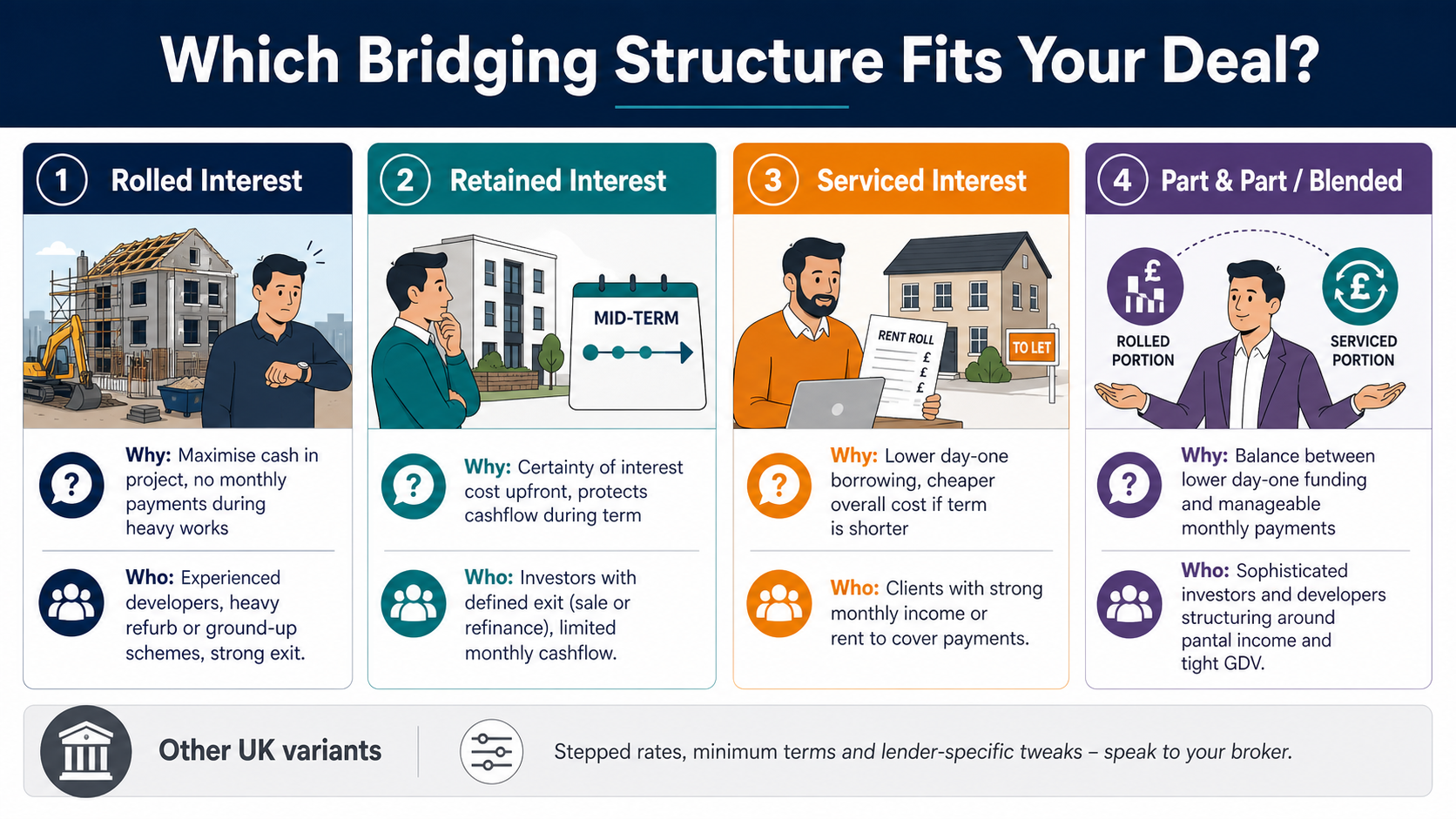
Whether you need short-term bridge finance to complete a receivership purchase, mezzanine debt to plug a funding gap on a stalled scheme, or a structured multi-layered debt stack for a larger distressed portfolio acquisition, our specialist property finance services are structured around speed and execution. We act as a single point of contact for structuring, negotiation, and lender engagement, so you are not managing multiple relationships under time pressure.
If you want to see how we have applied these structures in practice, our case studies cover a range of distressed and complex transactions. For investors ready to explore their options, speak to our team directly.
FAQ
What are distressed assets in UK property?
Distressed assets are properties or loans where the owner or borrower is under severe financial pressure, typically due to default, insolvency, or inability to service debt. In UK real estate, this includes repossessed properties, stalled development sites, and commercial assets with non-performing loans attached.
How does distressed asset finance differ from a standard mortgage?
Distressed asset finance, typically structured as a bridge loan, is assessed on the property’s After-Repair Value and projected cash flow rather than the borrower’s credit profile. It is provided by specialist lenders rather than high street banks, and terms are short, usually 6 to 36 months, with a defined exit strategy required.
What is a loan-to-own strategy?
A loan-to-own strategy involves acquiring distressed debt at a discount with the intention of converting it into equity ownership through restructuring or insolvency proceedings. It requires significant legal and financial expertise but allows the investor to gain control of an asset at a below-market cost basis.
What legal risks should I be aware of in distressed acquisitions?
The primary legal risk is successor liability, where a buyer may inherit the distressed seller’s historic legal claims or obligations if the transaction resembles a merger. Out-of-court acquisition mechanisms such as receivership sales and Assignments for the Benefit of Creditors also lack the full protections of formal bankruptcy court sales.
Why do specialist lenders rather than banks finance distressed assets?
Traditional banks are constrained by regulatory capital requirements and credit policies that make distressed lending impractical. Specialist lenders, family offices, and private credit funds operate under different mandates that allow them to lend against impaired collateral, complex title situations, and assets in receivership, often at speed.
Recommended
Related Topics
Speak to a specialist
Discuss your finance with James directly
Whole-of-market specialist finance — bridging, development, commercial and residential. No call centres, no obligation. James reviews every enquiry personally.
New to specialist finance? How unbiased broker advice works · Deals we have completed
Explore Related Finance