
Published · Updated
what is exit financeWhat is exit finance? a guide for UK developers
By James Dawes, CeMAP, Founder, James William & Co Capital

TL;DR:
- Exit finance is a transitional loan that replaces expiring development or restructuring facilities, providing developers and businesses with time and capital to maximize outcomes. It includes development exit finance for property schemes and corporate exit finance for businesses emerging from insolvency, both aimed at smooth transitions. Proper planning and early application strengthen lenders’ confidence, enabling better terms and supporting strategic cash-flow management.
Exit finance is a specialist lending solution that replaces an expiring development loan or restructuring facility, giving developers and businesses the capital and time needed to complete a clean, profitable transition.
In UK property development, the term most commonly refers to development exit finance. This is a short to medium-term loan drawn down at or near practical completion, replacing the original development facility before it expires. In corporate contexts, the same phrase describes exit financing for companies emerging from Chapter 11 bankruptcy or formal restructuring, providing capital to settle creditor obligations and resume operations. Understanding exit finance means recognising it as a transitional tool, not a rescue product. It is designed for developers and businesses that have executed well but need more time, or better terms, to maximise their outcome.
What is exit finance and how does it work?
Development exit finance replaces existing development loans at or near practical completion, providing a short-term loan to extend marketing periods or refinance into a more suitable facility. The mechanics are straightforward. A developer completes a scheme, the original development loan approaches maturity, and rather than selling units under time pressure, the developer draws down an exit facility to buy breathing room. The exit lender repays the development lender, and the developer services the new loan while completing sales or lettings at optimal prices.
Corporate exit finance works differently. It provides capital post-bankruptcy to refinance existing debt, support operational costs, and fund working capital for future growth. The collateral is typically business assets rather than completed property. Both variants share the same core logic: replace a high-risk, short-term facility with something more appropriate for the next phase.
The key distinction from standard bridging finance is purpose. Bridging finance covers a gap between two events. Exit finance specifically addresses the transition out of a development or restructuring phase, with repayment tied to sales proceeds, refinancing, or resumed trading income.
What are the main types of exit finance?
The two primary forms serve very different borrowers, though both follow the same transitional principle.
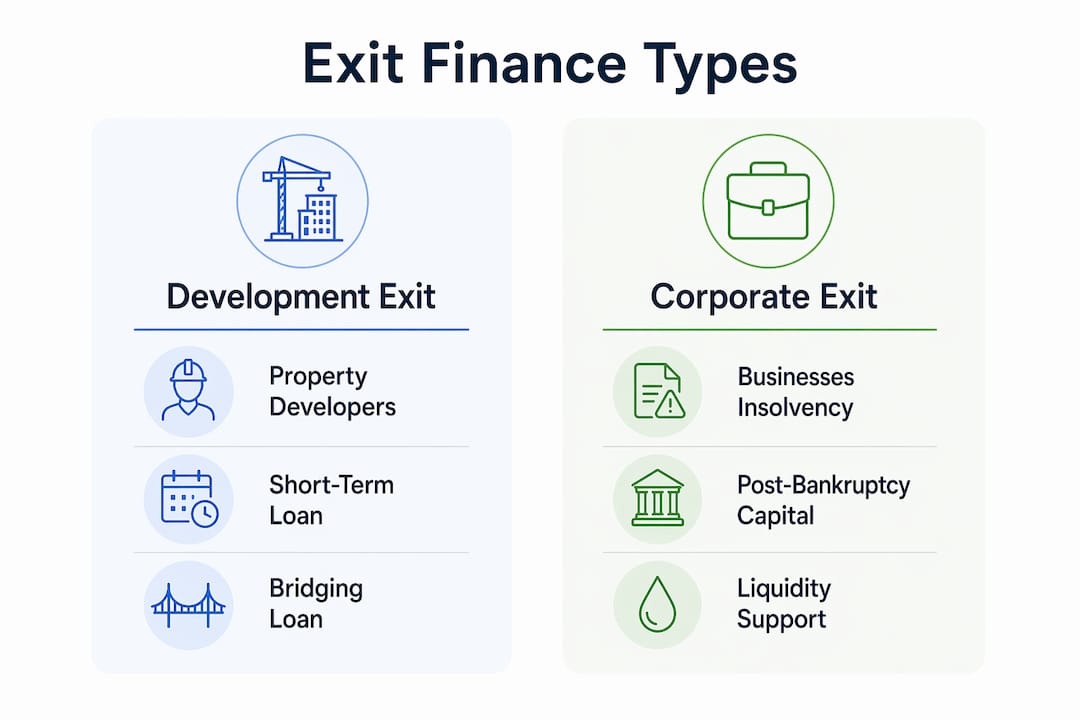
Development exit finance is the version most relevant to UK property professionals. It is structured as a bridging loan, typically running 6–18 months, secured against completed or near-completed residential or commercial property. The loan-to-value ratio is generally lower than a development loan because the asset risk has reduced post-build. Interest rates are also lower than construction-phase lending, reflecting the improved security position.
Corporate exit finance serves businesses leaving formal insolvency proceedings. It ensures business stability, liquidity, and operational momentum post-exit. It can be asset-based, structured around receivables, inventory, or property, and is negotiated as part of the restructuring plan itself.
| Feature | Development Exit Finance | Corporate Exit Finance |
|---|---|---|
| Borrower | Property developer or investor | Business emerging from insolvency |
| Security | Completed or near-complete property | Business assets, receivables, or property |
| Purpose | Replace development loan, extend sales period | Settle creditors, fund working capital |
| Typical term | 6–18 months | 12–36 months |
| Repayment trigger | Unit sales or refinance | Trading income or asset disposal |
| Risk profile | Asset-backed, lower post-build risk | Higher operational risk, complex structure |
The choice between these two types is rarely optional. Developers use development exit finance; restructuring businesses use corporate exit finance. What matters is understanding which applies to your situation and structuring the application accordingly.
What do lenders look for in a strong exit finance application?
Lenders assess exit finance applications differently from development loans. Lenders focus on exit visibility to mitigate risk rather than solely build progress. A completed building with no sales pipeline is a weaker application than a near-complete scheme with ten reservations and a credible sales schedule.
The documentation that carries the most weight includes:
- Sales schedules and reservation evidence. Active buyer interest, solicitor instruction letters, and exchange deposits all demonstrate real demand rather than projected demand.
- Quantity surveyor reports. An independent QS report confirming practical completion or near-completion status gives lenders confidence in the asset’s condition and value.
- Updated development appraisal. A current appraisal showing revised gross development value, remaining costs, and projected net proceeds tells the lender exactly how and when they will be repaid.
- Agent marketing evidence. Formal instruction letters from estate agents, current listings, and recent comparable sales support the valuation and the exit timeline.
Lenders assess remaining risks, repayment plans, and market conditions in underwriting. A developer who presents a scheme with clear unit pricing, active buyer interest, and a realistic 12-month sales forecast will always outperform one who submits a completed building with no sales activity and a vague plan to “sell when the market improves.”
Pro Tip: Prepare your exit finance application as a lender would read it. Lead with the exit strategy, not the build story. Lenders already know you built it. They want to know how they get repaid.

Timing is the other critical variable. Applying 3–6 months before your development facility expires avoids emergency borrowing and the significantly higher costs that come with it. Late applications force developers into a weaker negotiating position and often result in extension penalties or default interest on the expiring loan.
How does exit finance support investment strategies and cash flow?
Exit finance is a capital recycling tool as much as it is a refinancing product. The strategic benefits extend well beyond simply buying more time to sell units.
- Avoid distressed sales. A developer who must sell within 30 days of loan maturity will accept lower offers. Exit finance removes that pressure, allowing the developer to hold out for full market value.
- Transition to lower-cost debt. Exit finance transitions construction-focused development loans to income or asset-backed facilities with generally lower rates and longer terms. The interest saving across a 12-month exit facility on a £5 million scheme can be material.
- Optimise the letting strategy. Some developers choose to let completed units rather than sell, particularly in strong rental markets. Exit finance provides the runway to achieve full occupancy before refinancing onto a buy-to-let or commercial investment mortgage.
- Recycle equity into the next project. By refinancing rather than selling, a developer can extract equity from a completed scheme and deploy it as a deposit on the next acquisition, without waiting for a full sales programme to conclude.
Exit finance avoids extension penalties or default interest on expiring development loans. That alone can justify the cost of the facility. Default interest on a development loan typically runs at a punitive rate, and extension fees compound quickly. An exit facility at a lower rate, even with arrangement fees, frequently costs less than staying on an expired development loan.
Pro Tip: Model the exit finance scenario against the cost of a distressed sale before you decide. In most cases, the interest cost of a 12-month exit facility is less than the discount you would accept under sales pressure.
For investors considering how to reinvest proceeds from completed schemes, exit finance creates the structured pause needed to make that decision without pressure.
How does exit finance fit within UK property finance?
Exit finance occupies a specific position within the broader UK property finance spectrum. It sits between the development loan and the long-term investment mortgage, filling a gap that neither product covers well.
Standard development loans are designed for construction. They are drawn down in tranches, monitored by a monitoring surveyor, and priced to reflect construction risk. They are not designed to sit on a completed scheme for 18 months while a developer sells units. Buy-to-let and commercial investment mortgages require stabilised income, which a newly completed scheme with empty units cannot demonstrate. Exit finance bridges that gap without the distortion of forcing a developer into an inappropriate product.
| Finance Type | Stage | Security | Typical Term |
|---|---|---|---|
| Development loan | Construction | Land and WIP | 12–24 months |
| Development exit finance | Post-completion | Completed property | 6–18 months |
| Bridging finance | Any gap | Property | 1–18 months |
| Buy-to-let mortgage | Stabilised income | Tenanted property | 2–25 years |
| Commercial investment mortgage | Stabilised income | Commercial property | 5–25 years |
The limitations of exit finance are worth acknowledging. It is not a long-term solution. It carries arrangement fees, interest costs, and a defined repayment date. A developer who uses exit finance without a credible exit plan simply defers the problem. The product works when the underlying asset is sound and the sales or letting strategy is realistic. It does not work as a substitute for a viable scheme.
For a full picture of UK development funding sources, exit finance is one component of a well-structured capital stack, not a standalone strategy.
Key takeaways
Exit finance is a transitional lending product that replaces expiring development loans or restructuring facilities, giving developers and businesses the time and capital to achieve the best possible outcome from a completed scheme or restructured business.
| Point | Details |
|---|---|
| Core definition | Exit finance replaces an expiring development loan at or near practical completion. |
| Two distinct types | Development exit finance and corporate exit finance serve different borrowers with different security and repayment structures. |
| Lender priority | Exit visibility, including sales schedules and reservation evidence, matters more to lenders than build completion alone. |
| Timing is critical | Apply 3–6 months before your development facility expires to avoid emergency borrowing and higher costs. |
| Strategic value | Exit finance prevents distressed sales, reduces interest costs, and creates space to recycle capital into the next project. |
Exit finance is a planning decision, not a last resort
I have seen developers treat exit finance as something you reach for when things go wrong. That framing costs them money. The developers who use it most effectively plan for it from the outset, modelling the exit facility as a deliberate stage in the capital stack rather than an emergency measure.
The most common mistake I see is the late application. A developer completes a scheme in month 18 of a 24-month development loan, assumes the remaining six months is enough time to sell, and then finds themselves in month 23 with four units unsold and a lender threatening default interest. At that point, the exit finance market knows you are under pressure. Your negotiating position is weak, and the terms reflect it.
The developers who come to James William & Co early, with a clear sales schedule and realistic pricing, consistently secure better terms. Lenders respond to transparency. A developer who says “I have 12 units, eight are reserved, four are actively marketed at £X, and I need 12 months to complete the sales programme” is a fundamentally different credit to one who says “I need more time.”
Exit finance is also not just for residential schemes. Commercial developers, mixed-use schemes, and build-to-rent projects all use exit facilities to transition from construction debt to appropriate long-term financing. The product is flexible. The discipline required to use it well is not complicated. Plan early, document thoroughly, and present a credible exit strategy.
Specialist exit finance structuring with james william & co
James William & Co Capital works with UK property developers and investors to structure exit finance facilities that fit the specific demands of each scheme.
Whether you are approaching the end of a development loan on a residential scheme, managing unsold inventory on a mixed-use project, or refinancing a completed commercial development, James William & Co arranges facilities across the full spectrum of specialist property finance options. The firm works with private credit funds, family offices, and specialist lenders to deliver terms that reflect the quality of your scheme, not the pressure of your timeline. If you are within six months of development loan maturity, speak to James William & Co now. Early engagement consistently produces better outcomes.
FAQ
What is exit finance in UK property development?
Exit finance is a short to medium-term loan that replaces an expiring development facility at or near practical completion. It gives developers more time to sell or let completed units without the pressure of an expiring construction loan.
How does exit finance differ from bridging finance?
Bridging finance covers a gap between two events, such as a purchase and a sale. Exit finance specifically replaces a development or restructuring facility and is structured around a post-completion asset with a defined sales or refinancing exit.
When should i apply for development exit finance?
Apply 3–6 months before your development facility expires. Late applications reduce your negotiating position and can result in emergency borrowing at significantly higher costs.
What do lenders prioritise in exit finance applications?
Lenders prioritise exit visibility over build progress. Clear sales schedules, reservation evidence, quantity surveyor reports, and a credible repayment plan carry more weight than a completion certificate alone.
Can exit finance be used for commercial property schemes?
Exit finance applies to residential, commercial, and mixed-use schemes. The key requirement is a completed or near-complete asset with a credible sales, letting, or refinancing strategy that demonstrates how the lender will be repaid.
Recommended
Related Topics
Speak to a specialist
Discuss your finance with James directly
Whole-of-market specialist finance — bridging, development, commercial and residential. No call centres, no obligation. James reviews every enquiry personally.
New to specialist finance? How unbiased broker advice works · Deals we have completed
Explore Related Finance