
Published · Updated
what is hard cost financingWhat is hard cost financing for property developers
By James Dawes, CeMAP, Founder, James William & Co Capital
TL;DR:
- Understanding and properly managing hard cost financing is crucial for preventing project stalls and controlling cash flow.
- Lenders release funds through a staged draw schedule verified by inspections, with lien waivers being a key documentation requirement.
Most developers assume hard costs are the straightforward part of a construction budget. They are the bricks, the steel, the labour. Fixed, tangible, predictable. That assumption is where most financing problems begin. Understanding what is hard cost financing, how lenders treat these costs, and what controls exist around fund release is not optional knowledge for serious developers. It is the difference between a project that flows and one that stalls at the worst possible moment. This article covers the mechanics, the lender logic, and the practical strategies that experienced UK developers use to stay in control.
Table of Contents
- Key takeaways
- What is hard cost financing and how do hard and soft costs differ?
- How hard cost financing works in practice
- Hard money loans and their role in construction financing
- Practical tips for managing hard cost financing
- My honest view on hard cost financing in the UK market
- How Jwcapital supports your hard cost financing
- FAQ
Key takeaways
| Point | Details |
|---|---|
| Hard costs dominate the budget | Physical construction costs typically represent 70–80% of a total project budget, making them the primary financing focus. |
| Draw schedules control fund release | Lenders release hard cost funds in stages tied to verified milestones, not in a single lump sum. |
| Documentation prevents delays | Missing lien waivers are the leading cause of draw delays, blocking fund release even when work is complete. |
| Hard money loans offer speed at a price | Asset-based hard money loans close in days but carry 10–15% interest, suited to time-sensitive deals. |
| Contingencies are non-negotiable | A 5–10% contingency on hard costs protects against material price volatility and structural surprises. |
What is hard cost financing and how do hard and soft costs differ?
Hard cost financing, explained simply, is the funding arranged specifically to cover the direct, physical costs of constructing a building. These are the costs you can see and touch: structural materials, groundworks, labour on site, mechanical and electrical installation, concrete, steel, glazing, roofing and all the physical components that transform a plot of land into a completed structure. Hard costs typically represent 70–80% of a total construction budget, which means they represent the single largest financing challenge on any development.
Soft costs, by contrast, cover everything that supports the build but does not physically become part of it. Architects’ fees, planning permission costs, legal expenses, surveys, insurance, and project management all fall into the soft cost category. These are what are referred to as indirect costs in financing, and they typically account for 20–30% of the total project budget.
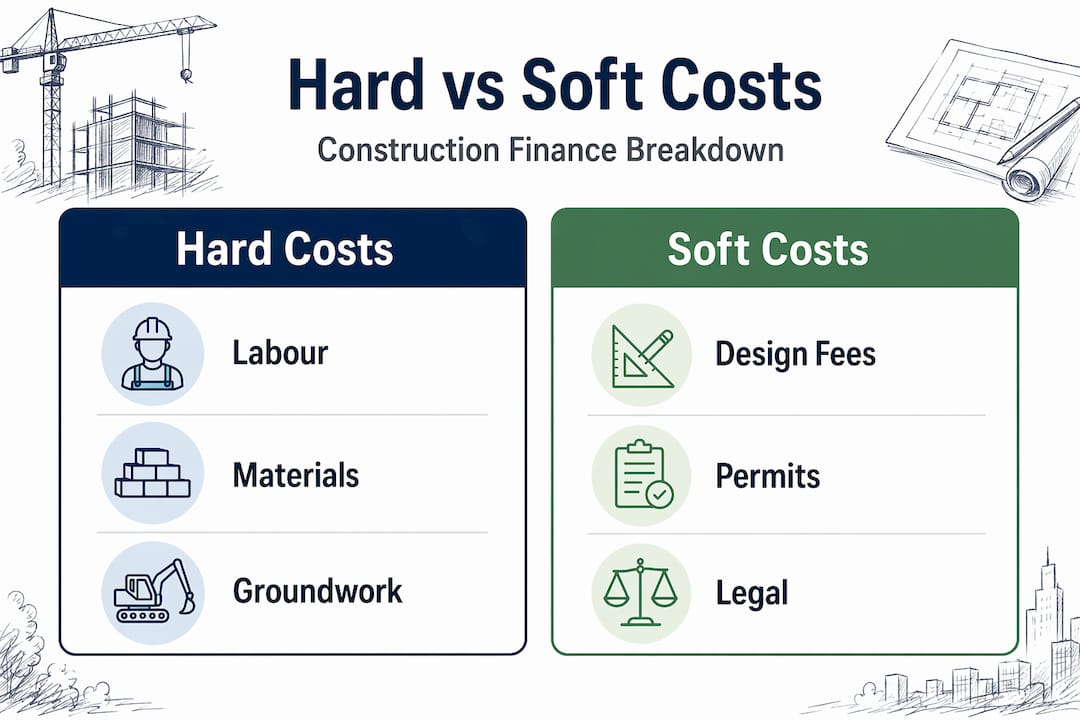
The distinction matters enormously in a financing context. Lenders treat hard costs and soft costs differently because they carry different risk profiles and different verification methods.
| Category | Examples | Typical budget share |
|---|---|---|
| Hard costs (direct) | Labour, materials, groundworks, M&E | 70–80% |
| Soft costs (indirect) | Planning, legal, architectural, surveys | 20–30% |
When you are structuring a development finance facility, your lender will almost always want a separate breakdown of hard and soft costs. The hard cost element drives the loan facility size, the draw schedule structure, and the monitoring requirements. Getting this breakdown right from day one is not administrative detail. It is the foundation of your entire funding structure.
Pro Tip: When presenting your cost plan to a lender, have your quantity surveyor produce a hard cost schedule that separates labour and materials by trade package. Lenders respond to specificity. A vague cost plan increases perceived risk and can reduce the LTC they are willing to offer.
How hard cost financing works in practice
The core mechanism of hard cost financing is the draw schedule. Rather than releasing the full facility on day one, lenders disburse funds in tranches as verified construction milestones are reached. This is not bureaucratic caution. The draw process is a fundamental lender risk control method that enforces a pay-for-performance model, ensuring that loan capital is only ever secured against completed, verified work.
A standard UK development finance facility will typically involve the following draw process:
- Initial advance. Released on or shortly after first drawdown, usually covering preliminary costs and mobilisation.
- Milestone-based tranches. Subsequent draws are tied to verifiable stages: foundations complete, superstructure to DPC, roof on, first fix complete, second fix and finishes, practical completion.
- Third-party inspection. Before each draw is released, the lender’s monitoring surveyor visits site to verify that the claimed milestone has been reached.
- Draw request submission. The developer submits a formal draw request with supporting documentation including cost certificates, contractor invoices, and lien waivers from subcontractors.
- Fund release. Once the monitoring surveyor signs off, the lender releases the next tranche directly to the developer or into a designated project account.
Typical construction loans involve 4 to 6 draws, each linked to a specific milestone. The timing between draws is equally important. Draws scheduled too frequently create administrative overhead, whilst draws spaced too far apart can starve contractors of cash, causing programme delays that cost far more than any monitoring fee.
One documentation requirement that catches developers out is the lien waiver. Failing to provide lien waivers from subcontractors is the leading cause of draw delays, blocking fund release even when the physical work has been completed and inspected. Set up a lien waiver collection process with your main contractor before the build begins.
Understanding financing hard costs means understanding that the draw schedule is not just a disbursement mechanism. It is the lender’s primary tool for protecting their position, and your primary tool for managing project cash flow. Treat it with the same rigour as your construction programme.
Hard money loans and their role in construction financing
Hard money loans occupy a specific and often misunderstood position in the world of examples of hard cost financing. They are short-term, asset-based loans where the underwriting decision rests on the value of the property, not on the personal credit history or trading record of the borrower. This single characteristic explains both their appeal and their cost.

Lenders cap LTC at 80–85% and typically limit total loan exposure to 60–70% of ARV, requiring developers to inject 15–20% equity into the deal. This matters when you are thinking about how to structure your hard cost financing alongside your equity contribution. The loan-to-cost metric tells the lender how much of the physical build they are financing. The after-repair value or gross development value metric tells them whether their security is sufficient if things go wrong.
The advantages of hard money lending are real and specific:
- Speed of execution. Hard money loans close in 3–10 days compared with 30–60 days for traditional bank finance, which is decisive in competitive acquisition situations.
- Approval based on property metrics, not borrower profile, opening access for developers who lack a long track record.
- Flexibility in deal structure, particularly for unusual assets or complex planning situations that mainstream lenders decline.
- Short hold periods that align with development and flip strategies.
The costs, however, are equally specific. Interest rates of 10–15% per annum are standard, and interest reserves mean developers effectively pay interest on interest during the construction hold period, pushing the true all-in cost of finance higher than the headline rate suggests. Arrangement fees, monitoring fees, legal costs, and exit fees all compound the expense. Hard money lending is not cheap finance. It is fast, flexible finance, and knowing when that trade-off makes commercial sense is the skill.
For UK property developers pursuing off-market acquisitions or distressed assets with tight timescales, hard money loans offer access that no high-street bank can match. For projects with longer hold periods and more conventional risk profiles, development finance from a specialist lender will almost always be more cost-effective.
Practical tips for managing hard cost financing
Getting the finance in place is one challenge. Managing it through an 18-month build is another. Most cost overruns and cash flow crises on development sites are not caused by bad lenders or bad luck. They are caused by poor draw schedule management and inadequate contingency planning.
Hard costs, despite appearing fixed, are vulnerable to local market changes and material price volatility, which is why a 5–10% contingency on hard costs is the standard recommendation for any project. That contingency needs to be explicitly budgeted and, ideally, agreed with your lender as part of the facility structure. A contingency line that exists only in your spreadsheet but not in the loan facility creates a dangerous gap.
Practical measures that experienced developers use to keep hard cost financing on track:
- Align your draw request dates with your contractor’s payment schedule to avoid funding gaps that trigger retention disputes.
- Build float into your milestone dates. If practical completion is targeted for month 18, request draws as if it is month 16.
- Monitor your interest reserve balance monthly. If the build programme slips, the interest reserve may be insufficient to cover the extended period without a facility amendment.
- Maintain a single point of contact with both your lender and your monitoring surveyor. Miscommunication between these two parties is a common source of unnecessary draw delays.
- Review your development funding structure before each draw, not just at the start, to catch any covenant drift early.
Pro Tip: Send your monitoring surveyor a brief progress report two weeks before each planned draw request. If they understand what they are going to see before they arrive on site, inspections move faster and draw approvals follow sooner.
My honest view on hard cost financing in the UK market
I have worked with enough developers to know that the biggest mistakes in hard cost financing happen before construction starts, not during it. The most common one is treating the cost plan as a document for the lender rather than a management tool for the developer. When the cost plan is built to satisfy a lender’s box-ticking process rather than to reflect the actual build programme, the draw schedule falls apart within two or three tranches.
What I have also seen consistently is that hard money loans get a worse reputation than they deserve. They are expensive, yes. But on a deal where speed genuinely matters, where a traditional lender’s 60-day process would simply cost you the site, the premium is rational. The mistake is using hard money finance on a project where you have the time and the profile to access cheaper capital. That is where the cost becomes punishing.
The market in 2026 continues to reward developers who understand their numbers at a granular level. Lenders are more forensic than they were five years ago. Monitoring requirements are tighter. The gap between a developer who understands hard cost financing and one who does not is not just academic. It shows up in the terms they receive, the speed of their draw approvals, and ultimately in their project margins.
— James
How Jwcapital supports your hard cost financing
At Jwcapital, structuring hard cost financing for UK developers is exactly what we do. Whether you need a ground-up development facility with a bespoke draw schedule, a hard money loan for a time-critical acquisition, or a multi-tranche structure that layers senior debt with mezzanine capital, we have the lender relationships and the structuring expertise to put the right facility together.
We work across London and the wider UK market, connecting developers and investors with family offices, private credit funds, and specialist lenders who understand complex projects. Our specialist property finance team handles lender negotiations, draw schedule design, monitoring surveyor coordination, and covenant management as part of a single, joined-up service. You get one contact who understands every layer of your deal, from land acquisition through to exit. If you want to see how we have structured deals for other developers, our case studies walk through the detail. Get in touch to discuss your project.
FAQ
What does hard cost financing cover?
Hard cost financing covers the direct, physical costs of construction: labour, materials, groundworks, and mechanical and electrical installation. These costs typically represent 70–80% of a total project budget and are funded via a draw schedule tied to verified milestones.
How many draws are typical in a UK construction loan?
Most construction finance facilities involve 4 to 6 draws, each linked to a verifiable milestone such as foundations, superstructure, roof, or practical completion, with a monitoring surveyor inspection required before each fund release.
What is the difference between hard costs and soft costs in financing?
Hard costs are direct, physical construction expenses, whilst soft costs cover indirect supporting costs such as planning fees, legal costs, and professional fees. Lenders treat them differently because hard costs are verifiable on site, whilst soft costs require documentation-based verification.
When does a hard money loan make sense for a developer?
A hard money loan makes sense when speed is the overriding factor, such as competitive acquisitions or distressed asset purchases, where a traditional lender’s 30 to 60-day approval process would cost you the deal. The 10–15% interest cost is the trade-off for that speed and asset-based flexibility.
What causes delays in hard cost draw releases?
The most common cause of draw delays is missing or incomplete lien waivers from subcontractors and suppliers. Even when construction work is physically complete and verified, lenders will not release funds without the full documentation package in place.
Recommended
Related Topics
Speak to a specialist
Discuss your finance with James directly
Whole-of-market specialist finance — bridging, development, commercial and residential. No call centres, no obligation. James reviews every enquiry personally.
New to specialist finance? How unbiased broker advice works · Deals we have completed
Explore Related Finance