
Published · Updated
what is leasehold lendingWhat is leasehold lending? A UK investor's guide
By James Dawes, CeMAP, Founder, James William & Co Capital
TL;DR:
- Leasehold lending in the UK involves securing debt against a time-limited property interest, making lease length and lease clauses critical for mortgage eligibility.
- Recent reforms aim to reduce ground rent and improve enforceability, potentially easing mortgage access for affected properties.
- Investors should prioritize long leases, proper lease drafting, and early extension strategies to optimize financing and asset value.
Leasehold lending is one of the most misunderstood areas of UK property finance, and the confusion costs investors money. Unlike freehold ownership, where your mortgage is secured against full land and building title, leasehold lending means securing debt against a time-limited interest in a property. The lease itself becomes the collateral. That distinction changes everything: how lenders assess risk, what terms they will accept, and how your investment performs over time. If you hold or are considering leasehold assets, understanding how this type of finance works is not optional. It is fundamental.
Table of Contents
- Key takeaways
- What is leasehold lending?
- How lease terms affect mortgage eligibility
- UK leasehold reforms and what they mean for lending
- Leasehold vs freehold financing: what investors need to know
- Practical steps for securing leasehold mortgages
- My perspective on leasehold lending
- How Jwcapital supports leasehold property financing
- FAQ
Key takeaways
| Point | Details |
|---|---|
| Leasehold as collateral | A leasehold mortgage is secured against the tenant’s interest, not the land itself, making lease length critical. |
| Minimum lease requirements | Most mainstream lenders require at least 75 to 80 years remaining after the mortgage term ends. |
| Specialist lenders fill the gap | Where mainstream lenders decline short leases, specialist lenders offer structured leasehold loan options. |
| UK reforms are changing the market | The Commonhold and Leasehold Reform Bill targets ground rent and forfeiture rules affecting approximately 3.8 million properties. |
| Lease terms drive eligibility | Mortgageability depends as much on lease clauses around consent and default cure rights as on lease length alone. |
What is leasehold lending?
Leasehold lending refers to mortgage finance secured against a leasehold interest rather than freehold ownership. To understand why that matters, you need to understand leasehold vs freehold at a structural level.
When you own a freehold property, you own the land and the building outright. A leasehold interest grants you the right to occupy and use a property for a defined period, after which that right reverts to the freeholder. The lease might run for 125 years on a flat or 999 years on a commercial ground lease. In every case, the interest is finite. A leasehold mortgage is therefore a lien over the tenant’s leasehold interest only. It does not touch the landlord’s freehold title.
In a ground lease structure, the most common leasehold lending context for commercial and development finance, the landlord retains land ownership and the tenant finances improvements or development. The leasehold mortgage sits solely over the tenant’s estate. Three parties define the structure:
- The lessor (freeholder/landlord): Retains the freehold and grants the lease. Their title is not encumbered by the tenant’s mortgage.
- The lessee (tenant/borrower): Holds the leasehold interest and offers it as security to the lender.
- The lender: Takes a charge over the leasehold estate, with rights to step in, cure defaults, and potentially assume the lease if the borrower fails.
Understanding leasehold agreements from this three-party perspective is what separates well-structured leasehold property financing from arrangements that collapse at the first sign of stress. The lender’s rights are entirely dependent on what the lease permits. Draft it badly, and the lender has weak remedies. Draft it well, and the finance flows freely.
How lease terms affect mortgage eligibility
The most visible factor in leasehold lending underwriting is lease length. Mainstream lenders typically require 75 to 80 years remaining on the lease after the mortgage term expires. A 25-year mortgage on a property with 90 years left would just about satisfy that threshold for some lenders. Drop to 85 years remaining with the same mortgage term, and you start falling outside standard criteria.

Specialist lenders are considerably more flexible, though they price that flexibility into their rates and conditions. The comparison below shows how requirements typically differ:
| Lease length remaining | Mainstream lender position | Specialist lender position |
|---|---|---|
| 100 years or more | Readily accepted | Readily accepted |
| 80 to 99 years | Usually accepted | Accepted, standard terms |
| 65 to 79 years | Often declined | Accepted with conditions |
| Under 65 years | Typically declined | Case-by-case, higher rates |
| Under 40 years | Not considered | Rarely accepted |
Lease length is only part of the assessment. Underwriting leasehold mortgages demands a detailed read of the lease document itself. Lenders look for clauses covering:
- The right to mortgage or charge the leasehold interest without requiring landlord consent each time, or at least with consent not unreasonably withheld.
- Notice provisions requiring the landlord to notify the lender of any default before taking action against the tenant.
- Cure rights, allowing the lender to remedy a breach and prevent lease forfeiture before it is too late.
- Transfer and assignment mechanics that allow the lender to dispose of the security if they need to enforce.
Effective lease drafting that anticipates these requirements can make the difference between a deal that funds in weeks and one that stalls for months. Lenders need evidence that they can control their position if things go wrong.
Pro Tip: Before submitting a leasehold mortgage application, commission a full lease review from a property solicitor experienced in mortgage finance. Identifying deficient clauses early gives you time to negotiate a deed of variation with the freeholder, rather than losing the deal at the underwriting stage.
UK leasehold reforms and what they mean for lending
The UK’s leasehold system is in the middle of significant legislative change. The draft Commonhold and Leasehold Reform Bill represents the most substantial overhaul of residential leasehold law in decades. Its implications for leasehold property financing are considerable.
Approximately 3.8 million leasehold properties are affected by the proposed legislation. The key changes with direct lending implications include:
- Ground rent caps: Ground rents are to be capped at £250 per year for 40 years, after which they convert to a peppercorn. This removes the escalating ground rent structures that have previously made some leasehold flats unmortgageable.
- Forfeiture reform: The current forfeiture regime, under which landlords can theoretically recover a property worth hundreds of thousands of pounds over a disputed service charge of a few hundred pounds, is being replaced with a statutory enforcement scheme. This removes a significant lender risk.
- Commonhold expansion: The government is pushing to make commonhold the default ownership structure for new flats, which would eventually eliminate new leasehold flat creation.
- Extended lease rights: Easier, cheaper lease extensions reduce the risk that lease terms will erode to mortgage-limiting lengths.
These reforms improve lender confidence and mortgage access for leasehold buyers. However, the timeline for implementation remains uncertain. Investors holding existing leasehold assets should not assume these protections are in place today. The transitional period creates genuine uncertainty for both lenders and borrowers navigating leasehold loan options in the near term.
Leasehold vs freehold financing: what investors need to know
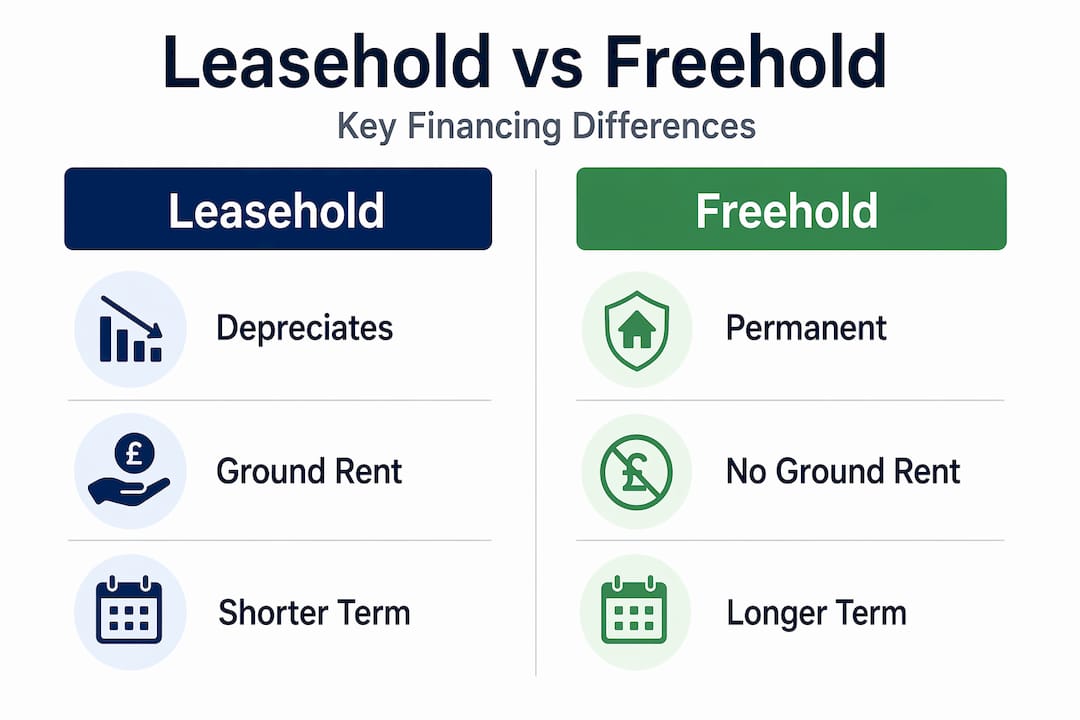
The differences between leasehold and freehold financing go beyond lease length. They affect how lenders price risk, how investors exit, and how much your asset is worth at refinance.
| Factor | Leasehold | Freehold |
|---|---|---|
| Collateral | Depreciating interest (lease term reduces) | Permanent ownership interest |
| Loan-to-value | Often lower, reflecting diminishing asset | Higher LTVs typically available |
| Mortgage cost | Potentially higher rates, depending on term | Standard market rates |
| Refinancing | Harder as lease shortens | Straightforward |
| Resale | Restricted once below 80 years | No lease-related restriction |
| Ground rent exposure | Yes, ongoing liability | None |
The core risk with leasehold collateral is that the asset depreciates as the lease runs down, even if the building itself holds value. A flat with 60 years remaining is materially worth less than an identical flat with 100 years. Investors who ignore this dynamic when building a portfolio are setting up future refinancing difficulties.
For property investors considering leasehold property financing, the key considerations are:
- Acquire leasehold properties with long leases, ideally 125 years or more, particularly for buy-to-let portfolios where long-term hold strategies are common.
- Budget for lease extension costs when purchasing shorter-lease assets. The earlier you extend, the lower the statutory premium typically.
- Consider how leasehold restrictions interact with your exit strategy. Selling a property with a short lease in a buyer’s mortgage market is difficult.
- In commercial and development contexts, ground lease structures can offer strong yields but require sophisticated intercreditor arrangements, particularly where landlord and tenant mortgages sit alongside each other in the debt stack.
Practical steps for securing leasehold mortgages
Securing leasehold finance without preparation wastes time and risks your deal. These steps will improve your chances of a clean, fast approval.
- Obtain and review the full lease document before approaching any lender. Know the remaining term, the ground rent provisions, and what consents are required for mortgaging.
- Check the ground rent level. Many lenders will not lend on leases where annual ground rent exceeds 0.1% of the property value. A £500,000 flat with a £600 annual ground rent can fail this threshold.
- Identify any defective clauses relating to default notice periods, assignment rights, and lender protections. Instruct a solicitor to advise on whether a deed of variation is needed.
- Extend the lease before applying if it is approaching or below 80 years. This is the single most effective thing you can do to restore full mortgage market access.
- Use a specialist broker for anything below mainstream criteria. Specialist lenders assess leasehold lending case by case. Knowing which lenders will consider your specific lease structure, and at what terms, saves months.
Pro Tip: When extending a lease, instruct solicitors who regularly act on Section 42 notices (formal statutory extension requests). Informal extensions negotiated directly with freeholders sometimes include clauses that create new mortgage complications, particularly around ground rent and break rights.
For investors structuring more complex deals, including ground leases, build-to-suit arrangements, or development finance on leasehold sites, the funding structuring guidance available for UK developers offers a useful framework for understanding how leasehold interests sit within broader debt structures.
My perspective on leasehold lending
I have seen more deals fall apart over poorly drafted leases than over any other single issue in UK property finance. And the frustrating thing is that most of those failures were preventable.
The misconception I encounter most often is that lease length is the only thing lenders care about. It is not. I have seen 100-year leases declined because the assignment clause was defective and the lender had no credible enforcement route. I have also seen 65-year leases approved at competitive rates because the lease was well drafted, the borrower had a clear extension strategy, and the lender was a specialist with genuine appetite for the asset class.
The other thing investors consistently underestimate is the cumulative cost of leasehold over a 10 to 15-year hold period. Ground rent, service charges, and lease extension premiums compound. A freehold equivalent property may be more expensive to acquire but significantly cheaper to own and exit. That comparison rarely appears in investment appraisals, and it should.
My advice is to treat the lease as a financial instrument, not just a legal document. Read it commercially. Understand what it allows, what it restricts, and what it will cost to fix. If you are acquiring leasehold assets at scale, the time spent on lease due diligence before you commit is returned many times over in avoided problems and preserved finance options.
— James
How Jwcapital supports leasehold property financing
Leasehold lending requires lenders who understand the asset class and brokers who know which ones will actually commit. At Jwcapital, we structure specialist property finance for investors and developers working across all tenure types, including complex leasehold and ground lease transactions.
Whether you need a straightforward leasehold mortgage for a flat acquisition or a layered debt structure for a ground-up development on a leasehold site, our capital concierge approach gives you one point of contact for structuring, lender negotiation, and execution. We work with specialist lenders and private credit funds that mainstream brokers rarely access. Explore our specialist property finance services or visit the Jwcapital homepage to learn how we can support your next leasehold transaction.
FAQ
What is leasehold lending in the UK?
Leasehold lending is mortgage finance secured against a leasehold interest rather than freehold ownership. The lease itself is the collateral, and lenders assess its remaining term, enforceability, and key provisions before approving any loan.
How long does a lease need to be for a mortgage?
Most mainstream lenders require the lease to have at least 75 to 80 years remaining after the mortgage term ends. Specialist lenders can consider shorter terms on a case-by-case basis.
How do UK leasehold reforms affect mortgages?
The draft Commonhold and Leasehold Reform Bill caps ground rents and replaces forfeiture with a statutory enforcement scheme, which should improve mortgageability for many leasehold properties across the approximately 3.8 million affected homes.
What is the difference between a leasehold and freehold mortgage?
A freehold mortgage is secured against permanent ownership of land and building. A leasehold mortgage is secured against a time-limited interest that depreciates as the lease runs down, making it higher risk and subject to stricter lender criteria.
Can I extend my lease to improve my mortgage options?
Yes. Extending a lease, particularly to above 90 years, restores access to mainstream mortgage products and improves resale value. Statutory lease extensions under the Leasehold Reform Act give most flat owners the legal right to extend by 90 years on top of their existing term.
Recommended
Related Topics
Speak to a specialist
Discuss your finance with James directly
Whole-of-market specialist finance — bridging, development, commercial and residential. No call centres, no obligation. James reviews every enquiry personally.
New to specialist finance? How unbiased broker advice works · Deals we have completed
Explore Related Finance