
Published · Updated
what is property syndicationWhat is property syndication: a UK investor guide
By James Dawes, CeMAP, Founder, James William & Co Capital

You’ve likely heard that acquiring large commercial property requires massive capital outlay or full ownership. That’s a costly misconception. Property syndication allows UK developers and institutional investors to pool resources, share risk, and access prime assets that would otherwise remain out of reach. This guide explores the legal structures, regulatory landscape, risk management strategies, and practical application of syndication, equipping you to leverage this powerful investment approach for large-scale UK real estate opportunities.
Table of Contents
- Key takeaways
- What is property syndication and how does it work in the UK
- Legal and regulatory framework for UK property syndications
- Benefits and risks of property syndication compared to other investment approaches
- How property developers and institutional investors can apply syndication successfully
- Discover specialist property finance solutions
- Frequently asked questions
Key Takeaways
| Point | Details |
|---|---|
| Capital pooling advantage | Property syndication pools capital from multiple investors to fund large scale UK acquisitions. |
| Legal vehicle choices | Common vehicles include LLPs, limited companies, and SPVs with differing liability and tax implications. |
| Regulatory framework | FCA regulation applies with exemptions for certain investor types. |
| Governance and alignment | Sponsors retain operational control while investors hold economic interests and voting rights on major decisions. |
What is property syndication and how does it work in the UK
Property syndication is a joint investment structure where multiple parties combine capital to acquire commercial or large-scale residential property. Rather than purchasing assets individually, property syndication in the UK involves a small group around a dozen investors pooling capital for commercial properties with sponsor management and investor transparency. This collaborative approach unlocks access to business parks, retail centres, office blocks, and mixed-use developments that would demand prohibitive capital from a single buyer.
The typical syndicate comprises a sponsor and a group of passive investors. The sponsor identifies opportunities, structures deals, manages day-to-day operations, and coordinates exits. Investors contribute capital and receive proportional returns based on their stake. Most syndicates target hold periods of two to four years, aligning with value-add strategies such as refurbishment, lease restructuring, or planning permission enhancements.
Key operational characteristics include:
- Investor group size typically ranges from 6 to 20 participants, maintaining manageable governance
- Sponsors retain operational control whilst investors hold economic interests and voting rights on major decisions
- Capital calls follow defined schedules, with initial contributions covering acquisition and reserves for contingencies
- Profit distributions occur quarterly or annually, depending on cash flow and operating agreements
- Exit strategies are predetermined, often involving sale, refinance, or portfolio roll-up into larger vehicles
This model delivers distinct advantages over solo ownership. You gain exposure to institutional-grade assets whilst preserving capital for other opportunities. Optimising real estate funding through syndication allows diversification across multiple properties and sponsors. Transparency remains high because investors receive regular reporting and retain influence over strategic decisions. The structure also facilitates access to real estate funding sources that prefer larger deal sizes, improving leverage terms and reducing cost of capital.
Pro Tip: Prioritise syndicates where the sponsor commits meaningful co-investment alongside your capital. Aligned financial interests dramatically reduce principal-agent conflicts and improve decision-making quality.
Legal and regulatory framework for UK property syndications
Selecting the right legal structure determines liability exposure, tax efficiency, and operational flexibility. Legal structures include LLPs, Ltd companies, and SPVs; operating agreements govern profit sharing and control; sponsors typically contribute 5-20% equity. Each vehicle offers distinct trade-offs between simplicity, protection, and regulatory burden.

Limited Liability Partnerships provide tax transparency, passing profits directly to members without corporate tax. Members enjoy limited liability protection whilst maintaining flexibility in profit allocation. Limited companies offer straightforward governance and clear separation between the entity and shareholders, though they incur corporation tax before distributions. Special Purpose Vehicles isolate individual assets, ring-fencing risk and simplifying exits when syndicates hold multiple properties.
Operating agreements form the contractual backbone of every syndicate. These documents define:
- Profit and loss allocation formulas, often tiered to reward sponsor performance
- Voting thresholds for major decisions such as asset sales, refinancing, or capital expenditure
- Management fees, acquisition fees, and performance incentives for sponsors
- Transfer restrictions preventing members from selling interests without consent
- Dissolution triggers and exit procedures when hold periods conclude
Sponsor equity contributions signal commitment and align interests. Typical sponsor stakes range from 5% to 20% of total capital, demonstrating confidence in deal economics whilst preserving investor returns.
Regulatory compliance represents a critical consideration. Syndications often fall under FCA rules as CIS or AIFs, with exemptions for high-net-worth or sophisticated investors; Reserved Investor Funds provide new onshore, tax-transparent options. If your syndicate meets the definition of a Collective Investment Scheme, it requires FCA authorisation unless an exemption applies. High-net-worth investors with annual income exceeding £100,000 or net assets above £250,000 can participate in unauthorised schemes. Sophisticated investors certified by authorised persons also qualify for exemptions.
Reserved Investor Funds introduced in recent years offer tax-transparent onshore structures for qualifying investors, combining the benefits of offshore vehicles with UK regulatory oversight. RIFs allow investment by professional clients, high-net-worth individuals, and sophisticated investors whilst avoiding the complexity of offshore jurisdictions.
Non-compliance carries severe penalties. Operating an unauthorised CIS constitutes a criminal offence, exposing sponsors to prosecution and investors to unenforceable agreements. Ensuring your syndicate structure fits within regulatory boundaries or securing appropriate authorisation protects all parties from legal and financial jeopardy. Structured property finance professionals can guide you through classification and compliance requirements specific to your investment strategy.
Pro Tip: Engage FCA-experienced legal counsel before launching a syndicate. Classification as a CIS versus a joint venture hinges on subtle factors, and getting it wrong invalidates your entire structure.
Benefits and risks of property syndication compared to other investment approaches
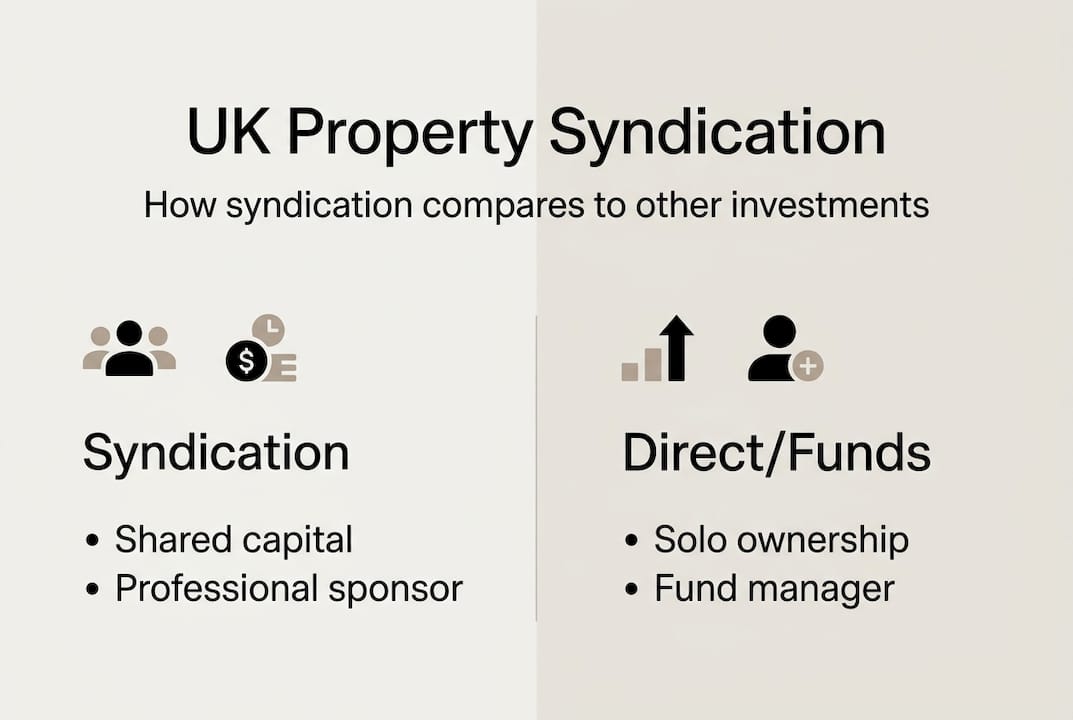
Understanding how syndication stacks up against direct ownership and funds clarifies when this strategy delivers optimal outcomes. Each approach involves distinct trade-offs in returns, control, capital requirements, and risk exposure.
| Factor | Direct ownership | Property syndicates | Property funds |
|---|---|---|---|
| Return potential | Highest (100% upside) | High (proportional stake) | Moderate (diluted by fees) |
| Control | Complete decision authority | Significant influence on major decisions | Minimal (manager discretion) |
| Capital requirement | Very high (full purchase price) | Moderate (proportional contribution) | Low (minimum investment thresholds) |
| Diversification | Single asset concentration | Limited (1-3 properties typical) | High (portfolio of assets) |
| Liquidity | Low (property sale required) | Very low (transfer restrictions) | Moderate to high (redemption windows) |
| Administrative burden | High (full management responsibility) | Low (sponsor handles operations) | None (manager responsibility) |
Syndicates offer higher returns and control versus funds, which provide diversification but diluted returns and no say; direct ownership provides full control but with higher capital barriers. For developers and institutional investors seeking meaningful stakes in prime assets without committing entire balance sheets, syndication occupies a strategic middle ground.
Yet syndication introduces specific risks that demand careful management:
- Illiquidity: Exiting before the planned hold period proves difficult. Operating agreements typically restrict transfers, and secondary markets for syndicate interests remain underdeveloped. Plan for capital to remain locked up for the full investment horizon.
- Personal liability: Without proper limited liability structures, members face exposure to partnership debts. Ensure your legal vehicle provides adequate protection.
- Tax complexity: Profit allocations, capital gains treatment, and international considerations require specialist advice. Mistakes trigger unexpected liabilities.
- Regulatory non-compliance: Operating outside FCA exemptions exposes sponsors to criminal liability and investors to unenforceable agreements.
- Operational risk: Poor property management, cost overruns, or market timing errors erode returns. Sponsor competence directly determines outcomes.
The Godwin Capital collapse investigation illustrates these dangers vividly. Risks include illiquidity, personal liability without limited status, tax complexities, FCA non-compliance, and operational risks; Godwin Capital failure shows dangers of poor governance. Investors lost millions when the sponsor mismanaged funds and failed to maintain adequate reserves. The case underscores the critical importance of due diligence, transparent reporting, and robust legal frameworks.
Mitigation strategies include:
- Securing assets with first-charge mortgages that protect investor capital ahead of sponsor interests
- Establishing clear fund flow waterfalls that prioritise investor returns before sponsor profit shares
- Requiring regular independent valuations and audited financial statements
- Implementing governance provisions that allow investor majorities to remove underperforming sponsors
- Maintaining adequate insurance coverage for property damage, liability, and key person risk
Staying informed about UK property finance trends helps you anticipate market shifts that impact syndicate performance. Interest rate movements, lending appetite, and regulatory changes all influence deal economics and exit opportunities.
Pro Tip: Insist on quarterly cash flow statements and annual third-party valuations. Transparency prevents small issues from becoming catastrophic losses.
How property developers and institutional investors can apply syndication successfully
Translating syndication theory into profitable practice requires systematic execution across structure selection, due diligence, compliance, and ongoing management. Follow this framework to maximise returns whilst controlling risk.
1. Select the optimal legal structure and ensure tax efficiency
For scaling prime assets, LLP/SPV structures offer tax efficiency and limited liability; prioritise FCA exemptions and aligned co-investment to avoid pitfalls. LLPs work well for UK tax residents seeking flow-through treatment. SPVs provide asset isolation when syndicates hold multiple properties. Limited companies suit situations requiring clear corporate governance or when international investors participate. Engage tax advisers early to model scenarios and identify the structure delivering the best after-tax returns for your investor base.
2. Perform robust due diligence and assess sponsor credibility
Investor protection begins with thorough vetting. Examine the sponsor’s track record across multiple market cycles. Request references from previous syndicate investors and verify claimed returns independently. Scrutinise the target property through professional surveys, title investigations, planning reviews, and environmental assessments. Model cash flows under stress scenarios, testing sensitivity to void periods, interest rate rises, and capital expenditure overruns. Never rely solely on sponsor projections.
3. Ensure FCA compliance and use Private Placement Memorandums
Document offerings comprehensively through Private Placement Memorandums that disclose all material risks, conflicts of interest, fee structures, and regulatory classifications. If your syndicate qualifies for high-net-worth or sophisticated investor exemptions, obtain and retain signed certificates confirming each investor’s status. Maintain these records meticulously because FCA enforcement actions often focus on documentation failures. Legal counsel should review all offering materials before circulation.
4. Align co-investment interests between sponsors and investors
Require sponsors to commit meaningful equity alongside your capital. Co-investment ratios of 10% to 20% create powerful alignment, ensuring sponsors share downside risk and avoid reckless decisions. Structure profit waterfalls that reward sponsors only after investors achieve preferred returns. Typical arrangements provide investors with 8% to 10% annual returns before sponsors receive performance fees, aligning incentives with capital preservation and growth.
5. Implement practical exit strategies and liquidity planning
Define exit pathways before committing capital. Common strategies include:
- Sale to third-party buyers after value-add initiatives complete
- Refinancing to return capital whilst retaining ownership for ongoing income
- Portfolio roll-ups where multiple syndicate assets consolidate into institutional funds
- Secondary market sales to other qualified investors, though liquidity remains limited
Build exit planning into operating agreements with clear timelines and decision thresholds. Avoid open-ended structures that leave investors trapped indefinitely.
6. Monitor operational and market risks continuously
Protecting returns requires active oversight throughout the hold period. Establish reporting cadences that provide visibility into occupancy rates, rental collections, capital expenditure, and debt service coverage. Track local market conditions, comparable transactions, and planning developments that affect property values. Implement governance rights that allow investor majorities to intervene if performance deteriorates or sponsors breach agreements.
Critical success factors for UK property syndication:
- Sponsor track record spanning multiple economic cycles with verified returns
- Transparent fee structures with no hidden charges or undisclosed conflicts
- Limited liability legal vehicles protecting investor assets
- Co-investment by sponsors demonstrating genuine commitment
- Regular independent valuations and audited financial statements
- Clear exit strategies with defined timelines and decision processes
- Governance provisions allowing investor intervention when necessary
Empirical evidence shows syndicates often outperform broad commercial indices when managed properly with transparent fund flows and secured assets. Success hinges on disciplined execution, rigorous due diligence, and continuous monitoring. Treat syndication as an active investment requiring ongoing attention, not a passive set-and-forget strategy.
Leverage specialist expertise to navigate complexities. Property development funding tips and capital advisory for property finance provide frameworks for structuring deals, securing optimal financing, and managing relationships with lenders and co-investors.
Pro Tip: Build relationships with multiple sponsors across different property sectors. Diversifying sponsor relationships reduces concentration risk and provides access to varied deal flow.
Discover specialist property finance solutions
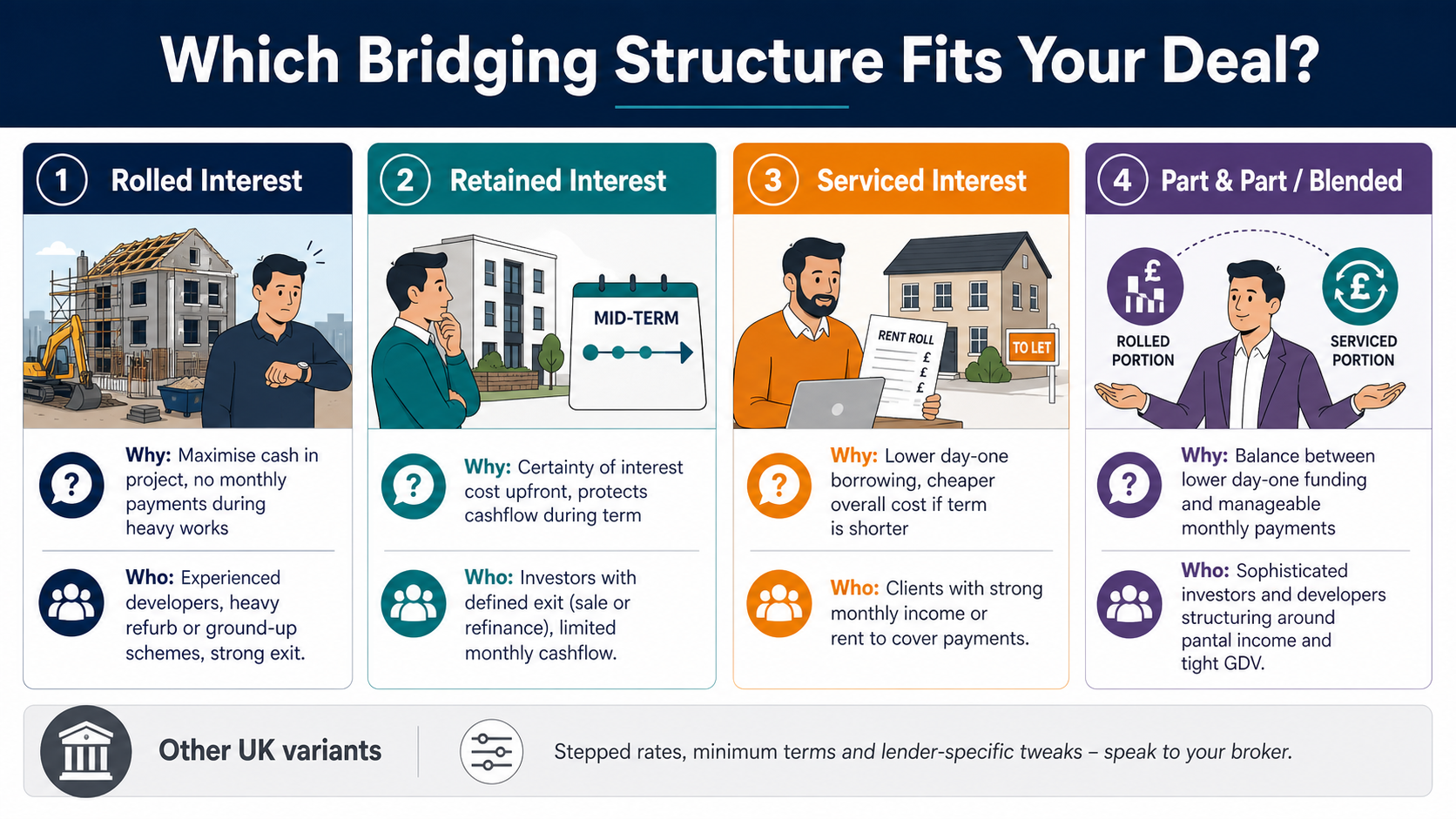
Navigating property syndication demands more than understanding structures and risks. You need access to sophisticated capital solutions that support large-scale acquisitions, refinancing, and development projects. James William & Co Capital specialises in arranging tailored finance for UK property developers, institutional investors, and high-net-worth clients pursuing complex real estate strategies. Whether you’re structuring syndicate debt, securing bridging finance for acquisitions, or arranging mezzanine layers to optimise returns, our capital concierge approach delivers rapid, bespoke solutions.
We work with family offices, private credit funds, and specialist lenders to structure multi-layered debt stacks, offshore vehicles, and covenant packages that traditional lenders won’t touch. Our track record demonstrates ability to execute under pressure, providing single-point-of-contact service from initial structuring through final drawdown. Explore our specialist property finance services to discover how we support syndicate investors and developers. Review our comprehensive property finance services portfolio or learn about strategic property wealth planning approaches that integrate syndication into broader investment strategies.
Frequently asked questions
What is property syndication?
Property syndication is a collective investment structure where multiple investors pool capital to acquire commercial or large-scale residential property. A sponsor identifies opportunities, manages operations, and coordinates exits whilst investors contribute capital and receive proportional returns. This approach provides access to institutional-grade assets without requiring full ownership or massive individual capital outlay.
What is the difference between a sponsor and an investor in a syndicate?
The sponsor identifies deals, structures legal entities, arranges financing, manages day-to-day property operations, and coordinates eventual exits. Sponsors typically contribute 5% to 20% equity and earn management fees plus performance incentives. Investors provide the majority of capital, hold economic interests proportional to their contributions, and retain voting rights on major decisions whilst remaining passive in daily operations.
How are profits distributed in property syndicates?
Profit distributions follow waterfalls defined in operating agreements. Common structures provide investors with preferred returns of 8% to 10% annually before sponsors receive performance fees. After preferred returns are satisfied, remaining profits split between investors and sponsors, often 70/30 or 80/20 favouring investors. Distributions occur quarterly or annually depending on property cash flow and agreement terms.
What are the main risks of property syndication and how can I mitigate them?
Key risks include illiquidity, personal liability without proper structures, tax complexity, FCA non-compliance, and operational failures. Mitigate these by selecting limited liability vehicles, performing thorough sponsor due diligence, requiring co-investment, establishing transparent reporting, securing first-charge protections, maintaining adequate insurance, and implementing governance rights that allow investor intervention. The Godwin Capital collapse demonstrates the catastrophic consequences of poor governance and inadequate oversight.
How is property syndication regulated in the UK?
Syndications may fall under FCA oversight as Collective Investment Schemes or Alternative Investment Funds. Exemptions exist for syndicates restricted to high-net-worth investors (annual income over £100,000 or net assets above £250,000) or sophisticated investors certified by authorised persons. Reserved Investor Funds offer tax-transparent onshore structures for qualifying investors. Operating unauthorised CIS without exemptions constitutes a criminal offence, making proper classification and compliance essential.
Recommended
Related Topics
Speak to a specialist
Discuss your finance with James directly
Whole-of-market specialist finance — bridging, development, commercial and residential. No call centres, no obligation. James reviews every enquiry personally.
New to specialist finance? How unbiased broker advice works · Deals we have completed
Explore Related Finance