
Published · Updated
what is specialist debtWhat is specialist debt: UK property developers' guide
By James Dawes, CeMAP, Founder, James William & Co Capital

Most UK property developers and high-net-worth investors mistakenly believe traditional bank loans represent the ceiling for real estate finance. In reality, specialist debt unlocks far higher leverage and bespoke terms tailored to complex projects that high-street lenders routinely decline. This guide demystifies specialist debt, explaining its mechanics, market trends, borrower profiles and practical application strategies. You’ll discover how layered debt structures, private credit funds and expert brokers enable ambitious acquisitions and ground-up developments with loan-to-cost ratios reaching 90%, transforming capital efficiency for sophisticated investors.
Table of Contents
- Key takeaways
- Defining specialist debt and its mechanics
- Understanding specialist debt nuances and borrower profiles
- Market trends and risk considerations in specialist debt
- Practical applications: optimising capital stacks with specialist debt
- Explore specialist property finance solutions
- Frequently asked questions
Key Takeaways
| Point | Details |
|---|---|
| Leverage up to ninety percent | Specialist debt can deliver leverage up to ninety percent of project cost, enabling more capital efficient developments. |
| Layered debt structure | Drawdowns are staged and verified by surveyors, with senior debt in first position and mezzanine layers in subordinated positions. |
| Private credit vital | Private credit funds and bespoke loan structures are increasingly vital in the UK market. |
| Optimised capital stacks | Developers and high net worth investors benefit from optimised capital stacks and expert brokers. |
Defining specialist debt and its mechanics
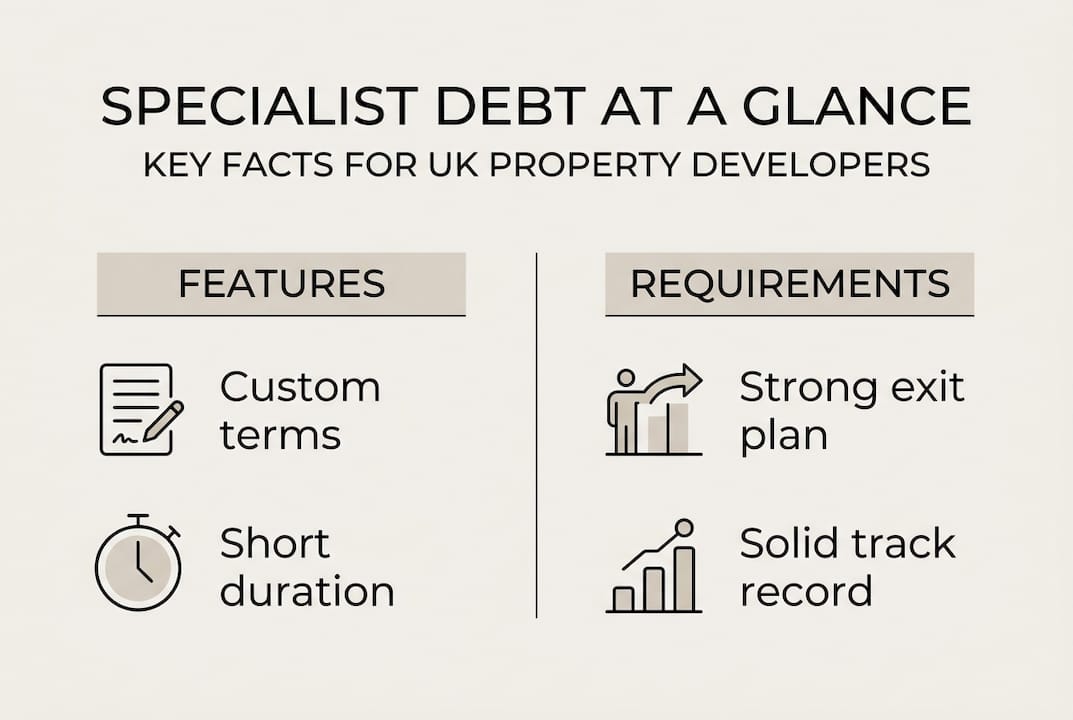
Specialist debt refers to customised finance designed specifically for complex UK real estate transactions that fall outside standard bank lending criteria. Unlike conventional mortgages offering fixed terms and conservative loan-to-value ratios, specialist debt provides flexible, project-specific funding for ground-up developments, large-scale acquisitions, heavy refurbishments and mixed-use schemes. These facilities typically combine higher leverage with tailored repayment structures, enabling developers and high-net-worth investors to pursue ambitious projects without tying up excessive equity capital.
The mechanics include staged drawdowns verified by surveyors, layered security charges, interest roll-up and balloon repayments. Senior debt sits in first position, secured by a primary charge over the property, whilst mezzanine layers occupy second or third positions with subordinated security. Lenders release funds in tranches as construction milestones are achieved, with independent monitoring surveyors certifying each stage before drawdown. Interest accrues as payment-in-kind, rolled into the outstanding balance rather than paid monthly, reducing cash drag during the build phase. Borrowers repay the entire facility via a balloon payment upon project completion, typically through refinancing onto long-term debt or outright sale.
Typical terms span 12 to 24 months, though extensions are negotiable for phased developments. Loan-to-cost ratios reach 70% to 90% depending on borrower experience, project risk profile and security quality. Senior debt usually covers 60% to 70% LTC at rates from 7% to 10% per annum, whilst mezzanine tranches fill the gap to 85% or 90% LTC at 12% to 18% annually. Exit fees, arrangement fees and monitoring costs add to the overall pricing, but the enhanced leverage often justifies these expenses for capital-efficient investors. Understanding these core features allows you to evaluate whether specialist debt aligns with your project economics and risk appetite, particularly when comparing against types of property finance available in the UK market.
Pro Tip: Always model multiple exit scenarios before committing to specialist debt. Ensure your refinancing or sales strategy accounts for potential market downturns, as balloon repayments leave no room for delays.
Understanding specialist debt nuances and borrower profiles
Not all developers and investors access specialist debt on identical terms. Lenders differentiate sharply between experienced operators with proven track records and first-time developers entering the market. Seasoned developers with multiple completed projects command higher loan-to-value ratios, lower interest rates and reduced covenant restrictions. Conversely, first-time developers face lower LTVs capped around 65% to 70% LTC, stricter monitoring requirements and mandatory personal guarantees to mitigate lender risk.
High-net-worth investors leverage bespoke solutions beyond standard development finance. Multi-currency facilities enable offshore clients to borrow in sterling whilst holding assets in other jurisdictions, hedging currency exposure. Lombard loans secured against investment portfolios provide liquidity without liquidating holdings, whilst hybrid structures blend property and asset finance for diversified security packages. Investment-backed interest-only mortgages allow HNW borrowers to service debt from portfolio income rather than property cash flow, preserving capital for additional acquisitions. These tailored arrangements require sophisticated legal and tax structuring, often involving offshore vehicles and cross-border covenant packages.
Intercreditor agreements become critical when layering multiple debt tranches. These legal documents define priority rankings, enforcement rights and information-sharing protocols between senior and junior lenders. Senior lenders retain first call on sale proceeds and control over major decisions, whilst mezzanine providers accept subordinated positions in exchange for higher returns. Standstill provisions prevent junior lenders from enforcing security during grace periods, giving borrowers breathing room to resolve issues. Negotiating balanced intercreditor terms protects all parties and ensures smooth execution, particularly when private credit funds and family offices participate alongside traditional lenders.
Facility sizes vary dramatically based on project scale and borrower credentials. Small-scale refurbishments might secure £500,000 to £2 million in specialist debt, whilst major mixed-use developments command £20 million to £100 million-plus facilities. Hybrid mezzanine and preferred equity solutions preserve borrower control by avoiding dilutive equity stakes, instead offering lenders enhanced returns through profit participation or conversion rights. This flexibility makes specialist debt attractive for developers unwilling to cede ownership but requiring capital beyond senior debt limits. Exploring property development funding tips reveals additional strategies for optimising borrower profiles and maximising facility terms.
“Specialist debt transforms capital efficiency by enabling developers to pursue multiple projects simultaneously, leveraging expertise across a diversified portfolio rather than concentrating equity in single assets.”
Market trends and risk considerations in specialist debt
The UK specialist debt market has evolved substantially as private credit funds with over £100bn AUM replace traditional banks constrained by post-2008 regulation. Debt funds, family offices and alternative lenders now dominate complex real estate finance, offering speed, flexibility and higher leverage than high-street institutions. This shift accelerated during 2024 and 2025 as banks retreated from development finance amid rising interest rates and economic uncertainty. Private credit providers stepped in, deploying capital rapidly with bespoke terms tailored to individual projects rather than rigid credit committee mandates.

Higher interest rates since 2022 have tightened lending covenants and increased scrutiny of borrower viability. Lenders demand robust feasibility studies, detailed cash flow projections and credible exit strategies before committing funds. Personal guarantees are now standard for mezzanine tranches, exposing borrowers to recourse beyond property security. Loan-to-value ratios have compressed slightly, with conservative lenders capping facilities at 75% to 80% LTC compared to pre-rate-rise peaks of 85% to 90%. These tighter conditions reflect heightened risk awareness, but opportunities remain for well-prepared developers with strong track records and resilient project economics.
Comparing traditional bank loans versus specialist debt highlights critical trade-offs. Banks offer lower interest rates, typically 4% to 6% over base rate, but impose stringent criteria, lengthy approval processes and conservative LTVs capped at 60% to 65%. Specialist debt providers charge 9% to 18% annually yet deliver faster decisions, higher leverage and flexible structures accommodating complex security arrangements. For time-sensitive acquisitions or projects requiring maximum capital efficiency, specialist debt often proves more viable despite higher costs. The table below summarises key differences:
| Feature | Traditional bank loans | Specialist debt |
|---|---|---|
| Interest rates | 4% to 6% over base | 9% to 18% per annum |
| Loan-to-value | 60% to 65% LTC | 70% to 90% LTC |
| Approval speed | 8 to 16 weeks | 2 to 6 weeks |
| Flexibility | Rigid criteria | Bespoke terms |
| Security | First charge only | Layered charges |
| Borrower profile | Established only | Experienced and novice |
Risk mitigation requires borrowers to maintain strong exit or refinance plans. Specialist debt’s short terms and balloon repayments create refinancing risk if projects overrun or markets soften. Developers must secure backup refinancing commitments, maintain liquidity buffers and stress-test projections against adverse scenarios. Mezzanine debt amplifies risk through higher costs and subordinated security, making robust project viability essential. Understanding these dynamics and staying informed about property finance trends 2026 positions you to navigate the specialist debt landscape confidently.
Pro Tip: Negotiate extension options upfront, even if you expect timely completion. A pre-agreed extension at a defined rate provides invaluable flexibility if unforeseen delays arise, avoiding expensive renegotiation under pressure.
Practical applications: optimising capital stacks with specialist debt
Building an effective capital stack using specialist debt requires methodical planning and expert guidance. Follow this stepwise process to maximise leverage whilst managing risk:
-
Define project economics and funding gap. Calculate total development costs, including land, construction, fees and contingencies. Determine how much equity you can commit and identify the funding shortfall requiring debt. Establish target loan-to-cost and loan-to-gross-development-value ratios based on project risk and exit strategy.
-
Engage a specialist broker early. Brokers access networks of private credit funds, family offices and alternative lenders unavailable to individual borrowers. They match your project profile with suitable lenders, negotiate terms and structure intercreditor agreements for layered debt. Broker fees typically range from 1% to 2% of facility size, but their expertise often secures better rates and higher leverage than direct approaches.
-
Structure senior and mezzanine layers strategically. Senior debt should cover 60% to 70% LTC at competitive rates, secured by a first charge. Mezzanine debt fills the gap to 85% or 90% LTC, accepting subordinated security for higher returns. Ensure intercreditor agreements clearly define priority, enforcement rights and standstill provisions to avoid conflicts during the project lifecycle.
-
Negotiate staged drawdown schedules aligned with milestones. Link fund releases to construction phases such as foundations complete, frame erected, watertight stage and practical completion. Independent monitoring surveyors certify each milestone, triggering drawdown. This structure protects lenders by ensuring funds match progress, whilst giving you capital as needed without over-borrowing.
-
Model exit scenarios rigorously. Specialist debt demands repayment within 12 to 24 months, so plan your refinancing or sales strategy from day one. Secure backup refinancing commitments, maintain relationships with long-term lenders and stress-test projections against market downturns. A credible exit plan reassures lenders and reduces covenant risk.
Key metrics to target include loan-to-cost ratios of 70% to 90%, loan-to-gross-development-value ratios below 65% and interest coverage ratios exceeding 1.2 times projected rental income. These thresholds balance leverage with viability, ensuring projects remain financeable even if costs overrun or values soften. The table below illustrates typical capital stack metrics for a £10 million development:
| Layer | Amount | % of total cost | Interest rate | Security |
|---|---|---|---|---|
| Equity | £1.5m | 15% | N/A | Residual |
| Mezzanine debt | £1.5m | 15% | 14% p.a. | Second charge |
| Senior debt | £7.0m | 70% | 9% p.a. | First charge |
| Total | £10.0m | 100% | Blended 9.8% | Layered |
Brokers play a pivotal role in optimising the capital stack, enabling leverage of 70% to 90% whilst minimising equity injection. They negotiate intercreditor terms, match borrowers with suitable lenders and structure bespoke covenant packages tailored to project specifics. This expertise proves invaluable for complex transactions involving offshore vehicles, multi-currency facilities or hybrid security arrangements. By integrating mezzanine and senior debt layers cautiously, you maximise capital efficiency without overextending risk, positioning your development for success in competitive UK markets. For further insights, explore how to optimise real estate funding using specialist debt strategies.
Explore specialist property finance solutions
Navigating specialist debt requires expertise, market access and tailored structuring. James William & Co Capital delivers bespoke specialist property finance solutions for UK developers and high-net-worth investors pursuing complex real estate projects. Our capital concierge approach provides a single point of contact for end-to-end debt structuring, lender matching and intercreditor negotiation, ensuring rapid execution under pressure.

We arrange bridging and development finance, commercial mortgages, mezzanine debt, asset finance and joint venture equity across multi-layered debt stacks. Our network spans family offices, private credit funds and specialist lenders, enabling us to secure competitive terms for large-scale acquisitions, ground-up developments and complex refinances. Explore our specialist finance services and review case studies demonstrating successful outcomes for clients across the UK property sector.
Frequently asked questions
What is specialist debt in property development?
Specialist debt is customised finance designed for complex UK real estate projects that exceed traditional bank lending criteria. It features higher leverage, staged drawdowns tied to construction milestones and flexible repayment structures including interest roll-up and balloon payments. Developers and high-net-worth investors use specialist debt to fund ground-up developments, large acquisitions and heavy refurbishments without tying up excessive equity.
Who can qualify for specialist debt in the UK?
Experienced developers with proven track records and solid exit strategies typically qualify for specialist debt at favourable terms. High-net-worth investors also access bespoke solutions including multi-currency facilities, Lombard loans and investment-backed structures. First-time developers face tighter loan-to-value limits, usually capped at 65% to 70% LTC, alongside stricter monitoring and mandatory personal guarantees.
What are the risks associated with specialist debt?
Specialist debt carries risks including higher interest rates, stricter lender covenants and personal guarantees, especially for mezzanine tranches. Short terms of 12 to 24 months create refinancing risk if projects overrun or markets soften. Borrowers must maintain robust exit plans, liquidity buffers and stress-tested projections to mitigate these risks. Balloon repayments demand timely refinancing or sales, leaving no room for delays.
How does private credit influence specialist debt availability?
Private credit funds with over £100 billion in assets under management have substantially increased specialist debt availability in the UK. These alternative lenders fill gaps left by traditional banks constrained by post-2008 regulation, offering faster decisions, higher leverage and bespoke terms. Private credit dominance has accelerated since 2024, enabling more flexible specialist debt options for developers and high-net-worth investors.
What is the typical term and interest structure for specialist debt?
Specialist debt typically spans 12 to 24 months, with interest often rolled up as payment-in-kind rather than paid monthly. Senior debt carries rates from 7% to 10% per annum, whilst mezzanine tranches charge 12% to 18% annually. Borrowers repay the entire facility via a balloon payment at project completion, usually through refinancing onto long-term debt or outright sale. Extension options can be negotiated upfront for added flexibility.
Recommended
Related Topics
Speak to a specialist
Discuss your finance with James directly
Whole-of-market specialist finance — bridging, development, commercial and residential. No call centres, no obligation. James reviews every enquiry personally.
New to specialist finance? How unbiased broker advice works · Deals we have completed
Explore Related Finance