
Published · Updated
what is underwriting in propertyWhat is underwriting in property: a 2026 guide
By James Dawes, CeMAP, Founder, James William & Co Capital

TL;DR:
- Property underwriting systematically assesses a property’s financial viability and risks to inform loan or investment decisions.
- It involves verifying income, analyzing expenses, stress-testing market scenarios, and applying risk guidelines to ensure deal viability.
Property underwriting is defined as the systematic process of assessing a property’s financial viability and associated risks to determine whether a loan or investment is sound. It sits at the heart of every mortgage approval, development finance decision, and commercial real estate transaction. Lenders use it to judge repayment risk. Investors use it to judge return potential. Both rely on the same core discipline: replacing optimism with evidence. Understanding what is underwriting in property, and how it works in practice, is the difference between a deal that performs and one that quietly destroys capital.
What is the role of underwriting in property investment and lending?
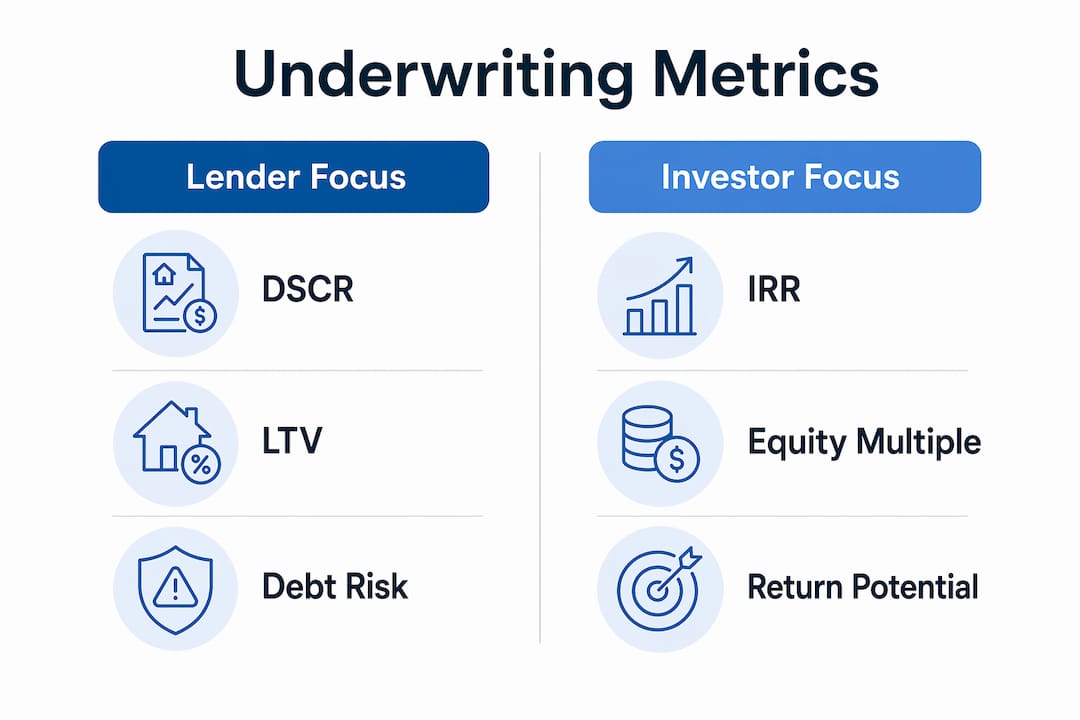
Property underwriting serves two distinct purposes depending on who is doing it. Lenders focus on DSCR and LTV, while investors prioritise internal rate of return (IRR), equity multiples, and cash-on-cash yield. The objective differs, but the discipline is the same: stress-test the numbers before committing capital.

Lender underwriting asks one question: will this borrower repay the debt? The debt service coverage ratio (DSCR) measures whether a property’s net operating income covers its loan repayments. A DSCR below 1.0 means the property cannot service its own debt. Loan-to-value (LTV) measures how much of the property’s value is being borrowed, setting the lender’s security cushion.
Investor underwriting asks a different question: does this deal generate an acceptable risk-adjusted return? IRR captures the time value of money across a hold period. The equity multiple shows total cash returned per pound invested. Cash-on-cash yield measures annual income against equity deployed. These metrics answer whether the deal is worth the risk, not just whether it is serviceable.
The two perspectives often collide on the same transaction. A lender may approve a loan at 65% LTV with a 1.25x DSCR, while the investor’s model shows an IRR of 14% only if rents grow at 4% annually. That gap between lender caution and investor ambition is exactly where underwriting earns its keep. Exploring UK property finance trends helps investors understand how these metrics are shifting in 2026.
How does the underwriting process work in property finance?
The underwriting process in real estate is iterative, not linear. Underwriting starts with key assumptions and walks away early if critical data contradicts projections. Wasting three weeks building a full financial model on a deal with a broken rent roll is a common and avoidable mistake.
The process typically follows these stages:
- Document collection. Rent rolls, lease agreements, bank statements, service charge schedules, and planning consents are gathered. Nothing is taken at face value.
- Income verification. Rent rolls are cross-referenced with bank deposits to validate in-place income against pro forma projections. Inflated income assumptions are the single most common flaw in deal submissions.
- Expense analysis. Operating costs, voids, management fees, and maintenance reserves are modelled. Underwriters distinguish between actual historical costs and projected costs.
- Market stress testing. Vacancy assumptions, rental growth rates, and exit cap rates are tested against downside scenarios. A deal that only works in a best-case market is not underwritten. It is speculated.
- Risk scoring and guidelines review. Underwriting guidelines define admissible risk, pricing parameters, conditions, and authority limits. A senior underwriter may approve deals up to a certain size; larger transactions require credit committee sign-off.
- Decision. The outcome is approve, approve with conditions, renegotiate terms, or decline. Conditions might include a personal guarantee, a rent deposit deed, or a reduced loan amount.
Pro Tip: Start your underwriting with the single assumption most likely to kill the deal. If the rent roll does not hold up against bank statements, stop there. Do not build a 200-line model on a foundation that has already cracked.
What are the common risks and challenges in property underwriting?
Property underwriting fails when the data is wrong, the assumptions are optimistic, or the risks are underestimated. Each of these failure modes is more common than practitioners admit.
The underinsurance problem is severe. 68% of commercial properties are underinsured by at least 25%. That figure means the majority of commercial assets carry a hidden gap between insured value and reinstatement cost. Underwriters who rely on declared values without independent reinstatement assessments are pricing risk on fiction.
Environmental exposure compounds this. Weather events cause over 65% of property losses in some markets. Climate risk is no longer a tail event. Flood zones, subsidence risk, and extreme weather frequency must be factored into underwriting models, not treated as footnotes.
Income instability is the most common deal-breaker in commercial real estate underwriting. Key risks include:
- Tenant concentration. A single tenant generating 80% of income creates binary risk. If they leave, the deal collapses.
- Lease expiry profiles. Multiple leases expiring within the same 12-month window create a void cliff that many pro formas ignore.
- Inflated pro forma income. Sellers present projected rents, not actual rents. Underwriters verify in-place income only.
- Incomplete broker submissions. Missing loss history, unverified rent rolls, or absent planning documents force underwriters to make assumptions. Assumptions introduce error.
In insurance underwriting, loss frequency is a stronger negative signal than a single large loss. A property with ten small claims over five years signals poor maintenance management. One large storm claim may be entirely external. Underwriters read patterns, not just totals.
Which financial metrics help underwriters assess property deals?
The metrics used in property underwriting are not arbitrary. Each one answers a specific question about risk or return. Using them correctly requires understanding what they measure and, equally, what they exclude.
Net operating income and its role
Net operating income (NOI) is the starting point for almost every valuation and metric calculation. NOI excludes mortgage payments and capital expenditure but captures all operating income minus operating expenses. That exclusion matters. NOI measures the property’s performance independent of how it is financed. Two identical properties with different debt structures will show the same NOI but very different cash flows after debt service.
DSCR, LTV, and lender metrics
DSCR divides NOI by annual debt service. A ratio of 1.25x means the property generates 25% more income than needed to cover loan repayments. Most UK commercial lenders require a minimum DSCR of 1.20x to 1.30x. LTV sets the maximum loan as a percentage of the property’s value. Lower LTV means more borrower equity and less lender exposure. Understanding real estate debt structures helps investors position deals within lender appetite.
IRR, equity multiple, and investor metrics
IRR calculates the annualised return on invested equity across the full hold period, accounting for the timing of cash flows. An IRR of 15% on a five-year hold is not the same as 15% per year on a savings account. The equity multiple shows total distributions divided by total equity invested. A 1.8x equity multiple means every pound invested returned £1.80. Cash-on-cash yield measures annual cash flow as a percentage of equity deployed, giving investors a year-by-year income picture.
Cap rates and lease structures influence all of these metrics. A long-dated lease to a strong covenant compresses the cap rate and raises the asset’s value. A short lease with a weak tenant expands the cap rate and depresses it. Underwriters model both scenarios.
Pro Tip: Build your financial model with three scenarios: base case, downside, and severe downside. If the deal only works in the base case, it is not a deal. It is a bet.
How do underwriters balance risk and growth in property deals?
Underwriting is not purely defensive. Accepting too many bad risks harms loss ratios; declining too many good risks loses market share. That tension is the central challenge of any underwriting function, whether in insurance or property lending.
The instinct to decline borderline deals feels prudent. In practice, excessive caution produces a portfolio of only the safest, lowest-yielding assets. That is not risk management. It is risk avoidance dressed up as discipline. The better approach is structured risk tolerance: define the parameters within which a deal is acceptable, then price and condition accordingly.
“Underwriting is a progressive confidence-building exercise. You start with the assumptions most likely to prove fatal, validate them quickly, and only invest deeper analysis when the foundation holds.”
Rigorous data analysis replaces gut feeling at every stage. A deal that feels right but cannot be verified is not ready for credit. A deal that looks marginal on paper but has verifiable income, strong covenants, and conservative assumptions may be the better risk. Exploring how to optimise real estate funding gives investors a practical framework for positioning deals within lender appetite.
Pro Tip: When a deal feels too good to be true, check the vacancy assumption first. Underwriters consistently find that sellers model 3% vacancy on assets that have historically run at 12%.
Key takeaways
Sound property underwriting replaces assumption-driven decisions with verified financial analysis, using metrics like DSCR, LTV, NOI, and IRR to assess whether a deal is genuinely viable under stress conditions.
| Point | Details |
|---|---|
| Underwriting has two perspectives | Lenders assess debt repayment risk via DSCR and LTV; investors assess returns via IRR and equity multiples. |
| Income verification is non-negotiable | Rent rolls must be cross-referenced with bank statements to confirm in-place income before any model is built. |
| Underinsurance is a systemic risk | 68% of commercial properties are underinsured by 25% or more, creating hidden gaps in risk coverage. |
| NOI drives all key metrics | Net operating income excludes mortgage payments and capital expenditure, making it the foundation of valuation and deal analysis. |
| Underwriting is iterative | Start with the assumptions most likely to kill the deal and stop early if the data does not hold up. |
James’s view: underwriting is where deals are won or lost
Most investors I speak with treat underwriting as a box-ticking exercise before the real work begins. That is exactly backwards. Underwriting is the real work. Everything that comes after, the negotiation, the financing, the asset management, is built on the foundation laid during underwriting. Get it wrong at that stage and no amount of operational excellence will save you.
The detail that consistently separates good underwriters from poor ones is the willingness to verify rather than assume. I have seen deals collapse at due diligence because the rent roll showed twelve tenants but the bank statements showed income from eight. The seller was not necessarily being dishonest. The leases existed. The tenants were simply not paying. That distinction matters enormously to a lender and to an investor’s return model.
Moving from optimism-based to evidence-based investing is the single most valuable shift a property professional can make. The market in 2026 rewards those who can underwrite with speed and precision. Lenders are tightening criteria. Margins are thinner. The deals that get funded are the ones where the underwriting is clean, the assumptions are defensible, and the risk is clearly understood. Build that skill and you will always find capital.
— James
Specialist property finance built around sound underwriting
Property finance works best when the underwriting and the funding strategy are aligned from the start. James William & Co structures complex transactions across specialist property finance in London and across the UK, working with developers, investors, and high-net-worth clients who need more than a standard mortgage.
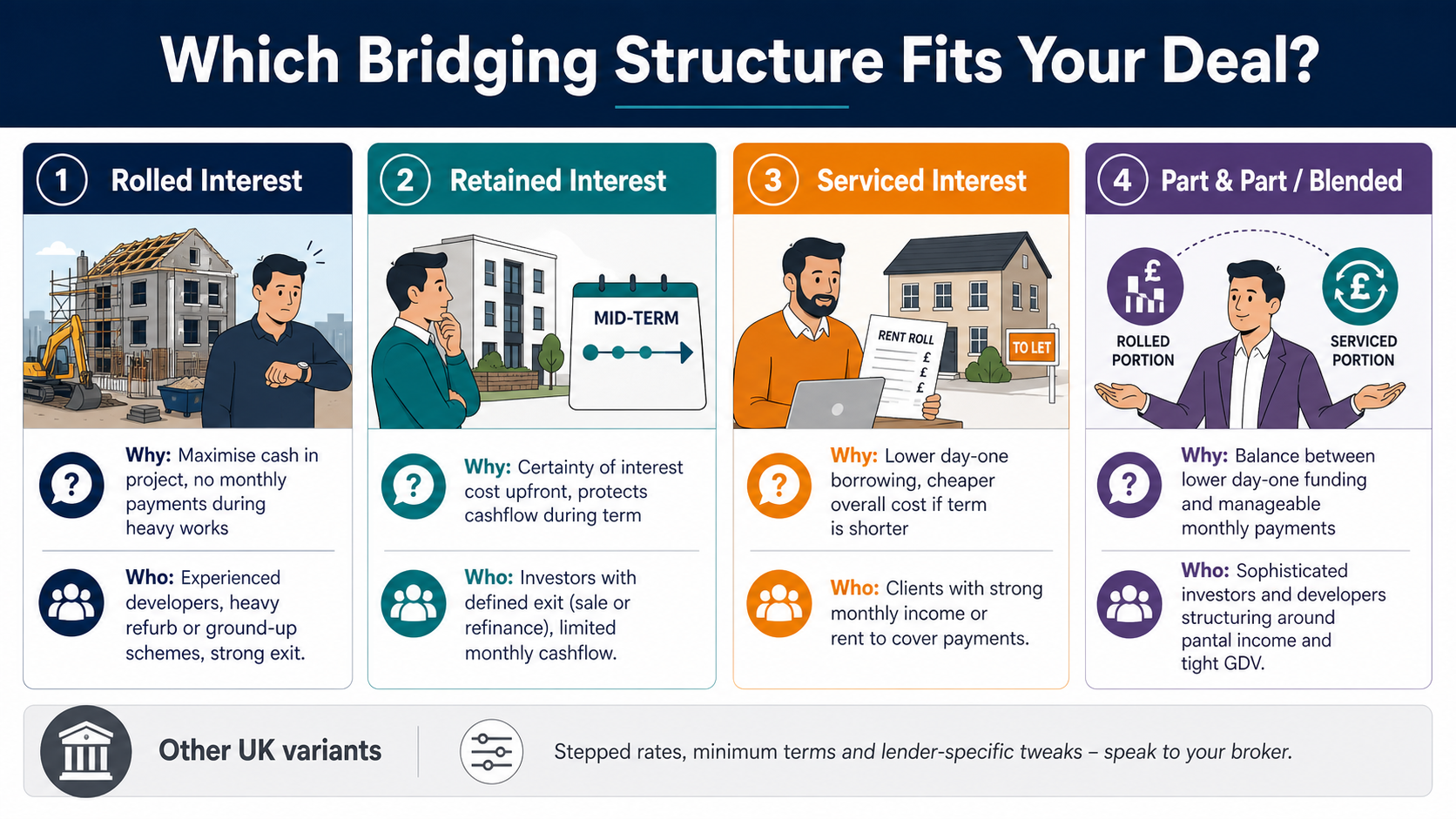
Whether you are structuring a ground-up development, a large-scale acquisition, or a complex refinance, James William & Co brings lender relationships and structuring expertise together under one roof. The firm arranges bridging finance, commercial mortgages, mezzanine debt, and JV equity, often across multi-layered debt stacks where underwriting rigour is the difference between a funded deal and a failed one. Speak to the team to discuss how your next transaction can be structured and financed with confidence.
FAQ
What does property underwriting mean?
Property underwriting is the process of evaluating a property’s financial performance, associated risks, and borrower credentials to determine whether a loan or investment is viable. It replaces assumption with verified analysis.
What is DSCR and why does it matter in property underwriting?
The debt service coverage ratio (DSCR) measures whether a property’s net operating income covers its annual loan repayments. Most UK commercial lenders require a minimum DSCR of 1.20x to 1.30x before approving finance.
How does investor underwriting differ from lender underwriting?
Lenders underwrite to assess repayment risk using DSCR and LTV. Investors underwrite to assess return potential using IRR, equity multiples, and cash-on-cash yield. Both processes stress-test the same underlying financial data.
Why is verifying rent rolls so important in the underwriting process?
Rent rolls must be cross-referenced with bank statements because pro forma income projections frequently overstate actual receipts. Unverified rent rolls are the most common source of error in commercial property underwriting.
What are underwriting guidelines in property finance?
Underwriting guidelines are internal criteria that define which risks a lender or insurer will accept, at what price, under what conditions, and up to what authority level. They set the boundaries within which individual underwriters make decisions.
Recommended
Related Topics
Speak to a specialist
Discuss your finance with James directly
Whole-of-market specialist finance — bridging, development, commercial and residential. No call centres, no obligation. James reviews every enquiry personally.
New to specialist finance? How unbiased broker advice works · Deals we have completed
Explore Related Finance