
Published · Updated
what is warehousing financeWhat is warehousing finance? A guide for investors
By James Dawes, CeMAP, Founder, James William & Co Capital
TL;DR:
- Warehousing finance includes inventory-backed loans and revolving credit lines used by lenders to manage loan origination and securitisation processes. Proper understanding of each structure’s collateral, costs, and legal requirements is essential to avoid underwriting errors, especially in property funding. These structures are increasingly vital in UK real estate for flexible capital management and scaling private credit activities.
Warehousing finance is one of those terms that trips up even seasoned property professionals. Part of the confusion stems from a genuine terminological overlap: the phrase covers two quite different mechanisms, and conflating them leads to costly underwriting errors. On one side sits inventory-backed warehouse financing, where physical goods act as loan collateral. On the other sits the warehouse facility, a revolving credit line used by lenders and debt funds to originate loans before sale or securitisation. If you are a real estate investor or finance professional trying to understand what is warehousing finance and how it applies to your funding strategy, this guide cuts through the noise.
Table of Contents
- Key takeaways
- What is warehousing finance, and how does it work?
- Warehouse facilities as revolving credit lines
- Comparing warehousing finance structures
- Warehousing finance in UK real estate funding
- Risks and best practice
- My perspective on warehousing finance
- How James William & Co can help
- FAQ
Key takeaways
| Point | Details |
|---|---|
| Two distinct structures | Warehousing finance covers both inventory-backed loans and revolving warehouse credit lines for lenders. |
| Collateral is central | Lenders advance funds against appraised asset values, with strict monitoring and control throughout. |
| Warehouse facilities recycle capital | Revolving lines fund loan origination and replenish as portfolio loans are sold or refinanced. |
| Field warehousing carries higher costs | Operational expenses for segregated inventory control are significant and suit specific borrower profiles. |
| Terminology confusion causes real harm | Mistaking warehouse financing for warehouse lending can derail underwriting and funding structures entirely. |
What is warehousing finance, and how does it work?
At its most fundamental level, warehouse financing is a loan secured against physical assets or inventory held in an approved storage location. The lender advances funds based on the appraised value of those assets, which transfer into the lender’s control as collateral. Repayment is typically aligned to the borrower’s inventory turnover cycle or the point at which the underlying assets are sold.

The process follows a clear sequence. The borrower deposits goods into a recognised warehouse. An independent inspector or lender-appointed monitor appraises the inventory. The lender advances a percentage of that value, often called the advance rate. As the borrower sells inventory and generates cash, those proceeds service the loan. The collateral position is monitored throughout, with periodic inspections and reporting requirements.
What separates this from unsecured working capital lending is the presence of a documentary instrument. Warehouse receipts serve as documents of title, legally representing the stored goods and enabling the lender to enforce security rights on default. The enforceability of those rights depends entirely on proper security interest creation and custody. If the documentation chain breaks down, the lender’s ability to seize and sell collateral is compromised.
A subset of this model is field warehouse financing. Rather than transporting goods to a third-party facility, the borrower’s own premises are partitioned off. Field warehouse inventory is surrounded by a fence, signed to indicate the lender’s lien, and subject to state or jurisdiction lien laws. Sales proceeds from that segregated stock go directly to the lender. If inventory values drop below the outstanding loan balance, the borrower must make up the shortfall immediately.
Pro Tip: When engaging with inventory-backed warehouse finance, request the lender’s eligibility criteria for acceptable collateral types upfront. Not all inventory qualifies, and commodity grade, shelf life, and liquidity all affect the advance rate you will receive.
Warehouse facilities as revolving credit lines
The second meaning of warehousing finance is less about physical goods and more about how lenders and debt funds manage their own capital. A warehouse facility is a revolving credit line that allows a lender or originator to fund new loans before those loans are sold on to investors or refinanced through securitisation.
Think of it this way. A bridging lender or real estate debt fund identifies deals and wants to write loans quickly. Rather than tying up its own balance sheet permanently, it draws on a warehouse facility to fund each new origination. Once a sufficient pool of loans accumulates, those assets are either sold to an institutional buyer or packaged into a securitisation vehicle. The proceeds repay the warehouse line, which then recycles and funds the next round of originations.
Key characteristics of this structure include:
- Short-term and revolving: Facilities are designed to be drawn and repaid repeatedly within a defined period, not held to maturity.
- Advance rate against loan commitments: The warehouse lender advances a percentage of the face value of originated loans, retaining a haircut as protection.
- Eligibility conditions: Lender diligence focuses heavily on which loans qualify for inclusion in the facility, with detailed eligibility criteria governing loan type, LTV, geography, and borrower credit quality.
- Liquidity management: Failure to manage the revolving cycle creates a gap between capital deployed and capital available, which can jeopardise fund liquidity at speed.
- Real estate debt fund relevance: For UK bridging lenders and private credit funds, these facilities are the engine of scale. Without them, origination capacity is capped by equity alone.
This is warehousing finance explained in its structured credit context. It is categorically different from inventory-backed lending, and the two should never be conflated when underwriting or structuring a real estate debt vehicle.
Comparing warehousing finance structures
Understanding the benefits and trade-offs of each model helps you select the right tool for your situation. The table below summarises the principal differences.
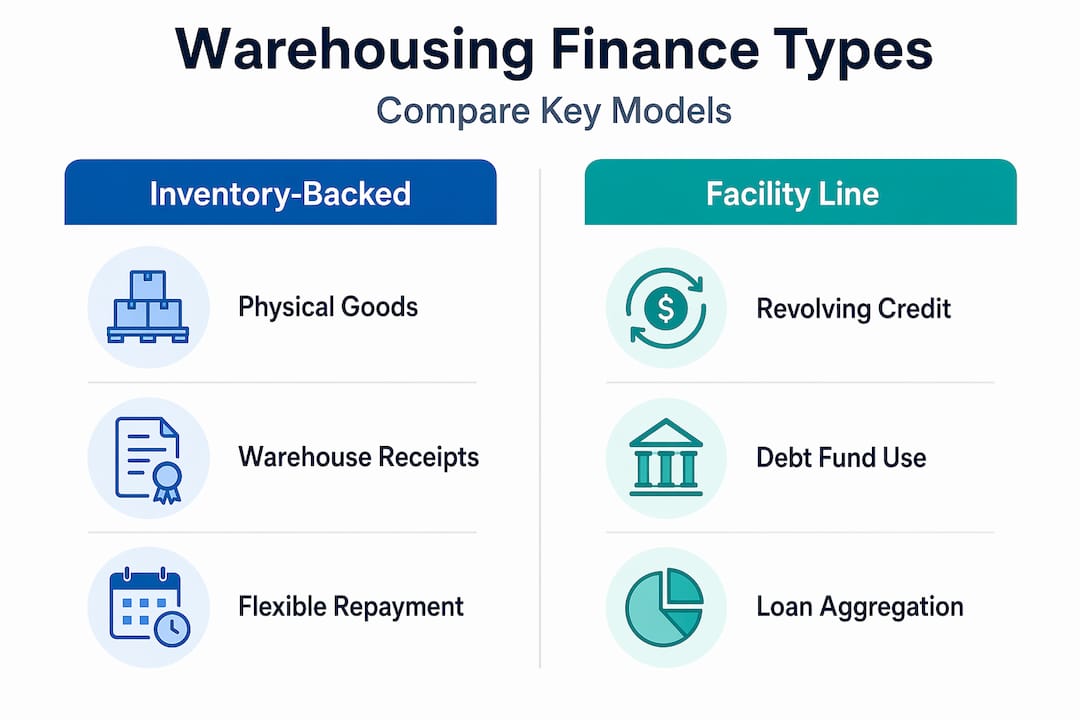
| Feature | Inventory-backed warehouse finance | Warehouse facility (revolving credit line) |
|---|---|---|
| Primary collateral | Physical inventory or goods | Originated loans or receivables |
| Typical borrower | Importer, manufacturer, retailer | Lender, debt fund, originator |
| Repayment trigger | Inventory sale or turnover cycle | Loan sale or securitisation |
| Duration | Short to medium term | Short-term, revolving |
| Key risk | Inventory value fluctuation | Eligibility breach or liquidity gap |
| Operational burden | High (monitoring, insurance, custody) | Moderate (reporting and compliance) |
| Regulatory consideration | Lien perfection and warehouse receipts | Credit facility documentation and covenants |
For businesses using inventory-backed warehouse financing, the principal benefit is flexibility. Repayments track the natural rhythm of trading activity rather than a fixed amortisation schedule. Interest rates tend to be more favourable than unsecured credit because the lender holds tangible collateral. This matters significantly for importers or manufacturers who need to preserve cash while stock sits in storage.
Field warehousing sits at the more expensive end of the spectrum. Operational costs are labour-intensive, covering management fees, security, and insurance for the segregated area. It suits businesses that want fewer bank covenants but have the cash flow to absorb those running costs. For a small wholesaler or a property developer holding physical assets awaiting sale, the cost-benefit calculation requires careful modelling.
Pro Tip: If you are a real estate developer considering inventory-backed warehouse finance against physical materials or goods, model the operational costs of field warehousing against a public warehouse arrangement before committing. The covenant reduction from field warehousing rarely compensates for the fee differential at smaller deal sizes.
Warehousing finance in UK real estate funding
Warehousing finance sits within the broader toolkit of real estate funding sources that UK developers and investors draw on. Its application in property takes several forms, and understanding each helps you match the right structure to your project.
-
Bridging finance and warehouse credit lines. Short-term property lenders in the UK frequently use warehouse facilities to fund their bridging loan books. The lender draws on its revolving line to originate each bridge, then repays and redraws as loans roll off the book. Investors accessing bridging finance for property deals are, in many cases, indirectly benefiting from this capital structure without realising it.
-
Asset-backed lending on physical property assets. Where a developer holds completed stock, raw materials, or physical assets tied to a development, a warehouse financing arrangement can release working capital against those holdings without requiring a full disposal. This preserves optionality while unlocking liquidity.
-
Debt fund origination platforms. UK private credit funds and alternative lenders increasingly rely on warehouse facilities to scale their real estate lending programmes. The facility allows them to commit to deals rapidly, with take-out financing arranged in parallel.
-
Documentation and eligibility preparation. Arranging warehouse finance in the UK requires detailed preparation. Lenders will want clear asset schedules, independent valuations, proof of title or custody, and cashflow projections demonstrating repayment capacity. Legal counsel experienced in UK security law is non-negotiable for warehouse receipt arrangements.
-
Integration with layered debt structures. Warehouse finance rarely sits alone. For complex UK transactions, it often forms one layer of a multi-tranche stack alongside senior debt, mezzanine, and equity. Understanding how the warehouse line interacts with those other layers, particularly on enforcement, is where structuring expertise earns its fee.
Risks and best practice
Every warehousing finance structure carries risks that demand active management rather than passive monitoring.
- Valuation fluctuations: The value of inventory or loan collateral can move against the lender. Commodity price swings, property market corrections, or deteriorating borrower credit quality can all erode the collateral base quickly.
- Legal enforceability: The effectiveness of warehouse receipts as collateral depends entirely on correct document title creation and perfection of security interests under applicable law. A single gap in the chain can render security unenforceable.
- Operational risk in field arrangements: Lender control rights require designated warehouse operators, regular inspections, and reporting protocols. Any breakdown in that chain creates credit exposure.
- Eligibility breaches in revolving facilities: In warehouse credit line structures, a loan that falls outside the agreed eligibility criteria triggers a borrowing base reduction. If multiple loans breach simultaneously, the consequences for fund liquidity can be severe.
- Terminology confusion in underwriting: Conflating warehouse financing with warehouse lending produces structuring errors. Warehouse lending funds mortgage loans pending sale to investors and is a distinct product with different legal and regulatory characteristics.
Pro Tip: Before signing any warehouse facility agreement, have a specialist review the eligibility matrix and cure period provisions. The detail in those clauses determines how much operational flexibility you actually have when market conditions tighten.
My perspective on warehousing finance
I have seen the consequences of terminological confusion cause real problems on live transactions. A borrower assumes a warehouse credit line works like a revolving business overdraft. A lender assumes the underlying collateral is liquid when it is not. Both assumptions result in deals that either fail to complete or unwind at the worst possible moment.
What I have come to believe, after working through these structures with UK developers, debt funds, and private credit managers, is that warehousing finance is genuinely powerful when matched correctly to the business model. The inventory-backed variant suits businesses with high-value, identifiable stock and predictable turnover. The revolving credit line variant suits lenders with a clear pipeline and a credible take-out strategy.
The mistake most people make is treating warehousing finance as a generic category rather than a structuring decision that requires specificity. Which assets qualify? What advance rate is realistic? How does repayment interlock with your sales or exit cycle? Those questions need answers before you engage a lender, not after.
My honest view is that the warehouse facility model will become increasingly relevant to UK real estate as private credit continues to expand. More alternative lenders entering the market means more origination platforms needing interim capital, and warehouse lines are the most capital-efficient way to provide it. Understanding this structure now puts you ahead of where most property investors and professionals currently sit.
— James
How James William & Co can help
If you are a property developer, investor, or fund manager looking to understand how warehousing finance structures could work within your funding strategy, James William & Co brings the structuring experience to make it happen. The team works across inventory-backed lending, revolving warehouse facilities, and multi-tranche debt stacks for complex UK real estate transactions.
Whether you need a specialist property finance solution for a ground-up development, a bridging arrangement supported by a warehouse line, or a bespoke credit facility for a growing loan origination platform, James William & Co acts as a single point of contact from structuring through to execution. Explore the firm’s completed transactions to see how these structures have been deployed across real UK deals.
FAQ
What is the difference between warehouse financing and warehouse lending?
Warehouse financing uses physical inventory as loan collateral, while warehouse lending funds mortgage loans pending sale to investors. They are distinct products with different collateral types, legal structures, and use cases.
How does a warehouse facility work for a real estate debt fund?
A warehouse facility is a revolving credit line that funds new loan originations. As portfolio loans are sold or refinanced, proceeds repay the line, which then recycles to fund the next batch of deals.
What are the main benefits of warehousing finance for businesses?
The principal benefits include flexible working capital tied to asset value, more favourable interest rates than unsecured credit, and repayment terms aligned to the natural turnover or exit cycle of the underlying assets.
What makes field warehouse financing different from public warehouse financing?
Field warehousing uses a segregated, fenced-off section of the borrower’s own premises as collateral storage, while public warehousing uses a third-party facility. Field arrangements reduce covenants but carry higher operational costs for management, security, and insurance.
What documentation is needed to arrange warehouse finance in the UK?
Lenders typically require asset schedules, independent valuations, proof of title or custody, cashflow projections, and legal opinions on security interest perfection. The exact requirements vary by lender and asset type.
Recommended
Related Topics
Speak to a specialist
Discuss your finance with James directly
Whole-of-market specialist finance — bridging, development, commercial and residential. No call centres, no obligation. James reviews every enquiry personally.
New to specialist finance? How unbiased broker advice works · Deals we have completed
Explore Related Finance