
Published · Updated
why complex funding packagesWhy complex funding packages work for large developments
By James Dawes, CeMAP, Founder, James William & Co Capital

TL;DR:
- Complex funding packages combine multiple layers of debt and equity to match the risks and timelines of large property developments. They outperform simple loans by offering flexibility, better cashflow management, and lower total costs, especially for multi-phase projects. Early planning, detailed modeling, and expert advice ensure these structured arrangements deliver optimal project outcomes.
Complex funding packages are defined as multi-layered, structured financial arrangements that combine senior debt, mezzanine finance, equity, and bridging facilities to match the precise risk profile, cashflow, and timeline of a large-scale property development. For UK developers and investors, understanding why complex funding packages outperform single-facility solutions is not academic. It is the difference between a project that completes on budget and one that stalls at practical completion. James William & Co structures these arrangements daily, working across ground-up developments, portfolio acquisitions, and complex refinances where a single lender and a single rate simply cannot carry the weight.
Why complex funding packages outperform simple finance
A complex funding package is not complicated for its own sake. It is structured because large developments carry risks that a standard term loan cannot absorb. Development finance problems often stem from inadequate project appraisal and unclear capital stacks rather than lender unwillingness. That finding reframes the entire conversation. Lenders do not reject good deals. They reject poorly evidenced ones.
The industry term for what most developers need is structured development finance, sometimes called a debt stack. This is the recognised vocabulary among UK specialist lenders, family offices, and private credit funds. The phrase “complex funding package” describes the same concept from the developer’s perspective. Both terms belong in any serious conversation about large-scale property finance.
What makes a funding package genuinely complex?
The components of a structured development finance package typically include several distinct layers working together.
- Senior debt covers the largest portion of the capital stack, usually secured against the gross development value (GDV) of the scheme.
- Mezzanine debt sits behind senior debt and fills the gap between senior lending limits and the developer’s available equity. It carries a higher rate but preserves equity.
- Bridging finance handles time-sensitive gaps, such as land acquisition before a development facility completes.
- JV equity brings a capital partner into the project in exchange for a profit share, reducing the developer’s own cash requirement.
- Contingency facilities provide pre-agreed headroom for cost overruns without triggering a full refinancing event.
Beyond the capital layers, the structural terms matter as much as the rates. Flexible drawdown schedules and stepped interest rates allow developers to manage project delays without triggering costly early refinancing. That is a structural benefit, not a pricing one. Financial covenants, exit triggers, monitoring surveyor requirements, and minimum utilisation fees all shape how a facility behaves in practice, not just on paper.
Pro Tip: Model your drawdown schedule before you approach a lender. Knowing your peak debt exposure month by month gives you negotiating power on utilisation fees and commitment charges.

Why simple funding solutions fall short for large projects
Most developers who have run a single-site scheme on a standard development loan understand its limitations only after they have hit them. For larger or multi-phase projects, those limitations become structural risks.
- Inflexibility under delay. A standard facility with a fixed term and no extension mechanism forces a refinancing event the moment a planning delay or contractor issue pushes the programme. Refinancing mid-build is expensive, disruptive, and sometimes impossible at short notice.
- Cashflow misalignment. A loan sized to total cost rather than cashflow phasing creates periods where the developer is either over-borrowed and paying unnecessary interest, or under-funded and unable to pay contractors.
- No contingency headroom. Standard facilities rarely include pre-agreed contingency drawdowns. When costs overrun, the developer must return to the lender cap in hand, often at a worse rate and with additional security requirements.
- Exit timing risk. A rigid repayment date tied to a sales programme creates acute pressure if the market softens or sales slow. Without an exit trigger mechanism built into the facility, the developer has no room to hold stock and wait for better conditions.
- Underestimating total finance cost. Developers frequently focus on headline interest rates and miss arrangement fees, exit fees, monitoring costs, and utilisation charges. Development finance is a detailed underwriting process that scrutinises every cost, timeline, and revenue assumption. A lower headline rate with punitive fees often costs more than a higher rate with flexible terms.
The pattern is consistent. Simple finance works for simple projects. The moment a scheme involves multiple phases, mixed uses, or a timeline beyond 18 months, a single-facility approach introduces risks that structured finance is specifically designed to remove.
Key advantages of complex financial packages
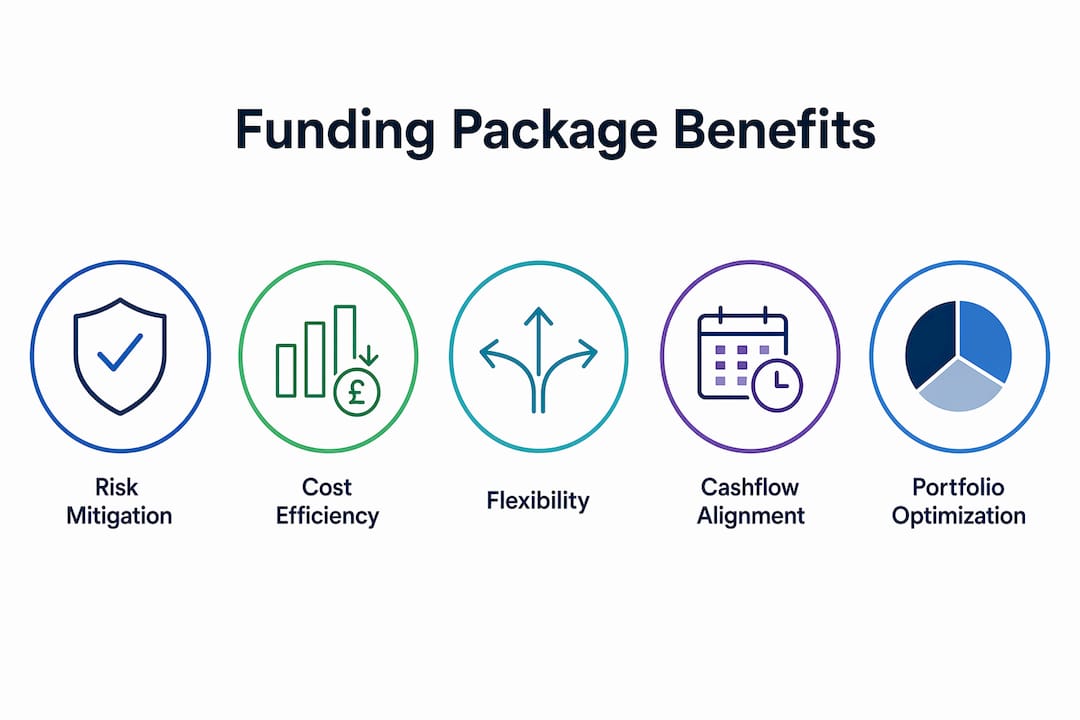
The benefits of complex funding are not limited to flexibility. They extend to cost of capital, risk absorption, and capital efficiency across the project lifecycle.
Liquidity management across the project lifecycle is increasingly valued alongside end-value projections, particularly given longer timelines and planning delays in the current UK market. That shift in lender thinking reflects a broader change in how structured lending is evaluated.
| Advantage | How it works in practice |
|---|---|
| Cashflow alignment | Staged drawdowns match funding releases to build programme milestones, reducing unnecessary interest accrual |
| Delay absorption | Pre-agreed extension options and contingency facilities prevent forced refinancing under programme slippage |
| Capital efficiency | Mezzanine and JV equity layers reduce the developer’s equity requirement, improving return on equity |
| Portfolio facilities | A single revolving credit facility sized to peak debt exposure removes the need for repeated credit approvals across multiple sites |
| Lower lifetime cost | Structured terms reduce total finance cost beyond the headline rate, including fees and monitoring charges |
Portfolio facilities sized to peak debt exposure improve capital efficiency and allow faster, more flexible project execution compared to site-by-site loans. For developers running three or more concurrent schemes, this is a material operational advantage. A single facility with cross-collateralisation removes the administrative and cost burden of separate credit approvals for each site.
Structured lending is increasingly treated as a value lever rather than simply a loan pricing mechanism among UK developers. That approach leads to lower lifetime costs and better project outcomes. The developers who understand this are the ones who consistently outperform on margin.
Pro Tip: When comparing facilities, build a total cost of finance model that includes all fees, monitoring costs, and extension charges. The cheapest headline rate is rarely the cheapest facility.
How to plan and model complex funding packages effectively
Effective planning for a structured development finance package starts before the first lender conversation. The modelling work done at appraisal stage determines whether a facility is fit for purpose or merely adequate.
- Model the downside first. Most developers fail to capture real-life funding behaviours in their models, missing critical triggers like drawdown timings, cost monitoring, and minimum utilisation fees. Build a scenario with a six-month delay and a 10% cost overrun before you build the base case.
- Integrate the full drawdown schedule. A robust funding model explicitly incorporates drawdown sequences, lender triggers, surveyor fees, and contingency drawdowns. These are not administrative details. They are the difference between a model that holds under scrutiny and one that collapses at credit committee.
- Align covenants with your programme. Financial covenants set at the wrong points in a build programme create technical defaults that have nothing to do with project viability. Negotiate covenant tests to align with actual construction milestones.
- Engage specialist advisers early. Working with a capital adviser like James William & Co at appraisal stage, rather than after heads of terms are agreed, gives you access to lender appetite, market pricing, and structural options before your position is fixed.
- Use structured lending as a planning tool. The capital stack is not just a funding mechanism. It is a risk allocation tool. Deciding which risks sit with senior debt, which sit with mezzanine, and which sit with equity is a strategic decision that shapes the entire project economics. Developers who treat it as such consistently achieve better outcomes. For a practical starting point, the guidance on structured property finance for UK developers covers the core principles in detail.
Multiple-project developers benefit from portfolio-based facilities with cross-collateralisation, which require strong financial reporting but enable flexible, efficient funding. The reporting burden is real, but the capital efficiency gains outweigh it at scale. Developers who build that reporting discipline early find it becomes a competitive advantage when approaching lenders for larger facilities.
For developers thinking about how funding package design connects to broader capital strategy, the principles of evidence-based underwriting apply equally across property and private equity contexts.
Key takeaways
Complex funding packages reduce risk, lower lifetime finance costs, and improve project outcomes when structured to match the actual cashflow, timeline, and risk profile of a development.
| Point | Details |
|---|---|
| Model the downside first | Build delay and cost overrun scenarios before approaching lenders to test facility robustness. |
| Total cost beats headline rate | Include fees, monitoring charges, and extension costs when comparing facilities. |
| Staged drawdowns protect cashflow | Drawdown schedules aligned to build milestones reduce unnecessary interest accrual throughout the project. |
| Portfolio facilities improve efficiency | A single revolving credit facility reduces repeated credit approvals and improves capital use across multiple sites. |
| Engage advisers at appraisal stage | Early specialist input shapes the capital stack before terms are fixed, not after. |
My view on where UK development finance is heading
The UK property finance market has shifted decisively away from lowest-headline-rate thinking. Specialist lenders increasingly base loan structures on cashflow alignment rather than just headline interest rates. That is not a trend. It is a structural change in how credit is underwritten, and developers who have not adjusted their appraisal approach are working with an outdated model.
What I see consistently is that developers who treat the capital stack as a financial engineering problem, rather than a procurement exercise, achieve materially better outcomes. They negotiate better terms, avoid expensive mid-project refinancing, and retain more equity at exit. The developers who shop on rate alone tend to find the savings at the front end eroded by fees, inflexibility, and emergency restructuring costs at the back end.
Planning delays and construction cost inflation have made cashflow alignment the central discipline of development finance in 2026. A facility that looks adequate at appraisal can become a liability six months into a build if it has no extension mechanism and no contingency headroom. The question is not whether your project needs a complex funding package. For any scheme above a certain scale or duration, it almost certainly does. The question is whether you have structured it correctly from the outset.
— James
Specialist funding for UK property developers
James William & Co works with UK property developers and investors who need funding structures that go beyond what a standard lender can offer.
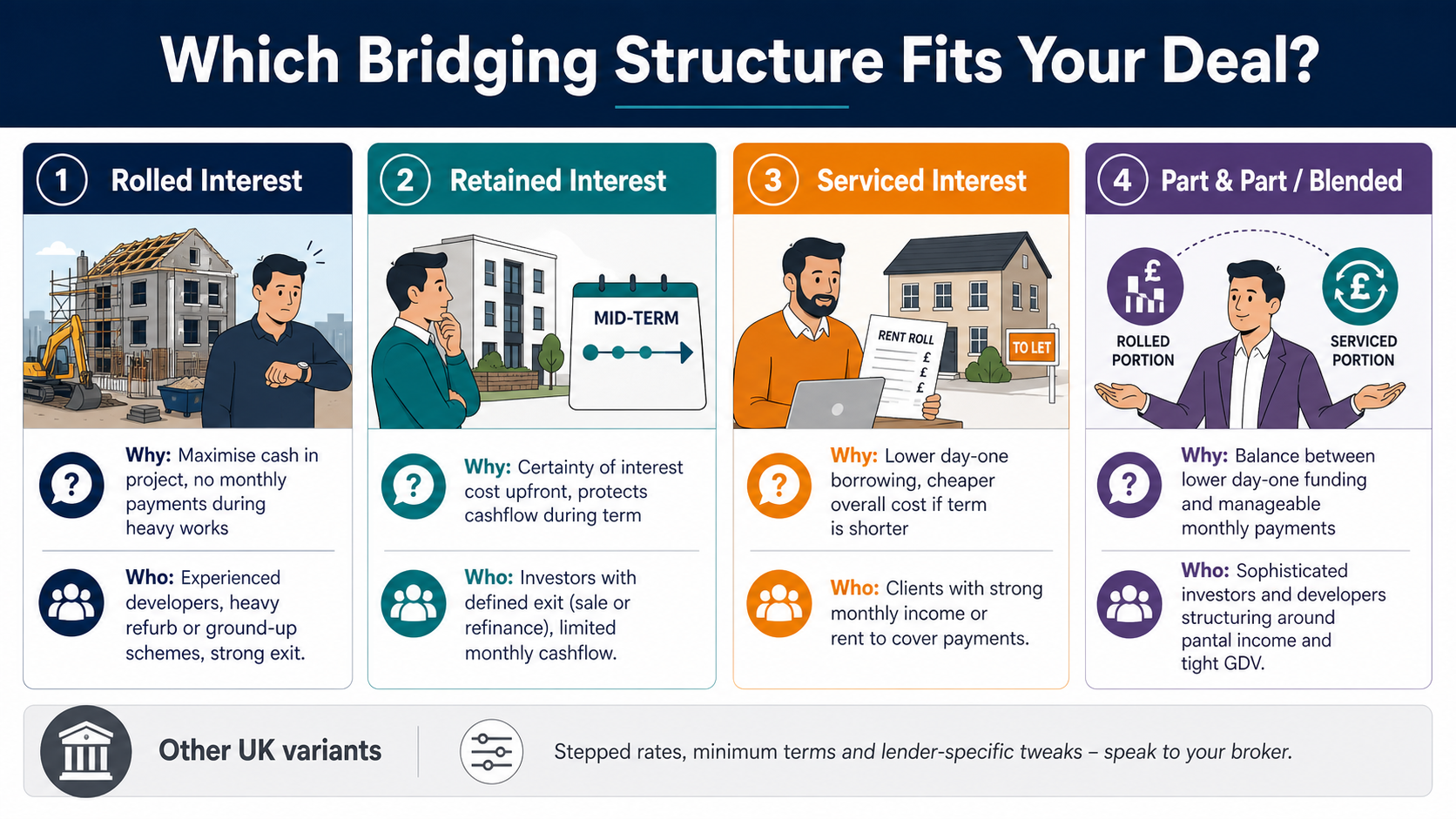
The firm arranges development finance, mezzanine debt, bridging facilities, and JV equity across ground-up schemes, portfolio acquisitions, and complex refinances. Every engagement starts with a detailed review of the capital stack, the project programme, and the lender market, so the structure fits the project rather than the other way around. For developers working on large-scale schemes in London and across the UK, James William & Co’s specialist property finance service provides a single point of contact for end-to-end structuring, negotiation, and execution. Speak to the team to discuss your project and funding requirements.
FAQ
What is a complex funding package in property development?
A complex funding package is a structured arrangement combining senior debt, mezzanine finance, equity, and bridging facilities to match the specific cashflow, risk, and timeline of a large-scale development project.
Why do large developments need complex financial packages?
Large developments involve phased cashflows, planning risks, and extended timelines that a single-facility loan cannot accommodate without creating liquidity gaps or forcing costly refinancing.
What is the biggest mistake developers make with funding structures?
Most developers fail to model downside scenarios, missing critical triggers like drawdown timings and utilisation fees, which leaves their facility exposed when delays or cost overruns occur.
How does mezzanine debt fit into a complex funding package?
Mezzanine debt sits behind senior lending in the capital stack, filling the gap between the senior loan limit and the developer’s available equity, reducing the cash required to start a scheme.
When should a developer engage a capital adviser for funding?
A developer should engage a specialist adviser like James William & Co at appraisal stage, before heads of terms are agreed, to shape the capital stack and access the full range of lender options.
Recommended
Related Topics
Speak to a specialist
Discuss your finance with James directly
Whole-of-market specialist finance — bridging, development, commercial and residential. No call centres, no obligation. James reviews every enquiry personally.
New to specialist finance? How unbiased broker advice works · Deals we have completed
Explore Related Finance