
Published · Updated
why forward fundingWhy forward funding works for UK property developers
By James Dawes, CeMAP, Founder, James William & Co Capital

TL;DR:
- Forward funding is a contractual agreement where institutional investors commit to purchasing a development before completion, providing staged payments during construction and shifting exit risk from the developer. It offers profit certainty, improved loan terms, and staged liquidity for large UK projects, while providing investors with higher IRRs and secured returns through discounts and covenant protections. Managers mitigate risks like delays and insolvency with contractual mechanisms, making forward funding a strategic risk management tool that enhances project finance and investor confidence.
Forward funding is a binding contractual arrangement where an institutional investor agrees to purchase a development before construction completes, releasing capital to the developer in staged milestone payments throughout the build. Unlike traditional development finance, where a developer carries full market risk until practical completion and sale, forward funding transfers that exit risk to the investor from the outset. The structure is standard for large UK residential projects of 200 or more units, where securing full development cost bank financing alone is increasingly difficult. For developers and investors alike, understanding why forward funding delivers structural advantages over conventional routes is the difference between a marginal deal and a highly profitable one.
Why forward funding outperforms traditional development finance
Forward funding, also referred to in the market as a forward commitment or forward purchase agreement, is the mechanism by which a developer locks in their exit before a single foundation is poured. The core principle is straightforward: executing a forward commitment before construction locks in developer profit margins and insulates the project from market volatility across the 12 to 24 month construction span.
The benefits of forward funding for developers are specific and measurable:
- Profit certainty from day one. Exit cap rates and sale price are agreed contractually before ground breaks, removing the risk that the market softens during construction.
- Improved construction loan terms. Presenting a binding forward purchase agreement to a lender converts construction loans from speculative to guaranteed bridge loans, enabling higher leverage and lower interest rates.
- Elimination of sales and leasing risk. The developer is not exposed to void periods, slow lease-up, or a deteriorating occupier market after completion.
- Liquidity throughout the build. Milestone payments from the investor fund construction costs progressively, reducing the developer’s reliance on senior debt drawdowns.
- Reduced equity requirement. Because the exit is guaranteed and the lender’s risk profile improves, the developer’s required equity contribution typically falls.
Pro Tip: Secure your forward funding agreement before approaching your senior lender. The binding purchase commitment materially changes the risk profile of your construction loan, and lenders price accordingly. Presenting both simultaneously gives you maximum negotiating leverage on rate and gearing.
The advantages of forward funding are most pronounced on schemes where construction timelines exceed 18 months and where the developer would otherwise be exposed to a single large speculative sale at completion. Ground-up residential blocks, build-to-rent schemes, and large commercial developments all fit this profile precisely.

How do investors benefit from forward funding arrangements?
Investors enter forward funding deals because the return profile compensates for the risks they absorb. Expected IRR from forward funding sits at 7.5 to 10% over 10 to 15 years, materially higher than the 5 to 7% typically available from stabilised acquisitions. That premium exists because the investor is taking on construction risk, lease-up risk, and the illiquidity of a pre-completion commitment. The spread is the price of that risk transfer, and for investors with long-dated capital, it is an attractive proposition.
The specific advantages of forward funding for investors include:
- Discounted acquisition price. Institutional investors secure a 10 to 25% discount on forward-funded projects compared to stabilised acquisitions, directly compensating for construction and lease-up risk.
- Access to development-stage returns without the operational complexity of acting as developer.
- Portfolio shaping. Forward funding allows investors to build homogeneous asset pools with predictable underwriting characteristics, which supports eventual securitisation and forward flow structures.
- Milestone discipline. Funds are disbursed at agreed construction milestones rather than in a single lump sum, giving the investor ongoing visibility and control over project progress.
- Developer covenants. Investors require parent company guarantees or step-in rights, meaning the investment is protected by the developer’s balance sheet as well as the asset itself.
The discount structure is not uniform. Forward funding pricing discounts decrease as the commitment is made later in the development cycle and as developer covenant strength increases. A financially strong developer committing at planning stage will give up less margin than a smaller operator committing at the same stage. This dynamic rewards developers who invest in their balance sheet and institutional relationships early.
What risks exist in forward funding, and how are they managed?
Forward funding is not without complexity. A balanced view of the structure requires acknowledging the risks that both parties carry and the contractual mechanisms used to manage them.
The primary risks in a forward funding arrangement are:
- Construction delays and cost overruns. If the developer exceeds the agreed programme or budget, the investor’s milestone payments may be withheld or the purchase price renegotiated.
- Lease-up risk. Many forward funding deals include a rent roll stabilisation requirement before final payment is released. If occupancy targets are not met, the investor retains price adjustment rights.
- Developer insolvency. The investor has committed capital to a project whose delivery depends entirely on the developer’s continued solvency and operational capability.
- Market value movement. If the completed asset is worth materially less than the agreed forward price, the investor has overpaid relative to the open market.
| Risk | Mitigation mechanism |
|---|---|
| Construction delay | Liquidated damages clauses and programme milestones |
| Cost overrun | Fixed-price build contracts and developer guarantees |
| Developer insolvency | Parent company guarantee and step-in rights |
| Lease-up shortfall | Rent guarantee or deferred payment structure |
| Market value decline | Discounted acquisition price and long hold period |
Developer covenant strength is the single most important variable in a forward funding deal. Investors require parent guarantees or step-in rights to mitigate insolvency risk, and the quality of those covenants directly affects the pricing discount demanded. Developers with strong balance sheets and a track record of delivery will always achieve better terms than those relying solely on the project’s projected value.
Forward funding vs other property financing methods
Understanding why forward funding is chosen over alternatives requires a direct comparison of how each structure allocates risk, capital, and return.
| Structure | Developer risk | Investor entry point | Typical return |
|---|---|---|---|
| Forward funding | Low (exit guaranteed) | Pre-construction | 7.5 to 10% IRR |
| Forward purchase | Medium (construction risk retained) | Post-practical completion | 5.5 to 7.5% IRR |
| Stabilised acquisition | None (sold at completion) | Post-stabilisation | 5 to 7% IRR |
| Joint venture | Shared | Pre-construction | Variable, profit share |
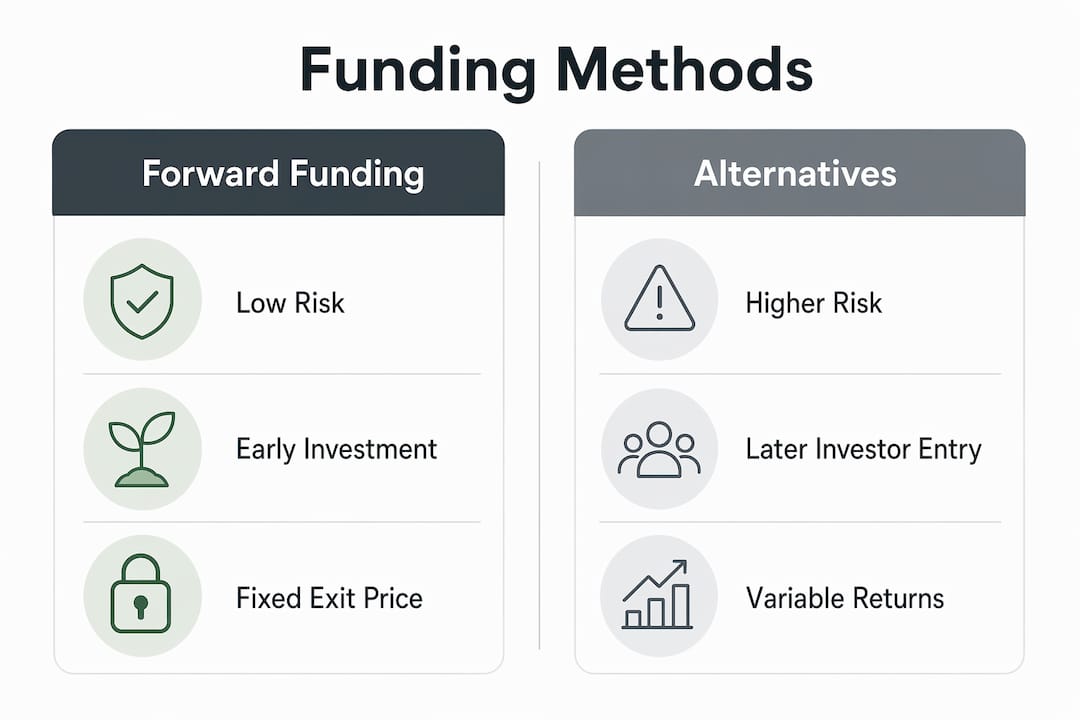
A forward purchase agreement differs from forward funding in one critical respect: the investor commits to buy at a future date but does not fund construction. The developer still carries the financing burden through the build and only receives the purchase price at completion. Forward funding removes that burden entirely by releasing capital progressively. For developers working on large-scale UK developments, this distinction is the difference between needing 40% equity and needing 15%.
Joint ventures offer profit participation but introduce a second decision-maker into the development process. Many developers find the operational friction of a JV partner outweighs the capital benefit, particularly on schemes where speed of execution is critical. Forward funding delivers institutional capital without surrendering development control.
How to structure and execute a forward funding deal
Structuring a forward funding deal correctly from the outset determines whether the arrangement delivers its full financial benefit or creates contractual friction throughout the build.
The key steps in executing a forward funding agreement are:
- Identify the right institutional investor early. Family offices, private credit funds, and specialist real estate investors are the primary counterparties. Working with a specialist broker who maintains active relationships with these investors is the most direct route to a credible offer.
- Agree the pricing framework before planning consent is finalised. The earlier the commitment, the larger the discount demanded, but the greater the developer’s profit certainty. Most developers find this trade-off favourable on schemes above 150 units.
- Instruct specialist legal counsel to draft milestone-linked payment provisions. Each payment trigger must be defined precisely, including Certificate of Occupancy, practical completion, and rent roll stabilisation thresholds.
- Present the forward purchase agreement to your senior lender simultaneously. This is the mechanism by which construction loan terms improve, as the lender’s exit risk is effectively eliminated.
- Negotiate developer covenant requirements carefully. Parent company guarantees and step-in rights are standard, but the scope and duration of those obligations vary significantly between investors.
Pro Tip: Do not treat the forward funding negotiation as separate from your construction finance negotiation. The two are interdependent. Lenders who see a binding forward purchase agreement in place will offer materially better gearing and pricing. Run both processes in parallel and use each to strengthen the other.
For developers exploring how to structure development finance on complex schemes, forward funding is increasingly the preferred mechanism precisely because it converts a speculative development into a contracted delivery programme with a known financial outcome.
Key takeaways
Forward funding is the most effective financing structure for large-scale UK developments because it guarantees the developer’s exit, improves construction loan terms, and delivers institutional investors a risk-adjusted return premium of 7.5 to 10% IRR.
| Point | Details |
|---|---|
| Developer profit certainty | Exit price and cap rates are locked contractually before construction begins. |
| Improved loan terms | A binding forward purchase agreement converts speculative construction debt into guaranteed bridge finance. |
| Investor return premium | Forward funding delivers 7.5 to 10% IRR, materially above the 5 to 7% from stabilised acquisitions. |
| Covenant strength matters | Developer balance sheet quality directly affects the discount demanded and deal terms available. |
| Milestone discipline | Staged payments protect both parties and maintain investor oversight throughout the build. |
The case for forward funding in 2026 UK conditions
I have structured enough complex development finance deals to say with confidence that forward funding is not simply a financing technique. It is a risk management decision. The developers who use it most effectively are not those who cannot access traditional finance. They are the ones who understand that carrying market risk across a 24-month build cycle is an unnecessary gamble when institutional capital is available to absorb it.
What I observe consistently is that developers underestimate how much their construction loan terms improve once a forward purchase agreement is in place. Lenders who were offering 55% loan-to-cost on a speculative scheme will move to 65% or beyond when the exit is contractually secured. That shift in gearing can transform a deal’s equity requirement and internal rate of return more dramatically than almost any other single factor.
The challenge in 2026 is that institutional investors are more selective about developer covenant quality than they were three years ago. Market volatility and a handful of high-profile insolvencies have made investors scrutinise balance sheets and track records with considerably more rigour. Developers who have invested in their corporate structure, maintained clean accounts, and built relationships with institutional counterparties are finding forward funding accessible and competitively priced. Those who have not are finding the discount demanded is punishing.
My advice is to treat your institutional investor relationships as a long-term asset. The developer who has already completed one forward funding deal with a family office or private credit fund will achieve materially better terms on the next one. Reputation and track record compound in this market in exactly the same way that financial returns do.
— James
How James William & Co can structure your forward funding deal
James William & Co operates as a debt structuring partner for UK developers and investors who need more than a standard broker introduction. On forward funding mandates, the firm works across its network of family offices, private credit funds, and specialist institutional lenders to identify the right counterparty for your specific scheme, covenant profile, and timeline. The team structures the full financing stack in parallel, ensuring your construction finance and forward purchase agreement are negotiated together to maximise gearing and minimise cost. If you are working on a ground-up development of scale and want to explore how specialist property finance can be structured around a forward funding commitment, James William & Co provides a single point of contact for end-to-end execution.
FAQ
What is forward funding in UK property development?
Forward funding is a contractual arrangement where an institutional investor agrees to purchase a development before completion, releasing staged payments to fund construction costs. It is standard practice on large UK residential and commercial schemes of 200 or more units.
How does forward funding differ from a forward purchase agreement?
A forward purchase commits an investor to buy at completion but does not fund the build. Forward funding releases capital progressively during construction, removing the developer’s reliance on speculative senior debt throughout the programme.
What returns do investors expect from forward funding?
Investors in forward funding arrangements typically target an IRR of 7.5 to 10% over a 10 to 15 year hold period, compared to 5 to 7% from stabilised acquisitions. The premium compensates for construction and lease-up risk assumed at the pre-completion stage.
Why does developer covenant strength affect forward funding terms?
Investors fund construction before the asset exists, so the developer’s balance sheet and parent company guarantees are the primary security during the build. Stronger covenants reduce the investor’s risk, which translates directly into a smaller pricing discount and better deal terms for the developer.
Is forward funding worth it for smaller UK developers?
Forward funding is most effective on schemes above 150 units where the financing complexity and construction timeline justify the structure. Smaller developers can access the model, but the discount demanded by investors tends to be larger, and the legal and structuring costs represent a higher proportion of total project value.
Recommended
Related Topics
Speak to a specialist
Discuss your finance with James directly
Whole-of-market specialist finance — bridging, development, commercial and residential. No call centres, no obligation. James reviews every enquiry personally.
New to specialist finance? How unbiased broker advice works · Deals we have completed
Explore Related Finance